From Hacking to Hypergrowth: Generative AI in Marketing
Why AI-Driven Growth Strategies Are No longer Optional
AI driven growth strategies are reshaping how businesses compete and scale in 2025. The data is clear: AI-mature companies grow 4.7x faster, and 63% of organizations already report measurable business growth from generative AI. This isn’t about incremental improvements—it’s about exponential advantage.
Effective AI strategies deliver exponential revenue growth, market expansion via scaled personalization, significant operational change, new revenue models, and a powerful competitive advantage. The gap between AI leaders and laggards is widening fast. Companies that proactively adopt AI aren’t just optimizing—they’re rewriting the rules of growth.
While 73% of companies are adopting AI, only 1% have achieved full operational integration. The winners aren’t those with the most tools, but those who fundamentally redesign how work gets done. This shift reshapes both defensive strategies (protecting market share) and offensive strategies (fueling new AI-enabled products). The entire enterprise operating model is being rewritten, and the question isn’t if you should adopt AI, but how quickly you can move from tactical experiments to strategic change.
I’m Joseph Riviello, CEO and Founder of Zen Agency™, and over the past 22 years, I’ve helped companies steer every major digital shift. AI-driven growth strategies represent the most significant change yet, requiring a complete rethinking of strategy, processes, and organizational design.
The New Growth Playbook: How AI is Redefining Business Strategy

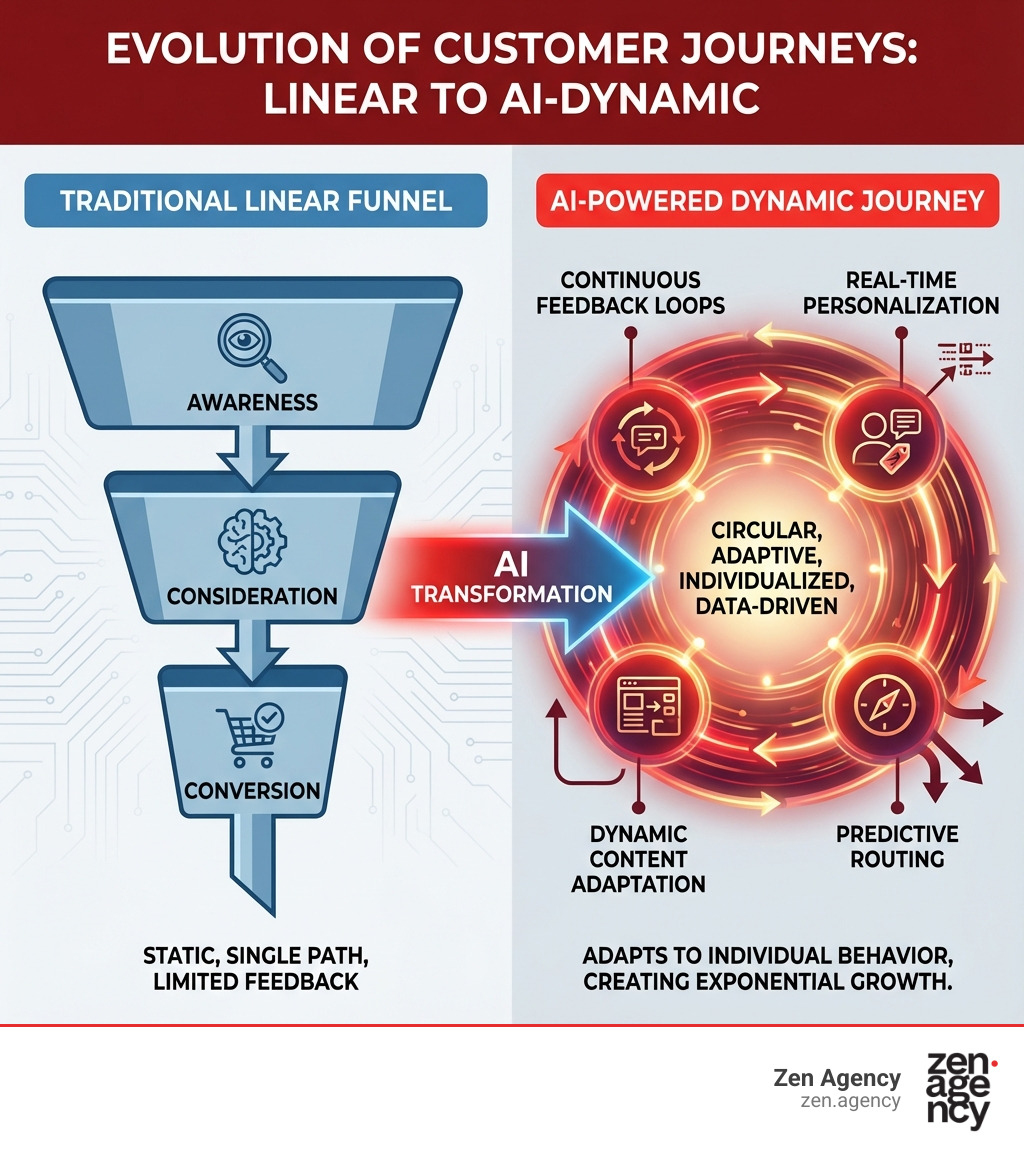
Artificial intelligence is moving business growth from simple “growth hacking” to a new era of “hypergrowth.” It’s about reimagining how we create value, connect with customers, and operate our businesses.
From Digital to AI Change: What’s the Difference?
Many businesses, including those in Wilkes Barre and Billings MT, have adopted digital change by digitizing manual processes and moving online. This made existing operations more efficient.
AI change goes further. It’s not just about digitizing; it’s about intelligent automation, predictive capabilities, and continuous learning. While digital change optimized tasks, AI change embeds intelligence across entire workflows to drive organization-wide change. It creates a powerful feedback loop where data trains models, models drive action, and actions generate new data, continuously improving outcomes. The impact is clear: 52% of companies report a changeal impact on operations from AI, far exceeding expectations.
Here’s a quick comparison:
| Feature | Traditional Digital Change | AI Change |
|---|---|---|
| Primary Goal | Digitize & Optimize existing processes | Reimagine & Innovate processes with intelligence, driving new value |
| Data Usage | Data collection & reporting | Data analysis, predictive modeling, continuous learning & feedback loops |
| Technology Focus | Cloud, mobile, web, automation of tasks | Machine Learning, Generative AI, Agentic AI, predictive capabilities |
| Outcome | Efficiency, accessibility | Exponential growth, new business models, competitive advantage |
Key Technologies Powering the Growth Engine
The backbone of AI driven growth strategies is a suite of powerful technologies that can be leveraged from marketing in Pennsylvania to manufacturing in Montana.
- Machine Learning (ML): The foundation of AI, ML allows systems to learn from data to identify patterns and make predictions, powering everything from product recommendations to fraud detection.
- Predictive Analytics: Uses historical data and ML to forecast future trends, such as customer behavior or market shifts, enabling proactive decisions.
- Natural Language Processing (NLP): Enables computers to understand and generate human language, powering chatbots, sentiment analysis, and content creation tools.
- Generative AI: Creates new content, including text, images, and video. It’s revolutionizing marketing by expediting personalized content and ad creation at scale.
- Agentic AI: The next frontier of autonomous systems that can execute multi-step tasks with minimal human input. They observe, plan, and act, moving beyond assistance to action. You can explore more info about AI’s impact on SEO to see how these technologies are changing search visibility.
- Computer Vision: Allows AI to interpret visual information from images and videos, used for quality control in manufacturing or analyzing foot traffic in retail.
These technologies, when strategically applied, become the engines of hypergrowth, enabling businesses to operate with unprecedented intelligence and agility.
Architecting Your AI-Driven Growth Strategies

Building effective AI driven growth strategies requires a clear blueprint, not a haphazard adoption of tools. This ensures your AI initiatives deliver maximum impact and sustainable growth.
Identifying and Prioritizing High-Impact AI Applications
The key is to identify where AI can deliver the most significant growth for your business. We focus on areas with changeal potential:
- Operational Efficiency: Streamline operations, reduce costs, and cut manual errors. For example, AI-powered predictive maintenance in a Billings MT manufacturing facility can minimize equipment downtime by scheduling repairs before a failure occurs.
- Customer Experience: Personalize interactions at scale to improve engagement and loyalty, from intelligent chatbots to custom product recommendations.
- New Market Entry: Analyze vast datasets to identify untapped customer segments and emerging market opportunities for expansion.
For marketing, top AI use cases include hyper-personalization, predictive lead scoring, dynamic pricing, and automated content creation, all of which free up human marketers for more strategic tasks.
Leveraging AI for Superior Decision-Making and Strategic Planning
AI is revolutionizing strategy by augmenting human decision-making. As a strategic partner, AI can act as a researcher, synthesizing vast amounts of market data in minutes; an interpreter, identifying subtle patterns in data; a thought partner, pressure-testing assumptions; and a simulator, modeling the impact of strategic choices. This data-driven approach helps mitigate human cognitive biases.
To gain a true strategic advantage, you must develop proprietary data ecosystems. Your unique customer and operational data, when fed into AI models, becomes an exclusive source of competitive advantage that no one else has. As McKinsey’s research highlights, this is how AI is transforming strategy development.
Developing a Roadmap for Your AI driven growth strategies
The journey to AI excellence requires a structured approach:
- AI Readiness Assessment: Understand your current maturity in data, talent, governance, and culture. For many in places like Scranton, the biggest barrier is a lack of knowledge.
- Set Quarterly Goals: Break down the vision into achievable, measurable quarterly objectives.
- Form a Cross-functional Task Force: Ensure alignment and effective resource allocation by including marketing, IT, finance, and other key departments.
- Pilot High-Impact Use Cases: Start with small, low-complexity projects to demonstrate value quickly and build internal confidence.
- Scale Successes: Once a pilot proves its value, develop a plan to scale it across the organization, often using no-code or low-code platforms to accelerate adoption.
For more insights into how AI is redefining creative processes, you can read more info about AI’s role in design.
Hyper-Personalization at Scale: AI in Marketing and Customer Experience
Today’s consumers demand personalization. With an estimated 40% of consumers feeling that ads fail to connect with them, businesses in Montana and Pennsylvania are missing a massive opportunity. AI is the key to bridging this gap, enabling hyper-personalization at a scale previously unimaginable.
Using AI to Understand and Engage Customers
AI driven growth strategies in marketing hinge on deeply understanding each customer. AI algorithms analyze vast amounts of data—purchase history, browsing behavior, social media sentiment—to create dynamic customer profiles. This allows for real-time audience segmentation, moving beyond static groups to individual preferences. As a customer in Billings MT shows interest in a product, AI can instantly adjust website content or email campaigns to match. This level of personalized messaging, powered by AI-driven CRM systems, improves customer loyalty. When customers feel understood, satisfaction can improve by 15-20% and revenue by 5-8%, creating long-term, sustainable growth.
For a deeper dive into how autonomous AI systems are changing customer interactions, you can explore more info about AI agents in marketing.
Reimagining the Creative Workflow with Generative AI
Generative AI is reimagining the entire creative workflow, enabling unprecedented speed and personalization.
- Automated Content Creation: Generative AI can quickly draft compelling ad copy, emails, and social media posts, freeing human creators to focus on high-level strategy and brand voice.
- AI-Powered Asset Design: Beyond text, generative AI creates images and videos, allowing for hundreds of ad variations to be tested against different audience segments without massive manual effort.
- End-to-End Creative Workflow: While many use GenAI for single tasks, a huge opportunity lies in adopting it for the entire creative process. Only 9% have adopted AI for their end-to-end creative workflow, from concept to optimization.
- Expediting Content Production: The speed of generative AI allows businesses to maintain an “always-on” marketing presence, responding to real-time trends with relevant content efficiently.
To see how AI is pushing the boundaries of visual content, check out more info about AI video editing.
Building an AI-Ready Organization: From Strategy to Execution
Adopting AI driven growth strategies is about more than technology; it’s about preparing your people, processes, and culture in places like Pennsylvania or Montana for a new way of working.
Overcoming the Problems to AI Adoption
Many organizations face significant problems in their AI journey:
- Talent Shortages: A global AI talent shortage is compounded by the need to reskill existing teams. The World Economic Forum reports that 50% of employees will need reskilling by 2025, yet many receive little support.
- Data Privacy and Security: Half of organizations cite privacy and security as top blockers. Protecting sensitive customer data and ensuring regulatory compliance is paramount.
- Resistance to Change: Employees may fear job displacement or resist new workflows. Effective change management and clear communication are essential.
- Lack of Knowledge: For most, the biggest barrier is a lack of understanding of AI’s capabilities and implementation, making it an educational challenge, not a budget issue.
- Legacy System Integration: Integrating modern AI solutions with outdated IT infrastructure can be a major technical hurdle.
Cultivating an AI-First Culture and Measuring Success
An AI-ready organization thinks with AI. This requires:
- Leadership Buy-in: AI change must be championed from the top down.
- Upskilling and Reskilling: Invest in your workforce with training to build AI literacy and adapt to new, AI-integrated workflows.
- Establishing AI Governance: Implement robust governance frameworks to manage risks like bias and ensure ethical, transparent, and fair AI use. Leaders like Citadel treat this as a core part of business strategy, as detailed in Citadel’s approach to AI governance.
- Transparency and Trust: Be transparent about how AI is used, ensure its outputs are explainable, and maintain human oversight to build trust.
For more general information on AI, you can always visit our AI category page.
Measuring the ROI of AI driven growth strategies
Measuring AI success requires a holistic view. Key performance indicators (KPIs) to track include:
- Operational Efficiency: Reduced cycle times, cost savings from automation, and increased productivity.
- Customer Outcomes: Higher customer satisfaction (CSAT), Net Promoter Score (NPS), lifetime value (LTV), conversion rates, and reduced churn.
- Innovation: Faster time-to-market for new products and revenue generated from AI-driven offerings.
- Employee Experience: Improved employee satisfaction and time freed up for strategic work.
- Capital Allocation: Smart, strategic investment is key. Organizations allocating at least 5% of their budget to AI are more likely to see positive returns.
The Future is Agentic: What’s Next for AI-Powered Growth?
The next frontier for AI driven growth strategies is agentic AI, which promises to be truly transformative.
- Agentic AI Workflows: These are autonomous systems that can observe, plan, and act to achieve complex goals. Imagine AI agents that, upon detecting a demand surge in Billings MT, automatically reallocate ad spend, adjust pricing, and refresh creative assets without human intervention. 35% of organizations are already using agentic AI.
- Autonomous Systems: These systems apply institutional knowledge and learn continuously, shifting the model from task delegation to operational orchestration. Three-quarters of extensive adopters believe agentic AI is enabling new sources of competitive advantage.
- Offensive vs. Defensive Strategies: Defensively, businesses must guard against AI-native disruptors. Offensively, they can use agentic AI to create new advantages, as shown by a US homebuilder that tripled conversion rates by training AI sales agents to emulate top performers.
- Modular AI: Building AI from smaller, interchangeable components allows for greater flexibility, scalability, and rapid customization to meet specific business needs.
- The Future of Work: Agentic AI will rebalance the workforce, creating demand for generalists who can manage human-agent teams. The focus will shift to human capabilities like strategy and oversight, while AI handles execution, as detailed in Agents Are Accelerating the Next Wave of AI Value Creation.
To understand how AI agents are already impacting e-commerce, check out more info about AI agents in e-commerce.
Frequently Asked Questions about AI Growth Strategies
How do you prioritize AI use cases for maximum growth?
We prioritize using a framework that balances business impact against implementation feasibility. Every AI initiative must align with overarching strategic goals. We focus on solving core business problems end-to-end, starting with high-value, low-complexity projects to build momentum and demonstrate quick wins.
What is the difference between AI implementation and AI change?
- AI Implementation is tactical. It means adding a specific AI tool to an existing workflow, like using a chatbot. It offers localized improvements.
- AI Change is strategic. It involves embedding AI across core workflows, strategies, and decision-making to drive organization-wide growth. It’s about fundamentally redesigning how work gets done, changing culture, and upskilling the workforce for a systemic change.
How can companies ensure the ethical use of AI in marketing?
Ethical AI use is critical for building trust and achieving sustainable growth in areas like Wyoming and Montana. Key practices include:
- Governance: Establish clear policies for acceptable AI use, data handling, and accountability.
- Transparency: Be open with customers about how and when AI is used, and give them control over their data.
- Bias Mitigation: Actively test and correct AI models for biases that could lead to unfair outcomes.
- Data Privacy: Strictly adhere to regulations like CCPA. Our CCPA information details our commitment.
- Human Oversight: Maintain human supervision in critical AI-driven processes to ensure accountability and correct errors.
Conclusion: Your Journey to AI-Powered Hypergrowth Starts Now
The era of growth hacking is over; AI-powered hypergrowth is here. AI driven growth strategies are no longer an advantage but a strategic imperative for any business aiming to thrive in 2025 and beyond.
We’ve explored how AI reshapes business strategy, the technologies that power it, and the roadmap to implementation. From hyper-personalization in marketing to building an AI-ready culture, the path forward is clear. The future is agentic, and the companies that accept this change by reimagining workflows and cultivating an AI-first mindset will be the ones that achieve hypergrowth.
At Zen Agency™, we’ve been at the forefront of digital change for over two decades, helping businesses in Wilkes Barre, Scranton, and Billings MT steer complex technological shifts. Our expertise lies in providing enterprise-grade solutions and innovative strategies to help businesses scale by increasing visibility, profitability, and ROI. We understand that AI success requires a complete rethinking of strategy, processes, and organizational design.
Your journey to AI-powered hypergrowth starts now. Let us help you open up the full potential of AI for your business. Transform your e-commerce business with our AI vision and find how our expertise can drive your next era of unprecedented growth.