Decoding the ADA: A Layperson’s Guide to Compliance Laws and Web Accessibility
Why Understanding ADA Compliance Laws Matters for Your Business
ADA compliance laws are federal regulations from the Americans with Disabilities Act of 1990, a civil rights law prohibiting discrimination against people with disabilities. These laws mandate that businesses and public entities make physical spaces and digital properties accessible.
Quick Overview: What You Need to Know About ADA Compliance Laws
- The ADA Statute – The foundational 1990 civil rights law protecting people with disabilities.
- DOJ Regulations – Specific rules for state/local governments (Title II) and businesses (Title III).
- ADA Standards for Accessible Design – Technical requirements for physical accessibility.
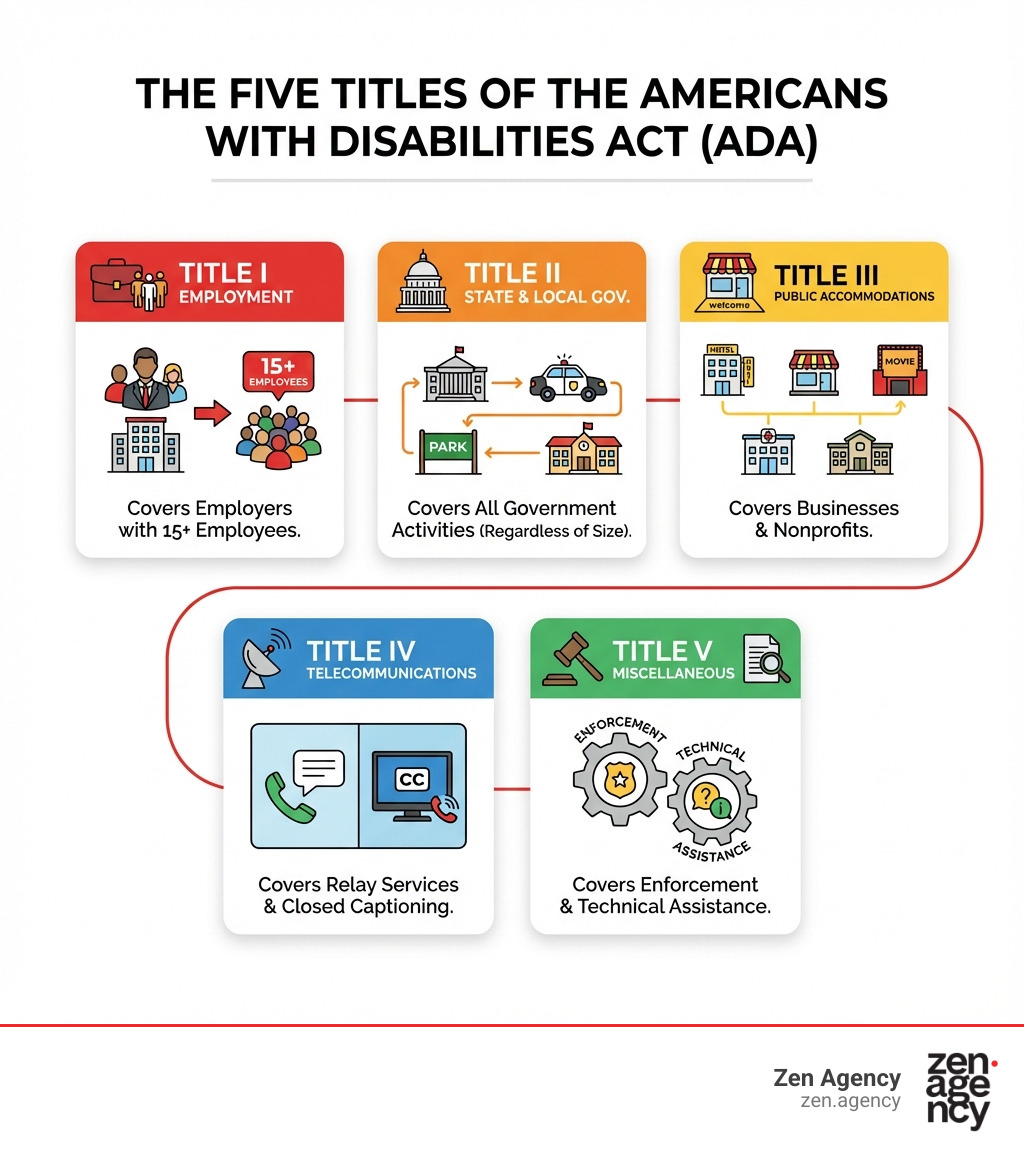
- Title I – Employment (15+ employees).
- Title II – State and local government activities.
- Title III – Public accommodations and commercial facilities.
- Existing Facilities – Must remove architectural barriers when “readily achievable” (easily done without great difficulty or expense).
- New Construction – Must comply with 2010 ADA Standards if built after March 15, 2012.
Many business owners only face ADA laws after receiving customer complaints or legal pressure, often due to confusion about requirements for existing facilities. But the ADA is about more than avoiding lawsuits; it’s about opening your business to everyone. Making your location and website accessible connects you with the 26% of U.S. adults living with a disability—a significant market you might be missing.
I’m Joseph Riviello, and with 22 years in digital marketing, I’ve helped businesses steer ADA compliance for their websites, an area where lawsuits have surged. Understanding these laws is key to legal protection and building a brand that serves all customers.
The Foundation of ADA: Statute, Regulations, and Standards
ADA requirements come from two primary sources: the ADA statute and regulations from the Department of Justice (DOJ). The statute, passed in 1990, is the foundational law outlining broad protections. DOJ regulations translate these mandates into specific obligations for governments and businesses.
These regulations are supported by the ADA Standards for Accessible Design, which provide technical specifications for physical accessibility. The U.S. Access Board develops the minimum guidelines for these standards, which the DOJ then enforces. This layered approach ensures clear, actionable requirements. You can explore the details of The Americans with Disabilities Act directly from the source.
What are the ADA Standards for Accessible Design?
The ADA Standards for Accessible Design are the blueprints for accessibility, setting minimum scoping and technical requirements for new or altered facilities. The original 1991 Standards for Accessible Design were updated to the current 2010 Standards for Accessible Design, which became mandatory for new construction and alterations after March 15, 2012. These standards ensure elements like ramps, doorways, and restrooms meet specific criteria for access.
The Federal Regulatory Process
The federal regulatory process allows these laws to evolve. The Unified Agenda details federal agencies’ planned regulatory actions. For instance, the DOJ’s Fall 2024 Unified Agenda shows plans for new ADA regulations on topics like “The Public Right of Way” and “Equipment and Furniture.” This demonstrates a proactive approach to expanding accessibility. Staying informed about proposed changes is crucial for ongoing compliance.
Understanding the Core ADA Compliance Laws by Title

The ADA is divided into five titles, but Title II and Title III are most relevant for many entities. They define the responsibilities of public entities (state and local governments) versus private ones (public accommodations and commercial facilities). Understanding this distinction is key to knowing your obligations under ADA compliance laws.
Key Requirements for State and Local Governments (Title II)
Title II covers all activities of state and local governments, regardless of size. This means a town hall in Wilkes Barre, PA, and a state agency in Montana must both comply. Key responsibilities include:
- Nondiscrimination: Cannot discriminate against qualified individuals with disabilities in services, programs, or activities.
- Program Accessibility: Services and programs must be accessible, even if not all buildings are. For example, a meeting in an inaccessible room must be moved.
- Effective Communication: Must provide aids like interpreters or large print materials for people with hearing, vision, or speech disabilities.
- New Construction and Alterations: New and altered government facilities must comply with ADA Standards.
- Public Transportation: Government-provided transportation services must be accessible.
Key Requirements for Public Accommodations and Commercial Facilities (Title III)
Title III applies to private entities open to the public, like restaurants, hotels, and stores, as well as commercial facilities like warehouses and office buildings. Key mandates include:
- Nondiscrimination: Cannot discriminate in the provision of goods, services, or facilities.
- Barrier Removal: Must remove architectural barriers in existing facilities when “readily achievable.”
- Reasonable Modifications: Must modify policies or procedures to avoid discrimination, unless it would fundamentally alter the service.
- Auxiliary Aids and Services: Must provide aids for effective communication, unless it causes an undue burden.
- New Construction Rules: New and altered facilities must be fully accessible according to ADA Standards.
Physical Accessibility: From New Builds to Existing Facilities
Physical accessibility is a tangible aspect of ADA compliance laws, covering how people with disabilities use buildings. The requirements differ for new construction, alterations, and existing buildings, a key distinction for property managers in places like Scranton, PA, or Billings, MT.
New Construction and Alterations
New facilities must be designed and built to be fully accessible, incorporating the ADA Standards for Accessible Design from the start. When an existing facility is “altered,” the changed portions must also comply with the standards to the “maximum extent feasible.” Any construction or alteration started after March 15, 2012, must follow the 2010 ADA Standards.
If an alteration affects a “primary function” area (like a sales floor), the “path of travel” to that area, including restrooms and drinking fountains, must also be made accessible. However, this extra cost is not required if it exceeds 20% of the total alteration cost. For more guidance, see the Guide to Disability Rights Laws. A limited “elevator exemption” exists for some smaller buildings, but not for shopping centers or healthcare provider offices.
Navigating ADA compliance laws for existing buildings
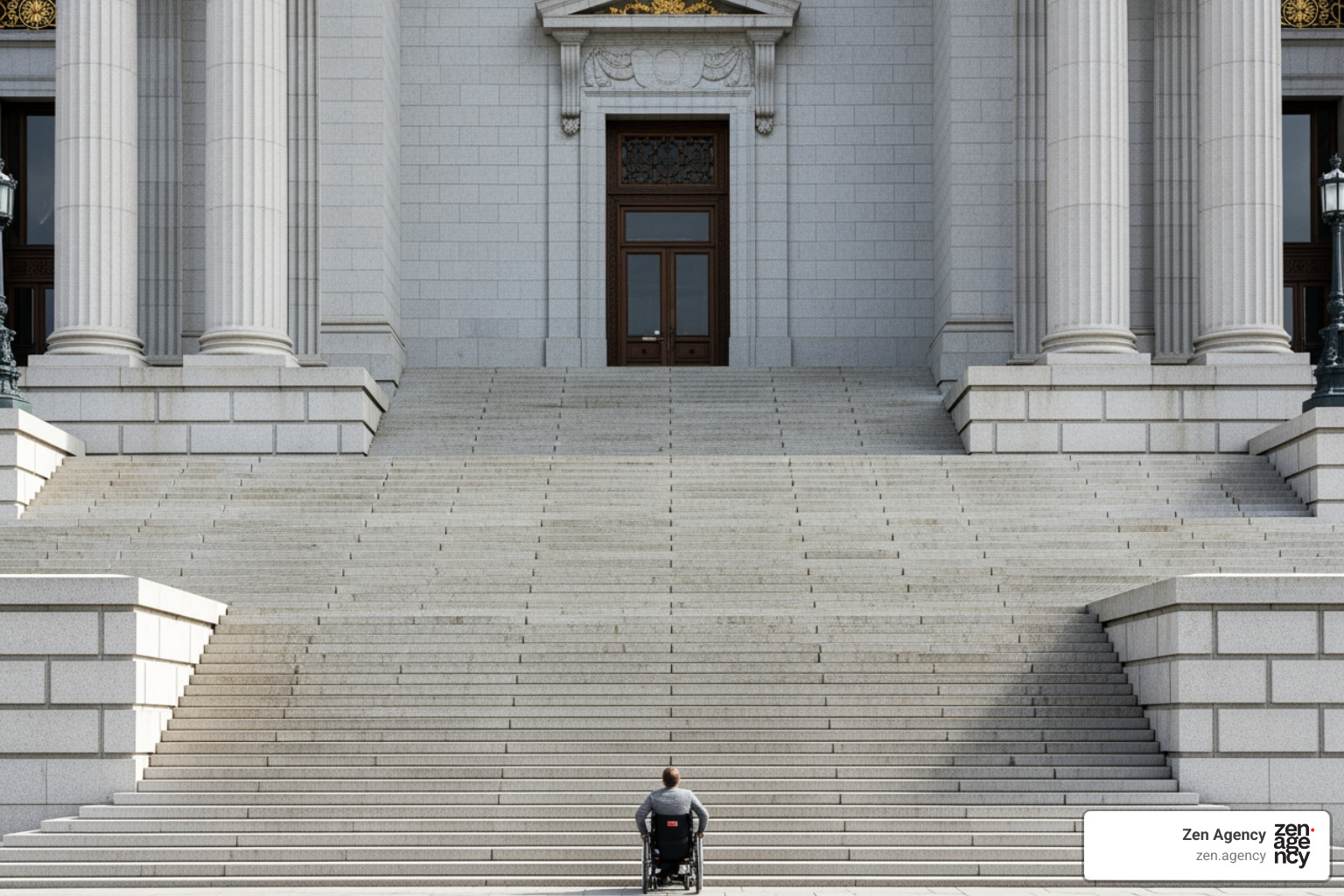
A common misconception is that buildings constructed before the ADA are exempt. This is false. The ADA requires public accommodations to remove architectural barriers in existing facilities unless it is “not readily achievable.” This is an ongoing obligation. Common barriers include steps at entrances, narrow doorways, inaccessible restrooms, high counters, and a lack of accessible parking.
What ‘Readily Achievable’ Barrier Removal Means
The term “readily achievable” means “easily accomplishable and able to be carried out without much difficulty or expense.” This is a flexible standard that depends on a business’s resources. Factors include the nature and cost of the action, the facility’s financial resources, and the type of operation. The burden of proof is on the business to show that removal is not readily achievable.
The DOJ prioritizes barrier removal as follows:
- Provide access from public sidewalks and parking.
- Provide access to areas where goods and services are offered.
- Provide access to public restrooms.
- Take any other necessary measures to provide access.
Examples include installing ramps, widening doorways, repositioning furniture, and installing accessible door hardware. The DOJ’s Checklist for Readily Achievable Barrier Removal can help businesses survey their facilities.
The ‘Safe Harbor’ Provision Explained
The “safe harbor” provision means that facility elements built or altered to comply with the 1991 Standards before March 15, 2012, do not need to be modified to meet the 2010 ADA Standards. However, this protection does not apply to elements that were not covered in the 1991 Standards (like swimming pools or play areas). Any new alterations to a “safe harbor” element must comply with the current 2010 standards.
Digital Accessibility: ADA Compliance for Websites
ADA compliance laws extend to online environments. Although the ADA statute doesn’t mention “websites,” the Department of Justice (DOJ) and courts have affirmed that websites of public accommodations are subject to Title III. An inaccessible website is a barrier to a business’s goods and services, which can be a form of discrimination.
Understanding WCAG as the Gold Standard
Since the ADA lacks specific technical rules for websites, the Web Content Accessibility Guidelines (WCAG) have become the de facto standard. Developed by the World Wide Web Consortium (W3C), WCAG is built on four principles (POUR):
- Perceivable: Users must be able to perceive the information being presented (e.g., alt text for images).
- Operable: Users must be able to operate the interface (e.g., keyboard-only navigation).
- Understandable: Users must be able to understand the information and the interface (e.g., clear instructions).
- Robust: Content must be reliably interpreted by various user agents, including assistive technologies.
WCAG has three conformance levels: A, AA, and AAA. Most legal and industry best practices recommend WCAG 2.1 Level AA conformance. At Zen Agency, we help businesses meet these standards. You can learn more about these guidelines on our dedicated WCAG page.
Common Web Accessibility Failures
Many common accessibility failures are straightforward to fix but often overlooked:
- Missing Alt Text: Images without descriptive “alt text” are invisible to screen readers.
- Poor Color Contrast: Insufficient contrast makes text hard to read for users with low vision.
- Keyboard Traps: Content that cannot be steerd using only a keyboard.
- Lack of Captions/Transcripts: Videos and audio are inaccessible to users with hearing impairments.
- Inaccessible Forms: Forms without proper labels and instructions are difficult for assistive technologies to use.
- Non-descriptive Link Text: Vague links like “click here” are unhelpful for screen reader users.
Addressing these issues is a significant step toward a compliant and inclusive website.
Enforcement, Resources, and Related Laws
Understanding ADA compliance laws includes knowing how they are enforced, where to find help, and how they relate to other disability rights laws.
How to Report a Disability Rights Violation
Individuals can report ADA violations to the Department of Justice (DOJ), a primary enforcement agency. The process involves filing an online complaint, which the DOJ reviews. Next steps may include investigation, mediation, or litigation. Individuals can also file private lawsuits against non-compliant entities.
Essential Resources and Checklists
Numerous resources can help businesses meet their obligations:
- DOJ Checklists: The DOJ offers tools like the Checklist for Readily Achievable Barrier Removal.
- Updated Checklists: Organizations like the Institute for Human-Centered Design provide updated checklists reflecting the 2010 ADA Standards.
- ADA National Network: A comprehensive resource offering technical assistance and training, with regional centers serving areas like Pennsylvania and Montana.
- Primers and Guides: The DOJ publishes easy-to-understand primers for small businesses and state and local governments.
We encourage businesses in our service areas of Wilkes Barre, Scranton, Wyoming PA, and Billings MT, to use these resources to improve their accessibility.
A Brief Look at Other Key ADA compliance laws
The ADA is part of a broader legal framework protecting individuals with disabilities:
- Rehabilitation Act (Sections 504 & 508): Section 504 prohibits disability discrimination in federally funded programs. Section 508 requires federal agencies to make their electronic and information technology accessible.
- Fair Housing Act (FHA): Prohibits disability discrimination in housing and mandates accessibility features in new multi-family housing.
- Air Carrier Access Act (ACAA): Prohibits disability discrimination in air travel on U.S. and foreign carriers.
Together, these laws ensure equal access across many sectors of public life.
Frequently Asked Questions about ADA Compliance
Here are answers to common questions about ADA compliance laws.
Does the ADA apply to small businesses?
Yes. Title III of the ADA applies to public accommodations regardless of size. A small coffee shop in Scranton, PA, has the same non-discrimination obligation as a large chain. However, the “readily achievable” standard for barrier removal in existing facilities considers a business’s resources. What is achievable for a large corporation may not be for a small business, so the scope of required modifications can differ.
What are the penalties for not complying with the ADA?
Non-compliance can lead to significant consequences. The Department of Justice can impose civil penalties up to $75,000 for a first violation and $150,000 for subsequent ones. Individuals can also file private lawsuits to force compliance and recover attorneys’ fees, which can cost businesses tens of thousands of dollars. Investing in accessibility upfront is far more cost-effective than facing a lawsuit.
Is my old building exempt from the ADA?
No. There is no “grandfather clause” in the ADA that exempts older buildings. Existing facilities have an ongoing obligation to remove architectural barriers when it is “readily achievable” to do so. Even if your building in Wilkes Barre, PA, was built before 1990, you must make it accessible where modifications are easily accomplishable. What is “readily achievable” can change over time, so regular assessment is essential.
Conclusion: Making Accessibility a Core Business Value
The Americans with Disabilities Act has fundamentally reshaped our understanding of inclusion and equal access in the United States. Far from being an optional consideration, ADA compliance laws are a federal mandate designed to break down barriers for people with disabilities, ensuring they can participate fully in all aspects of life, from employment and government services to public accommodations and digital interactions.
For businesses and public entities, understanding these laws is not just about avoiding legal pitfalls; it’s about embracing a broader market and fostering a more inclusive society. When we design our physical spaces and digital platforms with accessibility in mind, we’re not just meeting a legal requirement—we’re creating better experiences for everyone. This proactive approach transforms accessibility from a burden into a core business value, opening doors to new customers and enhancing brand reputation.
At Zen Agency, we believe that true enterprise-grade solutions extend to every user. For help ensuring your website meets the latest digital accessibility standards, explore our ADA Compliance Services. Let’s work together to build a more accessible and equitable digital landscape.