Convert Like a Pro: Top Tips for CRO Excellence
Introduction: What is CRO and Why It’s Your Biggest Growth Lever
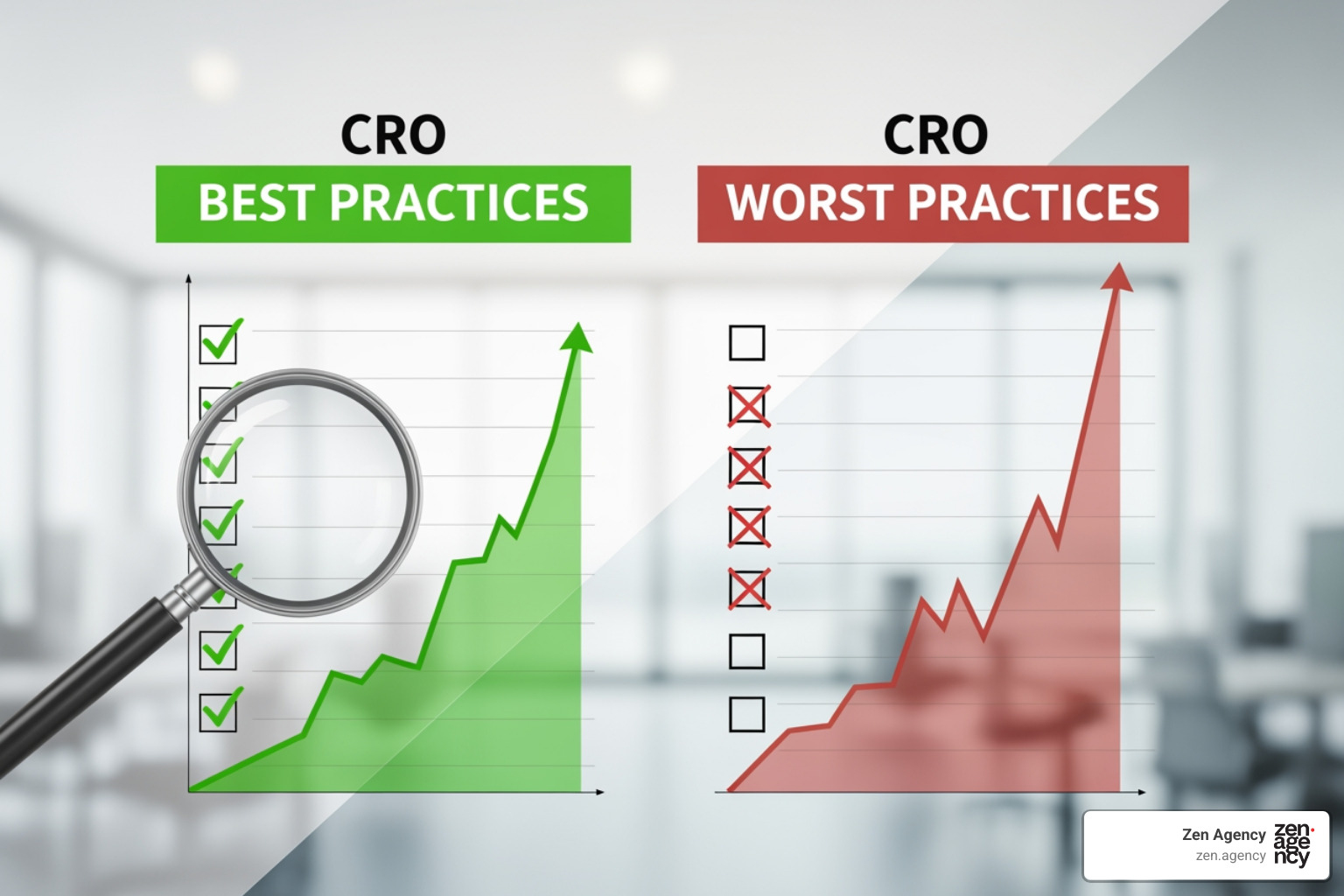
CRO best practices are systematic methods for improving your website’s ability to turn visitors into customers through data-driven testing, user research, and strategic optimization. Here are the core practices that drive results:
- Start with research, not guessing – Use analytics, heatmaps, and customer feedback to identify real problems
- Prioritize high-impact pages – Focus on pages with high traffic and conversion intent (landing pages, checkout, pricing)
- Test one change at a time – Run A/B tests until you reach statistical significance
- Reduce friction everywhere – Simplify forms, speed up pages, clarify your value proposition
- Build trust with social proof – Display reviews, testimonials, and security badges prominently
- Optimize for mobile first – Ensure seamless experiences on smaller screens
- Make it a continuous process – CRO is ongoing optimization, not a one-time project
Here’s the brutal truth: getting traffic is expensive, and it’s getting more expensive every month. But most businesses obsess over traffic volume when they should focus on what happens after someone clicks.
Bump your conversion rate from 2% to 4%, and you’ve just doubled your results. Same ad spend. Same traffic. Double the conversions.
That’s the power of conversion rate optimization. A $5,000 monthly ad budget with a 2% conversion rate gives you 100 conversions. That same $5,000 with a 3% conversion rate delivers 150 conversions. You just gained 50 extra conversions without spending another dollar.
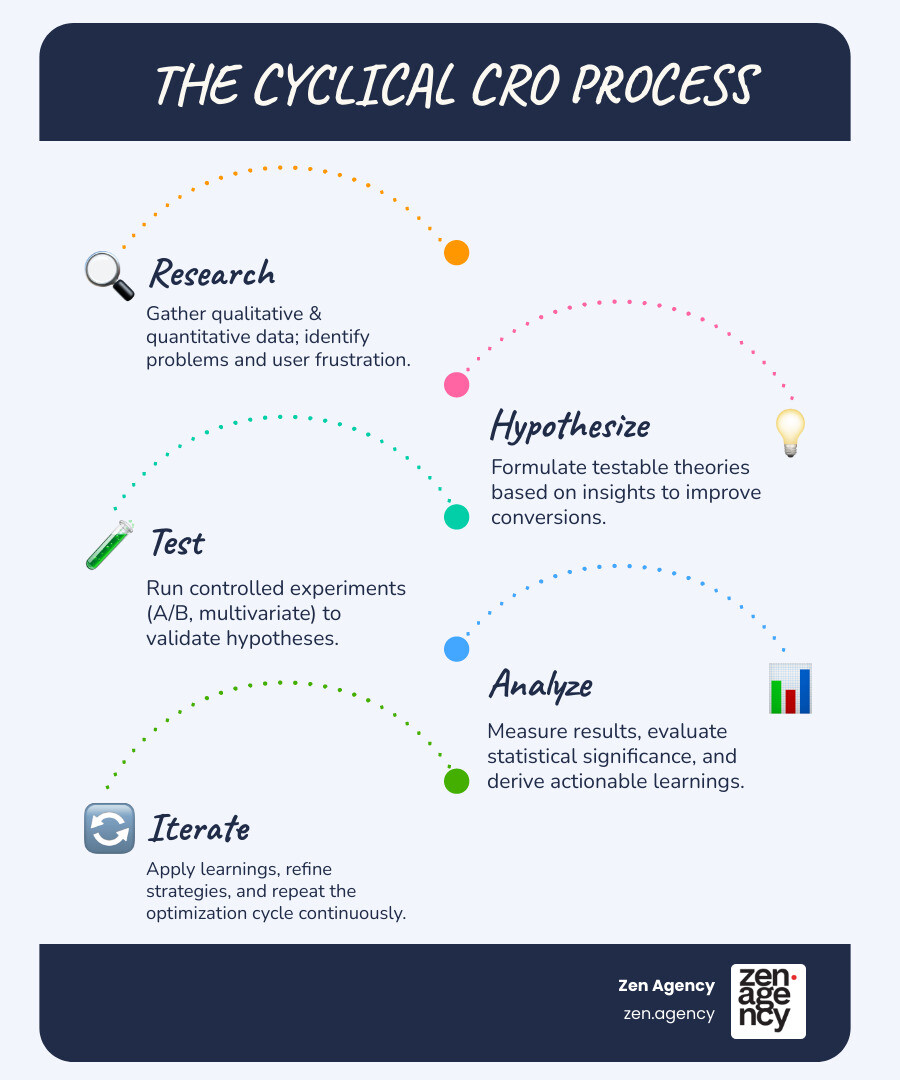
CRO isn’t about quick fixes. It’s a systematic process of research, hypothesis generation, testing, and analysis. You gather qualitative (what users say) and quantitative (what users do) data to identify friction, form hypotheses, test changes, measure results, learn, and iterate.
The research is clear: personalized experiments drive 41% more impact than generic changes. User research is the most undervalued marketing investment, yet it uncovers the insights that lead to breakthrough improvements. Companies that build a culture of experimentation—where testing is routine and learning from both wins and losses is celebrated—see compounding gains over time.
Most businesses go for CRO half-heartedly and miss the benefits. They make decisions based on intuition instead of data. They test randomly without understanding why something might work. They stop after one or two tests instead of building momentum.
But the companies that get it right? They treat CRO as a growth multiplier that makes every other marketing dollar work harder.
I’m Joseph Riviello, and over 22 years in digital marketing, I’ve seen how implementing cro best practices transforms struggling businesses into conversion machines that scale profitably. At Zen Agency, we’ve helped countless companies double or triple their conversion rates by following the systematic approach outlined in this guide.
Laying the Groundwork: Data, Research, and Strategy
Before tweaking a headline or button color, we must understand the bedrock of successful CRO best practices: data and research. Without this foundation, we’re just guessing, and guessing is expensive.
Understanding Your Audience: The First Step in CRO Best Practices
The most critical step in any CRO strategy is to truly understand your audience. Who are they? What do they want? What are their pain points, and what prevents them from taking the desired action on your website? Our philosophy is simple: always, always, always start with user research before running tests.
We leverage two main types of data to paint a complete picture of your users:
-
Quantitative Data (The “What”): This is the numerical data that tells us what users are doing on your site. We dive into analytics tools like Google Analytics to understand traffic sources, bounce rates, time on page, conversion rates, and user flows. This data reveals where people are dropping off in your funnel, which pages are popular, and which ones are struggling. We also look for user frustration signals like dead, rage, or error clicks and erratic cursor movements, which can point to immediate fixes. For instance, if we see a high number of rage clicks on a specific element, it suggests users are frustrated and expecting it to be interactive.
-
Qualitative Data (The “Why”): While quantitative data tells us what is happening, it doesn’t tell us why. That’s where qualitative research comes in. This involves gathering direct feedback from your users through:
- Customer Interviews: Speaking directly to customers, whether current or potential, is invaluable. We ask them about their motivations, objections, and their experience on your site.
- Surveys: We deploy surveys, including Net Promoter Score (NPS) for power users and exit-intent surveys for those who are about to leave. Questions like “What’s missing?” or “What were you looking for?” can uncover critical issues.
- User Testing/Session Recordings: Watching actual users steer your site, either in live user testing sessions or through recorded sessions, helps us observe their behavior firsthand. We can see where they get stuck, confused, or delighted, providing context to the quantitative data.
- Heatmaps and Click Maps: These visual tools show us where users are clicking, moving their mouse, and how far they’re scrolling on a page. They highlight areas of interest and neglect, helping us understand user engagement patterns.
By combining both quantitative and qualitative data, we move beyond assumptions and opinions. We identify the real leaks in your conversion funnel, understand the “why” behind user behavior, and gather the insights needed to formulate effective hypotheses for our tests. This detailed and custom approach is how we optimize your website for your specific audience in Pennsylvania, Montana, and across the USA.
Building Your CRO Roadmap
Once we have a solid understanding of your audience and the problem areas on your site, the next step is to build a strategic CRO roadmap. This isn’t about random testing; it’s about prioritizing efforts for maximum impact.
First, we define clear goals. What constitutes a conversion for your business? This can vary significantly. For an e-commerce site, a macro-conversion is usually a purchase. For a B2B service, it might be a demo request or a contact form submission.
However, it’s crucial to also track micro-conversions. These are smaller actions users take that indicate progress towards a macro-conversion. For a SaaS or services site, micro-conversions could include:
- Downloading a lead magnet
- Signing up for a free trial
- Watching a product or service demo video
- Adding an item to a cart or quote
- Clicking a specific call to action (CTA)
- Subscribing to a newsletter
Measuring micro-conversions is particularly important for websites with lower traffic, as they provide more frequent data points and allow us to run experiments and see indicative results faster. Many optimization experiments target key metrics like CTA clicks, revenue, checkout completion, registration, and add-to-cart actions.
With our goals defined, we then prioritize test ideas using established frameworks like ICE (Impact, Confidence, Ease) or PXL. These frameworks help us evaluate potential tests based on:
- Impact: How big of a change could this test make to our conversion goals?
- Confidence: How certain are we that this change will have the desired effect, based on our research?
- Ease: How difficult or time-consuming will it be to implement this test?
This prioritization ensures that we focus on high-impact, achievable tests first, creating a test backlog that guides our ongoing optimization efforts. A well-structured roadmap allows us to establish a regular cadence for CRO work, with focused check-ins, a steady rhythm of new test launches, and periodic reviews to refine our strategy. It’s about making CRO an ongoing process, not a one-time project.
On-Page CRO Best Practices: Designing for Conversion
Now that we understand our audience and have a strategic roadmap, it’s time to apply CRO best practices to your website’s design and content. This is where we make your pages more compelling to your target audience.
Optimizing Landing Pages and User Experience (UX)
Your landing pages and overall user experience (UX) are your digital storefront. They need to be inviting, easy to steer, and clearly present what you offer. Our goal is always clarity and simplicity, reducing any friction that might prevent a user from converting.
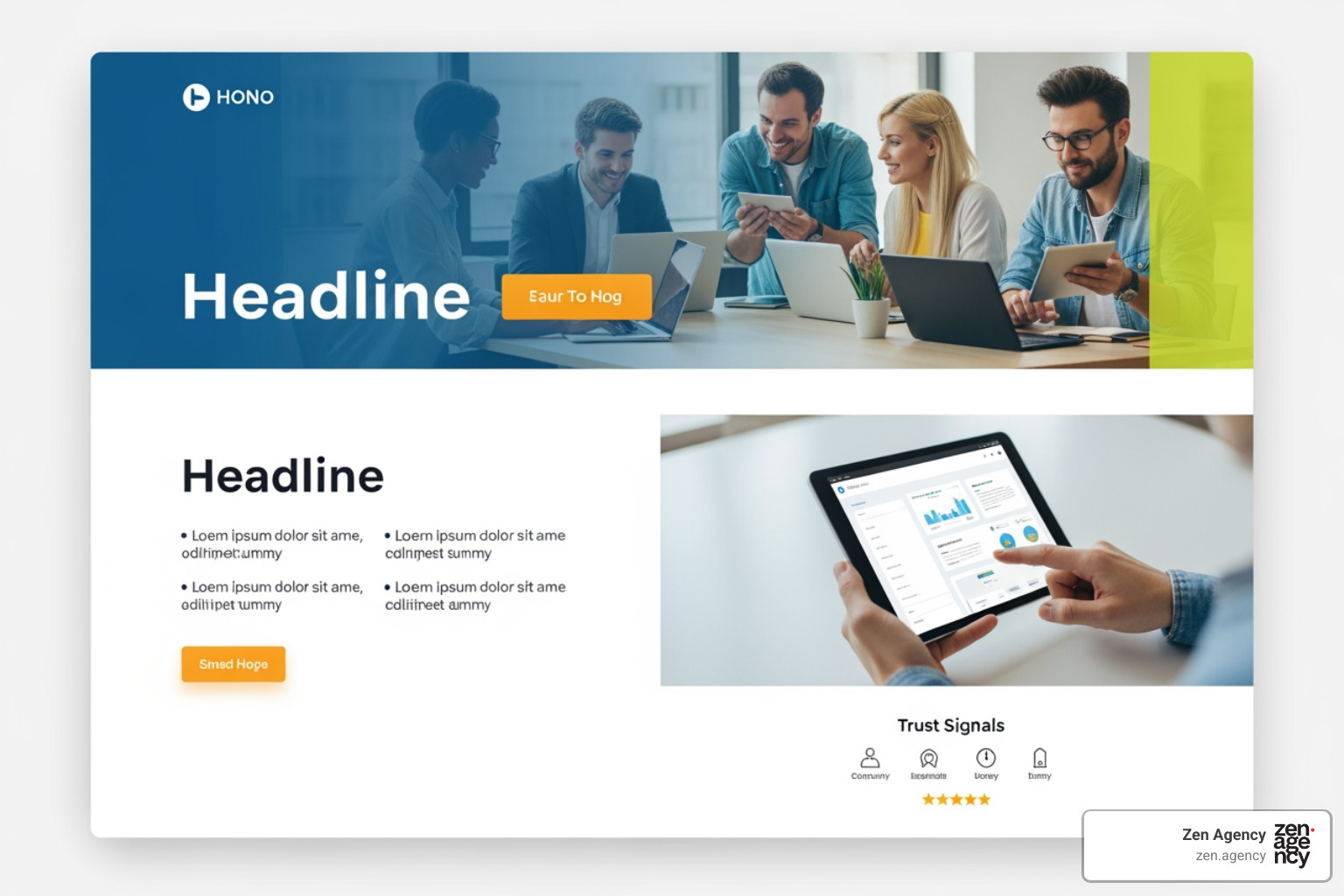
- Clarity and Simplicity: You have only a few seconds to answer the question: “Why should I care?” Your value proposition must be immediately clear, ideally above the fold (the part of the page visible without scrolling). We recommend that anyone looking to launch a landing page first work through a value proposition design process. Keep landing pages simple, focusing on one user goal per page and eliminating distractions or unneeded steps.
- Reducing Friction: Friction refers to anything that makes it difficult or frustrating for a user to complete a desired action. This could be excessive form fields, confusing navigation, or slow loading times. We conduct friction audits to identify these pain points.
- Website Navigation: A clutter-free and intuitive website design significantly improves conversions. Your navigation should guide users naturally through your site, helping them find what they need without confusion.
- Page Load Speed: Users expect websites to load quickly. A slow page load time is a major source of friction and can lead to high bounce rates. We optimize images, minimize scripts, and leverage caching to improve speed, supporting both user experience and SEO.
- User-Centric Design: While good design principles are important, we’re not trying to create a pretty brochure; we’re trying to create a website that motivates people to take action. This means focusing on content and user needs before focusing on cosmetic elements.
Crafting Compelling Copy and Calls-to-Action (CTAs)
Your website copy and calls to action are at the heart of your persuasive efforts. They need to resonate with your audience and clearly tell them what to do next.
- Strong Value Proposition: This is the core of your message. It’s the unique benefit your product or service offers that differentiates you from competitors. We ensure your main headline succinctly delivers your core value proposition, making it emotionally resonant and attention-grabbing.
- Benefit-Driven Headlines and Copy: Visitors care more about outcomes than features. Our copy focuses on solving your audience’s problems and highlighting “what’s in it for me?” We write for “skimmers” with succinct language, bullet points, and clear subheadings.
- Clear call to action (CTA): A good CTA is crucial. It needs to be:
- Concise and Action-Oriented: Use strong verbs that clearly state the desired action (for example, “Get a Free Quote,” “Download Now,” “Buy Now”).
- Visually Distinct: The CTA button should stand out on the page through contrasting colors, size, and placement.
- Aligned with Copy: Ensure the CTA text aligns with the surrounding copy and the user’s intent at that stage of their journey.
- Urgency/Scarcity (used carefully): When appropriate, adding numbers or time-sensitive language can create a sense of urgency.
- Location-Specific: For businesses in Wilkes Barre, Scranton, Wyoming PA, or Billings MT, a CTA like “Find Your Local Expert in Pennsylvania” can be highly effective.
- A/B Testing Copy: We regularly test different versions of headlines, body copy, and CTAs. Even small changes in wording can lead to measurable conversion lifts.
Mobile-First CRO Best Practices for Today’s User
With a majority of consumers now using smartphones to shop and browse online, a mobile-first approach is essential. Mobile users face unique challenges that desktop visitors never encounter, and our CRO best practices ensure a seamless experience on smaller screens.
- Responsive Design: Your website must adapt to any screen size, ensuring content is readable and elements are accessible.
- Large Tap Targets: Buttons and clickable elements should be large enough to be easily tapped with a thumb, preventing frustrating errors. Adjusting form layout and tap targets alone can dramatically improve mobile conversion rate.
- Simplified Forms: Mobile users have less patience for lengthy forms. We advocate for reducing the number of fields to the minimum required.
- Thumb-Friendly Navigation: Design navigation that is easy to access and use with one hand. Think about where users naturally hold their phones and place key interactive elements within easy reach.
- Mobile Page Speed: Mobile page speed is critical. Users will abandon slow-loading mobile sites quickly. We optimize images and code specifically for mobile to support fast loading times.
- Critical Content Early: Ensure your most important content and primary CTA are visible without excessive scrolling on a mobile device.
By prioritizing mobile experiences, we ensure your website is optimized for how most people interact with the internet today, supporting higher engagement and conversion rates for local and national businesses alike.
Building Trust and Streamlining the Customer Journey
Beyond design and copy, building trust and smoothing out the entire customer journey are paramount to achieving higher conversion rates. Users need to feel secure and confident in their decisions.
Leveraging Social Proof and Trust Signals
In the online world, trust is crucial. Users are constantly evaluating whether they can trust your brand, your product, and your website. We leverage social proof and various trust signals to instill that confidence.
- Customer Reviews and Ratings: Many buyers rely on reviews to evaluate or learn more about a product. We ensure customer reviews and ratings are prominently displayed, especially on product pages and near decision points.
- Testimonials and Case Studies: Authentic testimonials, particularly video testimonials, and detailed case studies showcasing real results are powerful forms of social proof. We strategically place these near calls to action, on landing pages, and on “About Us” pages.
- Security Seals and Industry Badges: For e-commerce and lead generation sites, displaying security seals (like SSL certificates), payment provider logos, and industry certifications or awards can increase perceived trustworthiness.
- Authenticity Over Perfection: Users are savvy and can often spot fake reviews. We focus on showcasing authentic social proof, even if it’s not perfectly polished, because authenticity supports credibility.
By embedding these trust signals throughout your website, especially near crucial conversion points, we reinforce your credibility and help visitors feel more comfortable taking the next step.
Optimizing the E-commerce Funnel and Checkout
For e-commerce businesses, the conversion funnel culminates in the checkout process. This is often where conversions are lost, with cart abandonment being a common challenge. Our CRO best practices focus on streamlining this critical stage.
- Simplified Checkout Process: A lengthy or complicated checkout process is a major reason for abandonment. We aim for as few steps and form fields as possible. Many checkouts display more fields than are truly needed, so we work to reduce this number.
- Guest Checkout Option: Forcing users to create an account before purchase can drive abandonment. Offering a guest checkout option, with the opportunity to create an account after the purchase, removes that barrier.
- Clear Pricing and Shipping: Hidden costs, especially for shipping, are a common reason for abandonment. Clearly displaying all costs upfront and using straightforward shipping messages helps reduce surprises.
- Flexible Payment Options: Providing a variety of trusted payment methods that your target audience prefers removes friction at the final step.
- Transparent Return Policy: A clear, fair, and easily accessible return policy increases buyer confidence. Linking it in the footer and near checkout reassures new customers.
- High-Quality Product Visuals and Descriptions: On product pages, users rely heavily on visuals. We ensure high-quality, zoomable images, product videos where appropriate, and clear, benefit-driven product descriptions that answer common questions.
- Thoughtful Promotional Fields: Prominent coupon fields can distract users and send them searching for discounts elsewhere. Hiding promotional code fields behind a small link reduces this distraction while still allowing code entry.
- Working Autocomplete: For forms, especially address fields, solid autocomplete support reduces user effort and speeds up checkout.
By carefully optimizing each step of the e-commerce funnel, from product page to final purchase, we help reduce cart abandonment and increase completed sales for businesses in Pennsylvania, Montana, and beyond.
The Engine of Improvement: Testing, Personalization, and Culture
At the heart of all effective CRO best practices lies a commitment to experimentation, personalization, and a culture that supports continuous learning.
Mastering A/B Testing and Experimentation
Experimentation is the backbone of CRO. It allows us to validate our hypotheses with real data, moving beyond guesswork and intuition.
- A/B Testing: This is the most common form of testing, where two versions of a webpage element (A and B) are shown to different segments of your audience at the same time to determine which one performs better. We focus on one significant variable at a time (for example, headline, CTA button color, image) to clearly attribute success or failure.
- Split URL Testing: Similar to A/B testing, but it compares two different versions of a page, often hosted on different URLs.
- Multivariate Testing: This allows us to test multiple variables on a single page simultaneously, identifying which combination of elements performs best when traffic volume supports it.
- Statistical Significance: We run tests until they reach statistical significance, typically 95%, to reduce the chance that results are random. It’s important not to tweak a running experiment, as this harms the data and can invalidate the test.
- Quality Assurance (QA): Before launching any experiment, thorough QA is essential to ensure that both the control and variant versions function correctly across different browsers and devices.
- Analyzing and Iterating: A/B tests are data-gathering exercises. We analyze the results, document our findings (including “no-change” tests), and use those insights to inform our next round of experiments. This iterative process is central to continuous improvement.
Personalizing the User Experience
Generic experiences are increasingly ignored. Today’s users expect interactions that feel relevant, and personalization is a powerful CRO best practice that supports this.
- Dynamic Content: We can adjust website content based on user characteristics (such as location, past behavior, or referral source). For instance, a user from Billings, Montana, might see content featuring local businesses or region-specific offers.
- Behavioral Targeting: By tracking user behavior (pages visited, products viewed, downloads), we can present custom recommendations or messages. If a user viewed several pages about website development, we might show them a CTA for a free website audit.
- Personalized Recommendations: For e-commerce, this means suggesting products based on past purchases or browsing history. Personalized experiences often generate stronger engagement than one-size-fits-all pages.
- Geotargeting: For businesses serving specific regions like Pennsylvania or Montana, geotargeting allows us to tailor content, offers, and CTAs to local audiences, making the experience more relevant.
By using available user data carefully and responsibly, we can create more relevant experiences that support engagement and conversion rates.
Fostering a Culture of Experimentation
One of the most impactful CRO best practices is not a single tactic but an organizational mindset: a culture of experimentation. CRO is a marathon, and continuous improvement is the goal.
- Data-Driven Decisions: We help teams base decisions on data rather than assumptions. While opinions can help shape hypotheses, experiments provide the objective evidence.
- Learning from Failure: Not every test will be a “winner,” and that is expected. The key is to learn from every test, whether successful or not. Documenting these learnings helps avoid repeated errors and informs future hypotheses.
- Team Collaboration: CRO is not a siloed activity. It benefits from collaboration between marketing, design, development, and sales teams. Sharing test results and insights fosters a collective understanding and leads to better ideas.
- Avoiding Common Mistakes: Many businesses treat CRO as a one-off project or focus on short-term “hacks.” Instead, we advocate for building an internal program that supports continuous experimentation, with dedicated time and resources.
By embedding experimentation into your organization’s DNA, you create a practical engine for growth, constantly adapting and optimizing your digital assets for better performance.
Conclusion: Your Path to Continuous Conversion Growth
We’ve covered the essentials, from understanding your audience and building a strategic roadmap to optimizing your pages, crafting compelling copy, and embracing a culture of continuous experimentation. These CRO best practices are not isolated tactics; they are interconnected components of a holistic strategy designed to maximize the value of every visitor to your website.
CRO is a marathon, not a sprint. It’s an ongoing journey of learning, testing, and refining. The digital landscape is constantly evolving, and so too should your website. By consistently applying these principles, you can see meaningful improvements in your conversion rates, gain a deeper understanding of your customers, and build a more resilient, profitable business.
At Zen Agency, we specialize in providing enterprise-grade solutions and innovative strategies to help struggling-to-scale businesses increase visibility, profitability, and ROI. Our expertise in conversion rate optimization, custom to businesses in Wilkes Barre, Scranton, Wyoming PA, Billings MT, and across Pennsylvania and Montana, means we understand the unique challenges and opportunities in your market.
Ready to open up your website’s full potential and convert like a pro? Start improving your website’s performance with our conversion rate optimization services today.