How to Put Your Ecommerce Support on Autopilot Without Losing the Human Touch
How to Put Your Ecommerce Support on Autopilot Without Losing the Human Touch
Your Ecommerce Support Is Drowning — Here’s How AI Fixes It
AI customer service ecommerce is the use of AI-powered agents to automate support tasks like order tracking, returns, refunds, and product questions — so your team spends less time on repetitive tickets and more time on work that actually grows the business.
Here’s what AI customer service does for ecommerce stores:
- Automates routine tickets — order status, shipping updates, return requests
- Cuts response times dramatically (some brands went from 24-hour waits to 12-minute replies)
- Reduces cost per ticket — one jewelry brand dropped theirs from $5.50 to $2
- Handles support surges during peak seasons without adding headcount
- Works 24/7 in 50+ languages across chat, email, and SMS
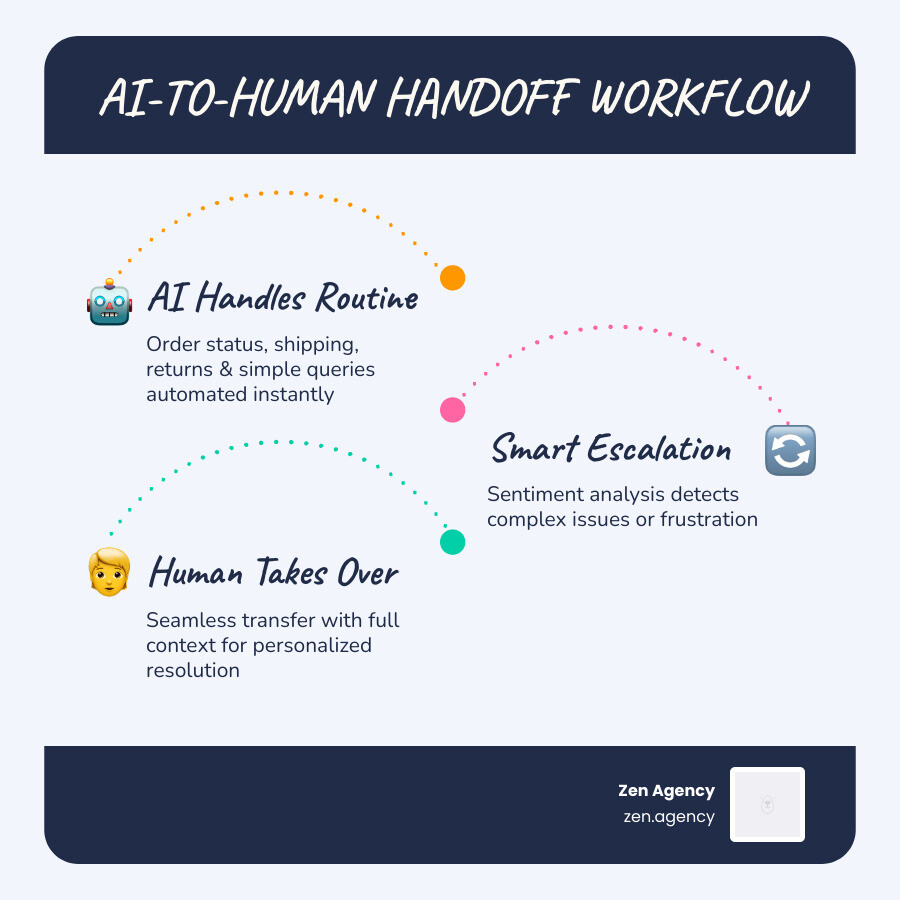
- Escalates complex issues to a human agent when needed — no dropped balls
The challenge most ecommerce brands face isn’t finding an AI tool. It’s knowing which one fits your store, how to set it up without breaking the customer experience, and how to keep the human touch where it matters most.
That’s exactly what this guide covers.
I’m Joseph Riviello, CEO and Founder of Zen Agency, with over 22 years of experience helping ecommerce brands scale through digital strategy — including deploying AI customer service ecommerce solutions that drive real revenue results. Let’s walk through how to put your support on autopilot without losing what makes your brand worth buying from.
Basic AI customer service ecommerce glossary:
What are AI Agents in Ecommerce Customer Service?
In the early days of online shopping, “automated support” meant a rigid chatbot that could only understand three keywords and usually ended up frustrating the customer. Today, we have moved into the era of the AI Agent.
Unlike those old-school bots, modern AI agents utilize Natural Language Processing (NLP) and Machine Learning to actually understand the intent behind a customer’s message. If a customer asks, “Where is my stuff?” or “My package hasn’t arrived yet,” the AI understands both mean the same thing.
These agents are designed to handle complex, transactional tasks autonomously. Instead of just giving a generic answer, an AI servicebot can verify a customer’s identity, look up their order in your database, provide real-time order updates, and even initiate returns management workflows.
Key characteristics of these agents include:
- 24/7 Availability: They never sleep, meaning a customer in Scranton or Wilkes-Barre can get an answer at 3:00 AM just as easily as at noon.
- Multilingual Support: Leading platforms now speak over 50 languages fluently, allowing you to scale globally without hiring a massive international team.
- Contextual Awareness: They remember previous interactions, providing a seamless experience rather than asking the customer to repeat their order number five times.
Why AI Customer Service Ecommerce Is Essential for Modern Brands
If you’re running a growing ecommerce brand in Pennsylvania or Montana, you know that support volume scales faster than revenue. Hiring more people isn’t always the answer—it’s expensive and slow. This is where AI customer service ecommerce becomes a competitive necessity.
The statistics speak for themselves. Brands implementing advanced AI agents have seen 91% accuracy on complex shipping tickets and a staggering 87% drop in response times. Imagine moving your average response time from 24 hours down to 12 minutes. That is the difference between a lost customer and a loyal fan.
Tools like the Gorgias Marketing Suite take this a step further by using proactive chat campaigns. These don’t just wait for a problem; they engage shoppers in real-time to reduce bounce rates by up to 37%.
Other major benefits include:
- Scalability: AI handles the “Where is my order?” (WISMO) surges during Black Friday or the holidays without you needing to hire seasonal staff.
- Cost Efficiency: By automating up to 70-80% of inquiries, the cost per ticket can drop significantly—in some cases from over $5.00 to under $2.00.
- CSAT Improvements: Customers are happier when they get instant, accurate answers. We’ve seen CSAT scores climb from 3.5 to 4.2 simply by removing the wait time.
Integrating AI Customer Service Ecommerce with Shopify and BigCommerce
For an AI agent to be effective, it can’t live in a vacuum. It needs to “talk” to your store. We prioritize integrations that connect directly via API or native apps to platforms like Shopify, BigCommerce, WooCommerce, and Magento.
When your AI is integrated with your tech stack (including Salesforce, HubSpot, and Zendesk), it gains access to:
- Real-time inventory data: To tell a customer if an item is back in stock.
- Customer Profiles: To see a shopper’s lifetime value and offer personalized discounts.
- Shipping Carriers: To provide exact GPS coordinates of a package.
Maximizing ROI with AI Customer Service Ecommerce Workflows
At Zen Agency, we focus on the bottom line. AI isn’t just a cost-saver; it’s a revenue generator. Some brands have reported a 30x ROI and 70% automation rates within just a few months of deployment.
By utilizing the Agentic Commerce Protocol, AI can now handle the entire customer journey. This leads to:
- Higher Conversion Rates: By answering pre-purchase questions instantly, the AI removes friction.
- Abandoned Cart Recovery: Proactive AI can reach out to a customer who left the checkout page, offering to answer questions or provide a small incentive to finish the purchase.
- Personalized Recommendations: Based on chat history, the AI can suggest products the customer actually wants, driving incremental revenue.
Top 10 AI Agents for Ecommerce Support Automation
Choosing the right tool is half the battle. Here are the top contenders in the market today that we often evaluate for our clients:
- Fin by Intercom: A highly sophisticated AI agent that works with any helpdesk to resolve complex queries across every channel.
- alby for Retail: A unified agent for sales and support that guides shoppers from discovery to post-order support.
- Crescendo.ai: Known for 99.8% response accuracy and native-level fluency in over 50 languages.
- Ada: An enterprise-level platform that excels at automating complex, multi-step workflows.
- Yuma AI: Specifically built for Shopify merchants to automate draft replies and handle shipping inquiries with high precision.
- Netomi: Uses deep learning to resolve tickets across email, chat, and social media.
- Tidio: Great for small to mid-sized businesses looking for a mix of live chat and AI Lyro capabilities.
- Manychat: The go-to for automating support and sales via Facebook Messenger and Instagram DM.
- Freshchat: Part of the Freshworks suite, offering robust AI-driven bot campaigns.
- HubSpot Chatflows: Ideal for brands already deeply embedded in the HubSpot CRM ecosystem.
| AI Agent | Automation Rate | Key Ecommerce Feature |
|---|---|---|
| Fin by Intercom | Up to 80% | Works with any existing helpdesk |
| alby | 85% CSAT | Predictive buttons for discovery |
| Crescendo.ai | 70%+ | 10x faster response times |
| Yuma AI | 70% | Deep Shopify integration |
| Ada | High Enterprise | Multi-step workflow automation |
Key Capabilities to Look for in an AI Support Agent
When we help a business in Pennsylvania or Montana select an AI partner, we look for more than just a “chat box.” You need a system that protects your brand.
- Brand Voice & Tone Customization: Your AI shouldn’t sound like a robot. Look for tools that allow you to set a “personality”—whether that’s professional, friendly, or even humorous.
- Safety Guardrails: To prevent “hallucinations” (where the AI makes things up), you need a platform that allows for strict guidance and policy enforcement.
- Multilingual Fluency: If you sell globally, the AI must handle nuances in different languages, not just provide a “Google Translate” version of your FAQ.
- Image Handling: Advanced agents can now interpret photos. If a customer sends a picture of a damaged item, the AI can recognize the issue and start a return.
- Human-in-the-loop: The system must know when it’s out of its depth and seamlessly hand the conversation to a human agent without the customer feeling abandoned.
- Security & Data Privacy: Ensure the provider uses high-level encryption and complies with frameworks like GDPR or CCPA to protect your customer’s sensitive info.
Preparing for the Era of Agentic Commerce
The world of shopping is changing. We are entering the “Agentic Commerce” era, where AI doesn’t just help you find a product—it buys it for you.
OpenAI recently introduced ChatGPT Instant Checkout, allowing 700 million weekly users to purchase products directly within the chat interface. Similarly, the Walmart-OpenAI partnership is paving the way for AI-first shopping experiences where discovery and purchase happen in a single conversation.
To prepare, ecommerce brands should:
- Optimize for Conversational SEO: AI agents pull information from your site to answer questions. Your content needs to be structured to be “readable” by these agents.
- Implement Structured Data: Use schema markup so AI can easily identify your prices, availability, and product features.
- Simplify Checkout: The more frictionless your checkout (like one-click options), the easier it is for an AI agent to complete a transaction on behalf of a customer.
Common Questions About Support Automation
How do AI agents handle returns and refunds?
AI agents are remarkably good at policy enforcement. When a customer asks for a return, the agent can look up the order date, check your 30-day return policy, and—if eligible—automatically generate a shipping label. If the request falls outside the rules, the agent can explain why or escalate it to a manager for a “one-time exception” review.
Is customer data safe with AI agents?
Reputable AI platforms prioritize security through data residency controls, end-to-end encryption, and strict access logs. When evaluating a tool, look for SOC2 compliance and clear documentation on how they handle PII (Personally Identifiable Information). At Zen Agency, we always ensure the tools we recommend meet the highest security standards.
How long does it take to set up an AI agent?
While old-school systems took months, modern AI customer service ecommerce solutions can be live in 5 to 30 days. Most of this time is spent “ingesting” your knowledge base and training the AI on your specific brand voice and policies. Once live, the agent continues to optimize itself based on training logs and human feedback.
Conclusion
Putting your ecommerce support on autopilot doesn’t mean removing the soul of your business. It means freeing your human team from the “Where is my order?” treadmill so they can focus on high-value interactions that require empathy and creativity.
At Zen Agency, we specialize in helping businesses in Pennsylvania, Montana, and across the USA navigate this transition. We don’t just “install a bot”—we build enterprise-grade AI strategies that increase visibility, profitability, and ROI. Whether you are struggling to scale or looking to stay ahead of the agentic commerce curve, we have the innovative strategies to get you there.
Ready to see how AI can revolutionize your store? Transform your store with AI Vision and let’s build something that scales.