The Complete Guide to ADA Legal Requirements
The Complete Guide to ADA Legal Requirements
What Are ADA Legal Requirements? A Plain-Language Overview
ADA legal requirements are the rules that protect people with disabilities from discrimination in employment, public spaces, government services, and digital platforms.
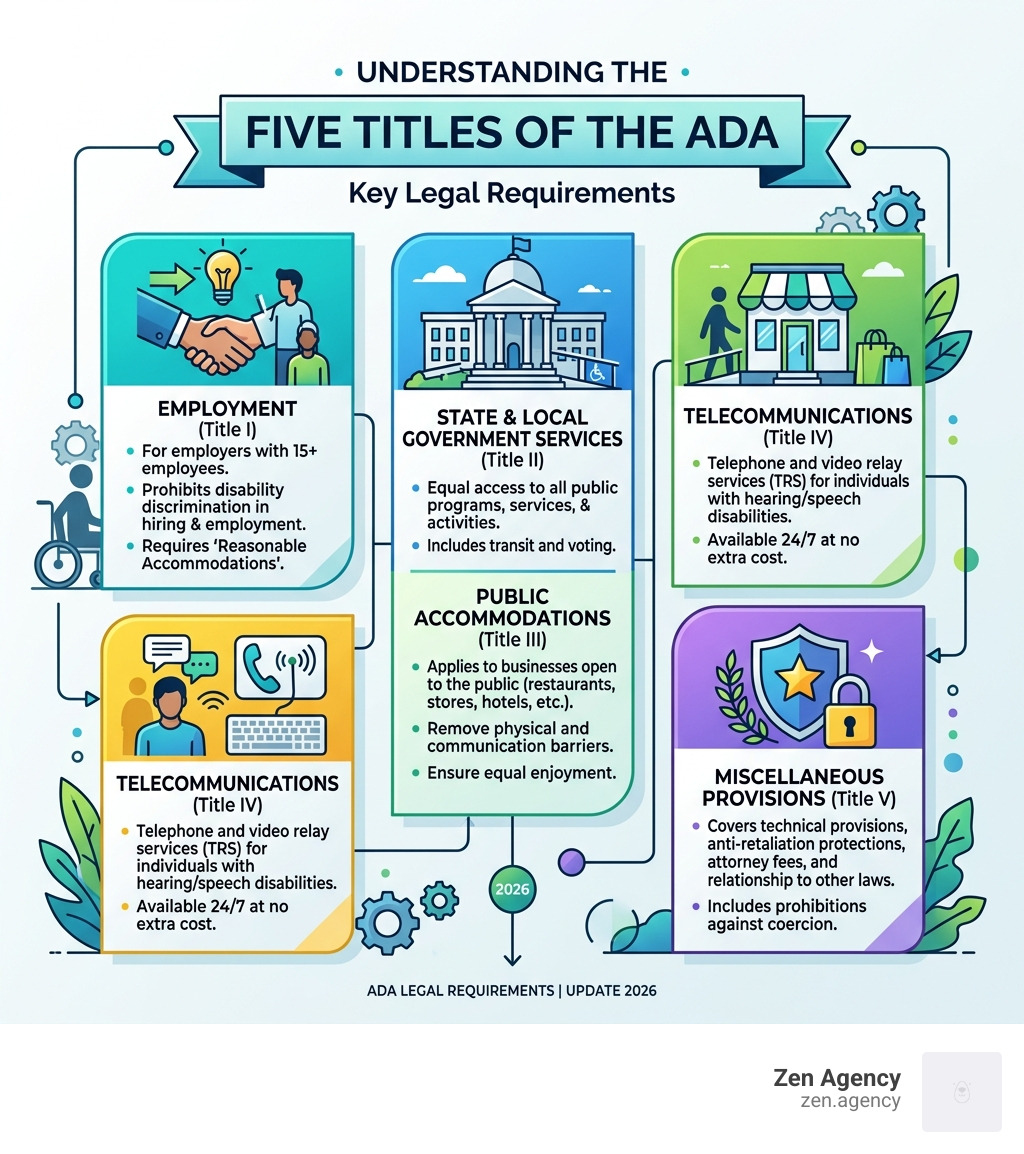
Here is a quick summary of what the ADA requires, by title:
| ADA Title | Who It Covers | Core Requirement |
|---|---|---|
| Title I | Employers with 15+ employees | No disability discrimination in hiring; provide reasonable accommodations |
| Title II | State and local governments | Equal access to all programs, services, and activities |
| Title III | Businesses open to the public | Remove barriers; ensure equal enjoyment of goods and services |
| Title IV | Telecommunications companies | Provide relay services for people with hearing/speech disabilities |
| Title V | All covered entities | Miscellaneous provisions; anti-retaliation protections |
The ADA was signed into law on July 26, 1990, and later strengthened by the ADA Amendments Act of 2008. It draws directly from the Civil Rights Act of 1964 — treating disability rights as civil rights, plain and simple.
The law has three layers you need to understand:
- The statute — defines who is protected and who has obligations
- Agency regulations — spell out the specific duties of employers, governments, and businesses
- Design standards — specify the technical details, like how many entrances must be accessible
Together, these three layers tell you exactly what you must do to comply.
I’m Joseph Riviello, CEO and Founder of Zen Agency, and over my 22+ years in digital strategy I’ve helped businesses navigate complex compliance challenges — including ADA legal requirements that touch everything from physical facilities to websites and mobile apps. Understanding these obligations is the first step toward protecting your business and serving every customer well.
ADA legal requirements terms made easy:
Understanding the Americans with Disabilities Act (ADA) and Its Core Components
To truly grasp ADA legal requirements, we have to look at the three-legged stool that supports the law: the statute, the regulations, and the design standards. The statute is the broad law passed by Congress. It identifies who counts as a person with a disability and sets the high-level non-discrimination rules.
Under the ADA, a disability is defined as a physical or mental impairment that substantially limits one or more “major life activities.” This is a broad definition—it covers everything from mobility and vision to major bodily functions like digestive or neurological systems. The 2008 Amendments made it clear that we should interpret “disability” broadly to favor coverage, including conditions that are episodic or in remission (like cancer) if they would limit a major life activity when active.
Regulations are the “how-to” guides written by federal agencies. They detail the rights of people with disabilities and the specific responsibilities of covered entities. Finally, the ADA Standards for Accessible Design are the technical blueprints. They don’t just say “make it accessible”; they say “your grab bar must be between 33 and 36 inches above the floor.”
Federal Agencies and Enforcement Roles
Several different “sheriffs” in town enforce these rules. Knowing who does what is key to staying compliant:
- Department of Justice (DOJ): The heavy hitter. They develop the regulations for state and local governments (Title II) and public accommodations (Title III). They are also the ones who investigate complaints and file lawsuits to enforce the law.
- Equal Employment Opportunity Commission (EEOC): They handle Title I, which focuses on employment. If someone feels they were denied a job or a promotion because of a disability, the EEOC is their first stop.
- Department of Transportation (DOT): They ensure that public transit systems—buses, trains, and paratransit—are accessible.
- Federal Communications Commission (FCC): They oversee Title IV, ensuring that telecommunications services are functional for people with hearing or speech disabilities.
For a deep dive into how these overlapping laws work, you can check out the official Guide to Disability Rights Laws.
ADA Legal Requirements for Employment and Public Entities
The ADA isn’t just for big corporations; it affects almost every corner of public life. Whether you are a local government office in Scranton or a retail store in Billings, there are specific ADA legal requirements you must meet.
Title I focuses on the workplace, ensuring that qualified individuals—people who can perform the “essential functions” of a job with or without help—aren’t left out. Title II applies to “public entities,” which means all state and local government activities. This covers everything from voting and town meetings to public parks and local courts. Title III covers “public accommodations,” which is a fancy legal term for private businesses that are open to the public, such as restaurants, hotels, and doctor’s offices.
Core ADA Legal Requirements for Employers
If you have 15 or more employees, Title I is your rulebook. The goal is to provide an equal playing field. This starts with reasonable accommodations. This might mean modifying a work schedule for an employee with cancer who needs chemotherapy, or providing a screen reader for a blind employee.
The only time you aren’t required to provide an accommodation is if it causes “undue hardship”—meaning it’s significantly difficult or expensive given the size and resources of your business. However, don’t assume something is an undue hardship just because it costs money; the bar is quite high.
You also need to be careful with medical inquiries. You generally can’t ask a job applicant if they have a disability before offering them a job. Once they are hired, any medical information you do have must be kept in a separate, confidential file. For more details on these rules, the EEOC provides a great Facts About the Americans with Disabilities Act sheet.
ADA Legal Requirements for Public Accommodations
Under Title III, businesses like retail stores and non-profits must ensure that people with disabilities can enjoy their goods and services just like everyone else. This involves three main tasks:
- Barrier Removal: If you have an existing building, you must remove architectural barriers (like a step at the entrance) if doing so is “readily achievable”—meaning it can be done without much difficulty or expense.
- Effective Communication: You must provide auxiliary aids, such as braille menus or sign language interpreters, unless it results in an undue burden.
- Service Animals: You must allow service animals (dogs and, in some cases, miniature horses) to go anywhere the public is allowed. You can only ask two questions: Is the dog a service animal? and What task is it trained to perform? You cannot ask for “papers” or a demonstration.
Physical Accessibility and the 2010 ADA Standards for Accessible Design
When it comes to the physical world, the 2010 ADA Standards for Accessible Design are the gold standard. These rules apply to new construction and alterations of existing facilities. If you are building from scratch in Wyoming, PA, or Hazleton, you must follow these to the letter.
Accessible Entrances and Routes
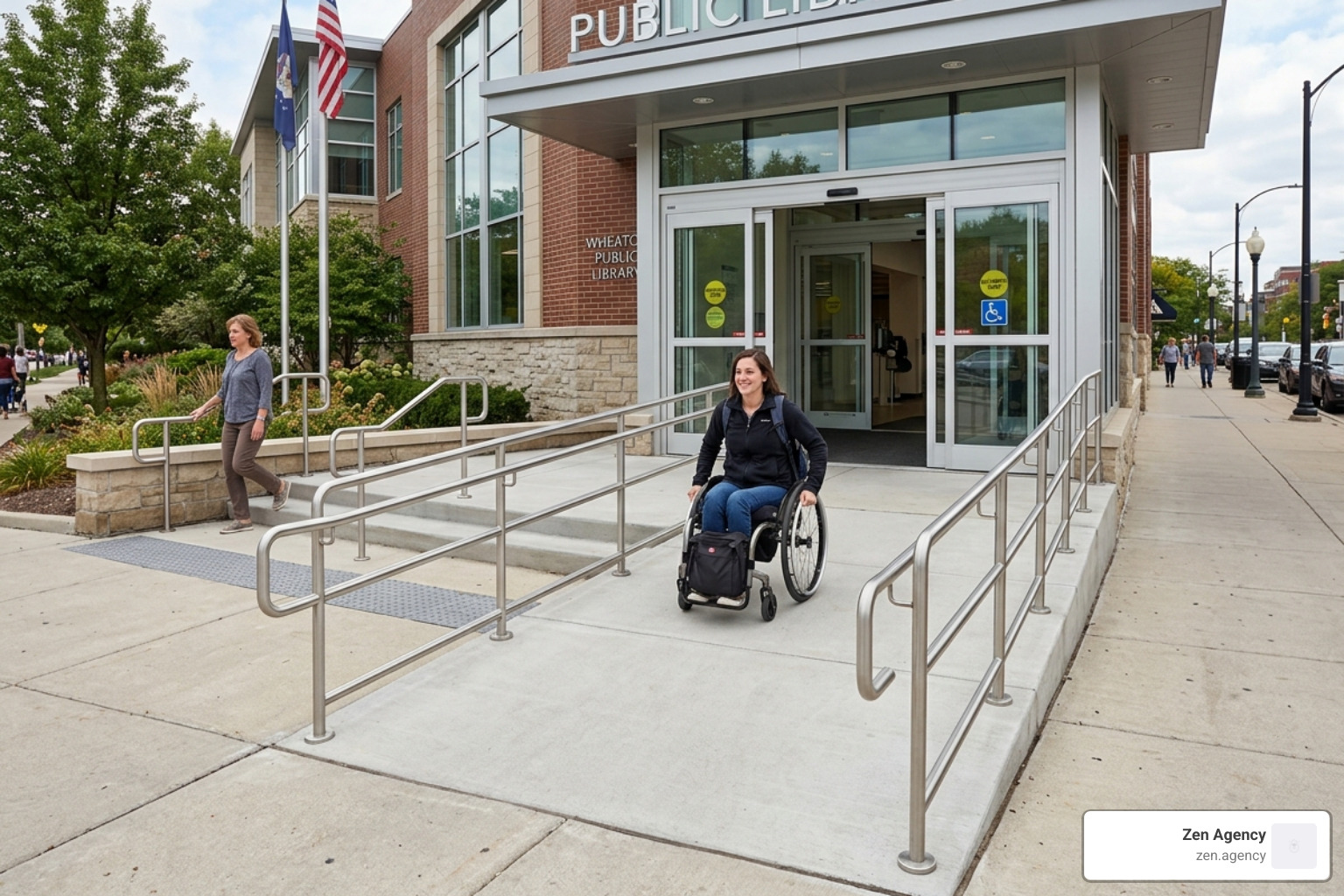
An “accessible route” is a continuous, unobstructed path connecting all accessible elements and spaces in a building. Think of it as the “highway” for wheelchairs and people with mobility aids.
- The 60% Rule: At least 60 percent of all public entrances in new construction must be accessible.
- Connectivity: These routes must connect accessible parking to the entrance, and connect different stories within a building (though there are some exceptions for small two-story buildings).
- Platform Lifts: These are permitted as part of an accessible route in certain situations, such as reaching a performing area in a theater or providing access to a courtroom witness stand.
Parking and Loading Zone Requirements
Parking is often the first thing people notice. If your parking lot isn’t compliant, you’re signaling that some customers aren’t welcome before they even get out of their cars.
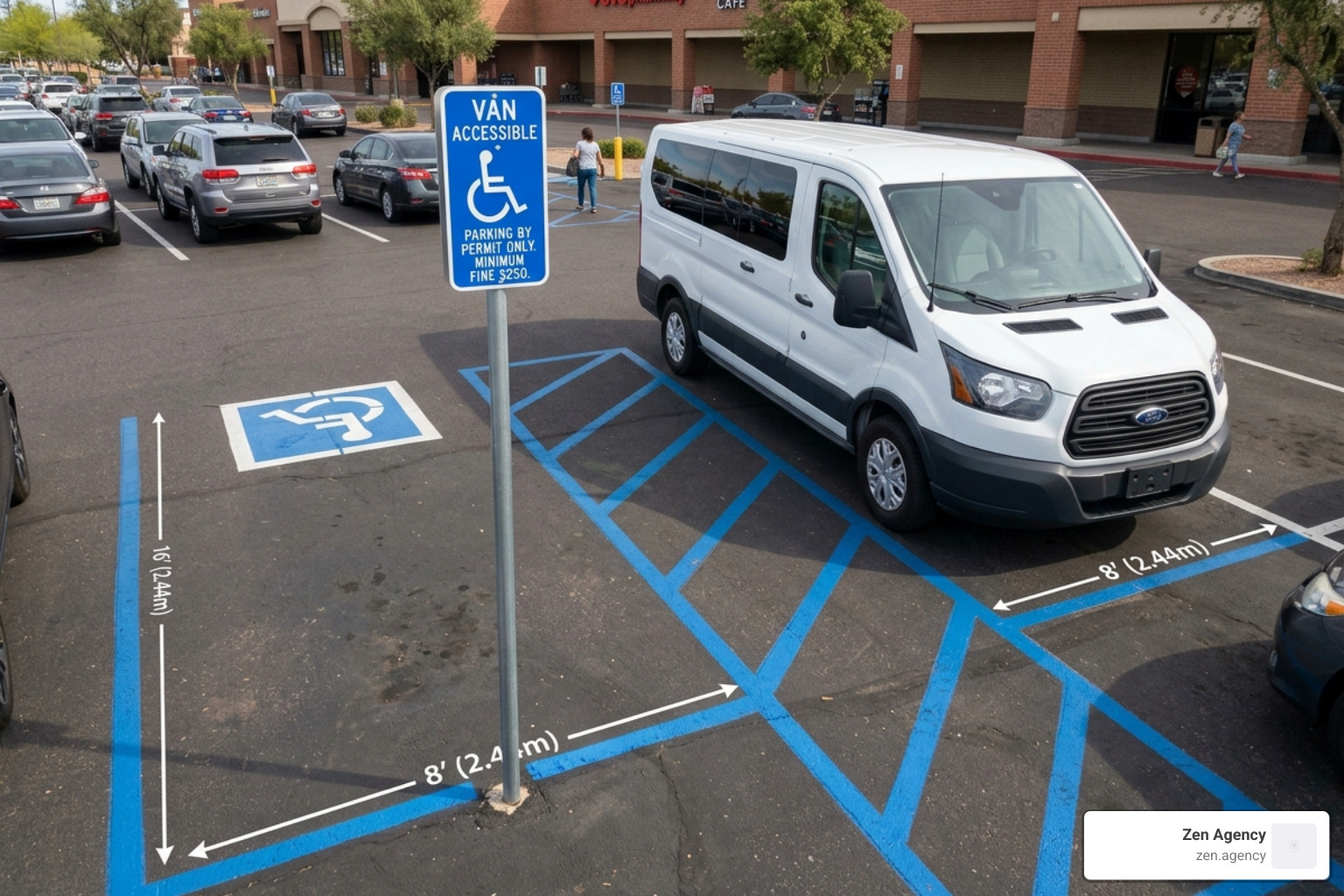
- The 2% Rule: For large lots (501 to 1000 spaces), 2 percent of the total must be accessible. For even larger lots (1001+), you need 20 spaces plus 1 for every 100 spaces over 1000.
- Van Accessibility: For every six accessible spaces, at least one must be a van-accessible space with a wider access aisle.
- Medical Facilities: Requirements are stricter here. Hospital outpatient facilities need 10% accessible parking, and rehabilitation facilities specializing in mobility need 20%.
Digital Accessibility: ADA Legal Requirements for Websites and Mobile Apps
In April 2026, we are living in a world where the “public square” has moved online. The DOJ has been very clear: the ADA applies to the digital world. If your website is inaccessible, it’s the digital equivalent of having steps at your front door with no ramp.
For state and local governments, a major Title II Web Rule was recently finalized (April 2024), setting strict timelines for making all web content and mobile apps accessible. While Title III (private businesses) doesn’t have a specific “checklist” in the statute yet, the DOJ consistently points to the Web Content Accessibility Guidelines (WCAG) as the standard to meet.
Barriers to Digital Access
What does an “inaccessible” website look like? It’s often hidden in the code.
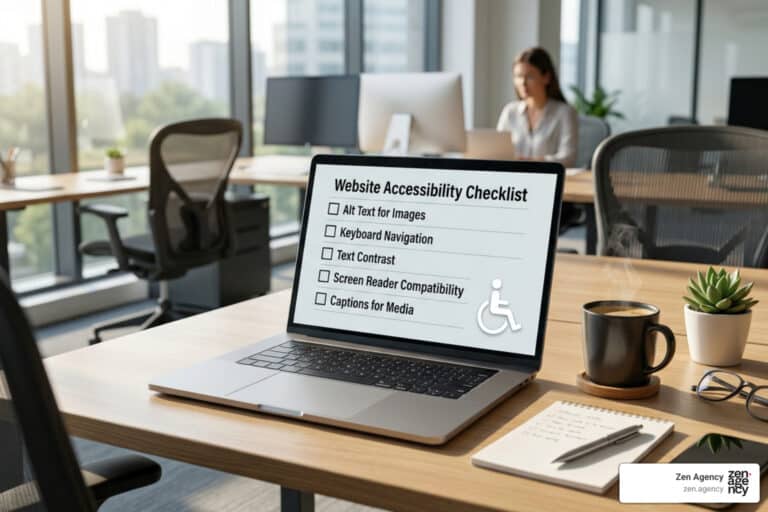
- Color Contrast: If your text is light gray on a white background, people with low vision can’t read it. We recommend a contrast ratio of at least 4.5:1.
- Alt Text: Screen readers describe images to blind users. If you don’t provide “alt text,” the user just hears “Image 123.jpg.”
- Keyboard Navigation: Many people can’t use a mouse. Your site must be fully navigable using only the “Tab” and “Enter” keys.
- Video Captions: Essential for the deaf and hard-of-hearing.
To help you remember the core of digital ADA legal requirements, we use the POUR principles:
- Perceivable: Users must be able to see or hear the content.
- Operable: Users must be able to navigate the interface (no “mouse-only” traps).
- Understandable: The information and operation must be clear.
- Robust: The site must work with a wide variety of browsers and assistive technologies.
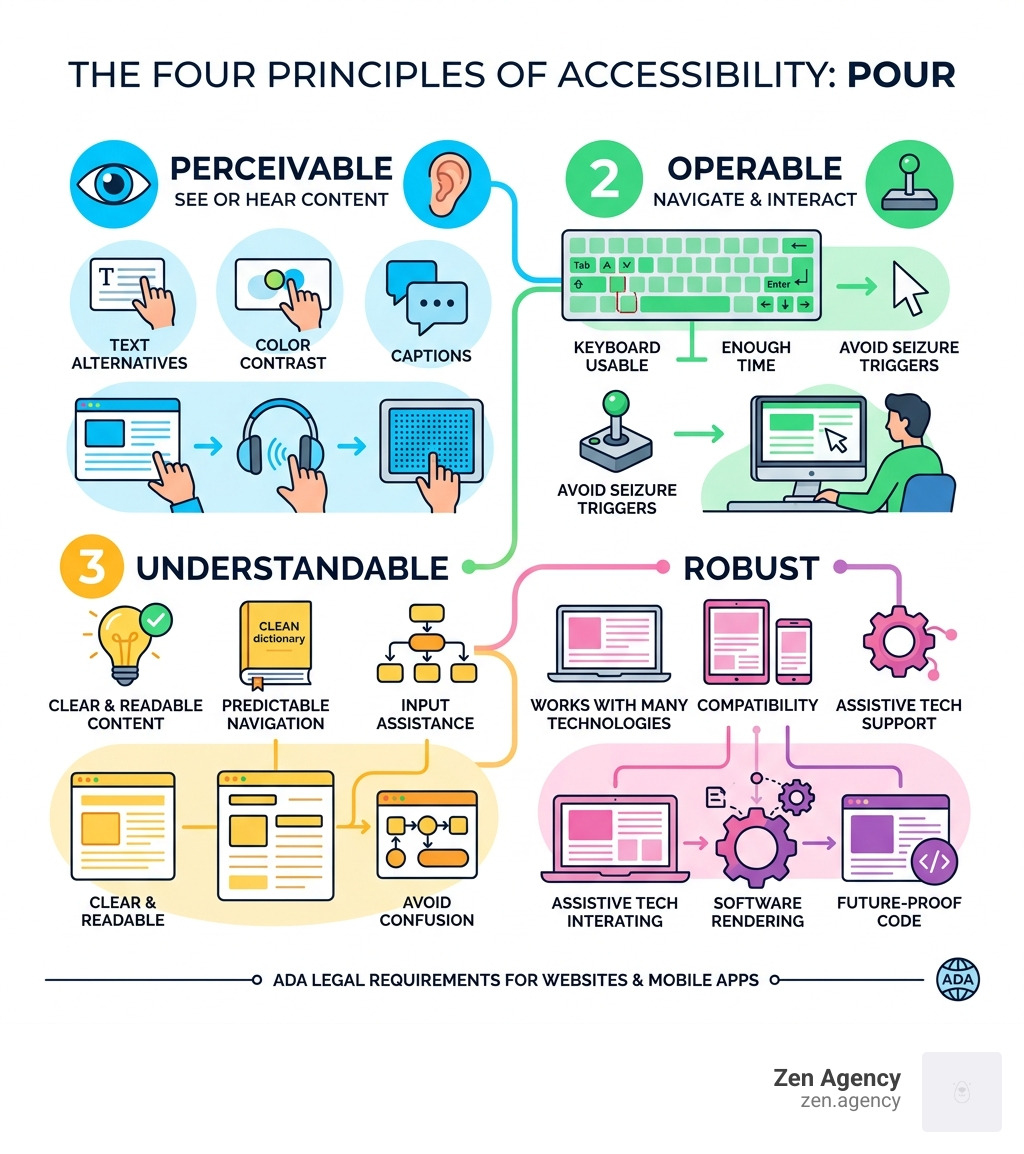
For more on the specifics of the DOJ’s stance, see the official Guidance on Web Accessibility and the ADA.
Compliance in Existing Facilities: Alterations and Barrier Removal
What if you aren’t building a new office, but just remodeling your current one in Wilkes-Barre? This is where the rules for “alterations” kick in. When you alter a “primary function area” (the place where the main activity happens, like a bank’s lobby or a dining room), you must also ensure the “path of travel” to that area is accessible.
The 20% Rule and Technical Infeasibility
The law recognizes that you shouldn’t have to spend your entire budget on a ramp. Alterations to the path of travel are deemed “disproportionate” if the cost exceeds 20% of the cost of the overall alteration.
There is also the concept of technical infeasibility. If it is literally impossible to meet the standards—perhaps because removing a load-bearing wall would cause the building to collapse—you must comply to the maximum extent feasible.
Specific Exemptions and Exceptions
The ADA is broad, but it isn’t universal. There are a few notable exceptions:
- Religious Organizations: Facilities controlled by religious entities (churches, synagogues, mosques) are generally exempt from Title III.
- Private Clubs: Truly private clubs that are not open to the public are also exempt.
- Employee-Only Areas: In certain spaces like a commercial kitchen or a “raised” lifeguard stand, full accessibility might not be required if it’s not a public area.
- Historic Properties: If following the ADA standards would “threaten or destroy” the historic significance of a building, alternative requirements may apply.
Frequently Asked Questions about ADA Legal Requirements
What is the 20% rule for ADA alterations?
When you renovate a “primary function area,” you must spend up to an additional 20% of the construction cost to improve the “path of travel” (the route, restrooms, and water fountains serving that area) to make it accessible. If the cost of the path of travel improvements exceeds 20%, you only have to spend up to that 20% limit.
How many accessible parking spaces are required for large lots?
For lots with 501 to 1000 spaces, 2% of the total must be accessible. If you have a lot with 1,200 spaces, you would need 20 spaces for the first 1000, plus 2 more (1 for each 100 over), for a total of 22 accessible spaces.
Does the ADA require all websites to be accessible in 2026?
Yes. While the specific technical standards for private businesses (Title III) are still being refined by the DOJ, the courts and the DOJ have consistently ruled that websites are public accommodations. State and local governments (Title II) are now under a strict federal mandate to ensure their web content and mobile apps meet WCAG 2.1 Level AA standards.
Conclusion
Navigating ADA legal requirements can feel like a daunting task, but it’s really about two things: civil rights and smart business. By removing barriers—whether they are physical steps or digital code—you are opening your doors to a massive segment of the population that is often overlooked.
At Zen Agency, we specialize in helping businesses across the USA—from our home base in Pennsylvania to our partners in Montana—achieve enterprise-grade compliance. Whether you need a full audit of your website’s accessibility or a long-term digital strategy that mitigates risk, we provide innovative solutions that increase your visibility and ROI.
Don’t wait for a complaint or a lawsuit to take action. Making your business accessible is a proactive step that pays dividends in customer loyalty and brand reputation. For more information on how we can help you stay ahead of the curve, check out our ADA compliance services. We’ve been helping businesses scale since 2008, and we’re ready to help you ensure your digital presence is welcoming to everyone.