Effective Social Media Campaigns: Lessons from Brands That Nailed It
Effective Social Media Campaigns: Lessons from Brands That Nailed It
What Makes Effective Social Media Campaigns Work in 2026
Effective social media campaigns don’t succeed by accident. The brands winning right now — from Chipotle to Dove to Spotify — follow clear, repeatable patterns that anyone can learn from.
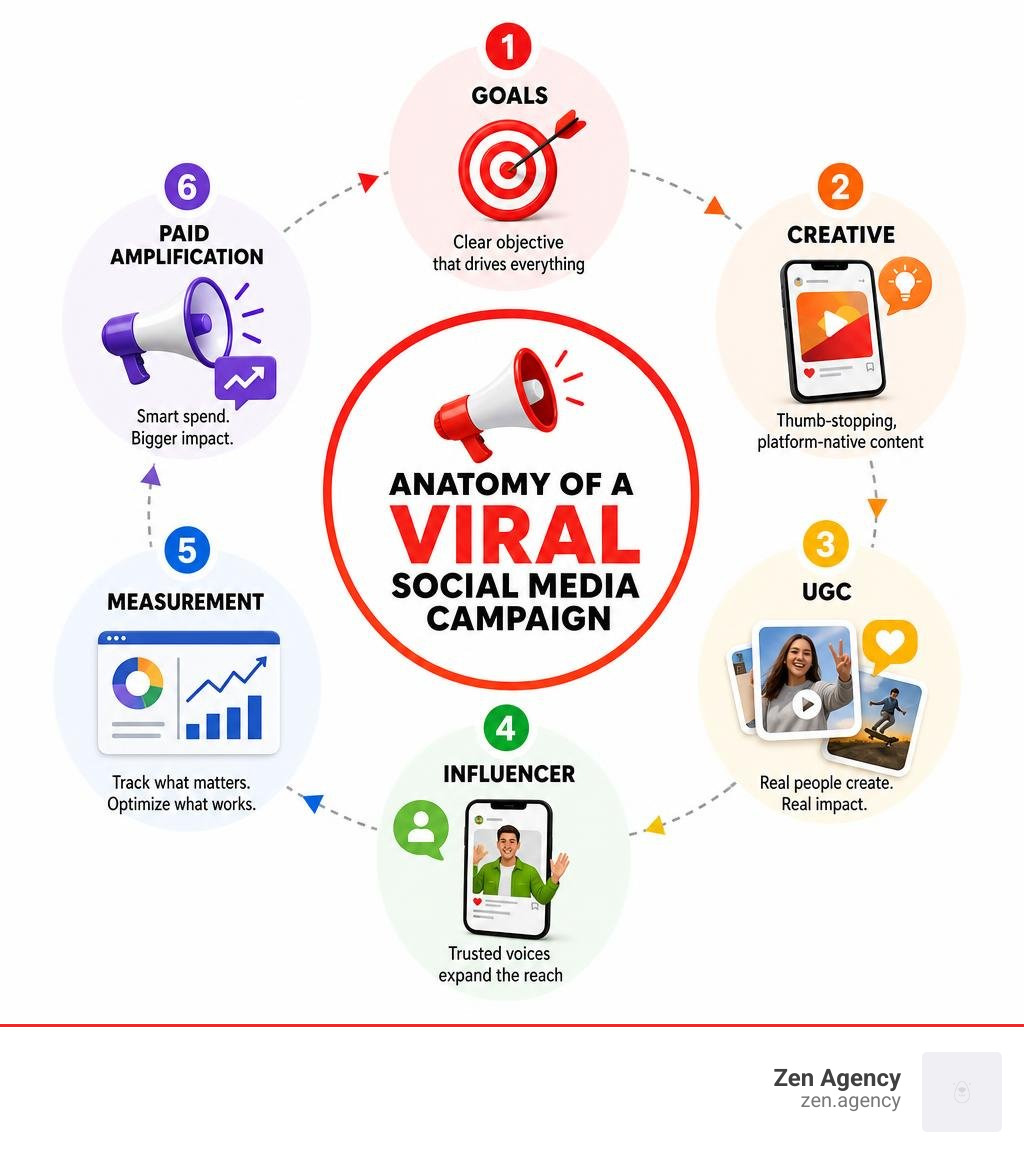
Here’s a quick snapshot of what separates campaigns that perform from ones that get ignored:
| Element | What It Looks Like in Practice |
|---|---|
| Clear goal | Brand awareness, digital sales, UGC volume, or lead gen — one primary objective |
| Audience-first creative | Platform-native content built for how people actually scroll |
| Participation hook | A hashtag, challenge, or cultural moment that invites people in |
| UGC or influencer layer | Authentic voices amplifying the message beyond paid reach |
| Built-in measurement | KPIs and tracking set up before launch, not after |
Brands that nail all five consistently outperform those that rely on a single great idea or a big paid budget.
Consider this: Chipotle’s #GuacDance challenge generated over 250,000 video submissions and drove record digital sales — not because they had the biggest budget, but because they gave their audience a reason to participate. That principle scales from fast-casual chains to Fortune 500 enterprises.
I’m Joseph Riviello, CEO and Founder of Zen Agency, and over 22 years of leading digital marketing strategy I’ve seen what separates effective social media campaigns that move the needle from those that just generate noise. In the sections below, I’ll break down the exact lessons — backed by real campaign data — that you can apply to your own brand.
Effective social media campaigns terms to remember:
1. The Core Pillars of Scalable Social Media Campaigns
To build a campaign that doesn’t just look pretty but actually scales, you need a structured foundation. Whether you are a mid-market business in Scranton, PA, or an enterprise brand operating across the USA, the mechanics of scaling remain identical.
Defining the Blueprint for Effective Social Media Campaigns
Every high-performing campaign begins with a blueprint. Without a clear target and platform strategy, you are essentially throwing budget at a wall and hoping it sticks.
- Establish Clear KPIs: Are you driving direct-response conversions, or are you building top-of-funnel brand equity? An effective campaign focuses on one primary metric (e.g., CPA, video completion rate, or UGC submission volume) while keeping secondary metrics as supporting indicators.
- Develop Accurate Target Personas: Modern targeting goes beyond basic demographics. In 2026, we target based on shared cultural behaviors, niche communities, and digital consumption habits.
- Strategic Platform Selection: Do not try to be everywhere at once. If your goal is B2B lead generation, focus on LinkedIn. If you want to drive Gen Z e-commerce sales, TikTok and Instagram are your primary canvases.
For a complete breakdown of platform dynamics, check out our social media marketing guide 2026.
Scaling Production with a Unified Social Media Toolkit
One of the biggest bottlenecks in-house teams face is the sheer velocity of content required to keep campaigns fresh. Enterprise-scale campaigns require massive, coordinated production. This is where a social media toolkit becomes your secret weapon.
A toolkit provides the creative infrastructure for consistent execution. It includes pre-approved design templates, asset libraries, platform-optimized copy variations, and clear guidelines on brand voice. This allows multi-market teams to deploy assets instantly without starting from scratch every time.
When planning your next campaign, we recommend following this structured, 10-step checklist to keep your production on track:
- Step 1: Goal Definition — Set concrete, measurable KPIs before touching a creative asset.
- Step 2: Audience Audit — Research active communities, vocabulary, and preferred platforms.
- Step 3: Competitor Analysis — Map what your competitors are doing to find white space.
- Step 4: Creative Concepting — Develop a single, strong creative hook that scales.
- Step 5: Content Architecture — Map out platform-specific formats (reels, carousels, static).
- Step 6: Asset Production — Shoot high-quality photography, video, and design assets.
- Step 7: Toolkit Assembly — Package templates, copy, and guidelines for your team.
- Step 8: Media Planning & Budgeting — Set up your paid ad structures and audience targeting.
- Step 9: Community Management Plan — Assign dedicated resources to monitor and respond to comments.
- Step 10: Launch & A/B Testing — Deploy, track early signals, and optimize mid-campaign.
By streamlining your production pipeline, you can drastically reduce creative fatigue and improve marketing roi to make your budget work harder.
2. Case Studies: Lessons from Brands That Nailed It
To truly understand how to build effective social media campaigns, we must look at the brands that have successfully captured cultural attention and translated it into business growth.
Spotify Wrapped: Leveraging Personalized Data Storytelling
Every December, Spotify turns its entire user base into an unpaid, highly enthusiastic sales force. The genius of Spotify Wrapped lies in its focus on personalized data storytelling.
Instead of advertising its own product features, Spotify packages user listening data into beautiful, highly shareable, and personalized graphics. This taps into the psychological desire for self-expression and builds massive FOMO (fear of missing out) for non-users. By turning raw data into an annual cultural event, Spotify drives explosive organic reach and app downloads without relying solely on traditional paid media.
Discover more ways brands leverage interactive sharing in these 25 Social Media Campaign Examples to Inspire You in 2026.
Dove #Faceof10 and Reddit r/eal Reviews: Radical Transparency
Dove has long been a pioneer in purpose-driven marketing, but its recent campaigns show how the brand has mastered platform-native execution.
With the #Faceof10 campaign, Dove tackled the disturbing trend of young girls buying anti-aging skincare products. By highlighting the pressure on children and pairing it with actionable resources, Dove generated over 1.5 million organic views and achieved a staggering 99% positive sentiment across online conversations.
But perhaps their boldest move was the r/eal Reviews campaign. Recognizing that 71% of consumers use Reddit to research brands before buying, Dove partnered with Redditors to promote its Intensive Repair 10-in-1 Serum Hair Mask. Instead of using polished, corporate ad copy, Dove published the first 50 unedited, raw Reddit reviews directly on physical billboards and social feeds.
Even when one reviewer candidly remarked that the mask “kinda smells like expired hotel shampoo,” Dove kept it in. This radical transparency built instant trust, resulting in over 1 billion impressions and driving high single-digit growth for Unilever’s hair care category in early 2026.
Read the full story of how Dove turned Reddit’s honesty into unmissable marketing.
Chipotle #GuacDance: Driving Record Sales with Interactive Challenges
When Chipotle wanted to drive digital sales on National Avocado Day, they didn’t just run a standard discount ad. They launched the #GuacDance challenge on TikTok, featuring a viral song about guac.
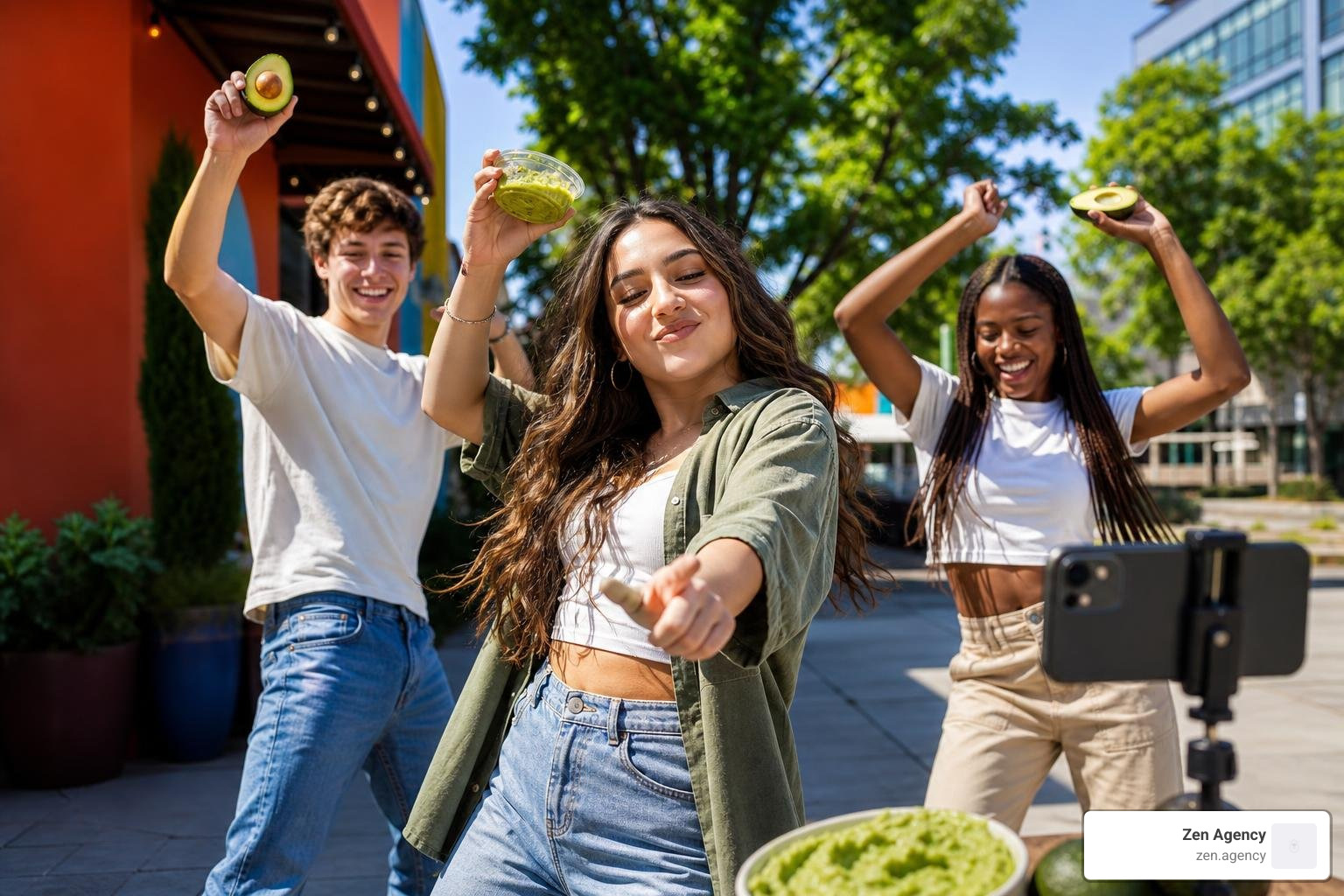
The campaign encouraged users to film themselves dancing to the song. The results were staggering:
- Over 250,000 video submissions
- More than 430 million video starts in under a week
- Record-breaking digital sales on National Avocado Day
Chipotle succeeded because they understood that TikTok is a participatory platform. They didn’t talk at their audience; they invited them to join the dance.
KFC Arabia and Heineken: Turning Crises and Cultural Insights into Viral Drama
What do you do when a popular menu item goes out of stock? If you are KFC Arabia, you turn it into a serialized, AI-powered social drama.
When their fan-favorite cheddar sauce went missing from menus, the brand launched a three-episode AI-generated drama series where menu items—like fries, pickles, and chicken strips—became characters investigating the disappearance of “Chedrawi” (the missing cheese). Fans went wild, debating storylines, creating memes, and staging mock boycotts. The campaign generated over 4 million views and 130,000 shares across Meta and TikTok with absolutely zero paid seeding.
Learn more about how KFC Arabia turned a cheddar sauce crisis into a viral AI drama.
Similarly, Heineken tapped into a deep cultural insight with The Boring Phone campaign. Recognizing that 90% of young adults admit to “doomscrolling” on nights out with friends, Heineken launched a limited-edition, low-tech “boring phone” that could only send texts and make calls. Launched at Milan Design Week, the campaign generated 9.5 billion impressions and over 2,200 press mentions by offering a physical solution to a digital problem.
Project Hail Mary: The Hybrid Entertainment Playbook
When Amazon MGM launched the sci-fi blockbuster Project Hail Mary, they bypassed the standard Hollywood press junket in favor of a highly collaborative, social-first playbook.
Lead actor Ryan Gosling actively participated in creating viral, native social content. He threw a football through the iconic Randy’s Donuts sign in LA to tease the trailer, and appeared in crossovers like “fixing” the La La Land poster for its 10th anniversary (which pulled over 1.1 million likes).
Additionally, the campaign leveraged niche creator partnerships. They paired with science communicator Cleo Abram to explain the real physics of the film, and had Adam Savage walk through practical sets. By treating social media as a creative playground rather than a billboard, the film secured a massive $140.9 million global opening weekend and maintained an incredibly low 32% box office drop in week two.
Get the full breakdown in Project Hail Mary: The Complete Marketing & Media Playbook.
3. Balancing Influencer Content, UGC, and Paid Social
The most effective social media campaigns do not rely on a single content source. Instead, they find the perfect balance between three distinct pillars: influencer partnerships, user-generated content (UGC), and paid amplification.
The Triad of Modern Social: Influencers, UGC, and Paid Amplification
To build trust and drive conversions simultaneously, you must understand how these content types interact.
| Content Type | Primary Benefit | Level of Control | Best Use Case |
|---|---|---|---|
| Influencer Content | High reach, professional quality, peak cultural relevance | Medium (guided by creative briefs) | Creating initial campaign buzz, product education |
| User-Generated Content (UGC) | Maximum authenticity, high trust, lower production costs | Low (organic and community-driven) | Social proof, driving conversions, community building |
| Paid Social Ads | Highly targeted distribution, predictable scale, direct-response | High (complete platform control) | Retargeting, scaling winning organic creative |
Campaigns that incorporate UGC see a 50% increase in engagement compared to brand-only content. The key to scaling this model is to use influencer content to spark a trend, curate the resulting organic UGC, and then use paid social to amplify the highest-performing pieces to a wider, targeted audience.
Case Studies in Multi-Channel Integration: Levi’s, Adidas, and CeraVe
Several global giants have mastered this integrated approach:
- CeraVe: For their Michael Cera Super Bowl campaign, they built a month-long, multi-channel narrative suggesting the actor secretly founded the brand. They combined influencer podcast appearances, unpolished UGC “conspiracy” videos, and heavy paid social spend. The campaign generated over 32 billion earned impressions and achieved 2.4 times the engagement of all other health and beauty brands combined during the big game.
- Levi’s: For their festival season and back-to-school campaigns, Levi’s deployed a hybrid model. They executed high-production influencer shoots in the Topanga hills to create polished assets, while simultaneously running a campus-based influencer program that generated raw, authentic UGC.
- Adidas: To celebrate Lionel Messi, Adidas created a global social media toolkit. This toolkit allowed local markets to instantly deploy localized, platform-native creative (such as Snapchat interactive features) that aligned perfectly with their global paid social strategy.
By aligning these elements, brands can build a cohesive, full funnel digital marketing campaign that captures attention and drives conversions simultaneously.
Why La Roche-Posay Made TikTok’s Comment Section the Creative Canvas
Sometimes, the best place to run a campaign isn’t on your main feed—it’s in the comment section.
La Roche-Posay proved this with their “No Regerets” campaign in the Nordics (one of the most heavily tattooed regions in the world). To address tattoo care and regret, they invited creators to share their own funny or regretted tattoos.
Instead of asking users to create separate videos, they encouraged them to post photos of their own tattoo regrets directly in the TikTok comment section using the platform’s native photo-reply feature. By turning the comment section into a living, participatory archive of user experiences, La Roche-Posay generated 39% of its total annual Nordic engagement in just six weeks.
Discover how they executed this by reading why La Roche-Posay made TikTok’s comment section the creative canvas.
Designing Effective Social Media Campaigns Through A/B Testing
No matter how brilliant your initial creative concept is, you must let data make the final decisions.
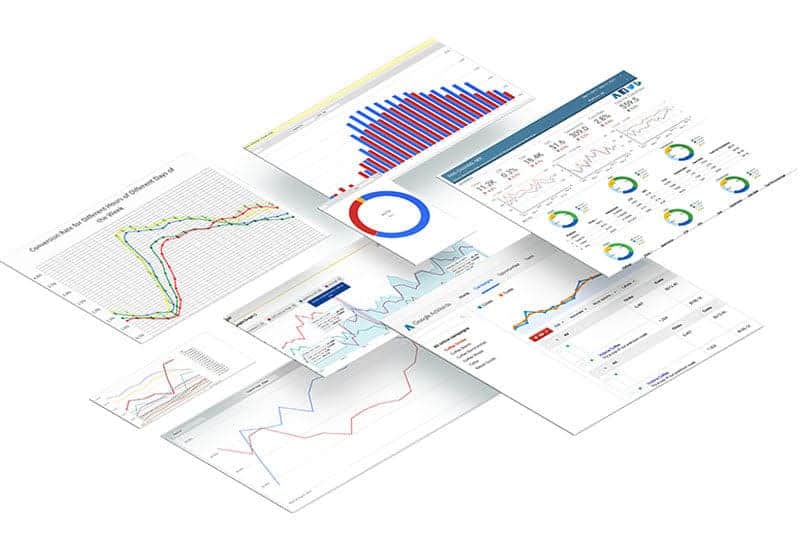
When running paid social, we always recommend deploying multiple creative variants. Test different hooks in the first three seconds of your videos, compare static imagery against short-form video, and experiment with different calls to action (CTAs). By monitoring metrics like click-through rate (CTR), cost per acquisition (CPA), and conversion rate, you can systematically scale the winning assets while pausing the underperformers.
4. How to Plan, Track, and Optimize Your Social Strategy
The secret to long-term social media success is simple: listen before you speak, and measure after you launch.
Implementing Social Listening for Campaign Planning
Most brands plan campaigns based on internal assumptions or outdated quarterly research. The most effective social media campaigns, however, are built on real-time social listening.
By utilizing advanced social listening tools, you can conduct a pre-brief audience audit to identify exactly what your target market is talking about, the vocabulary they use, and the cultural narratives they care about. This allows you to map the “narrative climate” before you launch, ensuring your campaign enters an existing conversation rather than trying to force a new one.
During the campaign, social listening allows you to track sentiment ratio and detect early signals of messaging misinterpretation in the first 24 to 48 hours, giving you the power to pivot your creative in real time.
For a complete blueprint on integrating these insights, see our Social Listening for Campaign Planning: A 2026 Step-by-Step Guide.
Frequently Asked Questions about Effective Social Media Campaigns
What defines a successful social media campaign for enterprise brands versus smaller businesses?
For enterprise brands, success is defined by scale, multi-market consistency, and brand equity. They require highly coordinated production pipelines, global creative toolkits, and sophisticated social listening setups to protect brand sentiment across millions of touchpoints.
For smaller, regional businesses—such as those we partner with in Scranton, PA, or Billings, MT—success is highly focused on local relevance, community engagement, and direct ROI. Smaller brands can move faster, leverage highly localized cultural moments, and build intimate customer relationships that enterprise giants simply cannot replicate.
What role does user-generated content play compared to influencer-created content?
UGC is the ultimate driver of authenticity and trust. Because it is created by real customers, it carries immense social proof and consistently achieves higher engagement rates at a lower cost.
Influencer content, on the other hand, gives you greater creative control. It allows you to align your brand with established creators who have highly engaged, niche audiences, making it ideal for product launches, education, and top-of-funnel reach.
How do top brands measure and optimize campaign performance in 2026?
Top brands look far beyond surface-level vanity metrics like likes or impressions. They measure success using:
- Net Sentiment Change: Did the campaign positively shift how people talk about the brand?
- Organic Amplification: How much did the audience voluntarily share and engage with the campaign assets?
- Conversion and ROI Metrics: Did the social activity drive direct digital sales, lead generation, or in-store foot traffic?
By combining attribution dashboards with real-time social listening, brands can continuously optimize their creative and media spend mid-campaign.
Conclusion
Building effective social media campaigns requires a delicate balance of bold creative, structured production, and data-driven optimization. Whether you are looking to launch a viral interactive challenge or scale your paid social ROI, you don’t have to navigate this rapidly changing landscape alone.
At Zen Agency, we specialize in helping brands transition from struggling-to-scale to highly profitable market leaders. From custom website development to enterprise-grade digital marketing strategies, we build the infrastructure that drives real business growth.
If you are ready to elevate your social media performance, let’s talk. Learn how to choose the right social media marketing service provider for your goals or explore our full suite of digital marketing services today.