
Full Funnel Digital Marketing Is the Only Way to Fly
Why Full Funnel Digital Marketing Is the Only Strategy That Actually Scales
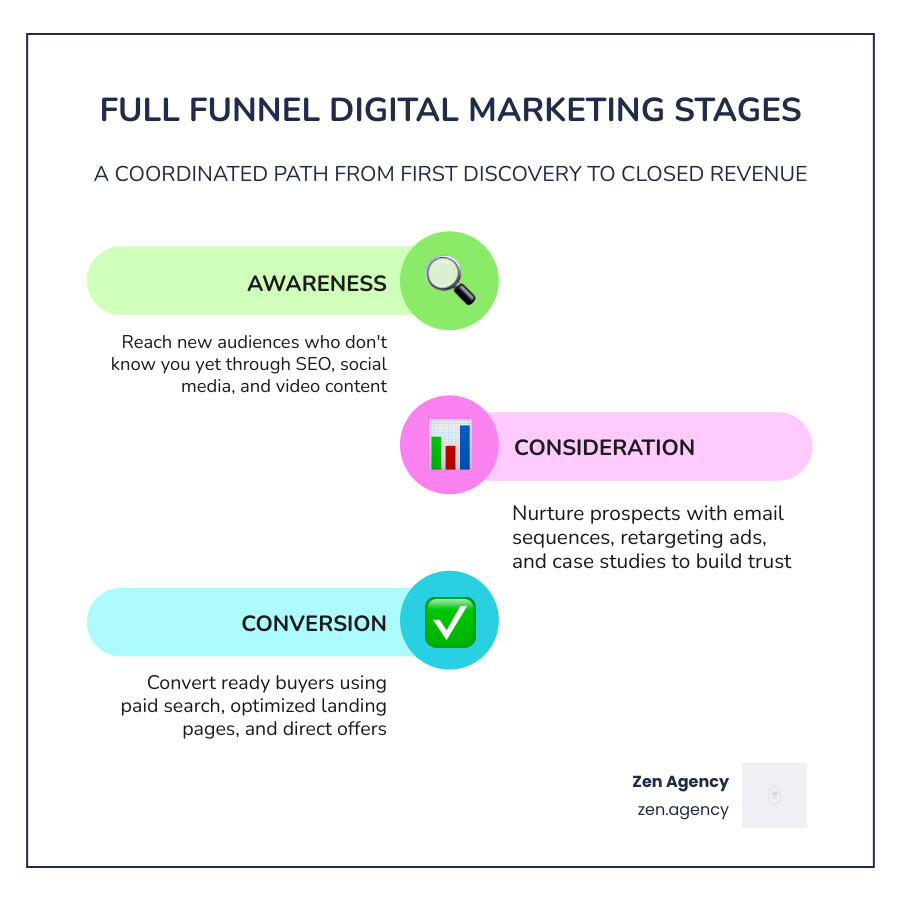
Full funnel digital marketing is a coordinated approach that guides potential customers from first discovering your brand all the way through to purchase — and beyond. Instead of focusing only on one stage (like running ads to close sales), it connects every touchpoint in the buyer’s journey.
Here’s what a full funnel strategy covers:
- Awareness (Top of Funnel) — Reach people who don’t know you yet via SEO, social media, and video content
- Consideration (Middle of Funnel) — Nurture interested prospects with email sequences, retargeting, and case studies
- Conversion (Bottom of Funnel) — Turn ready buyers into customers with paid search, strong offers, and optimized landing pages
- Retention — Keep customers coming back with post-purchase sequences and loyalty programs
Most businesses pour budget into bottom-of-funnel tactics — ads, promotions, hard sells. And they wonder why growth stalls.
The problem isn’t effort. It’s architecture.
Today’s buyers don’t move in a straight line. They discover a brand on social media, Google it three days later, read a review, abandon their cart, see a retargeting ad, and then buy. Research shows that brands using a full funnel approach see 32% higher conversion rates and 25% greater ROI compared to single-channel campaigns. Yet 68% of B2B companies still have no formal funnel measurement in place.
That gap — between how people actually buy and how most companies actually market — is where growth gets lost.
I’m Joseph Riviello, CEO and Founder of Zen Agency, and over my 22+ years building full funnel digital marketing strategies for companies across industries, I’ve seen how connecting every stage of the funnel — from brand awareness to closed revenue — is the single biggest lever for scalable growth. Let’s walk through exactly how to build it.
What is Full Funnel Digital Marketing?
At its core, full funnel digital marketing is a holistic strategy that bridges the gap between traditional brand building and high-pressure performance marketing. For too long, marketing departments have had a “split personality.” One team focuses on making the brand look good (awareness), while another team obsesses over clicks and sales (performance).
The reality? These two worlds must collide to drive sustainable revenue growth. According to research from McKinsey, a thoughtful and data-driven full funnel approach can lead to a 15 to 20 percent lift in marketing ROI.
When we talk about a “full funnel,” we are moving away from the idea of isolated campaigns. Instead, we are building a permanent infrastructure. This architecture ensures that no matter where a customer enters the journey—whether they search for a specific solution or stumble upon a helpful video—there is a logical next step waiting for them. By integrating all your efforts into one compounding system, you stop treating channels as alternatives and start treating them as complements. For a deeper dive into how these channels interact, check out The Only Digital Channel Marketing Guide You Will Ever Need.
The Three Pillars of a Full Funnel Strategy
To make full funnel digital marketing work, you have to align your messaging with customer intent. You wouldn’t ask someone to marry you on the first date, right? (If you would, we need to have a different talk). Similarly, you shouldn’t ask a stranger to “Buy Now” before they even know what problem you solve.
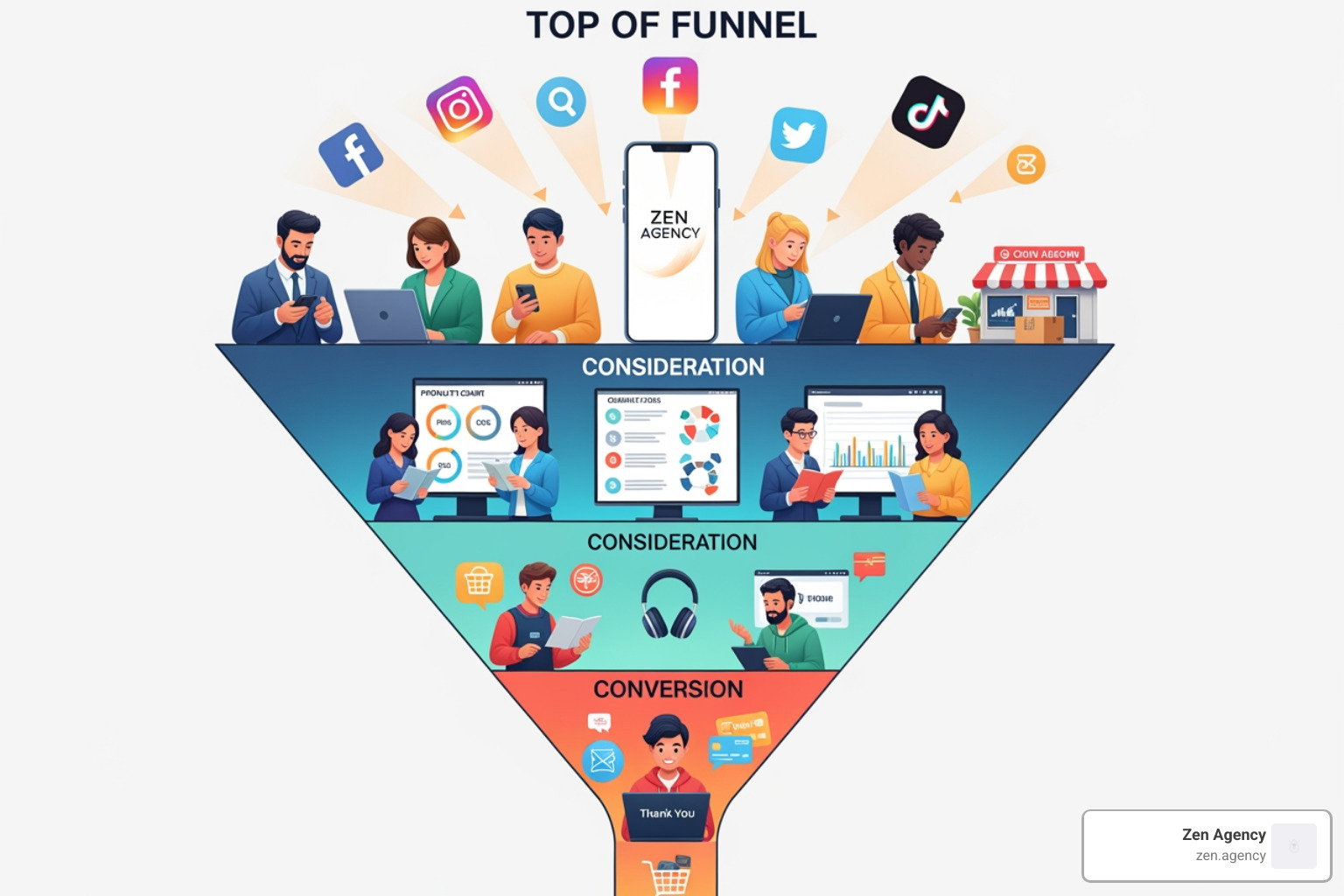
A successful strategy relies on multi-channel coordination across three primary stages. This coordination is the secret to how to improve marketing ROI and make your budget work harder.
Top-of-Funnel (TOFU): Building Awareness in Full Funnel Digital Marketing
The goal here is brand discovery. In May 2026, the digital landscape is more crowded than ever. AI-driven search summaries now handle about 50% of Google queries, meaning your content has to be more authoritative and visible than ever to cut through the noise.
- SEO: This is your long-term engine. By targeting informational keywords, you capture people looking for answers. Learn more about the basics in SEO 101: From Zero to Search Hero.
- Social Media: Use organic social to stay top-of-mind. Consistency is key here; it’s about building a narrative, not just posting for the sake of it.
- Video Content: Video is a powerhouse for awareness. Statistics show that one-third of all online activity is spent watching video, and prospects are many times more likely to engage with a video ad than a static banner.
Mastering this stage is the difference from obscurity to opportunity: mastering online presence and organic traffic.
Middle-of-Funnel (MOFU): Nurturing Consideration
Once they know you, you need to build trust. This is where most funnels break. In fact, 53% of companies experience a “broken handoff” where prospects who engage with marketing content are never followed up by sales.
- Lead Magnets: Offer high-value resources like white papers, webinars, or e-books in exchange for an email address.
- Email Sequences: Once you have the email, don’t just spam them. Use a welcome series that answers their top questions and positions you as the expert.
- Retargeting: If someone visits your site but doesn’t convert, use retargeting ads to show them case studies or testimonials. Segment these ads by intent—someone who looked at your pricing page needs different messaging than someone who just read a blog post.
For those in the B2B space, this stage is critical. See our Ultimate Guide to B2B SaaS Lead Gen Success and our tips on B2B Lead Generation and Appointment Setting for more.
Bottom-of-Funnel (BOFU): Driving Conversion in Full Funnel Digital Marketing
This is the “closing” stage. Your prospects are ready to make a decision, and you need to give them the final nudge.
- PPC: Paid search is excellent for BOFU because it targets high-intent keywords (e.g., “best full funnel agency in USA”). Check out The B2B PPC Playbook: How to Win at Paid Search to see how we manage these high-stakes campaigns.
- CRO (Conversion Rate Optimization): Small changes to your landing pages—like adding social proof near the CTA or improving page load speed—can have a massive impact. A one-second delay in page load can reduce conversions by 7%.
- Direct Offers: Free trials, demos, or limited-time discounts work best here.
To maximize these results, you need a comprehensive approach. Explore The Ultimate Guide to Improving Your Conversion Rate for actionable tactics.
Building Your Full-Funnel Architecture
Building a full funnel digital marketing strategy isn’t a one-time event; it’s about creating a system that compounds over time. We start by working backward from your revenue goals to determine the right channel mix.
| Funnel Stage | Primary Goal | Key Tactics | Success Metrics |
|---|---|---|---|
| TOFU | Awareness | SEO, Video, Social Ads | Reach, Branded Search Lift |
| MOFU | Consideration | Email, Case Studies, Retargeting | MQLs, Engagement Depth |
| BOFU | Conversion | PPC, CRO, Direct Sales | Sales, CAC, ROI |
| Retention | Loyalty | CRM, Loyalty Programs | LTV, NPS, Retention Rate |
This architecture requires deep audience research and the creation of detailed buyer personas. You need to understand the “why” behind the buy. Once you have the personas, you can optimize the user experience (UX) to ensure there is no friction. For a roadmap on this, see our Step-by-Step Guide to Website Conversion Optimization and Your Blueprint for B2B Website Success.
Budget Allocation and Resource Management
A common question we get is, “How much should I spend on each stage?” While every business is different, a solid starting point for a balanced full funnel digital marketing strategy is the 40/30/30 split:
- 40% Awareness: Investing in the “top” ensures you always have new blood entering the system.
- 30% Consideration: This funds the “middle” where trust is built and leads are nurtured.
- 30% Conversion: This is your “bottom” spend, focused on closing the deal.
As your brand matures, these percentages may shift. For example, a mature brand might move toward a 70% organic / 30% paid ratio over 60 months as their SEO compounds. When planning your budget, it’s also important to understand the costs involved in the underlying assets, such as The Ultimate Guide to Custom Website Design Pricing Without the Sticker Shock.
Measuring Success and Avoiding Common Pitfalls
If you can’t measure it, you can’t manage it. In full funnel digital marketing, last-click attribution is a relic of the past. It significantly undervalues the top and middle of the funnel. If someone sees five of your videos and then clicks a search ad to buy, the search ad shouldn’t get 100% of the credit.
We look at several key metrics:
- Customer Acquisition Cost (CAC): What does it cost to get a new customer across the entire funnel?
- Lifetime Value (LTV): How much is that customer worth over time? A healthy baseline is a 3:1 LTV to CAC ratio.
- Funnel Velocity: How fast are people moving from awareness to conversion?
Effective measurement is about beyond the click: a guide to comprehensive PPC management and using CRO secrets to stop losing leads.
Common Mistakes to Avoid
Even the best intentions can go awry. Here are the five mistakes that kill a full funnel strategy:
- BOFU-Only Focus: Obsessing over immediate sales while ignoring brand building. This leads to customer saturation and rising costs.
- Broken Handoffs: Marketing generates leads, but Sales doesn’t follow up, or the messaging changes abruptly.
- Siloed Teams: When your SEO team doesn’t talk to your PPC team, you lose the compounding effect of integrated data.
- Measurement Voids: 68% of B2B companies have no formal funnel measurement. Don’t be one of them.
- Sending Cold Traffic to Hard-Sells: This is the fastest way to waste your ad budget.
For more on dominating your market through better conversion, see Convert More Leads: B2B CRO for Digital Dominance.
Frequently Asked Questions about Full Funnel Marketing
How long does it take to see results from a full funnel strategy?
While paid media can produce data and leads almost instantly, a foundational full funnel digital marketing architecture typically takes 60-90 days to build and stabilize. You’ll usually see initial improvements within 3-6 months. SEO and organic content take longer (6-12 months) to compound, but they eventually provide the lowest cost-per-lead. For professional help in speeding up this process, you might look into Marketing, Advertising, & Media Production Services.
What is the ideal budget split for a new full funnel campaign?
As mentioned, a 40/35/25 (Awareness/Consideration/Conversion) split is a great starting point for new campaigns. This ensures you are building a pipeline while still chasing immediate revenue. We recommend reviewing and optimizing this split quarterly based on performance data.
How does full funnel marketing differ for B2B versus B2C?
The framework remains the same, but the tactics shift. B2B often involves longer sales cycles, multiple decision-makers, and a heavy emphasis on educational content and “logic-based” trust. B2C usually relies more on emotional connection, shorter decision cycles, and simplified purchase paths. You can read more about these nuances in Navigating the Lead Landscape: B2B vs B2C Strategies.
Conclusion
In 2026, running disconnected marketing campaigns is a strategic liability. Full funnel digital marketing isn’t just a “nice-to-have” option; it’s the only way to build a scalable, revenue-accountable growth engine. By connecting every stage of the journey—from that first social media impression to the final checkout and beyond—you create a system that learns, adapts, and wins.
At Zen Agency, we specialize in helping businesses in Pennsylvania, Montana, and across the USA move from fragmented tactics to enterprise-grade funnel architecture. We’ve been doing this since 2008, and we’re ready to help you stop losing leads and start maximizing ROI.
Ready to see how a full funnel approach can transform your business? Request a Quote today, and let’s build something that flies.