
How to Improve Marketing ROI and Make Your Budget Work Harder
How to Improve Marketing ROI and Make Your Budget Work Harder
Why Every Marketing Dollar Needs to Pull Its Weight
Improving marketing ROI is one of the most pressing challenges for business owners and marketing leaders today — and for good reason.
Here are the fastest ways to improve your marketing ROI right now:
- Track every cost accurately — include ad spend, tools, salaries, and creative production
- Switch from last-click to multi-touch attribution to see which channels actually drive revenue
- Implement server-side tracking to capture conversions that browser-based tools miss
- Cut underperforming channels and reallocate budget to proven performers weekly
- Use audience segmentation to target high-value customers with personalized messaging
- Add A/B testing to continuously improve conversion rates without spending more
- Factor in Customer Lifetime Value (CLV) — not just immediate revenue — to make smarter budget decisions
Just over half of marketers say they can confidently track marketing ROI. That means nearly half are making budget decisions in the dark. Meanwhile, businesses waste over $50 billion annually on campaigns that don’t deliver measurable results.
The problem isn’t always the budget. It’s the system.
Poor attribution, inaccurate tracking, and siloed data all quietly drain returns — even when your team is working hard. And as ad costs keep rising, the margin for error keeps shrinking.
This guide gives you a clear, practical framework to measure, analyze, and improve your marketing ROI across every major channel — without necessarily spending more.
I’m Joseph Riviello, CEO and Founder of Zen Agency, and over my 22+ years leading digital marketing strategy, I’ve helped companies of all sizes identify exactly where their marketing budgets were leaking — and build the data-driven systems needed to improve marketing ROI at scale. I’ll walk you through what actually works in 2026, backed by real data and proven frameworks.
Terms related to Improve marketing ROI:
- B2B Lead Generation and Appointment Setting
- B2B and B2C Lead Generation
- Appointment Setting Lead Generation Companies
Measuring Success: From Basic Formulas to Advanced Attribution
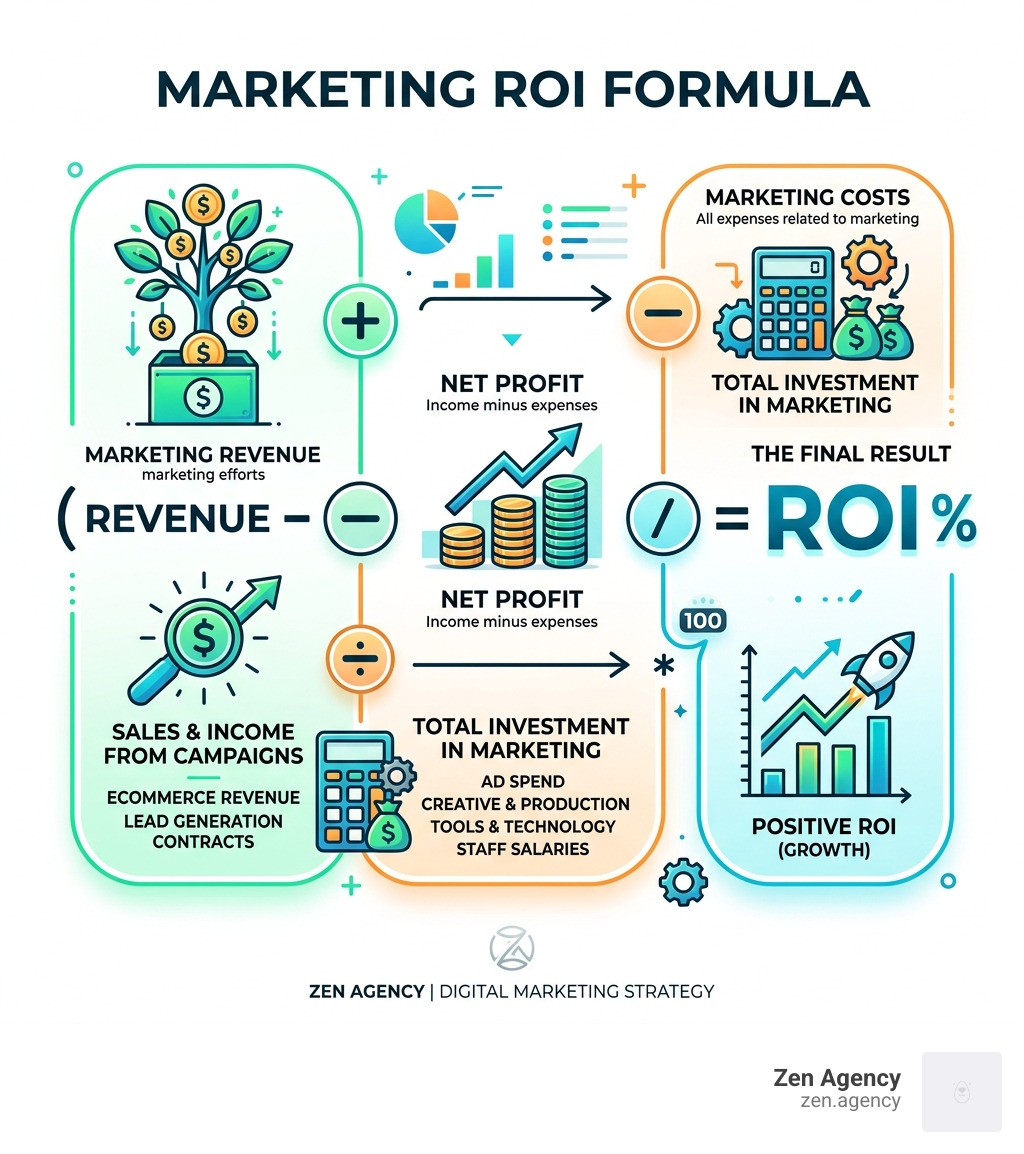
To improve marketing ROI, we first need to agree on how we’re measuring it. In the simplest terms, Marketing ROI is (Revenue – Marketing Cost) / Marketing Cost. If you spend $10,000 and generate $50,000 in revenue, your ROI is 400%.
However, in 2026, relying solely on this basic formula can be a trap. It often ignores the “shadow ROI” of brand awareness or the long-term value of a customer. We must distinguish between several key metrics to get the full picture:
- ROI (Return on Investment): The total profitability of your marketing, accounting for all costs including salaries and software.
- ROAS (Return on Ad Spend): A narrower metric (Revenue / Ad Spend) that tells you how well specific ads are performing but ignores overhead.
- Incrementality: This measures the true lift. It asks: “Would this customer have bought from us anyway without the ad?” By using 10% holdout groups, we can isolate the actual revenue driven by marketing.
- Marketing Mix Modeling (MMM): A high-level statistical analysis that looks at how different channels (even offline ones) interact over time to drive sales.
Using Multi-Touch Attribution to Improve Marketing ROI
The modern customer journey is rarely a straight line. A customer might discover you through a Scranton social media marketing post, read three of your blog posts over two weeks, and finally convert through a paid search ad.
If you use “last-click” attribution, the search ad gets 100% of the credit, and you might mistakenly cut your social media budget. Multi-touch attribution (MTA) solves this by distributing credit across the journey:
- Linear Modeling: Gives equal credit to every touchpoint.
- Time-Decay Attribution: Gives more credit to the interactions closest to the sale.
- Position-Based: Heavily weights the first and last interactions.
By using MTA, we can reallocate budgets toward awareness channels that are actually doing the heavy lifting, often uncovering that display ads or social content drive 40-60% more value than last-click models suggest.
Benchmarking Performance Across Key Channels
While every industry differs, 2026 data provides clear benchmarks for what “good” looks like. If your numbers are significantly lower, it’s a sign you have room to improve marketing ROI through optimization.
- Email Marketing: Remains the undisputed king with an average ROI of 3,800% (or $38 for every $1 spent).
- SEO Marketing: Provides a compounding return of roughly 2,200% (22:1). Because SEO traffic doesn’t stop the moment you stop paying, it is often the most sustainable long-term strategy.
- PPC Advertising: Yields an average ROI of 200%. While lower than SEO, it provides the instant scalability and “quick wins” necessary for growth.
| Metric | Basic ROI | ROAS | Incrementality | MMM |
|---|---|---|---|---|
| Focus | Total Profitability | Ad Efficiency | True Lift (Causality) | Strategic Allocation |
| Includes Labor? | Yes | No | No | Optional |
| Best For | C-Suite Reporting | Tactical Ad Tweaks | Proving Marketing Value | Long-term Planning |
Leveraging Technology and Data Accuracy in 2026
In the current landscape of Montana and Pennsylvania marketing, data privacy is a major hurdle. With the death of third-party cookies and increased browser restrictions, traditional tracking is often “blind” to 30-40% of conversions. To improve marketing ROI, your data foundation must be rock-solid.
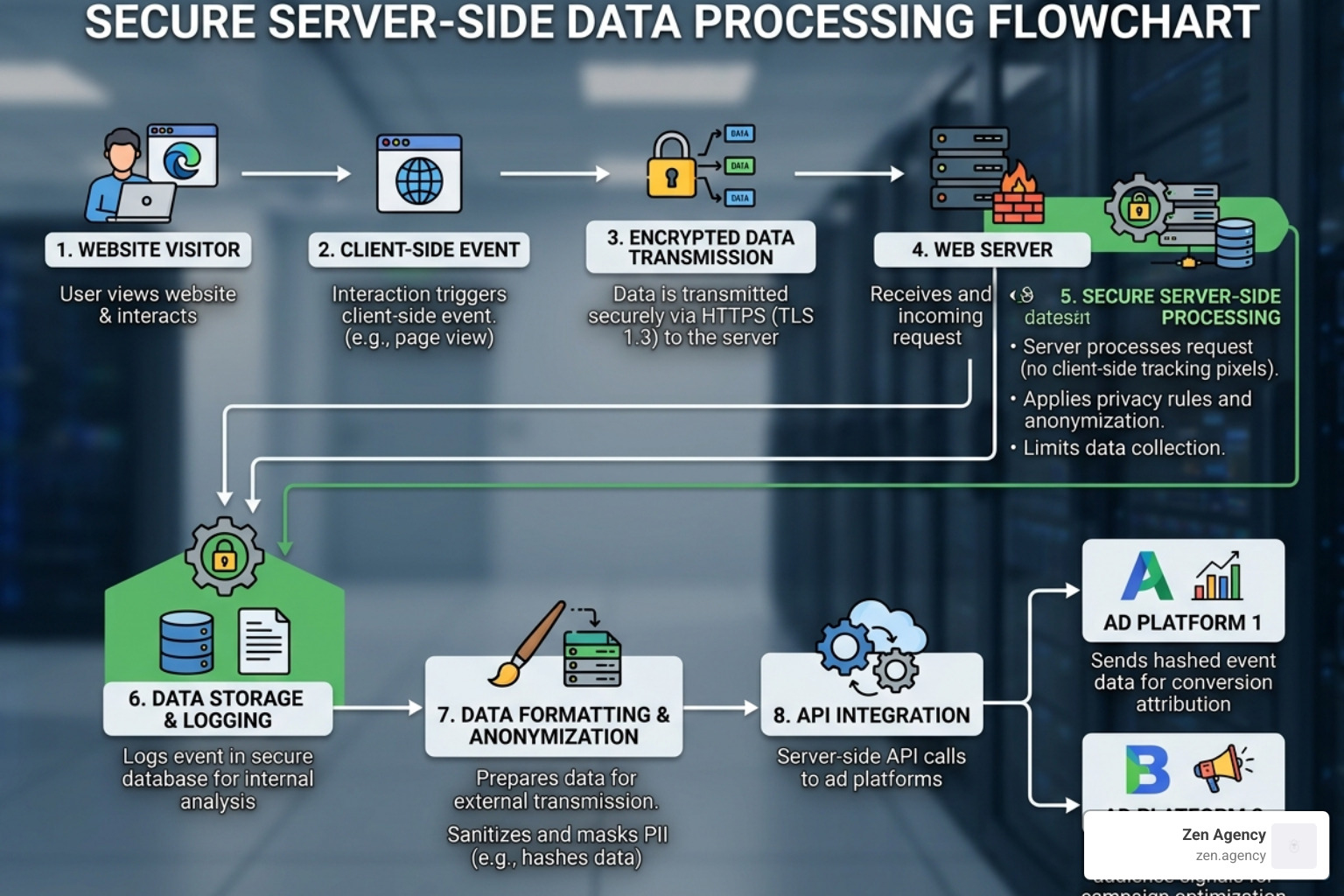
We advocate for Data Observability—a system that detects tracking errors before they impact your budget. If a tracking tag breaks on your landing page, you could waste thousands of dollars on “unsuccessful” ads that were actually converting.
How Server-Side Tracking Works to Improve Marketing ROI
Traditional tracking happens in the user’s browser. If the user has an ad blocker or a privacy-focused browser, the tracking fails. Server-side tracking (like Meta Conversions API or Google’s Server-Side GTM) moves this process to your server.
The results are often staggering. Businesses switching to server-side tracking have seen:
- A 30% increase in reported conversions.
- A 58% lower cost-per-purchase.
- A 33.65% increase in tracking accuracy for platforms like Facebook Ads.
By giving ad platforms better data, their AI algorithms can optimize your campaigns more effectively, directly leading to better returns.
The Role of AI and Predictive Analytics in Modern Marketing
AI is no longer a futuristic concept; it’s a daily tool to improve marketing ROI. In 2026, we use GenAI not just for writing copy, but for hyper-responsive workflows. For example, AI agents can now identify “distressed inventory” or slow sales periods and automatically recommend targeted campaigns to fill the gap.
Predictive targeting allows us to build “lookalike” audiences based on your best customers’ actual behavior patterns, not just demographics. This reduces the “trial and error” phase of new campaigns, saving significant budget. Furthermore, Causal AI helps us infer impact without needing user-level tracking, bypassing many modern privacy restrictions while maintaining 10-20% ROI gains.
Proven Strategies to Improve Marketing ROI Without Increasing Spend
You don’t always need a bigger checkbook; often, you just need a sharper scalpel. Improving marketing ROI is frequently about “fixing the leaks” in your current funnel.
Optimizing High-Yield Channels: SEO, PPC, and Email
To get more from your current channels, focus on these high-impact levers:
- SEO: Focus on “compounding” content. A single high-quality guide can drive leads for years. Ensure your SEO expert in Scranton is focusing on intent-based keywords rather than just high-volume “vanity” terms.
- PPC: Improve your Quality Scores. By aligning your ad copy perfectly with your landing page, you can lower your cost-per-click. We’ve seen PPC in Billings, Montana achieve 25% optimization gains simply by refining keyword match types and negative keyword lists.
- Email: Use A/B testing on subject lines and send times. A small lift in open rates from 2% to 2.8% might seem minor, but it represents a 40% increase in potential conversions.
Reducing Wasted Spend Through Better Targeting
Waste is the enemy of ROI. One of the most common drains is poor geo-targeting, which can waste up to 65% of ad spend. If you are a local business in Wyoming, PA, you shouldn’t be paying for clicks from three counties away unless you can actually serve them.
- Geo-fencing: Set optimal parameters (often a 4-5 minute travel radius for retail) to ensure your ads hit people when they are most likely to visit.
- Suppression Lists: Stop showing ads to people who just bought from you. By using first-party data to suppress recent converters, you save your budget for new prospects.
- Negative Keywords: In PPC, building robust negative keyword lists weekly prevents your ads from showing up for irrelevant searches (e.g., someone searching for “free” when you sell a premium service).
We recommend the 70/20/10 budget rule: 70% of your budget goes to proven, high-ROI channels; 20% to testing new tactics in those channels; and 10% to “experimental” high-risk, high-reward opportunities.
Beyond Financial Metrics: A Holistic View of Impact
If you only look at the immediate dollar-in vs. dollar-out, you’ll likely undervalue your most important marketing efforts. To truly improve marketing ROI, we must look at the “holistic” impact of a customer.
Customer Lifetime Value (CLV) is the total revenue a customer generates over their entire relationship with you. A channel might have a high cost-per-acquisition (CPA) but bring in customers who stay for five years. Conversely, a “cheap” channel might bring in customers who churn after one month.
Other metrics that provide a complete picture include:
- Retention Rates: It is 5-25x cheaper to keep an existing customer than to find a new one.
- Brand Sentiment: Is your marketing building trust? This is harder to measure but essential for long-term health.
- Micro-conversions: Newsletter signups or whitepaper downloads should be assigned a “dollar value” based on how often those leads eventually turn into paying customers.
Frequently Asked Questions about Marketing ROI
What is a realistic marketing ROI benchmark for 2026?
While it varies by industry, a 5:1 ratio (500% ROI) is generally considered “strong” for most digital marketing. However, for high-margin industries like software or professional services, you should aim higher. Email marketing benchmarks often sit at 38:1, while SEO targets 22:1.
How do I justify marketing spend to stakeholders using alternatives to traditional ROI?
Focus on Marketing Efficiency Ratio (MER)—Total Revenue divided by Total Marketing Spend. This gives stakeholders a “big picture” view of how marketing fuels the business. Additionally, use Incrementality Testing to show what happens to revenue when a specific channel is turned off. Proving “lost revenue” is often more persuasive than promising “future gains.”
What are the most common challenges in measuring marketing ROI today?
The “attribution blind spot” is the biggest hurdle. With 68% of businesses struggling to track revenue-driving channels accurately, the primary challenge is data fragmentation. Users switch between 2-3 devices before buying, making cross-device tracking and first-party data integration essential.
Conclusion
At Zen Agency, we believe that improving marketing ROI isn’t about finding a “magic” channel—it’s about building a culture of measurement and continuous optimization. Whether we are helping a business with digital marketing in Wilkes-Barre or scaling an enterprise-grade e-commerce brand, our focus is always on the data.
By implementing server-side tracking, embracing multi-touch attribution, and focusing on high-yield compounding channels like SEO and email, you can make your budget work significantly harder. The goal is to move away from “random acts of marketing” and toward a systematic, ROI-first plan.
Ready to stop the budget leaks and start scaling with confidence? Our team specializes in helping businesses navigate these complexities with enterprise-grade solutions. Learn more about our lead generation services and how we can help you turn your marketing into a predictable revenue engine.