Stop Losing Leads with These CRO Secrets
You’re Getting Traffic — But Are You Getting Leads?
CRO for lead generation is the practice of optimizing your website and marketing assets to turn more of your existing visitors into actual leads — without spending more on ads or traffic.
Here’s a quick answer to what it involves:
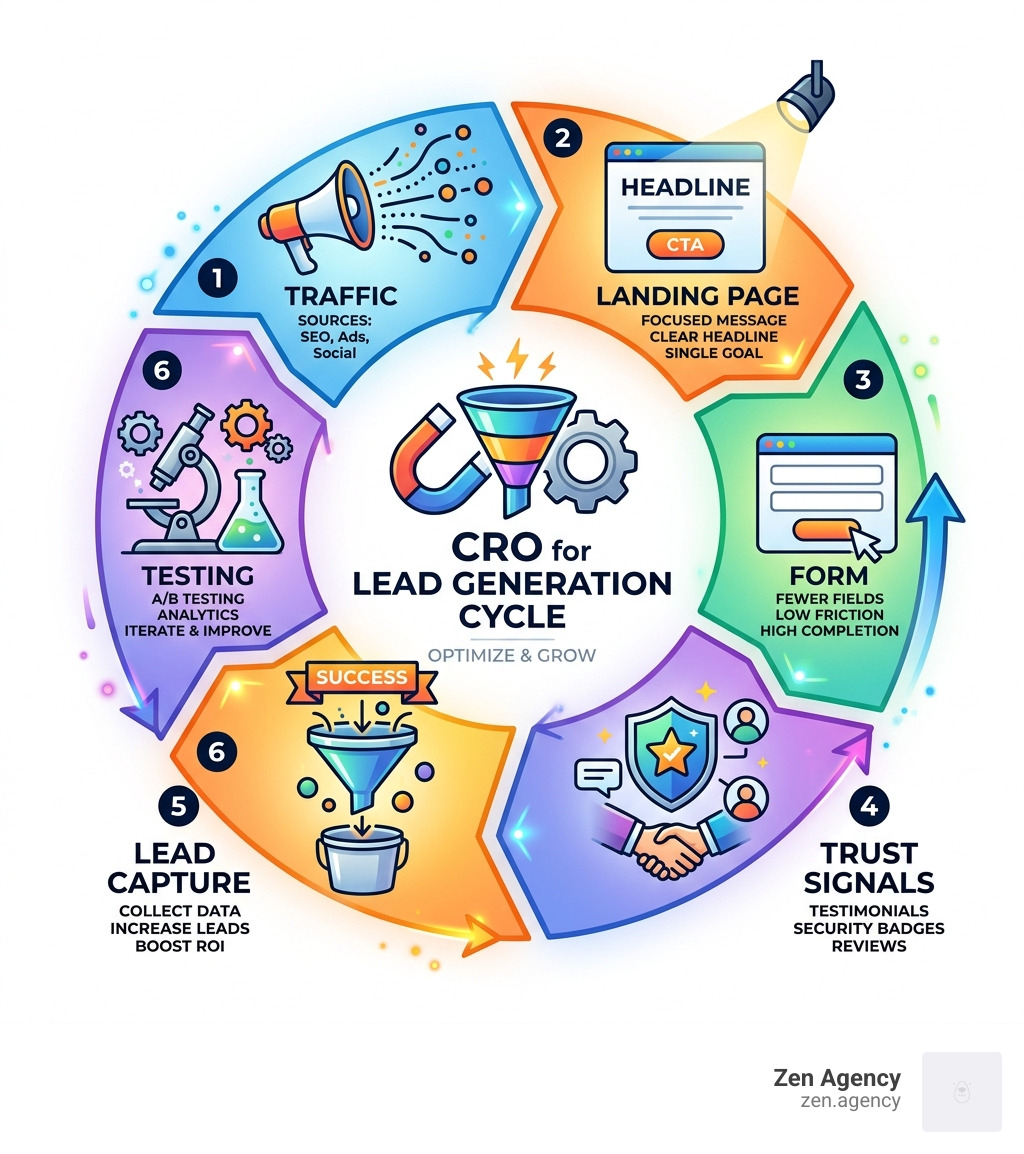
- Optimize landing pages — clear headlines, focused messaging, one goal per page
- Simplify lead capture forms — fewer fields, less friction, higher completions
- Strengthen CTAs — action-driven language, visible placement, compelling value
- Add trust signals — testimonials, security badges, case studies near conversion points
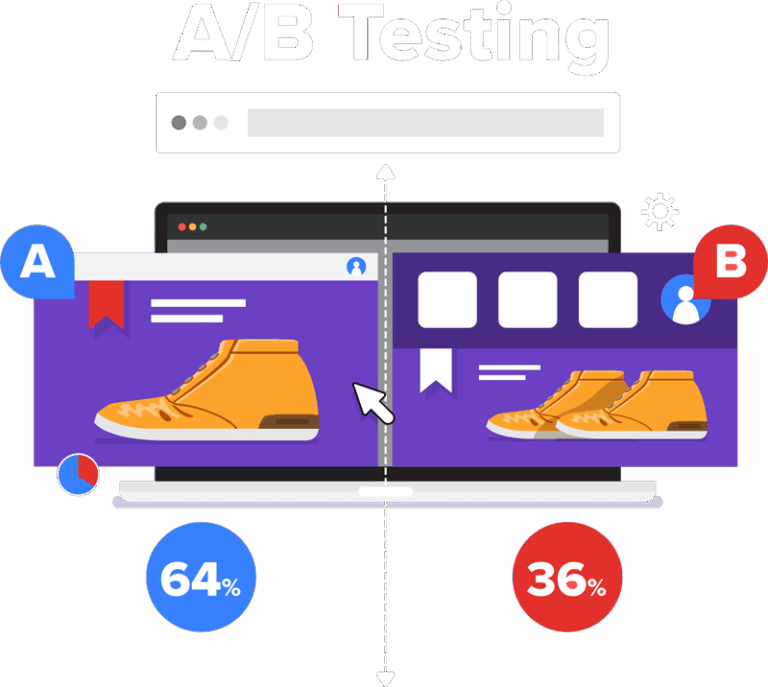
- Test and iterate — use A/B testing and analytics to find what actually works
- Personalize content — match messaging to visitor intent and behavior
The math is simple. If your site gets 10,000 visitors a month and converts at 1.5%, you’re getting 150 leads. Push that to 2.5% — and you’re getting 250 leads. Same traffic. 100 more leads. No extra ad spend.
That’s the power of CRO.
Most businesses pour budget into driving traffic, then lose potential customers the moment those visitors land on a page that’s slow, confusing, or unconvincing. The problem isn’t the traffic — it’s the leaking funnel.
This guide walks you through exactly how to fix that.
I’m Joseph Riviello, CEO and Founder of Zen Agency, and with over 22 years in digital marketing, I’ve helped companies at every scale diagnose funnel leaks and build smarter conversion strategies — making CRO for lead generation a core pillar of sustainable growth for our clients.
CRO for lead generation terms made easy:
Understanding CRO for Lead Generation and Why It Matters
In our years of experience serving clients from Wilkes Barre to Billings, we’ve seen a common pattern: businesses focus entirely on the “top of the funnel”—the traffic—while ignoring the “leaks” at the bottom. CRO for lead generation is the strategic process of plugging those leaks. It’s the science of analyzing user behavior and making data-driven adjustments to ensure that when someone lands on your site, they don’t just browse; they convert.
Defining CRO for lead generation
At its core, Conversion Rate Optimization (CRO) is about increasing the percentage of website visitors who take a specific, desired action. In the context of lead generation, those actions usually include submitting a contact form, signing up for a newsletter, downloading a whitepaper, or scheduling a consultation call.
Unlike e-commerce CRO, which focuses on immediate sales, lead gen CRO focuses on the start of the relationship. It’s about building enough trust and providing enough value that a visitor is willing to trade their contact information for what you’re offering. If you want to see how this looks in practice, How ExactBuyer Can Help You provides excellent context on modern techniques for lead-focused sites.
Why CRO is essential for reducing acquisition costs
In April 2026, the cost of digital advertising continues to climb. If you rely solely on increasing traffic to grow your business, your Customer Acquisition Cost (CAC) will eventually eat your margins alive.
CRO is the ultimate “force multiplier” for your marketing spend. By focusing on your existing traffic, you maximize the value of every dollar already spent on SEO or PPC. A mere 1% improvement in your conversion rate—moving from 1.5% to 2.5%—can generate 100 additional leads per month for a site with 10,000 visitors. This doesn’t just increase your revenue; it lowers your CAC and makes your entire sales pipeline more efficient. When your funnel is airtight, your marketing budget works harder, allowing you to scale profitably even in competitive markets like Pennsylvania or Montana.
Benchmarking Success: What a “Good” Conversion Rate Looks Like in 2026
How do you know if your website is actually performing well? We often hear clients ask for “the number” they should be hitting. While “better than last month” is always the best goal, industry benchmarks provide a necessary reality check.
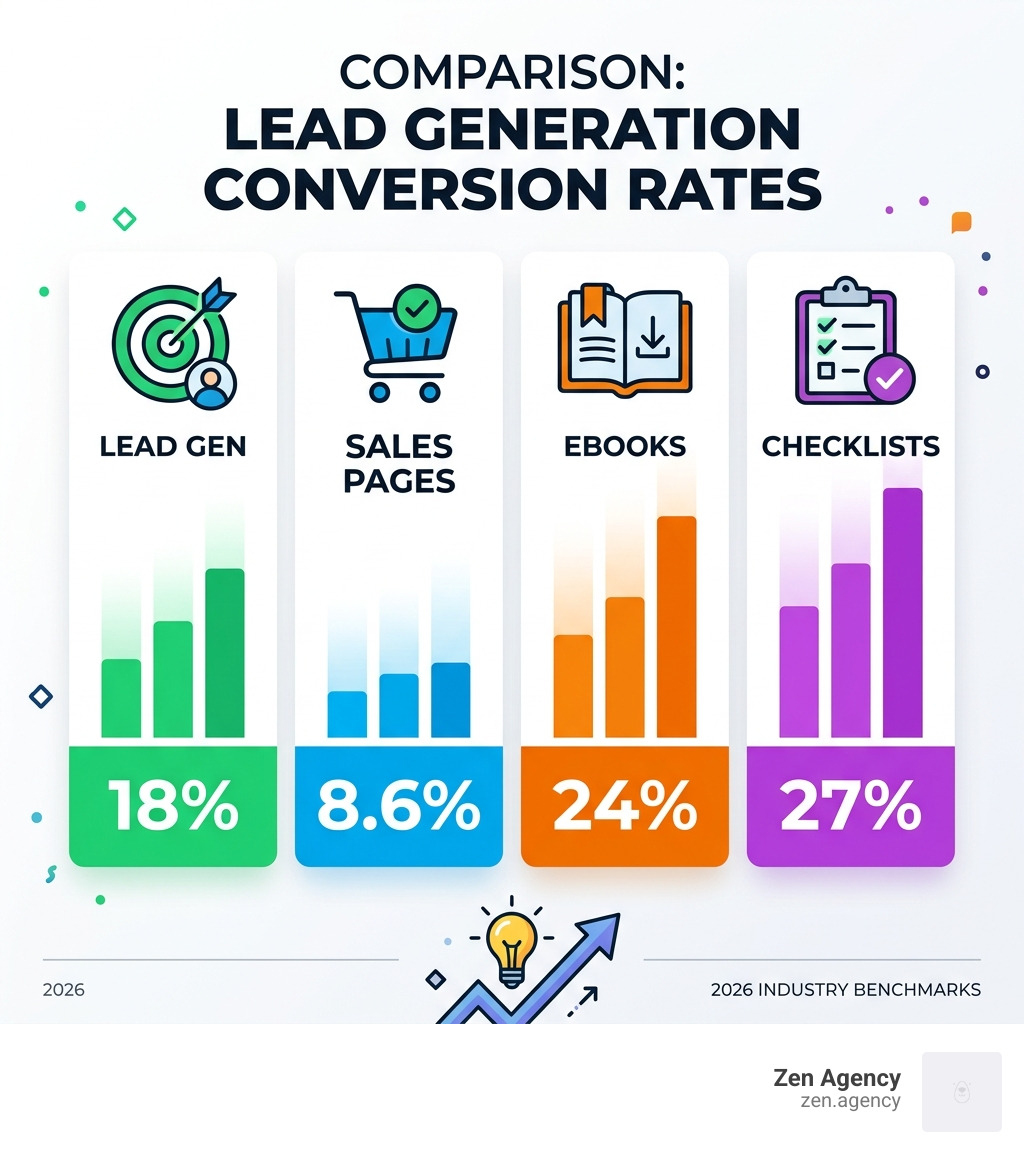
As of 2026, the average conversion rate for standard landing pages sits around 11.7%. However, for dedicated CRO for lead generation pages, that number jumps to 18%. In the B2B world, performance tiers are typically categorized as follows:
- Average: 2.2%
- Good: 4.3%
- Excellent: 6.1%
- Exceptional: 11.7% and above
High-converting lead magnet benchmarks
The type of offer you present significantly impacts your conversion rate. Our research into high-performing lead magnets reveals that “quick wins” usually convert the best:
- Cheat Sheets: 34% average conversion rate.
- Checklists: 27% average conversion rate.
- Ebooks: 24% average conversion rate.
- Mini-courses: 22% average conversion rate.
These benchmarks show that visitors in 2026 value their time. They are more likely to convert for a one-page checklist that solves a problem in five minutes than a 50-page whitepaper that requires an hour of reading.
Setting realistic optimization goals
While benchmarks are helpful, your primary focus should be on your own historical data. We recommend setting incremental goals. If your current rate is 2%, don’t aim for 15% overnight. Aim for 3%. Analyze your traffic quality—organic search visitors often convert at higher rates than social media traffic because they have higher “search intent.” Align your CRO goals with your specific business objectives: are you looking for more leads, or better leads? Sometimes, a lower conversion rate is acceptable if the leads being generated are of much higher quality.
High-Impact CRO for Lead Generation Strategies
To move the needle, you need to look beyond simple button colors. You need a holistic approach that combines psychology, design, and technology. If you’re looking to Elevate your Lead Generation with CRO Marketing, you must focus on the elements that directly influence a visitor’s decision-making process.
Creating CTAs that drive action
Your Call-to-Action (CTA) is the most critical element on the page. It’s the “doorway” to the conversion. To optimize it:
- Use Action-Oriented Language: Move away from “Submit” or “Click Here.” Instead, use benefit-driven text like “Get My Free Audit” or “Download the Checklist Now.”
- Contrast is Key: Your CTA button should pop. If your site is blue, try an orange or yellow button. It should be the first thing the eye gravitates toward.
- Strategic Placement: Ensure there is a CTA “above the fold” (visible without scrolling). For longer pages, repeat the CTA at the middle and bottom to capture visitors at different stages of their reading journey.
Leveraging trust signals and social proof
In an era of AI-generated content and digital skepticism, trust is your most valuable currency. Visitors need to know that you are a legitimate, high-quality business before they hand over their data.
- Testimonials: Place these near your conversion forms. A quote from a satisfied client in Scranton or Hazleton carries more weight than any marketing copy we could write.
- Case Studies: Show, don’t just tell. Highlighting a 20% increase in form submissions for a previous client provides tangible proof of your expertise.
- Trust Badges: Include security seals (like SSL), industry awards, or logos of well-known partners. These act as “mental shortcuts” that signal reliability.
Optimizing the Lead Capture Funnel: Forms and UX
The form is where the magic—or the tragedy—happens. This is the point of highest friction in the CRO for lead generation process. If your form is too long or confusing, visitors will bounce, regardless of how good your offer is.
Advanced CRO for lead generation tactics
We’ve found that the “less is more” rule generally applies to forms, but “smarter is better” is the real secret.
- Progressive Profiling: Don’t ask for 10 pieces of information at once. Use tools to recognize returning visitors and ask for new information each time they engage, building a profile over time.
- Field Prioritization: Only ask for what you absolutely need to qualify the lead. Do you really need their fax number? Probably not.
- Multi-step Forms: Sometimes, breaking a long form into two or three steps with a progress bar actually increases conversions. It feels less overwhelming and leverages the “sunk cost” fallacy—once a visitor starts, they want to finish.
- Auto-fill Technology: Enable browser auto-fill to make the process as painless as possible.
Enhancing UX for higher conversions
User Experience (UX) is the foundation of CRO. If your site is a nightmare to navigate, no amount of CTA optimization will save it.
- Page Speed: A one-second delay in load time can result in a 7% reduction in conversions. Optimize your images, use a CDN, and ensure your hosting is enterprise-grade.
- Mobile-First Design: In 2026, over 70% of leads are generated via mobile devices. Your forms must be easy to tap, and your text must be legible on small screens.
- Navigation Simplicity: Don’t give visitors too many choices. A dedicated landing page should often have the main navigation removed to keep the focus entirely on the conversion goal.
Continuous Improvement through A/B Testing and AI
CRO is not a “one and done” project; it is a cycle of continuous improvement. We use data to stop guessing and start knowing.
Implementing a data-driven testing framework
To see real results, you need a structured approach to testing:
- Hypothesis Building: Based on your analytics (like heatmaps or session recordings), identify a problem. “I think our headline is too vague, causing people to leave.”
- Variable Isolation: Test one thing at a time. If you change the headline, the button color, and the image all at once, you won’t know which one caused the change in performance.
- Statistical Significance: Don’t stop a test after 10 visitors. Ensure you have enough data to prove the results aren’t just a fluke.
- Frequency: Frequent testing based on your traffic volume allows you to compound small wins into massive growth over time.
The role of AI in 2026 lead generation
By April 2026, AI has moved from a buzzword to a fundamental tool in the CRO toolkit. AI-powered personalization engines can now adapt a website in real-time based on a visitor’s behavior. For example, if a visitor arrives from a LinkedIn post about “SEO,” the hero section of your site can dynamically change to highlight your SEO expertise.
Companies using AI for CRO often see a 35% higher conversion rate. These tools can automate A/B testing, predict which leads are most likely to convert (predictive lead scoring), and even optimize form fields on the fly to reduce abandonment. This level of hyper-personalization is what separates the market leaders from the rest.
Frequently Asked Questions about CRO for Lead Generation
How quickly can I see results from CRO changes?
The timeline depends heavily on your traffic volume. If you have a high-traffic site, you can see statistically significant results from A/B tests in as little as 1–2 weeks. Simple changes, like fixing a broken form or improving page speed, can show a positive impact on your lead volume within days.
Will reducing form fields hurt my lead quality?
This is a common fear, but the research suggests otherwise. By removing friction-causing fields that aren’t essential for qualification, you often increase both the quantity and the quality of leads. You can use “smart” fields or multi-step forms to gather qualification data (like budget or timeline) without scaring off top-of-funnel prospects. Strategic field reduction focuses on the intent of the visitor.
Is CRO only applicable to my website?
Absolutely not. The principles of CRO for lead generation should be applied across your entire digital ecosystem. This includes:
- Email Marketing: Optimizing subject lines and click-through rates.
- Paid Search Ads: Ensuring your ad copy perfectly matches the landing page experience.
- Social Media: Optimizing the “link in bio” or lead generation forms directly within platforms like LinkedIn or Facebook.
- Retargeting Ads: Using dynamic content to bring back visitors who didn’t convert the first time.
Conclusion
Stop letting your hard-earned traffic go to waste. In today’s competitive landscape, you can’t afford a leaky funnel. Whether you are a business in Wilkes Barre looking to scale or an enterprise in the USA aiming for better ROI, CRO for lead generation is the most effective way to grow your bottom line without increasing your advertising budget.
At Zen Agency, we specialize in providing enterprise-grade solutions and innovative strategies to help businesses increase their visibility, profitability, and ROI. We don’t just build websites; we build lead-generating machines. If you’re ready to transform your digital presence and stop losing leads, explore our Conversion Rate Optimization Services today. Let’s work together to turn your visitors into your most valuable customers.