Why Local SEO Still Reigns: A Small Business Survival Guide
Understanding Local Business SEO and Why It Matters
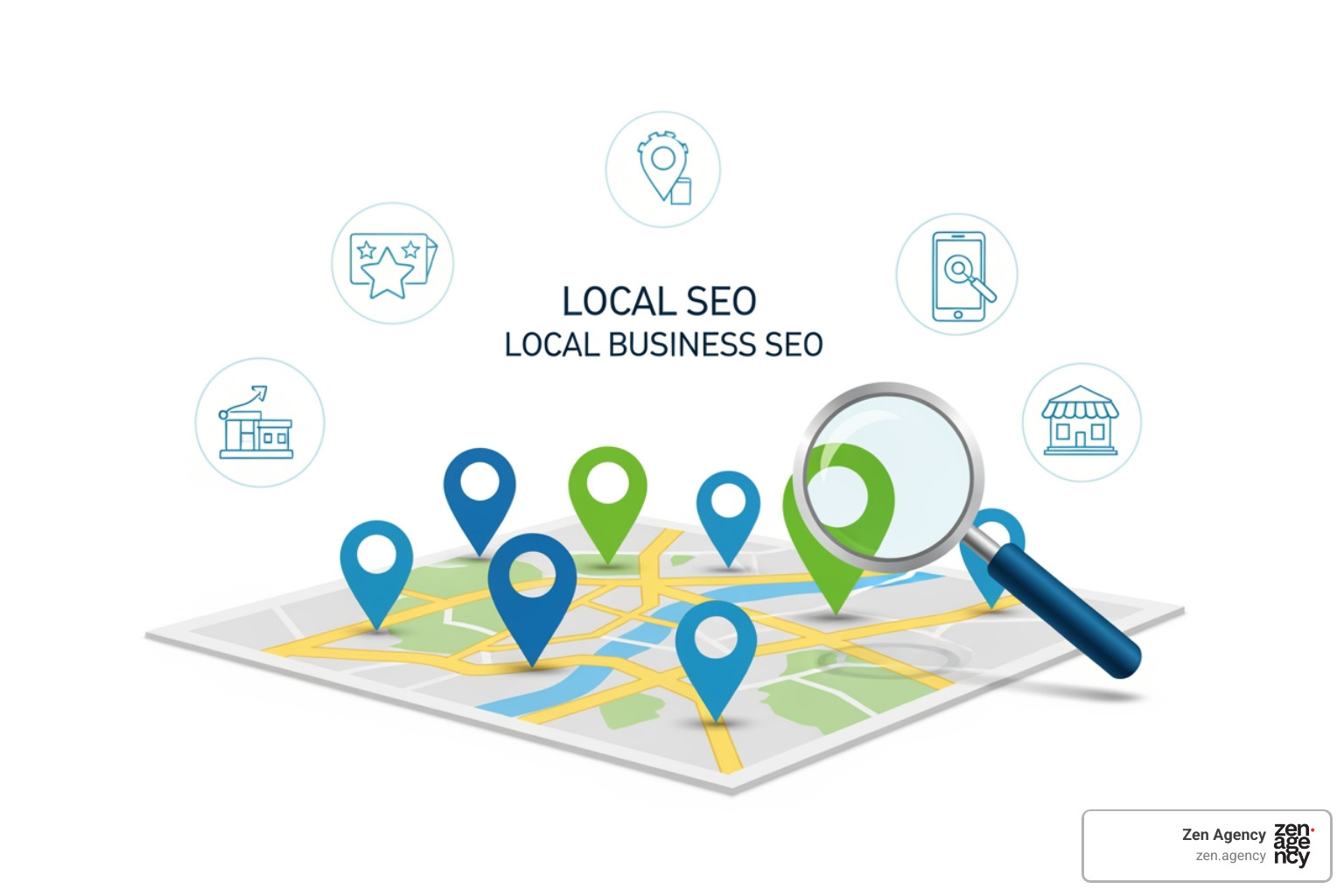
To master Local business SEO, we must first understand how Google’s local algorithm differs from its traditional global counterpart. While standard SEO focuses on relevance, authority, and configuration, local search is governed by three specific pillars: Relevance, Distance, and Prominence.
- Relevance: How well does your local business profile match what someone is searching for?
- Distance: How far is each potential search result from the location term used in a search? (If no location is specified, Google calculates distance based on what it knows about the user’s location).
- Prominence: How well-known is the business? This is based on information Google has about a business from across the web, such as links, articles, and directories.
The stakes are incredibly high. Research shows that 97% of search engine users find local businesses online. If you aren’t appearing in those results, you are effectively invisible to the vast majority of your market. In our Ultimate Guide to Local SEO: How to Dominate Your Market, we emphasize that local search isn’t just about being “on the internet”—it’s about being in the “Snack Pack.”
The Local 3-Pack (or Snack Pack) is the boxed area that appears at the very top of Google search results, displaying the three most relevant local businesses along with a map. Because these results appear above the standard organic links, they receive the lion’s share of clicks. Furthermore, 80% of local searches convert, meaning this traffic isn’t just “window shopping”; it’s ready to take action.
The Pillars of a High-Ranking Google Business Profile
If your website is your digital front door, your Google Business Profile (GBP) is your digital billboard on the busiest highway in town. Optimizing this profile is the absolute first step for any successful campaign.
To start, you must verify your business ownership. Without verification, you cannot manage your information or respond to reviews. Once verified, focus on these Four Keys High Performing Google Local Page elements:
- Complete Data: Don’t leave any field blank. Select the most accurate primary and secondary business categories. Google uses these to determine relevance.
- NAP Consistency: Your Name, Address, and Phone number must match your website and other directories exactly. Even small discrepancies (like “St.” vs. “Street”) can confuse search engines.
- High-Quality Photos: Profiles with photos receive 42% more requests for directions. Include shots of your exterior, interior, products, and friendly staff to build immediate trust.
- Google Posts: Think of these as “mini-ads.” Use them to share regular updates about product launches, local events, and special offers.
By keeping your profile active and utilizing specific business attributes (like “wheelchair accessible” or “free Wi-Fi”), you provide Google with more “hooks” to catch relevant searches.
Mastering Keywords and On-Page Optimization
Keywords in Local business SEO are different from general SEO. While a general search might be “how to fix a leaky pipe,” a local search is “emergency plumber in Scranton PA.” We call these “geo-modified” keywords.
| Keyword Type | Example | Intent |
|---|---|---|
| General Keyword | “Best pizza recipes” | Informational / Low Conversion |
| Local Keyword | “Best pizza in Wilkes Barre” | Transactional / High Conversion |
| Hyper-Local | “Pizza delivery near Public Square” | Immediate Action / Foot Traffic |
To truly Dominate Market Local SEO Content, you need to move beyond just mentioning your city name. We recommend creating hyper-local content that mentions local landmarks, neighborhood names, and community events. This signals to Google that you aren’t just a business in the area; you are a part of the community.
For those using tools like Google’s Keyword Planner, focus on “near me” queries. These have exploded in volume, with 82% of mobile shoppers conducting them regularly.
Implementing Local Business SEO on Your Website
Your website needs to back up what your Google Business Profile claims. This starts with technical on-page elements:
- Title Tags & Meta Descriptions: Include your city and primary service at the front of your title tags.
- Local Landing Pages: If you serve multiple areas like Hazleton, Kingston, and Wyoming, PA, create dedicated Local Landing Pages for each. Each page should have unique content, local testimonials, and specific NAP data.
- Schema Markup: This is “code for humans.” By Adding Schema Location Markup to Your Website, you provide search engines with a structured “ID card” of your business details, making it easier for them to display your info accurately.
- Internal Linking: Link your local service pages to your homepage and blog posts to distribute “ranking juice” throughout your site.
Building Trust Through Reviews and Citations
Trust is the currency of the local web. A staggering 98% of U.S. consumers read reviews before choosing a local business. If you have a 4.8-star rating and your competitor has a 3.2, the choice for the consumer is instant.
There are 3 Keys Building Trust Local Market:
- Citations: These are mentions of your business on other websites. Structured citations are found on business directories like Yelp, Yellow Pages, or the Top 100 international citation sites. Unstructured citations occur when a local blog or newspaper mentions your business.
- NAP Consistency: We cannot stress this enough. Inconsistent data across directories signals to Google that your business might be unreliable or closed.
- Review Volume & Recency: Ten reviews from three years ago won’t cut it. You need a steady stream of fresh feedback.
Managing Reviews for Local Business SEO
Don’t just collect reviews—engage with them. Google has stated that responding to reviews improves your local SEO. It shows you are active and care about customer satisfaction.
To make it easy for your customers, you should Create a link that goes directly to your review form. Put this link in your email signatures, on your receipts, and even on QR codes in your physical shop. Remember: never pay for reviews. Google’s “Helpful Content” system is designed to reward authentic human experiences and can detect “gaming” the system.
Advanced Strategies: Backlinks and Mobile Optimization
Once the basics are set, it’s time to look at the advanced factors that separate the leaders from the pack.
Mobile optimization is no longer optional. Since 82% of respondents use mobile devices for “near me” searches, your site must be lightning-fast. Statistics show that 60% of mobile users contact a business directly from the search results. If your site takes more than three seconds to load, they will bounce back to the search results and click your competitor. Use Google PageSpeed Insights to identify and fix lag.
Next, you must Build Long Lasting Local Link Building Strategy. In local SEO, a link from the Wilkes-Barre Chamber of Commerce or a local Scranton high school sports sponsorship is often more valuable than a link from a generic national blog. These “local backlinks” prove to Google that you are a prominent fixture in your specific geography.
Frequently Asked Questions about Local SEO
How long does it take to see results from local SEO?
In most markets, you should expect a timeline of 6-12 months to see meaningful, stable results. While some changes to your Google Business Profile can reflect in days, building the “prominence” required to dominate competitive markets takes time and consistency. SEO is a marathon, not a sprint, but the long-term ROI is significantly higher than fleeting paid ads.
Do I need a physical address for local SEO?
Not necessarily. If you are a Service Area Business (SAB)—like a plumber or a mobile dog groomer—you can still rank. Google allows you to hide your home address and instead define a service radius. There are many platforms which support hidden addresses, ensuring you can still build a robust citation profile without compromising your privacy.
How do I handle multiple business locations?
Managing SEO for locations in Billings, MT, and Scranton, PA, simultaneously requires a organized approach. You should follow our guide on How to Use Local SEO to Rank for Multiple Locations. Key tactics include:
- Creating unique landing pages for every city.
- Using store codes for organization.
- Utilizing bulk uploads if you manage more than 10 locations.
- Ensuring location-specific content (don’t just copy-paste the same text for every city).
Conclusion
At Zen Agency, we understand that for small and mid-sized businesses, Local business SEO isn’t just a marketing tactic—it’s a survival strategy. Since 2008, we have specialized in providing enterprise-grade solutions that help businesses in Pennsylvania, Montana, and across the USA scale their visibility and profitability.
If you’re tired of being outranked by competitors who offer half the quality you do, it’s time for an innovative strategy. From custom web development to fully managed Digital Marketing and SEO Services, we are here to help you increase your ROI and dominate your local market. Let’s turn those “near me” searches into your next loyal customers.