From Pixels to Profits: Optimizing Your Display Ad Campaigns
Why Display Ads Management Matters for Your Business Growth
Display Ads management is the process of creating, launching, and optimizing visual advertising campaigns across websites, apps, and platforms like YouTube and Gmail. The Google Display Network reaches 90% of internet users, making it one of the most powerful tools for building brand awareness and driving conversions.
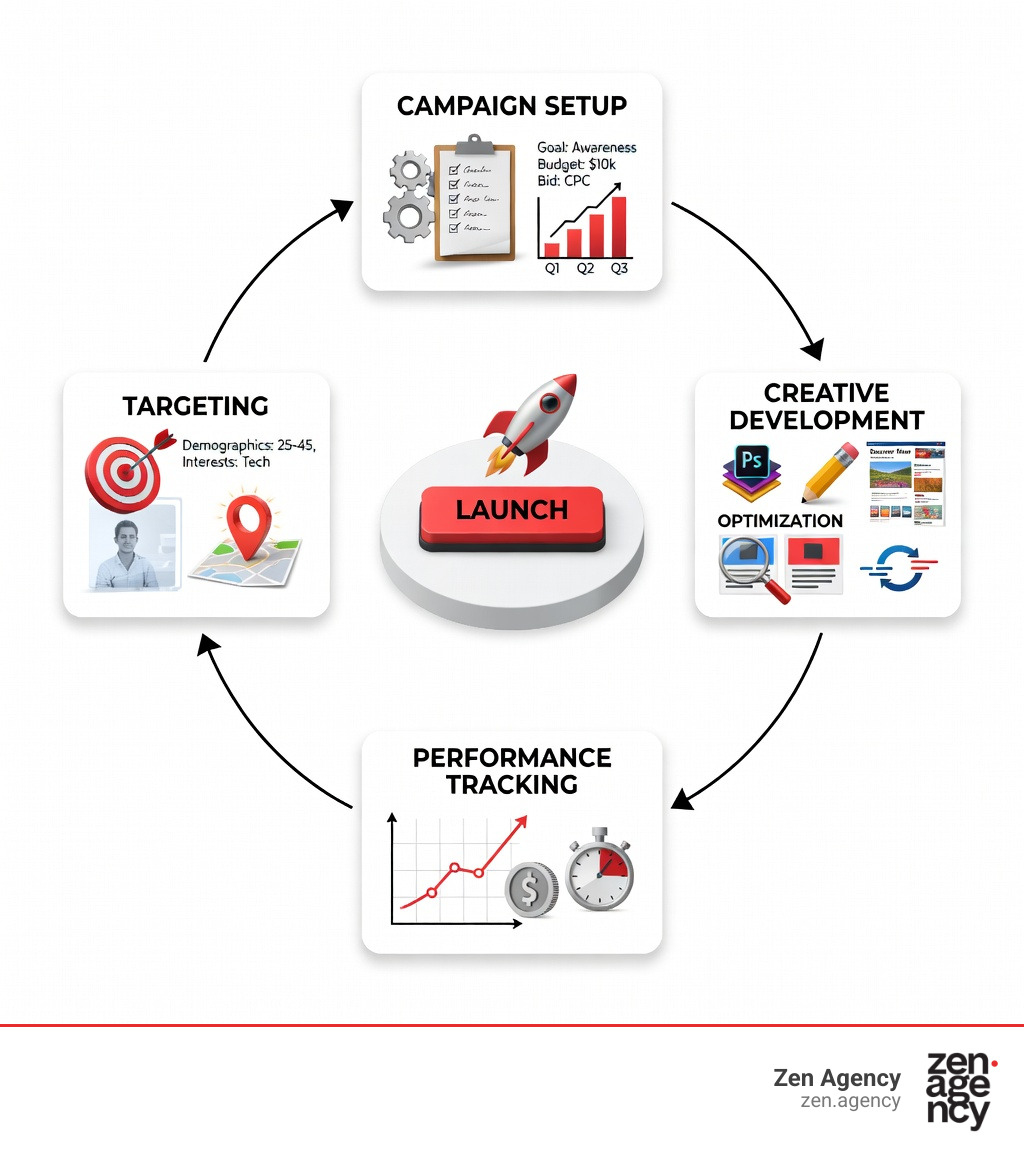
Quick Answer: What Display Ads Management Includes
| Component | What It Means |
|---|---|
| Campaign Setup | Defining goals, budgets, and bidding strategies (CPM, CPC, or CPA) |
| Creative Development | Building responsive display ads with images, headlines, and descriptions |
| Targeting | Reaching audiences through demographics, interests, keywords, or remarketing |
| Optimization | Testing assets, adjusting bids, and refining placements based on performance |
| Performance Tracking | Monitoring KPIs like CTR (average 0.46%), conversions, and view-through conversions |
Why Display Ads Are Different from Search Ads
Search ads respond to what people are actively looking for. Display ads work differently—they’re interruption marketing. They show your brand to people while they browse content, watch videos, or check email. This makes them ideal for:
- Building brand awareness (96% of brands use Google Ads for this purpose)
- Retargeting website visitors who didn’t convert
- Reaching audiences earlier in the buying cycle
- Supporting search campaigns (advertisers running both see 11% more search conversions)
The challenge? With 23 million ads shown every minute on the Display Network, poor management leads to wasted budget, irrelevant placements, and ad fatigue. Effective Display Ads management requires strategic targeting, compelling creatives, and continuous optimization—not a “set it and forget it” approach.
Who This Guide Is For
If your company struggles with brand visibility, inconsistent lead flow, or disappointing ROI from paid advertising, you need a systematic approach to Display Ads management. Whether you’re launching your first campaign or fixing underperforming ones, this guide walks you through the proven strategies that drive measurable results.
I’m Joseph Riviello, and over my 22 years leading digital marketing strategies, I’ve seen how proper Display Ads management transforms companies’ ability to scale profitably. At Zen Agency, we focus on holistic approaches that connect all aspects of your online presence to maximize revenue, not just clicks.
The Fundamentals of Professional Display Ads Management
To master Display Ads management, we first need to understand the vast ecosystem of the Google Display Network (GDN). Unlike the Search Network, where users are hunting for answers, the Display Network is where they live their digital lives. Whether someone is reading local news in Scranton, PA, or watching a DIY video in Billings, MT, the GDN allows us to place your brand right in front of them.
Professional management isn’t just about making “pretty” banners; it’s about understanding the mechanics of outbound marketing. While search is inbound (pulling users in), display is outbound (pushing your message out). The GDN includes over 2 million websites and apps, reaching 95% of the population every month. That is a massive playground, but without a guide, it’s easy to get lost.
| Feature | Search Ads | Display Ads |
|---|---|---|
| User Intent | High (Actively searching) | Low to Medium (Browsing) |
| Format | Text-based | Visual (Images, Video, HTML5) |
| Primary Goal | Conversions/Sales | Brand Awareness/Remarketing |
| Placement | Search Engine Results Pages | Websites, Apps, YouTube, Gmail |
| Cost Model | Primarily CPC | CPC or CPM |
At Zen Agency, we view PPC Management as a multi-layered discipline. For businesses in Pennsylvania and Montana looking to scale, the GDN offers a way to broaden the top of your sales funnel. You can learn more about the specifics of the network on the About Google Display ads and the Google Display Network page.
Strategic Campaign Setup: A Step-by-Step Guide
Setting up a campaign correctly from day one is the difference between a high-ROI engine and a money pit. We always start by identifying the core objective: are we looking for sales, leads, website traffic, or brand awareness? Your goal dictates how Google’s AI optimizes your placements.
Step 1: Define Your Goal and Subtype
When you Create a Display campaign page, Google will ask for your objective. For most of our clients in the Scranton and Wilkes-Barre areas, we recommend starting with “Leads” or “Website Traffic.” You’ll typically choose a “Standard Display Campaign” to maintain the most control over your settings.
Step 2: Budgeting and Bidding
Budgeting can be tricky. Google often recommends starting with a $10–$50 daily budget for new campaigns. We suggest being realistic about your industry; for example, The Cost of PPC Advertising: What E-Commerce Brands Need to Know highlights that costs can vary wildly depending on competition.
For bidding, you have several options:
- CPC (Cost-Per-Click): Best for driving traffic.
- CPM (Cost-Per-Thousand Impressions): Best for brand awareness.
- CPA (Cost-Per-Acquisition): Best for conversion-focused campaigns once you have enough data.
We often leverage Smart Bidding, which uses machine learning to optimize for conversions or conversion value in every single auction. It’s like having a tiny, super-fast math genius managing your bids 24/7.
Mastering Targeting and Creative Assets
Targeting is where Display Ads management either shines or fails. If you show an ad for a luxury spa in Kingston, PA, to someone looking for industrial tractor parts in Montana, you’ve wasted your money.
Advanced Targeting Options
Google’s AI-powered Optimized Targeting is a game-changer. Instead of just sticking to the audience segments you pick, it looks for people who are likely to convert based on real-time data. We also use:
- Demographics: Age, gender, and household income.
- Interests (Affinity and In-Market): Reaching people based on their long-term habits or what they are currently researching.
- Remarketing: This is the “secret sauce.” It allows us to show ads to people who have already visited your site but didn’t buy. This is why Why PPC is Crucial for Small Business Growth is so focused on the full customer journey.
The Power of Responsive Display Ads (RDAs)
Gone are the days when you had to hire a designer to create 20 different sizes of the same banner. With Responsive Display Ads, you provide the “ingredients,” and Google bakes the “cake.” You can upload:
- Up to 15 high-quality images.
- Up to 5 logos.
- Up to 5 headlines (30 characters each).
- 1 long headline (90 characters).
- Up to 5 descriptions.
Google’s AI then tests millions of combinations to see which one performs best for a specific user on a specific site. Advertisers who add an RDA to an ad group with a static ad see an average of 2x more conversions. Check out the About responsive display ads page for technical specs.
Advanced Optimization and Performance Tracking
You’ve launched your campaign. Now what? If you aren’t looking at your data at least weekly, you aren’t doing Display Ads management—you’re just gambling.
Key Performance Indicators (KPIs)
While the average CTR for Display Ads is 0.46%, we don’t just look at clicks. We look at:
- Conversions: Did they sign up or buy?
- View-Through Conversions (VTCs): This tracks people who saw your ad, didn’t click, but later came to your site and converted. This is huge for proving the value of display.
- Cost Per Acquisition (CPA): Is the lead worth what you paid?
Fighting Ad Fatigue
Over-exposure to the same creative causes ad fatigue, leading to “banner blindness.” We manage this through frequency capping. We generally find a “sweet spot” of 3 to 5 impressions per week for B2C campaigns. If people see your ad 20 times a day, they won’t buy; they’ll get annoyed.
For our local clients, we emphasize that How to Track and Measure PPC Success for Small Businesses requires looking at the “assisted conversion” report in Google Analytics to see how display ads helped your search ads close the deal.
Frequently Asked Questions about Display Ads Management
How do we ensure brand safety?
One of the biggest risks in the open programmatic environment is appearing on made-for-advertising (MFA) websites. These are low-quality sites designed only to host ads. We use content exclusions to keep your brand away from sensitive topics and low-quality “junk” sites, ensuring your reputation stays intact in Pennsylvania and beyond.
What is the average cost for Display Ads management?
The average CPC for the Google Display Network is typically $1 or less, which is much cheaper than search. However, management fees depend on the complexity of your account. We often tell clients that PPC Tips Every Small Business Owner Needs to Know include the fact that you get what you pay for; a “cheap” manager who doesn’t exclude bad placements will cost you more in wasted ad spend than an expert’s fee.
How does AI improve Display Ads management?
AI has completely shifted the landscape. From Performance Max campaigns that find customers across all of Google’s channels to automated bidding that adjusts in real-time, AI handles the “grunt work.” This allows us to focus on high-level strategy and creative excellence. You can Achieve your advertising goals today! by embracing these automated tools rather than fighting them.
When should a business use an agency for Display Ads?
If you are spending more than a few thousand dollars a month and aren’t seeing a clear ROI, it’s time for professional help. At Zen Agency, we provide enterprise-grade solutions for businesses in Scranton, Wilkes-Barre, and Billings who are struggling to scale. We don’t just manage ads; we optimize for ROI and long-term profitability.
Conclusion
The world of Display Ads management is moving fast. As we head toward a “cookieless” future, the reliance on first-party data and AI-driven targeting will only grow. Success in this space requires a blend of creative storytelling and rigorous data analysis.
Whether you are looking to increase brand awareness for a law firm via PPC Advertising for Lawyers or drive e-commerce sales, display ads are an essential part of the mix. Remember: search captures demand, but display creates it.
Ready to turn your pixels into profits? Our team at Zen Agency is here to help you navigate the complexities of the Google Display Network with innovative strategies that actually move the needle.
Take the next step in your digital journey: PPC Management