Why Your Old Customer Segments Are History Thanks to AI
Why Your Old Customer Segments Are Already Out of Date
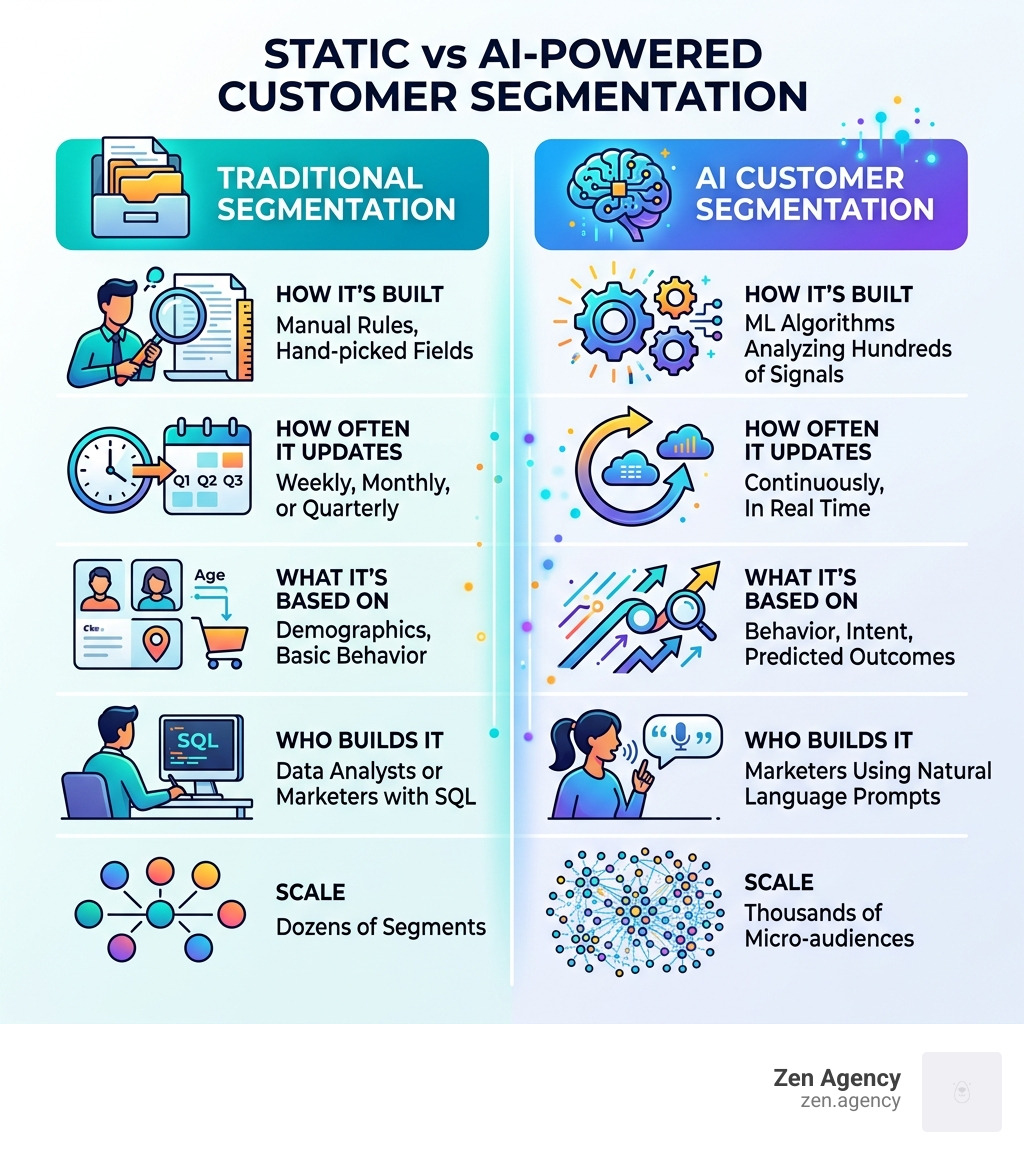
AI customer segmentation is the use of machine learning to automatically group customers based on behavior, intent, and predicted actions — updating in real time as your customers change, instead of relying on static lists you refresh once a quarter.
Here’s a quick snapshot of what that means in practice:
| Traditional Segmentation | AI Customer Segmentation | |
|---|---|---|
| How it’s built | Manual rules, hand-picked fields | ML algorithms analyzing hundreds of signals |
| How often it updates | Weekly, monthly, or quarterly | Continuously, in real time |
| What it’s based on | Demographics, basic behavior | Behavior, intent, predicted outcomes |
| Who builds it | Data analysts or marketers with SQL | Marketers using natural language prompts |
| Scale | Dozens of segments | Thousands of micro-audiences |
Most marketing teams are running campaigns on customer data that’s already wrong.
You built your segments last quarter. Maybe last year. Since then, customers have browsed, bought, churned, come back, and changed their minds — and your lists have no idea.
One widely cited pain point from real-world platform users puts it bluntly: segments that only sync once a day are out of date 99% of the time. That means your “active customer” list could be full of people who quietly stopped engaging weeks ago.
And the problem runs deeper than stale data. Enterprise customer data platforms can hold 500+ attributes per customer profile — but the average marketer only uses about 12 of them. The rest sit unused, not because they’re irrelevant, but because no human can make sense of that much complexity manually.
That gap — between the data you have and the insight you can actually act on — is exactly what AI closes.
I’m Joseph Riviello, CEO and Founder of Zen Agency, and over my 22+ years in digital marketing I’ve watched businesses leave enormous revenue on the table because their AI customer segmentation strategy was either nonexistent or years behind their actual customer behavior. In this guide, I’ll walk you through how AI-powered segmentation works, why it outperforms traditional methods, and how to start using it to drive real ROI.
Common AI customer segmentation vocab:
The Evolution of AI Customer Segmentation
For decades, segmentation was a manual chore. We relied on “if/then” rules: If a customer spent more than $500, then put them in the VIP list. This worked when data was scarce, but in April 2026, the volume of data is overwhelming. Traditional methods simply cannot scale to meet the complexity of modern consumer behavior.
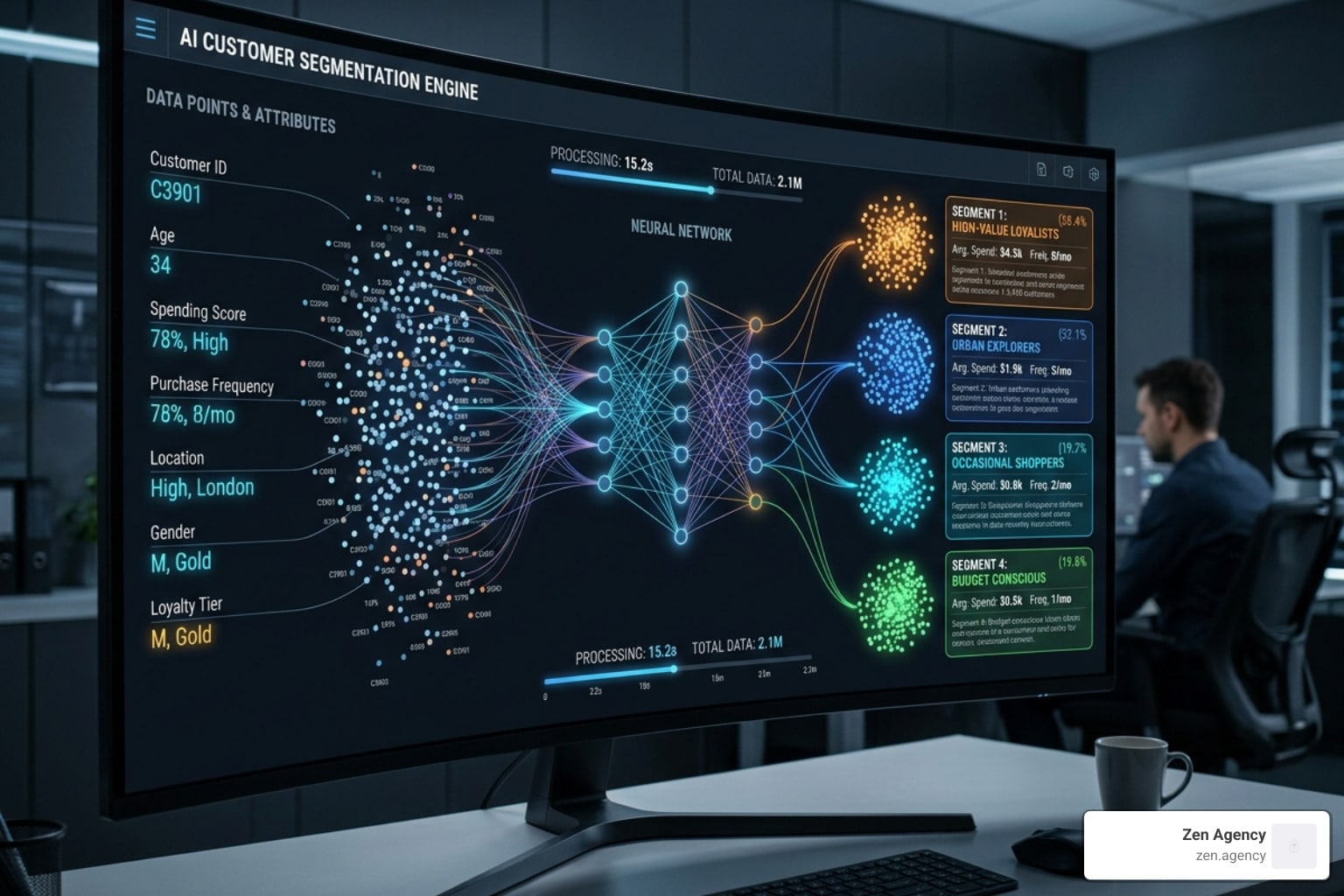
The evolution toward AI customer segmentation represents a shift from human-defined rules to machine-discovered patterns. By using machine learning, systems can now perform clustering — a process where the AI looks at your entire database and finds natural groupings that a human would never see. These algorithms recognize behavioral signals like the velocity of engagement, session depth, and even the sentiment of support tickets.
As noted in A Guide to AI Customer Segmentation | Braze, AI improves upon traditional methods by analyzing far more signals than humans can handle. This makes your targeting more precise and significantly faster to update.
Moving Beyond Demographic Buckets
In the old days, we grouped people by age, gender, or zip code. But does every 35-year-old man in Scranton, PA, want the same hiking boots? Of course not. AI customer segmentation allows us to layer in psychographic data and intent signals.
Instead of broad buckets, we now build micro-audiences. We can identify “weekend impulse buyers who only respond to free shipping” or “research-heavy shoppers who browse on mobile during commutes but buy on desktops within 48 hours.” By focusing on intent rather than just identity, we ensure our marketing feels like a helpful suggestion rather than an intrusive ad.
The Shift to Dynamic Living Segments
The biggest flaw in traditional models is “batch model staleness.” If your segments only refresh once a day, they are technically incorrect for 23 hours and 59 minutes of that day.
We are moving toward “living segments.” These are audiences that update the millisecond a new data point arrives. If a loyal customer suddenly exhibits churn signals — like reducing their login frequency or visiting a cancellation FAQ — they should move into an “at-risk” segment immediately, not after your next quarterly review. As the research indicates, segments are not up-to-date 99 percent of the day in traditional batch models; AI fixes this by ensuring your audience is always a reflection of the present moment.
How AI-Powered Customer Segmentation Works Step-by-Step
Understanding the “black box” of AI is easier when you break it down into a logical flow. It isn’t magic; it’s a sophisticated data pipeline designed to turn raw noise into clear signals.
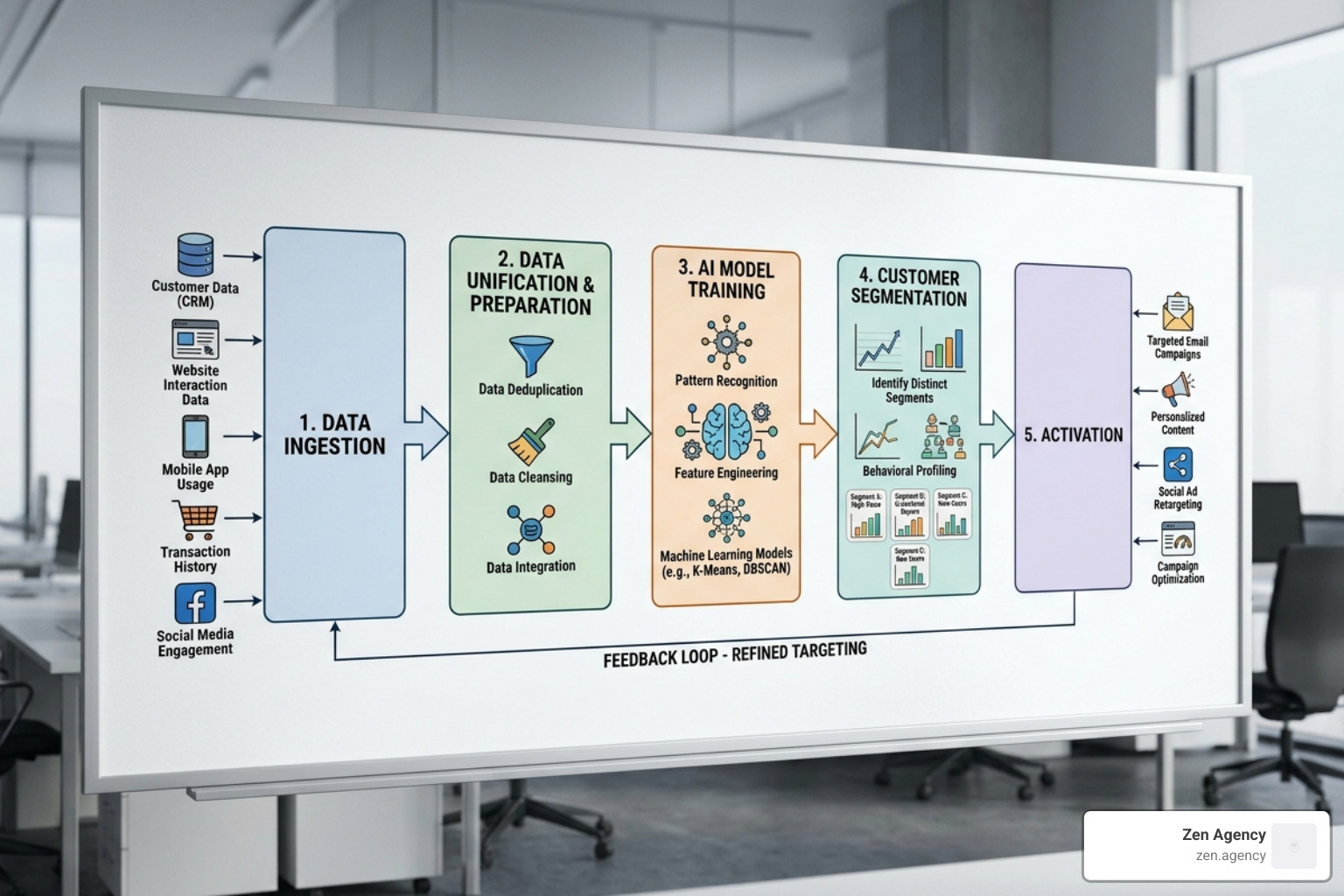
- Data Ingestion & Signal Unification: We start by pulling data from every touchpoint — your CRM, website analytics, email platform, and even in-store POS systems.
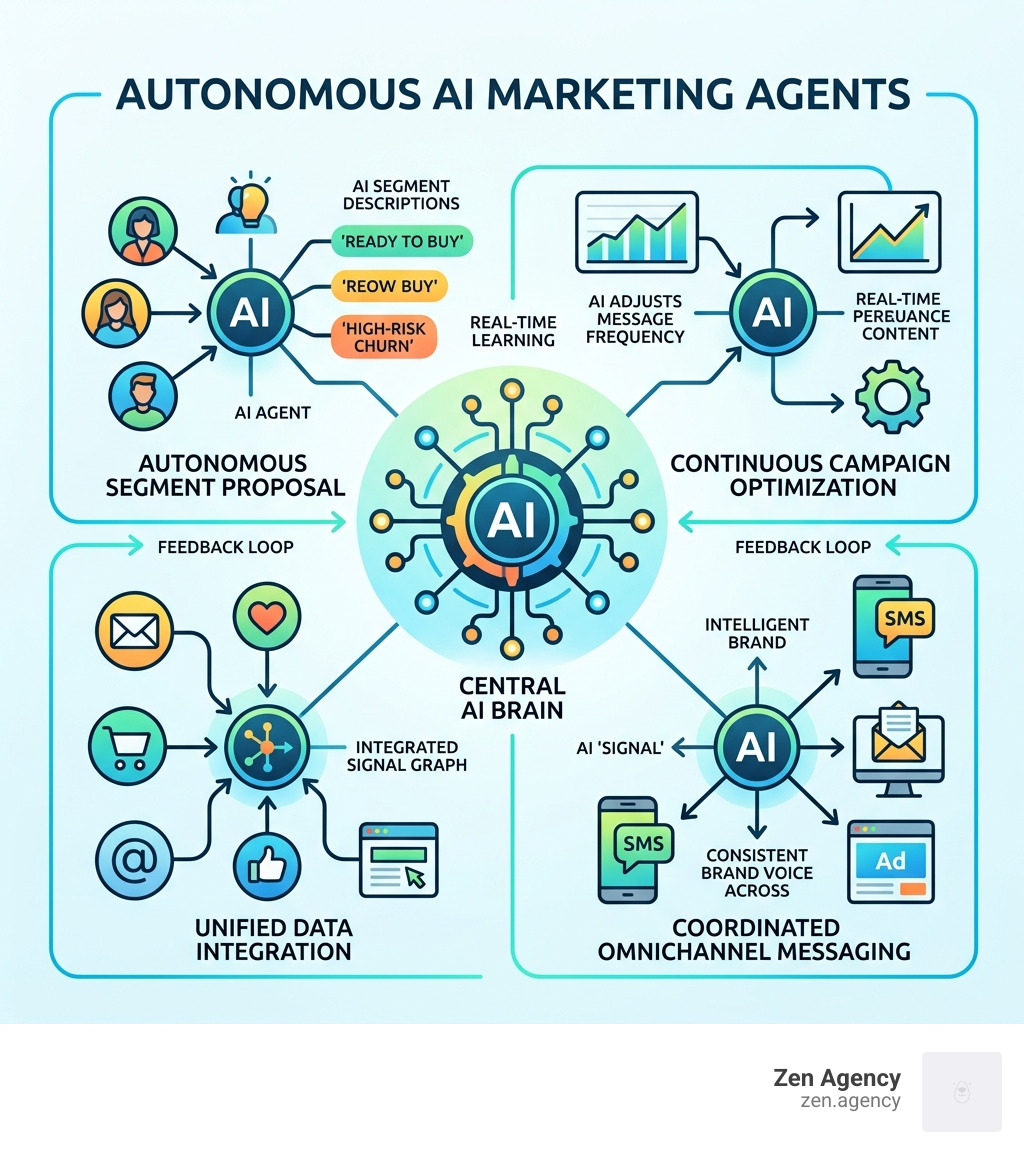
- Identity Resolution: This is the process of realizing that “John Doe” who opened an email on his iPhone is the same “J. Doe” who just added a pair of sneakers to his cart on a laptop. AI creates a unified signal graph for every individual.
- Pattern Recognition: Machine learning algorithms scan hundreds of attributes simultaneously. While a human might look at three variables, the AI looks at 500.
- Segment Creation: The AI identifies clusters of users with similar behaviors and assigns them to segments.
- Activation: These segments are pushed directly into your marketing tools (like Mailchimp or Braze) to trigger personalized journeys.
Predictive Modeling in AI Customer Segmentation
The real power of AI customer segmentation isn’t just knowing what customers did, but what they are going to do. This is where predictive modeling comes in.
- Propensity Scoring: AI assigns a score to every customer based on their likelihood to perform an action, such as making a purchase in the next 14 days.
- Churn Prevention: By identifying subtle patterns that precede a cancellation, we can intervene with a retention offer before the customer even realizes they’re unhappy.
- LTV Forecasting: We can predict the Lifetime Value of a new lead on day one based on how they interact with your site, allowing us to prioritize high-value prospects.
From Natural Language to Actionable Audiences
One of the most exciting developments in 2026 is the use of Generative AI to build segments. You no longer need to be a SQL expert or wait for the data team to run a report.
Modern platforms allow for “agentic discovery.” You can simply type: “Find me customers in Montana who haven’t purchased in 60 days but have a high predicted LTV and recently engaged with our sustainability blog.” The AI understands your data schema and builds that segment instantly. This shifts the marketer’s role from “data fetcher” to “strategist.”
Key Benefits of Moving Beyond Static Lists
If you’re still using static lists, you’re essentially marketing to ghosts — people who occupied a certain state weeks ago but have moved on. AI customer segmentation provides a competitive edge that traditional methods can’t touch.
| Feature | Traditional Method | AI-Powered Method |
|---|---|---|
| Precision | Broad (e.g., “All Women 18-35”) | Granular (e.g., “High-intent cart abandoners”) |
| Logic | Rigid and manual | Flexible and self-learning |
| Efficiency | High manual effort | Automated and scalable |
| Outcomes | Reactive | Proactive/Predictive |
According to AI-powered consumer segmentation: PwC, moving to AI-driven models allows organizations to make decisions in minutes rather than days, broadening access to insights for non-technical teams.
Accelerating Marketing ROI
When you target the right people, your costs go down and your revenue goes up. Research shows that AI-driven marketing can reduce customer acquisition costs by as much as 50% and deliver 20% higher conversion rates.
Furthermore, Treasure Data’s AI agents have been shown to accelerate marketing campaign planning by 3x. Instead of spending weeks debating who to target, we let the data tell us who is ready to buy. This “speed to insight” is a game-changer for businesses in Wyoming, PA, or Billings, MT, that need to stay agile in a fast-moving market.
Enhancing Omnichannel Consistency
Customers don’t live in silos, and your marketing shouldn’t either. AI customer segmentation provides a “next-best-action” brain that coordinates your messaging across email, SMS, social ads, and your website.
If a customer is flagged as “high-risk” for churn, they shouldn’t see a generic promotional ad on Instagram while receiving a “we miss you” email. AI ensures that the unified signal graph keeps your brand voice consistent across every channel, providing a seamless contextual marketing experience.
Overcoming Implementation Challenges and Data Privacy
We know what you’re thinking: “This sounds great, but is it safe? And is it hard to set up?” These are valid concerns. At Zen Agency, we focus on helping businesses navigate these hurdles without sacrificing security or performance.

Solving the Data Quality Gap
AI is only as good as the data you feed it. If your CRM is a mess of duplicates and outdated records, the AI will produce “hallucinations” — segments that don’t actually exist.
The first step is always data hygiene. We focus on leveraging first-party data (data your customers give you directly) and implementing robust consent management. This ensures you’re compliant with regulations like GDPR and CCPA while building a “clean” foundation for your machine learning models.
Mitigating Algorithmic Bias
One of the risks of AI customer segmentation is algorithmic bias. If a model is trained on biased historical data, it might unfairly exclude certain groups.
To prevent this, we advocate for “Explainable AI.” You should use tools that don’t just give you a list of names, but show their “work” — explaining why a customer was placed in a specific segment. Regular fairness audits and human oversight are essential. AI should be your co-pilot, not an unsupervised driver.
The Future: Agentic and Autonomous Systems
As we look toward the end of 2026 and beyond, we are entering the era of “agentic marketing.” We are moving past simple automation into systems where AI agents can autonomously propose, test, and optimize segments.
Getting Started with AI Customer Segmentation
For “struggling-to-scale” businesses, the jump to AI can feel daunting. You don’t need a perfect, massive data lake to start. Here is our recommended path:
- Data Audit: Identify where your customer data currently lives (Shopify, Mailchimp, CRM).
- Pilot Use Case: Choose one high-impact goal, like “Predictive Churn” or “VIP Identification.”
- Scalability: Use enterprise-grade solutions that grow with you. At Zen Agency, we specialize in implementing these strategies for businesses in locations like Wilkes Barre and Scranton, PA, ensuring they have the same tools as global giants.
Preparing for Autonomous Personalization
The future isn’t about reducing your marketing team’s headcount; it’s about “headspace expansion.” By letting “AI Workers” handle the granular task of sorting millions of data points into segments, your team is free to focus on high-level strategy and creative storytelling.
Setting strategic guardrails is key. You define the brand voice and the legal constraints, and the AI finds the most efficient way to reach your goals within those boundaries.
Frequently Asked Questions about AI Segmentation
What is AI customer segmentation?
It is the process of using machine learning and artificial intelligence to divide a customer base into groups based on shared characteristics. Unlike traditional methods, it uses automated grouping to find complex behavioral patterns that humans might miss, such as purchase frequency combined with web browsing depth and sentiment analysis.
How does AI segmentation differ from traditional methods?
Traditional segmentation is static, manual, and often based on broad demographics (age, location). AI customer segmentation is dynamic, automated, and based on intent and behavior. It updates in real time, whereas traditional lists often sit stale for months.
What role does predictive modeling play?
Predictive modeling allows businesses to forecast future actions. It can identify which customers are at a high risk of churning, which are most likely to make a purchase in the next week, and what the long-term value of a specific segment will be. This allows for proactive rather than reactive marketing.
Conclusion
The era of manual, static spreadsheets is over. If you want to remain competitive in 2026, you must embrace the speed, precision, and adaptability of AI customer segmentation.
By moving from demographic buckets to living, breathing segments, you can unlock massive ROI, reduce wasted ad spend, and provide the hyper-personalized experiences that modern consumers demand. Whether you’re a local business in Hazleton, PA, or a growing enterprise in Montana, the technology to scale your impact is already here.
Ready to see how AI can transform your bottom line? Explore our insights on AI Vision: Transforming E-commerce and start your journey toward smarter, faster growth today. At Zen Agency, we provide the enterprise-grade solutions you need to turn your data into your greatest competitive advantage.