Ad-vantage AI: How Smart Campaigns Win Big
Why AI Driven Ad Campaigns Are Redefining Marketing ROI
AI driven ad campaigns use machine learning, predictive analytics, and automation to optimize targeting, creative, and bidding in real time—delivering measurable performance improvements that manual campaigns simply can’t match. Here’s what you need to know:
Key Benefits of AI Driven Ad Campaigns:
- Real-time optimization – AI adjusts bids, audiences, and creative every hour vs. weekly manual cycles
- Massive cost savings – Production costs drop 90%+ (from $100k to $5-10k per campaign)
- Personalization at scale – Generate millions of unique ad variations tailored to micro-audiences
- Faster execution – Launch campaigns in days instead of months
- Proven results – Brands report 30-1082% increases in conversions, engagement, and ROI
Core Technologies:
- Generative AI (ChatGPT, Midjourney, Google Veo, Sora)
- Predictive analytics and Smart Bidding
- Generative Adversarial Networks (GANs)
- Natural Language Processing (NLP)
The numbers tell the story: AI-powered marketing campaigns generated over $100 billion in advertising value in 2025. Nike’s AI-driven campaign earned 4.2 million views in 48 hours—a 1082% increase over their typical content. Heinz generated 1 billion impressions worth 2500% more than their media investment. Kalshi produced a national TV ad for the NBA Finals in 72 hours for just $2,000—95% cheaper than traditional production.
But here’s what most marketers miss: AI isn’t magic. The brands winning big aren’t just throwing technology at their campaigns. They’re combining AI execution with human strategy, starting with clean data and clear objectives, then scaling what works through continuous testing.
I’m Joseph Riviello, CEO of Zen Agency, and over 22 years I’ve helped hundreds of companies transform their marketing performance through strategic innovation—now including AI driven ad campaigns that multiply creative output while maintaining brand integrity. This guide will show you exactly how to leverage AI for measurable advertising wins, from the technologies powering breakthrough campaigns to step-by-step implementation strategies.
The Mechanics of AI Driven Ad Campaigns
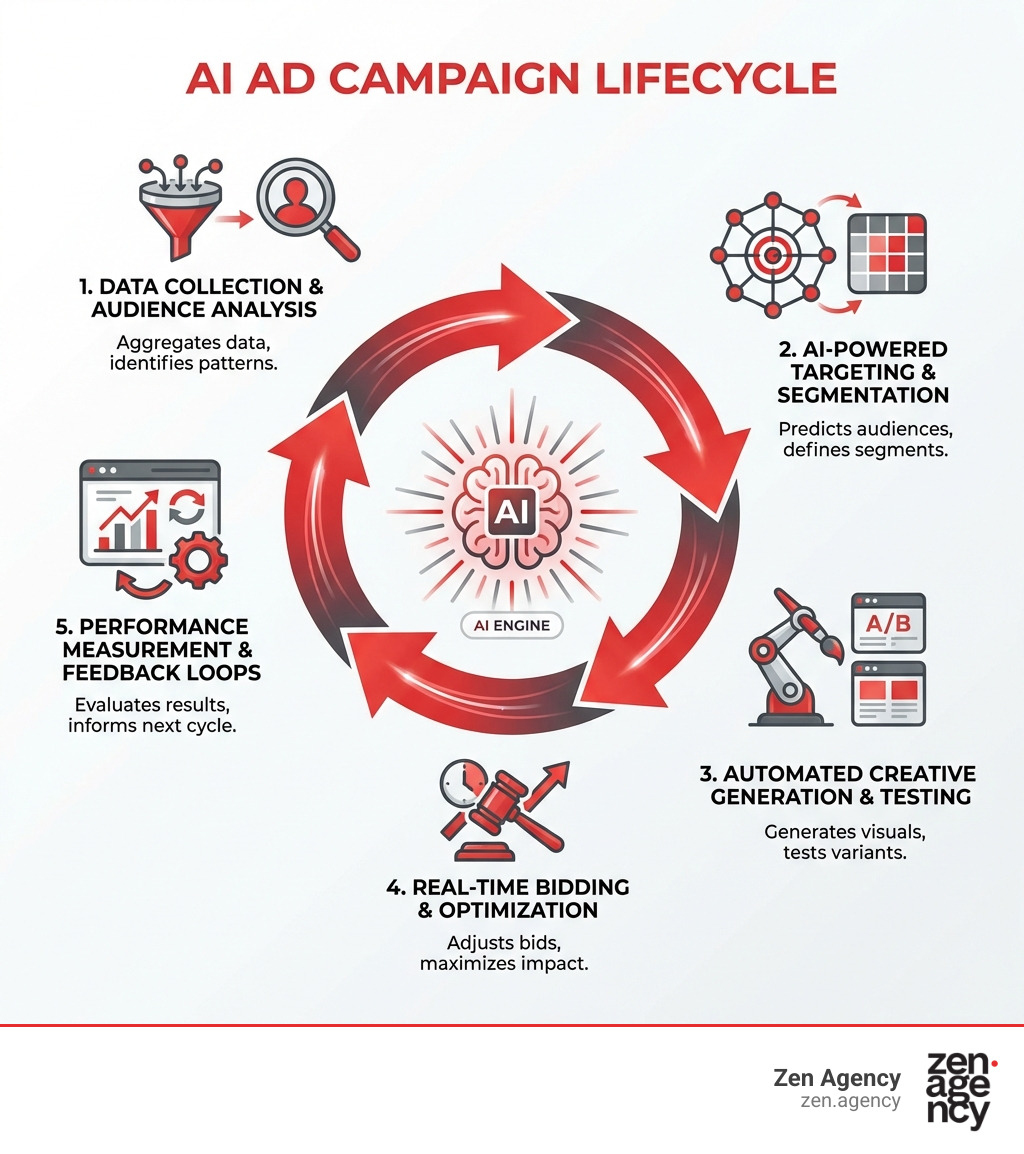
To understand why AI driven ad campaigns are so effective, we have to look under the hood. Traditional advertising relies on human intuition and manual adjustments. A marketer might check a campaign once a day (or once a week), look at the data, and decide to increase a bid or change a headline. By the time that change is made, the market has already moved.
AI changes the game by operating at a speed and scale that humans simply can’t reach. It uses neural networks to connect thousands of consumer touchpoints simultaneously. This allows for real-time bidding, where the AI evaluates billions of signal combinations to decide exactly how much to pay for a specific ad placement in milliseconds.
From Broad Buckets to Behavioral Micro-Audiences
One of the most powerful shifts is how we target people. Traditional campaigns often use broad demographics—like “Women aged 25-34 in Pennsylvania.” AI, however, builds behavioral micro-audiences. It looks at patterns: what someone searched for, which pages they visited, and even the “sentiment” of their recent interactions.
By using Natural Language Processing (NLP) and audience modeling, we can identify high-value users who are actually ready to buy, rather than just anyone who fits a generic age bracket. This level of precision is exactly how AI is transforming SEO strategies for better rankings and higher conversion rates.
| Feature | Traditional Manual Targeting | AI-Driven Autonomous Optimization |
|---|---|---|
| Optimization Cycle | Weekly or Daily | Real-time (Milliseconds) |
| Audience Reach | Static Demographics | Dynamic Behavioral Micro-Audiences |
| Bidding | Manual Caps/Adjustments | Value-based Smart Bidding |
| Creative Testing | A/B Testing (2-3 variants) | Multivariate Testing (Thousands of variants) |
| Data Usage | Historical Reports | Always-on Feedback Loops |
The Power of Data Feedback Loops
In an AI-driven ecosystem, every interaction is a lesson. If a user in Scranton clicks an ad but doesn’t buy, the AI records that. If a user in Billings, MT, watches a video ad to the end, the AI learns what visual elements kept them engaged. These continuous data feedback loops allow the campaign to self-correct. It’s not just “set it and forget it”; it’s “set it and let it get smarter.”
Breakthrough Examples of AI-Powered Success in 2025
The year 2025 has seen AI driven ad campaigns move from experimental novelties to the gold standard for global and local brands alike. We’ve seen a shift where AI isn’t just assisting the creative process—it’s running the show in ways that are playful, surprising, and incredibly efficient.
Nike’s “Never Done Evolving”
Nike used AI to simulate a virtual tennis match between Serena Williams at age 17 and age 35. By analyzing archival footage, the AI recreated her movements and playing style from different eras. The results were staggering: 4.2 million views in the first 48 hours and a massive 1082% increase in organic views compared to their non-AI content. This wasn’t just a gimmick; it was a masterclass in using AI for emotional storytelling.
Heinz AI Ketchup
Heinz tapped into the “cultural brain” of AI by asking image generators to simply draw “ketchup.” When the AI consistently produced images that looked exactly like Heinz bottles, the brand turned those AI-generated visuals into a campaign. This effort earned over 1 billion impressions, proving that AI can reinforce brand identity through user-generated content and surreal visuals.
The Kalshi NBA Finals Ad
Perhaps the most disruptive example for small-to-medium businesses is the Kalshi NBA Finals ad. Using Google Veo, the team produced a national TV spot in just 3 days for a total of $2,000. For context, a traditional national TV ad usually costs seven figures and takes months to produce. That is a 95% reduction in production costs, making primetime advertising accessible to brands that previously couldn’t afford the entry fee.
Localized Ad Scaling
For organizations like the British Council, AI solved the massive headache of localization. By using AI to adapt ads for 100+ different countries, they achieved a 70% reduction in content creation costs and a 50% faster turnaround time. This allows brands to feel “local” in every market, from Pennsylvania to Montana, without needing a massive army of designers for every region.
Scaling Personalization with AI Driven Ad Campaigns
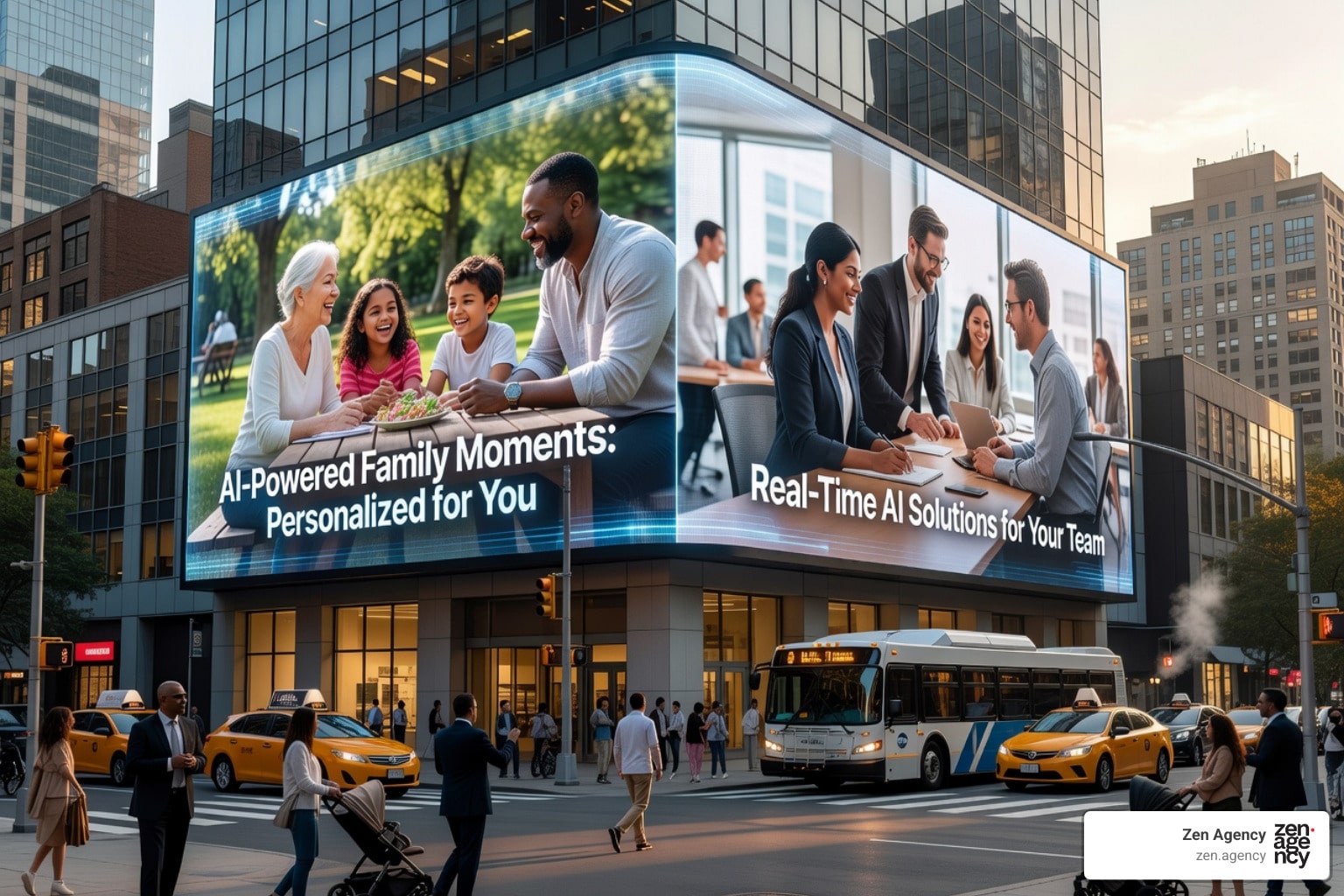
The true “holy grail” of marketing is hyper-personalization—showing the right message to the right person at the exact moment they need it. AI driven ad campaigns make this possible through Dynamic Creative Optimization (DCO).
Take Nutella, for example. They used AI to generate seven million unique jar designs. This turned a commodity product into a collectible, driving a massive sales lift because every customer felt they had something one-of-a-kind. Similarly, brands are leveraging AI in WooCommerce to recommend products based on real-time behavior, wine pairings, or even conversation tips for a date night.
To keep these millions of variations brand-safe, we implement brand-safe QA layers. These are “guardrail” AIs that check every generated image or text against your brand guidelines before it ever reaches a customer’s screen. This ensures you get the benefits of creative abundance without the risk of “brand drift.”
Essential Technologies Powering Modern Advertising
The magic behind these campaigns isn’t just one tool; it’s a stack of specialized technologies working in harmony. If you’re looking to launch your own AI driven ad campaigns, these are the names you need to know.
Generative Adversarial Networks (GANs)
GANs are essentially two AIs that work against each other to create something perfect. One AI generates a campaign configuration or an image, and the “discriminator” AI tries to find flaws in it. This process continues until the output is indistinguishable from human-made quality. We use these to generate thousands of campaign configurations that are predicted to deliver the highest ROI.
Generative Video and Audio
Tools like Google Veo, Sora, Runway, and Kling are revolutionizing video. You can now generate high-quality, cinematic video ads from a simple text prompt. When you combine this with synthetic voiceovers from platforms like ElevenLabs, you can produce a full commercial—complete with music and narration—in a fraction of the time it used to take. Many marketers are asking, are AI video editing tools the future of content creation? The answer is a resounding yes, as they allow for rapid iteration and testing that was previously impossible.
Creative Automation
Platforms like Visual Electric and Leonardo.ai allow us to build cohesive visual worlds. Instead of shooting one photo of a product, we can generate that product in a thousand different settings—a beach in Hawaii, a cozy cabin in Montana, or a sleek office in Scranton—all without leaving the desk.
Google’s Vision for AI Driven Ad Campaigns in 2026
Google is currently rebuilding its entire advertising infrastructure around what they call “the agentic era.” According to Google’s 2026 advertising redesign, the future of shopping will be driven by AI agents that assist, recommend, and complete transactions for the user.
Key developments to watch include:
- Universal Commerce Protocol (UCP): A new standard that allows for seamless browsing and “embedded checkout” directly within an AI chat or search result.
- Performance Max: A single campaign type that uses AI to find your highest-value customers across all of Google’s surfaces—Search, YouTube, Display, and Maps.
- Search Generative Experience (SGE): Ads will no longer just be links at the top of the page; they will be integrated into the conversational AI snapshots, providing customized offers at every step of the search journey.
Best Practices for Launching and Optimizing Your Strategy
Success with AI driven ad campaigns requires more than just a subscription to a few tools. It requires a foundational shift in how you approach your marketing data and team structure.
1. Prioritize Data Hygiene and First-Party Data
AI is only as good as the data you feed it. We always recommend starting with a robust foundation of first-party data. This means using your own customer lists (from your CRM or WooCommerce store) to train the AI on what a “good” customer looks like. Ensure you have sitewide tagging, such as the Google tag and Enhanced Conversions, to capture the signals that matter most.
2. Implement Value-Based Smart Bidding
Don’t just bid for clicks; bid for value. By assigning different values to different actions (e.g., a newsletter signup is worth $5, but a product purchase is worth $100), you allow the AI to optimize for the conversions that actually drive your bottom line. This is a core part of how AI agents are revolutionizing marketing strategies today.
3. Maintain Human-in-the-Loop Oversight
AI is an incredible execution engine, but it lacks strategic judgment and emotional nuance. We believe the best campaigns are “AI-powered, human-steered.” Your team should define the creative vision, set the guardrails, and provide the high-quality creative inputs that the AI then scales.
4. Foster a Culture of Experimentation
The biggest mistake you can make is trying to launch a “perfect” campaign. Instead, launch multiple variations, test them, and let the AI tell you what works. Use “seasonality adjustments” for short-term events like holiday sales in Pennsylvania or local festivals in Montana to give the AI a heads-up on expected traffic spikes.
5. Privacy-First Frameworks
With the phase-out of third-party cookies, your AI driven ad campaigns must be built on privacy-safe frameworks. Use Consent Mode and data exclusions to ensure you are respecting user privacy while still gathering the insights needed to optimize performance.
Frequently Asked Questions about AI Advertising
What is the measurable ROI of AI-driven ad campaigns?
While results vary by industry, the data from 2025 is clear. Brands using AI for production have seen costs drop by 90% or more. In terms of performance, AI-powered Search campaigns often see a 15-30% lift in conversions compared to manual campaigns. For example, tails.com tripled their dog food subscriptions by switching to an AI-powered “broad match” strategy combined with Smart Bidding.
How do I maintain brand integrity when using generative AI?
Brand integrity is maintained through strict creative parameters and “human-in-the-loop” reviews. You should provide the AI with specific brand guidelines, approved color palettes, and tone-of-voice documents. Using “pinnable” assets in responsive search ads also allows you to ensure that mandatory brand language always appears in specific positions.
What are the biggest pitfalls to avoid in AI-powered marketing?
The most common pitfalls include:
- Poor Data Quality: Feeding the AI “dirty” or incomplete data leads to poor optimization (the “garbage in, garbage out” principle).
- Over-Automation: Letting the AI run entirely without human oversight can lead to “uncanny valley” creative or off-brand messaging.
- Lack of Internal Readiness: Not having the technical infrastructure (like Google Analytics 4) to track the data the AI needs to learn.
Conclusion
The future of advertising isn’t just coming—it’s already here. By 2026, we expect to see fully autonomous campaign operations where AI agents don’t just show ads, but actively negotiate and complete purchases on behalf of consumers. For businesses looking to scale, the “Ad-vantage” of AI is no longer optional; it is the primary driver of growth in a crowded digital landscape.
At Zen Agency, we specialize in building these enterprise-grade AI strategies for brands that are ready to move beyond basic ads and into the era of AI Vision: Transforming eCommerce. Whether you are located in Wilkes Barre, Scranton, or Billings, MT, our team is dedicated to helping you increase your visibility, profitability, and ROI through innovative, AI driven ad campaigns.
Are you ready to stop guessing and start winning with data-driven precision? Let’s build your first AI-powered campaign together and see how far your marketing can go.