A Practical Guide to AEO, GEO, and AI Search Optimization
The Debate Is Over: Google Frames AEO and GEO as Part of SEO
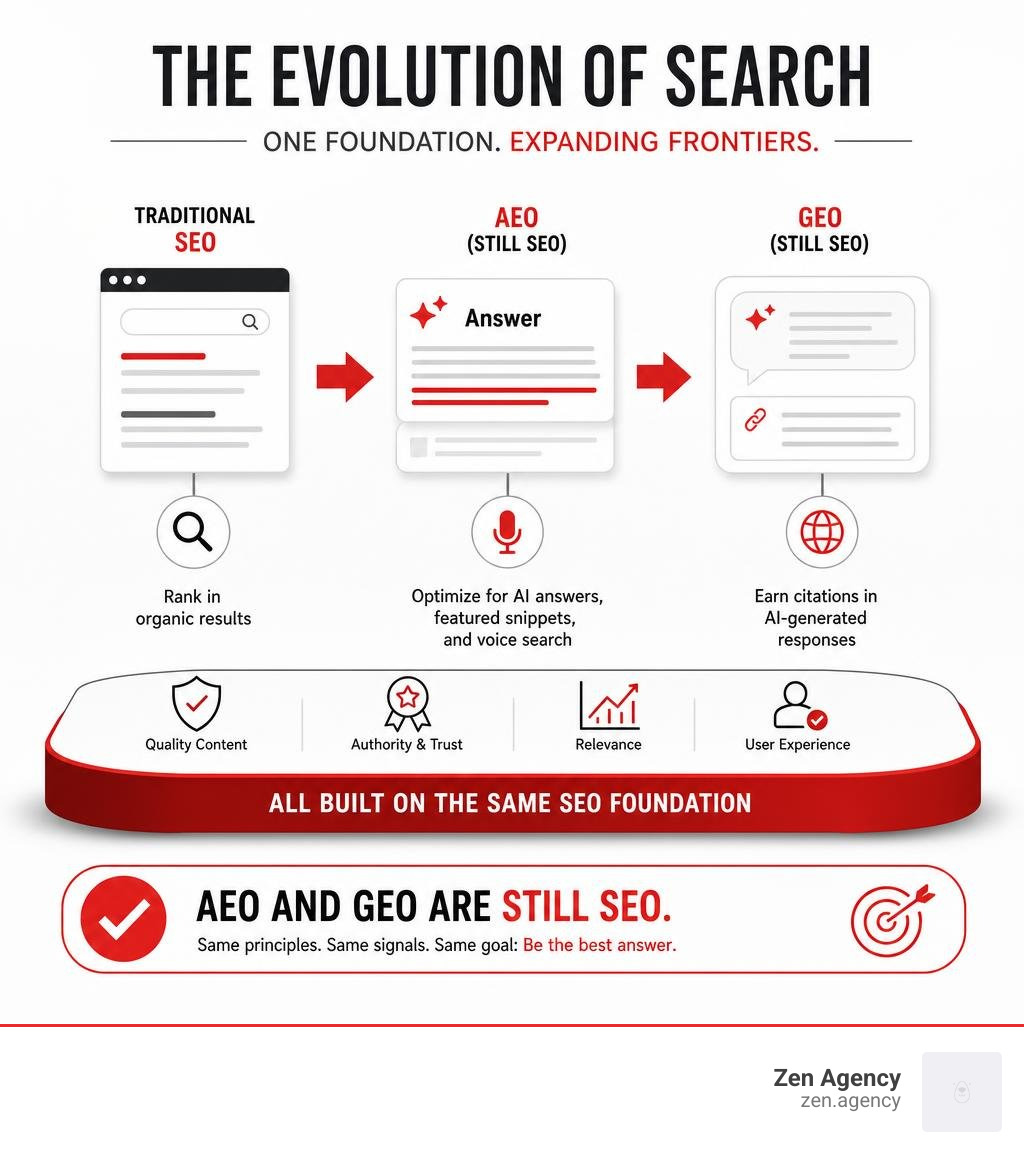
As of June 2026, Google’s AI search guidance makes one thing clear: Answer Engine Optimization and Generative Engine Optimization are not separate disciplines. They are simply SEO applied to AI-powered search features.
Here is what that means in plain terms:
| Term | What It Is | Google’s Position |
|---|---|---|
| AEO | Optimizing for featured snippets, voice search, AI answers | Part of SEO |
| GEO | Optimizing for citations in AI-generated responses | Part of SEO |
| Traditional SEO | Ranking in organic search results | Still the foundation |
Google published its official AI search optimization guide in May 2026, placing it directly within the Search Central documentation — the same home as its core SEO guidance. Now, in June 2026, the practical takeaway for marketers is clear: the same ranking systems, quality signals, and content principles that drive organic search also influence visibility in AI Overviews and AI Mode.
If you have been paying for a separate “AI Overview optimization” retainer, this guide changes the conversation.
AI Mode now reaches over one billion monthly users, with queries more than doubling every quarter. The stakes for getting this right have never been higher — and the good news is that what you need to do is less complicated than the industry has made it seem.
I’m Joseph Riviello, CEO and Founder of Zen Agency, with over 22 years of experience helping businesses scale through digital marketing strategies — including navigating every major shift in how Google ranks and surfaces content. Google’s clarification that AEO and GEO belong under the SEO umbrella is one of the most useful moments I’ve seen in this industry, and what follows is a practical June 2026 breakdown of what it means for your business and what to do next.
Google’s AI Search Guidance Puts AEO and GEO Under the SEO Umbrella
When Google published its first official AI search guide on the Search Central Blog, it sent a shockwave through the digital marketing industry. For the past two years, self-proclaimed “AI-SEO” gurus have been pitching expensive, specialized services claiming that traditional SEO was dead, replaced by entirely new playbooks.
Google’s documentation firmly put those claims to rest.

According to the official guide, generative AI features like AI Overviews and AI Mode are built directly on top of Google’s core ranking and quality systems. This means that appearing in an AI-generated summary isn’t about finding a secret back door; it’s about the same fundamental search performance that has always mattered. As reported in the industry analysis of Google’s AI search guidance and the role of AEO and GEO in SEO, the algorithms that decide which websites to cite in AI Overviews rely on the same crawlability, indexation, and authority signals that traditional search has used for years.
For businesses trying to scale, this is incredibly reassuring news. You do not need to throw out your marketing playbook or hire a boutique agency that only focuses on prompt engineering. Instead, you need to double down on the technical health and authoritative content that form the bedrock of solid search visibility. If you need a refresher on these core principles, our comprehensive guide on SEO 101: From Zero to Search Hero is the perfect place to start.
Defining AEO and GEO in the Context of Modern SEO
To understand why Google views these concepts as part of SEO, we have to look at how AEO and GEO are defined in the wild:
- Answer Engine Optimization (AEO): This is the practice of structuring your content so that voice assistants, smart speakers, and AI search tools can easily extract direct, concise answers. If you’ve ever optimized a page to win a Google Featured Snippet or target a “People Also Ask” box, you have already done AEO.
- Generative Engine Optimization (GEO): This refers to optimizing content specifically to be cited by large language models (LLMs) like Google Gemini, ChatGPT, and Perplexity. It involves building high fact-density, clear attributions, and deep topical authority so that an AI model selects your brand as a primary source.
While some agencies treat these as separate, siloed strategies, Google’s guide explains that they are simply different surface areas of the same core discipline. As detailed in the thought-provoking piece Google confirms AEO and GEO are not standalone disciplines, treating these as disconnected specialties is a fundamental misunderstanding of how modern search engines operate. They all pull from the exact same search index.
Why Google’s AI Search Guidance Matters for Marketers
This official clarification is a massive win for transparency. Over the past couple of years, the SEO services market has been flooded with “AI Overview optimization” retainers costing thousands of dollars a month. Many of these services were selling solutions to a distinction that Google simply does not recognize.
By confirming that AI search features are rooted in traditional ranking systems, Google has shifted the competitive edge back to editorial quality and structural discipline. Consider these eye-opening statistics:
- The Search Connection: Ahrefs data reveals that 88% of the URLs cited by ChatGPT actually come directly from traditional search indexes.
- The Authority Threshold: A landmark Princeton and IIT Delhi study analyzed GEO strategies and found that adding optimization layers (like statistical specificity and named citations) only lifted citation rates by 30% to 40% on articles that already possessed foundational topical authority.
In other words, if your site lacks basic search authority and technical health, no amount of “AI-specific formatting” will get you cited. If you want to work with a partner who understands how to build real, lasting authority without the hype, explore our breakdown of The Best SEO Companies for Small Business That Actually Deliver.
Under the Hood: How Google’s AI Search Features Work
To understand why traditional SEO remains so relevant in the age of AI, we have to look at how Google’s generative features actually work under the hood. Google doesn’t just let an LLM run wild and guess the answers to search queries. Instead, it uses a process called Retrieval-Augmented Generation (RAG) combined with query fan-out.
When a user types a query into Google, the system doesn’t just hand the prompt to Gemini. First, Google’s traditional search index retrieves a set of high-quality, relevant web pages using its standard ranking algorithms. Then, the system uses “query fan-out” to break the user’s main question down into several related, multi-step sub-queries (for example, analyzing “best lawn care” might fan out into “soil pH testing,” “nitrogen fertilizers,” and “seasonal mowing heights”).
Once the search engine gathers the best search results for all of these fanned-out queries, it feeds those web pages into the LLM as the “ground truth.” The LLM then synthesizes these highly ranked pages into a cohesive, conversational summary—the AI Overview—complete with citations linking back to the source pages.
For a deeper dive into how generative AI is reshaping marketing workflows, check out our insights on From Hacking to Hypergrowth: Generative AI in Marketing.
To make this technical process easier to visualize, Google’s documentation, which you can read directly at Optimizing your website for generative AI features on Google Search , highlights how the traditional index serves as the absolute foundation for AI generation:
| Feature | Traditional Search Retrieval | RAG-Driven AI Overviews |
|---|---|---|
| Primary Goal | Find and rank the most relevant web pages for a query. | Synthesize multiple sources into a direct, conversational answer. |
| Data Source | Google’s crawled and indexed web database. | Google’s traditional search index used to “ground” the LLM. |
| How It Matches | Keywords, semantic relevance, and user intent. | Query fan-out to analyze sub-intents and synthesize multiple pages. |
| Ranking Factors | E-E-A-T, backlinks, technical health, page experience. | Core search rankings determine which pages are fed to the LLM. |
Because RAG relies entirely on the traditional search index, a page must be crawlable, indexable, and highly ranked by standard search algorithms before it can ever be used to generate an AI Overview.
Mythbusting Generative AI Search: What to Ignore
One of the most valuable parts of Google’s new guide is the “mythbusting” section. Google explicitly calls out several popular, over-hyped tactics that website owners can completely ignore. If an agency tries to sell you on these specific services, it’s a major red flag.

1. The llms.txt File
Many developers rushed to create llms.txt files—a proposed standard for providing a clean, markdown-formatted version of a website specifically for AI crawlers. Google’s guide explicitly states that Google Search does not use llms.txt files and they have zero impact on your visibility in AI Overviews or AI Mode.
2. Content “Chunking”
Some consultants claim you must break your articles into tiny, isolated text “chunks” so AI models can easily digest them. Google’s systems are highly sophisticated; they understand the natural flow, context, and nuance of a long-form page. There is absolutely no need to ruin your user experience by chopping your content into unnatural fragments.
3. Special Schema Markup for AI
While structured data (like FAQ, Product, and Article schema) is highly recommended for helping Google understand your content’s context, there is no “secret” or special schema required exclusively for generative AI. Standard schema.org markup is more than sufficient.
4. Seeking Inauthentic Mentions
Trying to game the system by paying for spammy, inauthentic mentions on obscure forums or low-quality blogs in hopes that an AI crawler will associate your brand with a keyword is a waste of time. Google’s quality systems are designed to filter out inauthentic, manipulative mentions.
5. AI-Specific Rewrites
You do not need to rewrite your entire website to sound like it was written for an AI. In fact, writing in a highly unnatural, keyword-stuffed, or robotic format will hurt your user experience and likely trigger Google’s helpful content systems, which prioritize human-first writing.
Foundational SEO and Preparing for Agentic Experiences
Now that we’ve cleared away the myths, what should we actually focus on? The answer is simple: outstanding, foundational SEO. Because Google’s generative features rely on standard indexation, your primary goal is to make sure your technical foundation is flawless and your content is genuinely helpful.
At Zen Agency, we have spent nearly two decades helping clients across the United States—from our local communities in Pennsylvania (including Scranton, Wilkes-Barre, and Wyoming PA) to businesses in Montana and beyond—build robust search strategies. Whether we are optimizing a local business’s Google Business Profile to win local map pack citations (which Google’s AI frequently pulls from to recommend local services) or structuring large e-commerce catalogs, the fundamentals remain the same.
As we look toward the future, Google’s guide also introduces initial recommendations for agentic experiences and browser agents. AI is shifting from simple Q&A engines to autonomous agents that can browse the web, compare options, and make purchases on behalf of users. These agents don’t just read text; they interact with your website by analyzing visual screenshots, inspecting the Document Object Model (DOM), and interpreting your site’s accessibility tree.
To ensure your brand is ready for both human searchers and autonomous AI agents, we recommend aligning your strategy with the comprehensive frameworks found in The Only Digital Channel Marketing Guide You Will Ever Need.
To help you prioritize your efforts, here is our checklist of essential foundational SEO practices that directly drive AI search visibility:
- Establish Strong E-E-A-T: Make your real-world expertise clear. Include detailed author bios, link to primary sources, and show verifiable credentials.
- Write Clean, Semantic HTML: Use logical heading hierarchies (H1, H2, H3) and clean paragraph structures. This helps both Google’s RAG systems and autonomous browser agents easily parse your pages.
- Optimize Your Technical Health: Ensure fast page speeds, excellent Core Web Vitals, and mobile-first responsiveness. A poor page experience will prevent indexing.
- Leverage Standard Structured Data: Implement Article, Product, LocalBusiness, and FAQ schema to give search engines explicit context about your content.
- Maintain Your Local and E-Commerce Feeds: Keep your Google Business Profile updated and ensure your Merchant Center feeds are clean. Google’s AI agents rely heavily on these feeds, especially when utilizing the Shopify-supported Universal Commerce Protocol (UCP).
Frequently Asked Questions about AI Search Optimization
What is the difference between commodity and non-commodity content?
Commodity content is generic, surface-level information that can be easily found on hundreds of other websites (e.g., “7 Tips for First-Time Homebuyers”). AI engines can easily generate this themselves, meaning they have no reason to cite your page. Non-commodity content, on the other hand, features unique viewpoints, original data, first-hand case studies, or deep expert analysis (e.g., “Why We Waived Our Home Inspection and Saved $15,000: An Inside Look at Our Sewer Line”). This is the highly valuable, unique information that AI engines must cite to back up their claims.
Do I need to allow AI crawlers in my robots.txt file?
Yes, if you want your brand to be cited across a wide variety of AI platforms. While Google’s AI features rely on the main Googlebot crawler, other popular tools like ChatGPT and Perplexity use specific crawlers such as GPTBot and Google-Extended (for Gemini’s non-search training). Blocking these crawlers in your robots.txt file might protect your content from being used to train models, but it will also prevent those platforms from citing your business and sending you highly qualified referral traffic.
How do AI Overviews affect organic click-through rates?
AI Overviews do have a measurable impact on user behavior. Studies indicate that AI Overviews can reduce click-through rates for top-ranking organic content by up to 58% on highly informational queries, as users often find their answers directly on the search page. However, the citations that do appear in AI Overviews are highly targeted. Because nearly 40% of Google’s AI Overview citations overlap with the top 10 organic results, maintaining your traditional organic rankings remains the best way to secure these high-value, high-converting AI citations.
Conclusion
As of June 2026, Google’s AI search guidance brings a welcome dose of reality to a noisy marketing landscape. By making clear that optimization for generative AI search belongs within the broader practice of SEO, Google has reminded us that there are no shortcuts to search visibility. Success in 2026 and beyond still belongs to brands that build fast, technically sound websites and populate them with genuinely helpful, expert-driven content.
At Zen Agency, we specialize in cutting through the hype to deliver enterprise-grade digital marketing and custom web development solutions that actually scale your business. Whether you are looking to secure your presence in Google’s local map packs, optimize your e-commerce platform for autonomous browser agents, or build a robust content strategy that commands authority, we are here to help.
Ready to future-proof your search strategy? Explore More info about digital marketing services and let’s start building your digital authority today.