Conversational AI in Ecommerce: Benefits Guide
How Conversational AI in Ecommerce Is Changing the Way People Shop
Conversational AI in ecommerce is the use of AI-powered chat, voice, and messaging tools to help customers discover products, get answers, and complete purchases — all through natural conversation, without navigating a traditional website.
Here’s what you need to know at a glance:
- What it is: AI-driven assistants (chatbots, voice agents, in-chat shopping) that talk with customers in real time
- How it differs from old chatbots: Traditional chatbots follow rigid scripts; conversational AI understands intent, learns over time, and responds naturally
- Key benefits: Higher conversions, reduced cart abandonment, 24/7 support, and personalized recommendations at scale
- Where it’s used: On-site chat, messaging apps (WhatsApp, Facebook Messenger), voice assistants (Alexa, Siri), and now directly inside tools like ChatGPT and Google Gemini
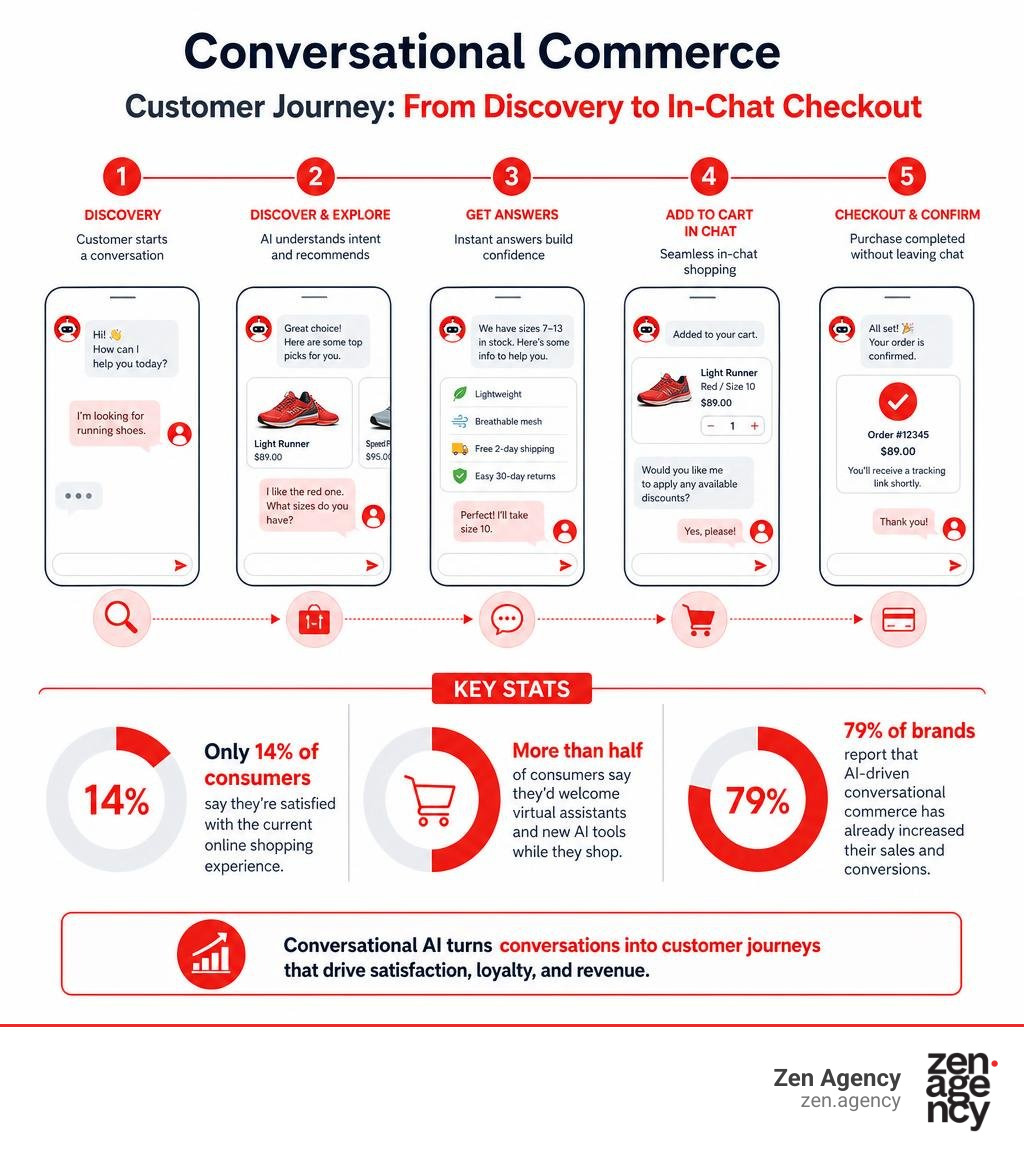
- Why it matters now: 79% of brands report that AI-driven conversational commerce has already increased their sales and conversions
The numbers tell a clear story. Only 14% of consumers say they’re satisfied with the current online shopping experience. At the same time, more than half say they’d welcome virtual assistants and new AI tools while they shop. That’s a massive gap — and conversational AI is built to close it.
Businesses that get this right aren’t just improving customer service. They’re turning conversations into revenue.
I’m Joseph Riviello, CEO and Founder of Zen Agency, with over 22 years of experience helping businesses grow through digital strategy and emerging technology — including implementing conversational AI in ecommerce environments to drive measurable results. In the sections below, I’ll walk you through everything you need to know to evaluate, implement, and measure conversational AI for your store.
Basic Conversational AI in ecommerce vocab:
What is Conversational Commerce and How Does It Differ From Traditional Chatbots?
Conversational commerce is the process of using automated customer interactions and AI technologies to create highly engaging customer experiences when shopping online. It meets customers where they already spend their time: in messaging apps, on-site chat windows, and voice assistants.
But there is a massive difference between the clunky chatbots we all used to tolerate and modern conversational AI in ecommerce. Comparing old chatbots to modern conversational AI is like comparing a pocket calculator to a MacBook.
Old chatbots relied on rigid, pre-programmed decision trees. If a customer typed something slightly outside of the script, the bot would break, repeating frustrating phrases like, “I’m sorry, I didn’t understand that.”
Modern conversational AI, on the other hand, is dynamic. It listens, chats, learns, and understands the nuances of human language. It can handle colloquialisms, slang, and highly complex, multi-layered queries.
| Feature | Rule-Based Chatbots | Conversational AI / AI Agents |
|---|---|---|
| Technology | Fixed rules, rigid decision trees | NLP, Machine Learning, LLMs |
| Understanding | Matches exact keywords | Understands intent, context, and slang |
| Flexibility | Breaks when user goes off-script | Adapts and guides the conversation |
| Learning | Requires manual updates by engineers | Learns and refines itself automatically |
| Scope | Basic FAQ deflection | Full shopping journey, discovery to checkout |
The Evolution of Conversational AI in ecommerce
The evolution of conversational commerce has been accelerated by breakthroughs in Natural Language Processing (NLP), Machine Learning (ML), and Generative AI.
Initially, chatbots were simply support-ticket deflection tools. Today, they have evolved into autonomous digital shopping assistants. As outlined in Why Conversational Commerce Is More Than a Chatbot – Bloomreach , conversational AI can speak in a consistent brand voice, synthesize real-time customer data, and guide shoppers through their entire customer journey.
Rather than forcing users to navigate complex menu bars and apply endless sidebar filters, AI allows shoppers to state what they want in plain English and receive curated recommendations instantly.
Rule-Based Chatbots vs. AI-Native Shopping Agents
AI-native shopping agents utilize advanced intent classification and semantic analysis to determine exactly what a customer is looking for.
For example, if a customer tells a rule-based chatbot, “I need a warm winter coat for a trip to Chicago, but nothing too bulky,” the traditional bot might get confused by the negation (“nothing too bulky”) and recommend heavy, insulated arctic parkas because of the keyword “warm.”
An AI-native agent understands the context. It can perform multi-step reasoning, cross-reference the live product catalog, read customer reviews to verify the warmth and fit of various coats, and recommend a sleek, windproof wool-blend coat that matches the buyer’s exact aesthetic and functional requirements.
Furthermore, these agents maintain context retention. If a returning shopper resumes a session, the AI remembers their past preferences, previous purchases, and cart items, eliminating the disconnected experience that makes 55% of customers feel like they are communicating with separate departments rather than one unified brand.
Key Benefits of Conversational AI in ecommerce

Implementing conversational AI in ecommerce is one of the fastest ways to scale your business, improve customer retention, and drive sales conversions.
Driving Conversions and Reducing Cart Abandonment
Cart abandonment is a multi-trillion-dollar problem for online retailers, often caused by search friction and checkout hurdles. Conversational AI acts as an interactive sales associate that proactively resolves friction before a shopper decides to leave.
If a customer lingers on a product page or hesitates at checkout, an AI agent can step in to ask if they have questions about sizing, materials, or shipping. By integrating with payment systems, the AI can even offer direct checkout links or clarify payment options inside the chat window.
To explore more ways to optimize your checkout flow and boost overall site performance, check out our guide on The ultimate playbook to skyrocket ecommerce conversion rates.
Enhancing Customer Experience and Brand Loyalty
Customer loyalty is built on trust, personalization, and speed. Studies show that 88% of e-commerce customers are willing to pay more for great customer experiences, and 72% of consumers are more likely to be loyal to a brand that offers a personalized experience.
Conversational AI delivers this personalization at scale. By analyzing customer data, browsing history, and real-time inputs, the AI can offer tailored recommendations, exclusive discounts, and proactive updates.
Providing 24/7 support means customers never have to wait until business hours to track a package, process a return, or ask a product question. This instant accessibility drives up customer satisfaction (CSAT) scores and turns first-time buyers into lifelong brand advocates.
Main Use Cases of Conversational AI in Retail

The applications of conversational AI span the entire customer lifecycle, from initial product discovery to post-purchase support.
- Guided product discovery: Helping customers find the exact product they need using natural language.
- Review summarization: Aggregating customer feedback on a product page to give shoppers quick pros and cons.
- Order tracking and updates: Providing real-time shipping milestones and delivery windows.
- Exchanges and refunds: Automating the return merchandise authorization (RMA) process directly in chat.
- Stock and inventory inquiries: Answering product availability questions and setting up restock alerts.
- Omnichannel engagement: Providing a unified shopping experience across web, SMS, WhatsApp, and social media.
Guided Product Discovery and Personalized Recommendations
Traditional ecommerce search relies on keyword matching. If a shopper types a complex query, the search engine often returns zero results or irrelevant items.
Conversational AI changes this by turning search into a dialogue. Academic research, such as the study on Wizard of Shopping: Target-Oriented E-commerce Dialogue Generation with Decision Tree Branching , shows that grounding AI dialogues in structured decision trees allows virtual assistants to ask the minimum number of clarifying questions needed to guide a customer to their ideal product.
For instance, an AI agent like Sibbi | Conversational Shopping & AI Shopping Agent | Marqo can guide a beauty shopper by asking about their skin type, main concerns, and preferred ingredients, immediately serving a curated routine instead of forcing them to browse dozens of category pages.
Autopilot Customer Support and Post-Purchase Engagement
Customer support doesn’t have to be a cost center. With conversational AI, you can automate repetitive, high-volume support queries like “Where is my order?” (WISMO), stock inquiries, and basic returns. This frees up your human support agents to focus on high-value, complex customer issues.
By automating these front-line queries, businesses can scale their operations without sacrificing the quality of their customer care. To learn how to set up these automated workflows while keeping your brand’s unique voice intact, read our guide on How to put your ecommerce support on autopilot without losing the human touch.
Challenges and Best Practices for Implementation
While the benefits of conversational AI in ecommerce are massive, successful implementation requires careful planning, robust security, and seamless system integrations.
Overcoming Integration and Data Privacy Hurdles
One of the biggest pitfalls in deploying conversational AI is failing to properly integrate the tool with your existing technology stack. To be truly effective, your AI agent must sync in real time with your product information management (PIM) system, inventory database, customer relationship management (CRM) software, and payment gateways. Without these integrations, the AI risks “hallucinating” or recommending out-of-stock items.
Data privacy is equally critical. In the United States, businesses must ensure that conversational data is securely collected, processed, and stored in compliance with relevant state and federal data protection regulations.
When planning your digital infrastructure, it is vital to work with experienced partners who understand secure API integrations and data compliance. To learn more about setting up your online store for scalable, secure growth, read our article on Unlock your e-commerce potential simple steps to increase online sales.
Implementing Conversational AI in ecommerce: Best Practices
To ensure a successful deployment, we recommend starting with a narrow, high-volume use case (such as automated order tracking or basic FAQ resolution) before expanding to full-scale conversational shopping.
According to the Conversational search developer’s guide | AI Commerce Search in Gemini Enterprise for Customer Experience | Google Cloud Documentation , developers and merchants should follow these core best practices:
- Ground responses in real-time data: Ensure your AI agent references live inventory and verified product specifications to prevent false claims.
- Design a seamless human handoff: Always give customers an easy, explicit way to connect with a human support agent if the AI cannot resolve their issue.
- Keep the interface accessible: Design your chat windows and voice prompts to be intuitive and accessible across desktop and mobile devices.
- Continuously monitor performance: Regularly review chat transcripts, track customer sentiment, and update the AI’s training data to close content and conversational gaps.
Measuring Success and the Future of Agentic Commerce
As conversational AI continues to evolve, we are moving beyond simple guided search and entering the era of agentic commerce—where AI agents can autonomously browse, negotiate, and complete transactions on behalf of users.
Key Metrics and ROI of Conversational Commerce
To justify your investment in conversational AI, you must track the right key performance indicators (KPIs). According to the Trend #2: Conversations Are the New Path to Checkout | Gorgias Report , brands adopting conversational AI are seeing massive improvements across several core metrics:
- Conversion Rate: The percentage of chat interactions that result in a purchase.
- Average Order Value (AOV): AI agents are highly effective at cross-selling and upselling by suggesting complementary products in real time.
- Customer Support Efficiency: Measuring the reduction in support ticket volume and average resolution time.
- Customer Retention and Loyalty: Tracking repeat purchase rates and post-interaction CSAT scores.
For many brands, deploying an advanced conversational assistant like the Loomi Conversational Agent | AI Shopping Assistant has led to immediate, measurable ROI, including double-digit increases in conversion rates and revenue per visitor.
The Future of Autonomous Shopping and In-Chat Checkout
The future of ecommerce is completely frictionless. Major brands are already paving the way by integrating their shopping experiences directly into the world’s leading AI platforms.
For instance, as highlighted in the Target Shopping Experiences in Conversational AI announcement, shoppers can now search, build baskets, apply loyalty rewards, and check out from major retailers directly inside ChatGPT, Google Gemini, and Microsoft Copilot.
With secure, tokenized payment integrations like PayPal, Venmo, and passkey checkouts, consumers can complete their entire shopping journey without ever leaving the chat interface. Voice shopping is also going mainstream, with smart assistant users regularly using voice commands to reorder everyday essentials hands-free.
Frequently Asked Questions
What is the difference between conversational AI and traditional chatbots?
Traditional chatbots rely on rigid, pre-programmed rules and decision trees. They can only respond to exact keyword matches and easily break when a user goes off-script. Conversational AI uses natural language processing (NLP), machine learning, and large language models (LLMs) to understand human intent, retain context across devices, and generate natural, helpful responses.
How does conversational AI improve personalization in online shopping?
Conversational AI analyzes real-time customer inputs, past purchase history, and browsing behavior to tailor recommendations to each individual shopper. Instead of showing generic product lists, the AI acts as a personal digital stylist, recommending items based on specific customer preferences, sizing, and use cases.
Can conversational AI handle secure checkouts directly in chat?
Yes. Modern conversational AI integrations support secure, tokenized checkout protocols. By syncing with trusted payment gateways (like PayPal, Venmo, and credit card processors), AI agents can generate secure “Pay Now” links or process transactions directly inside the chat window using passkeys, ensuring a frictionless and secure checkout experience.
Conclusion
Conversational AI in ecommerce is no longer a futuristic concept—it is a strategic necessity for brands that want to remain competitive, scale their customer service, and maximize their online sales. By transitioning from passive, page-based websites to active, conversation-led shopping experiences, you can meet your customers’ high expectations for speed, personalization, and convenience.
At Zen Agency, we specialize in helping businesses scale through custom website development, enterprise-grade digital marketing strategies, and cutting-edge AI integrations. Whether you are looking to deploy an AI-native shopping agent, optimize your conversion rates, or build a secure omnichannel commerce system, we have the expertise to make it happen.
Are you ready to transform your online store and unlock your brand’s full potential? Discover how we can help you integrate next-generation AI tools by exploring our AI Vision for Transforming E-Commerce or contact our team today to discuss a custom strategy for your business.