
Your Blueprint for B2B Website Success
Your Blueprint for B2B Website Success
Why B2B Web Development Is the Foundation of Business Growth
B2B web development is the process of building and optimizing websites specifically for businesses that sell products or services to other businesses — covering everything from front-end design to back-end integrations with CRM, ERP, and payment systems.
Here’s what you need to know at a glance:
| Topic | Quick Answer |
|---|---|
| What it is | Building websites tailored for business buyers, not consumers |
| How it differs from B2C | Longer sales cycles, multiple decision-makers, complex integrations |
| Key features needed | Lead capture, CRM integration, gated content, custom pricing |
| Typical cost | $20,000–$70,000+, depending on complexity |
| Typical timeline | 4–12 weeks for most projects |
| Goal | Generate qualified leads and support the full buyer journey |
Your website is no longer just a digital brochure. According to McKinsey, 80% of B2B companies now treat their digital storefront with the same priority as every other sales channel. And with 94% of B2B buyers researching online before they ever speak to a sales rep, a weak website doesn’t just hurt your brand — it actively costs you deals.
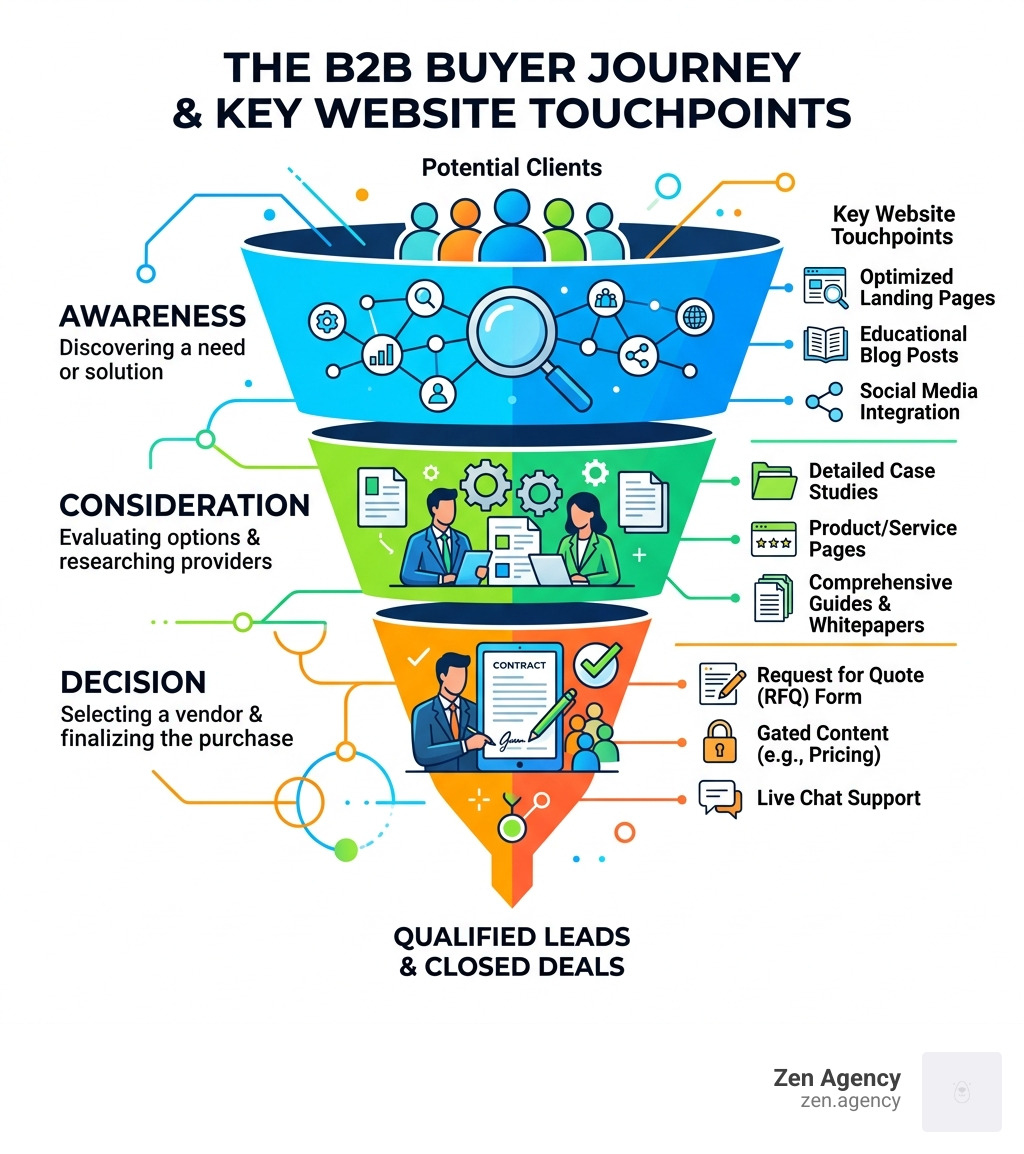
Yet most B2B websites are still built like B2C sites. That mismatch creates friction at every stage of the buyer journey. It slows down complex purchases. It fails the 6–10 stakeholders typically involved in a B2B buying decision. And it leaves serious revenue on the table.
That’s exactly the problem this guide is built to solve.
I’m Joseph Riviello, CEO and Founder of Zen Agency, with over 22 years of experience helping companies scale through strategic B2B web development and digital marketing. I’ve seen how the right website architecture transforms lead generation and revenue growth — and I’ll walk you through exactly how to build one.
Terms related to B2B web development:
The Critical Role of B2B Web Development in Modern Business
In B2B web development, the stakes are significantly higher than in the consumer retail space. While a B2C site might focus on an emotional, impulse-driven purchase of a $50 pair of shoes, a B2B platform must facilitate rational, data-driven decisions involving hundreds of thousands of dollars.
According to Forbes, 35% of corporate decision-makers are now comfortable spending $500,000 or more in a single online B2B transaction. This shift toward high-value digital commerce means your website is often your most important “salesperson.” However, Gartner research highlights a major hurdle: 77% of B2B customers describe making a purchase as “very complex or difficult.”
The primary goal of modern B2B web development is to reduce that complexity. We achieve this by understanding that we aren’t just selling to one person; we are selling to a decision-making group.
| Feature | B2C Requirements | B2B Requirements |
|---|---|---|
| Target Audience | Individual consumers | Decision-making groups (6–10 people) |
| Sales Cycle | Short (minutes to days) | Long (weeks to months) |
| Pricing | Fixed/Standard | Negotiated, volume-based, or contract-specific |
| Buying Logic | Emotional/Impulse | Rational/ROI-driven |
| Payment | Credit card/Digital wallet | Net-30, purchase orders, ACH, credit lines |
| Integrations | Simple shipping/tax | Complex ERP, CRM, and inventory sync |
Essential Features for High-Performance Platforms
To succeed, a B2B site needs functionality that goes far beyond a standard shopping cart. We focus on building “engines” that power business operations, not just pages that display text.

Key Functional Features:
- Password-Protected Access: Essential for protecting sensitive contract pricing from competitors or providing exclusive documentation to authorized dealers.
- Advanced Search & Filtering: B2B catalogs often contain thousands of SKUs. Users need to filter by technical specifications, compatibility, or part numbers.
- VAT and Tax Toggles: For companies operating across state lines or internationally, the ability to toggle tax displays or input tax-exempt IDs is critical.
- Inventory Tracking: Real-time visibility into stock levels across multiple warehouses ensures buyers can plan their own production schedules.
- Bulk Ordering & Quick-Add: Features like “upload CSV for order” or “reorder from history” save procurement managers hours of manual entry.
- Payment Portals: Support for complex financial workflows, including partial payments, credit limits, and automated invoicing.
Technical Requirements for B2B Web Development
The “back-end” is where the real work happens. We believe a website should be the central hub of your business ecosystem.
- ERP Integration: Connecting your site to systems like SAP, Oracle, or Microsoft Dynamics ensures that orders, inventory, and customer data stay perfectly in sync.
- CRM Synchronization: When a lead fills out a form, that data should flow instantly into Salesforce or HubSpot, allowing your sales team to strike while the iron is hot.
- API Connectivity: Using APIs allows your website to “talk” to third-party logistics (3PL) providers, custom pricing engines, and marketing automation tools.
- Role-Based Access: A purchasing manager might have the authority to buy, while an assistant can only build a cart for approval. Your site must support these organizational hierarchies.
Security and Compliance Standards
In B2B web development, security isn’t a “nice-to-have” — it’s a legal and professional requirement.
- SSL Certificates: The bare minimum for encrypting data between the user and the server.
- GDPR & CCPA Compliance: If you do business in Europe or California, your site must handle data privacy with extreme care.
- Enterprise-Grade Encryption: Protecting proprietary designs, contract terms, and sensitive financial data from breaches.
The Strategic Development Process
We don’t just start coding on day one. A successful B2B web development project follows a rigorous, strategic roadmap to ensure the final product actually moves the needle on your ROI.
1. Discovery and Strategy
We begin by diving deep into your business. We define your Ideal Customer Profile (ICP) and map out the user personas. Are we speaking to a CTO who cares about technical specs, or a CFO who cares about the bottom line? This phase results in a comprehensive creative brief and a technical specification document.
2. Information Architecture and Design
Before the “paint” goes on, we build the “blueprint.” This involves creating a sitemap and wireframes that dictate how a user will navigate from a blog post to a product page, and finally to a lead form.
3. Iterative Development
We use an agile approach, often working in 2-week sprints. This allows for constant feedback and adjustments. We build the front-end (what the user sees) and the back-end (the logic and database) simultaneously.
Best Practices for B2B Web Development and Design
- Mobile-First Approach: More than 50% of B2B researchers now use mobile devices. If your technical spec sheets don’t load on a phone, you’ve lost the lead.
- Responsive Design: Your site must look and function perfectly on everything from a 27-inch iMac to a 6-inch smartphone.
- Clean URLs and Semantic HTML: This isn’t just for humans; it helps search engines understand your site, which is vital for SEO.
- Custom CMS Blocks: We prefer using custom blocks in platforms like WordPress, which allow your marketing team to create new, high-quality pages without needing a developer every time.
Testing, Launch, and Optimization
Before going live, we perform exhaustive QA (Quality Assurance) testing. This includes:
- User Acceptance Testing (UAT): Ensuring the site works for the actual end-users.
- Performance Monitoring: Checking that the site can handle high traffic volumes.
- Security Audits: Scanning for vulnerabilities.
Maximizing ROI: Lead Generation and Performance
A beautiful website that nobody finds — or that takes forever to load — is a failed investment. In B2B web development, performance is directly tied to profit.
The Need for Speed
Nearly 70% of consumers say page speed impacts their willingness to buy. In B2B, time is literally money. The highest conversion rates occur on pages with load times between 0–2 seconds. Every second beyond that, your bounce rate climbs and your lead volume drops.
SEO Architecture
We bake SEO into the foundation. This includes:
- Fast Loading Times: A key Google ranking factor.
- Logic-Based Navigation: Helping search bots crawl your site efficiently.
- Keyword-Optimized Metadata: Ensuring your services appear when prospects search for solutions.
Content Strategy as a Conversion Tool
B2B buyers are hungry for information. Your website should be a library of expertise.
- Case Studies: Real-world proof that you’ve solved problems for companies just like theirs.
- Whitepapers & Gated Content: These are lead-generation gold. By offering a high-value guide in exchange for an email address, you build your sales pipeline.
- Social Proof: Displaying client logos, testimonials, and industry awards builds immediate trust.
Frequently Asked Questions about B2B Websites
How much does B2B web development typically cost?
While you can find “cheap” templates, professional B2B web development typically ranges from $20,000 to $70,000 for mid-sized businesses. For enterprise-level platforms with complex ERP integrations and custom-coded functionality, the investment can reach six figures. The cost is driven by the number of pages, the complexity of integrations, and the level of custom design required.
What is the typical timeline for a B2B website project?
A standard project usually takes between 4 to 12 weeks.
- Discovery & Design: 2–4 weeks.
- Development & Integration: 4–6 weeks.
- Testing & Launch: 1–2 weeks. For massive projects, we often recommend a Minimum Viable Product (MVP) approach — launching the core features first and then iterating based on user data.
Which CMS platform is best for B2B businesses?
We often recommend WordPress combined with WooCommerce for B2B. It offers the perfect balance of ease of use for your marketing team and extreme scalability for developers. Other strong contenders include HubSpot (for tight CRM integration) and Webflow (for highly visual, design-heavy sites). The “best” platform depends entirely on your specific technical requirements and internal team’s capabilities.
Conclusion
Building a high-performance B2B website is a journey, not a destination. It requires a blend of technical prowess, strategic marketing, and a deep understanding of the complex business buyer. At Zen Agency, we’ve spent over a decade perfecting this blueprint. We specialize in taking businesses that are struggling to scale and providing them with the enterprise-grade solutions they need to increase visibility, profitability, and ROI.
Whether you are based near our offices in Wilkes Barre, Scranton, or Billings, MT, or anywhere across the USA, we are ready to help you transform your digital presence.
If you’re ready to turn your website into your most productive sales asset, explore our B2B website design services and let’s start building your blueprint for success.
For more insights on specialized development, check out our guides on: