What Does a Simple Website Design Cost Really Include?
What a Simple Website Design Really Costs in 2026
A simple website design cost can range from under $500 for a small, template-based site with client-supplied content to roughly $500-$2,000 for a professionally built small business website. A custom design, original copy, booking tools, advanced SEO, or several unique page layouts can push the initial investment to $3,000 or more.
Before comparing quotes, separate the budget into two parts:
- One-time build costs: strategy, design, development, content setup, forms, and launch.
- Ongoing costs: domain renewal, hosting, software licenses, backups, security updates, and support.
The important question is not just, “What is the price?” It is, “What work, ownership, and post-launch support does that price include?” Two quotes may look similar while covering very different levels of design, functionality, and accountability.
I am Joseph Riviello, CEO and Founder of Zen Agency, with more than 22 years in digital marketing and growth strategy. I help businesses assess simple website design cost in the context that matters most: building a site that supports visibility, leads, conversions, and long-term revenue.
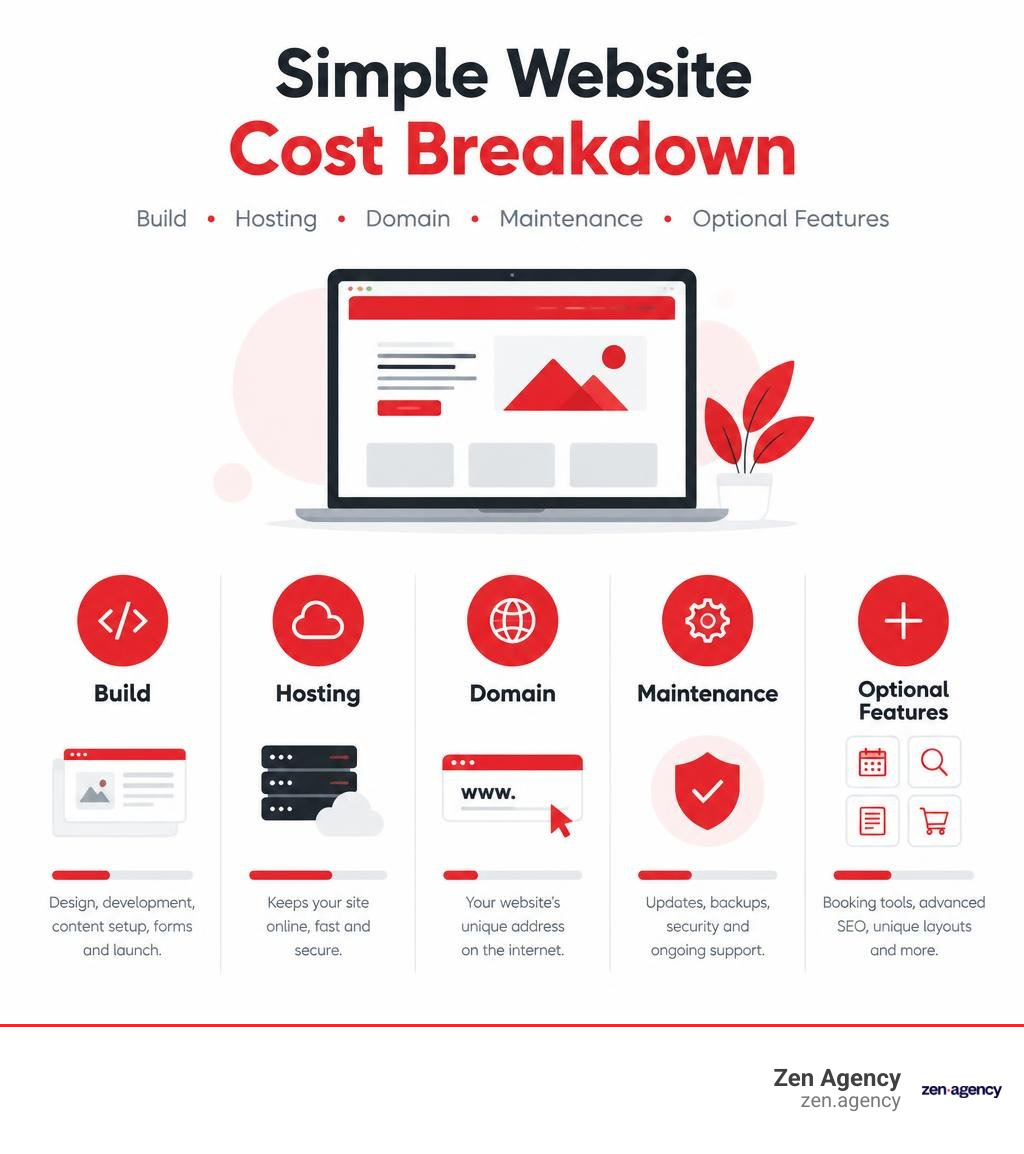
Simple website design cost vocabulary:
Average Simple Website Design Cost Breakdown for 2026
When planning your web presence, navigating price points can feel overwhelming. A website can be cheaper than a cup of coffee a day, but keeping it running smoothly takes more than caffeine. In 2026, baseline pricing models vary dramatically depending on whether you take the project on yourself, hire an independent contractor, or partner with an agency.

To establish realistic budget expectations, look at the entire lifecycle of the site rather than just the initial invoice. Our comprehensive breakdown of website design expenses shows that initial development is only one piece of the equation. According to data from a buyer guide to website cost benchmarks in 2026, web services feature a median midpoint project price of $1,000, with implied hourly rates clustering between $37 and $53 across basic service packages.
| Build Path | Upfront Design & Build | Typical Time Commitment | Annual Maintenance & Hosting | Ideal For |
|---|---|---|---|---|
| DIY Website Builder | $50 – $250 (theme/tools) | 20 – 60 hours of your time | $150 – $360 / year | Micro-businesses, side hustles, very low budgets |
| Freelance Designer | $500 – $2,500 | 2 – 4 weeks delivery | $300 – $900 / year | Service providers needing professional polish |
| Full-Service Agency | $3,000 – $10,000+ | 4 – 8 weeks delivery | $600 – $1,800+ / year | Growing companies wanting custom strategy & ROI |
DIY Builders vs. Freelancers vs. Agencies
Choosing the right partner or tool depends on your internal capabilities, timeline, and growth goals:
- DIY Builders ($4 – $60/month subscription): Platforms offer drag-and-drop interfaces that reduce upfront cash expenses. However, you pay in personal time. You must handle your own layout adjustments, copywriting, image compression, and basic on-page SEO. If technical issues occur, you are responsible for troubleshooting them.
- Freelancers ($500 – $2,500 project average): Hiring a freelance web designer provides a custom visual touch without agency overhead. Freelancers usually work from pre-existing themes or lightweight frameworks, customizing styles to fit your brand. The quality hinges on their specific technical discipline; some excel at visual design but offer minimal technical SEO or conversion optimization.
- Design & Development Agencies ($3,000 – $10,000+ for small business builds): Agencies provide an integrated team comprising project managers, UI/UX designers, frontend developers, and digital marketers. This path ensures robust quality assurance, high security standards, strategic lead funnels, and enterprise-grade infrastructure designed to scale as your business expands.
Upfront Expenses vs. Hidden Ongoing Fees
A frequent mistake in website budgeting is assuming the launch invoice is the final expense. A website functions like a digital property; it requires ongoing utility and maintenance fees to remain secure and operational.
- Domain Name Registration ($10 – $20/year): Your digital street address (e.g., yourcompany.com). Premium domain extensions or aftermarket names cost more.
- Web Hosting ($60 – $300/year for basic sites): Shared hosting starts around $5 to $10 per month, while managed cloud hosting or dedicated virtual private servers (VPS) for business sites run $25 to $75+ per month. High-performance hosting ensures fast load speeds, which directly support search rankings.
- SSL Certificates ($0 – $100/year): Standard SSL certificates are now included for free by most reputable hosts via Let’s Encrypt. However, specialized warranty-backed certificates can carry an annual cost.
- Plugin and Software Licenses ($0 – $250/year): While many core plugins are free, business features—such as advanced forms, automated offsite backups, spam protection, and security firewalls—often require annual premium licenses.
- Routine Maintenance & Security ($300 – $900/year): Regular core updates, PHP upgrades, database optimizations, and malware monitoring are necessary to protect your investment from vulnerabilities.
Key Factors Driving Website Pricing Up or Down
Why does one simple site cost $600 while another costs $4,000? Price differences rarely stem from arbitrary designer markups; they reflect the scope of work, technical requirements, and strategic depth involved. Reviewing the essential steps on how to design a business website makes it clear that structural planning directly influences development hours.
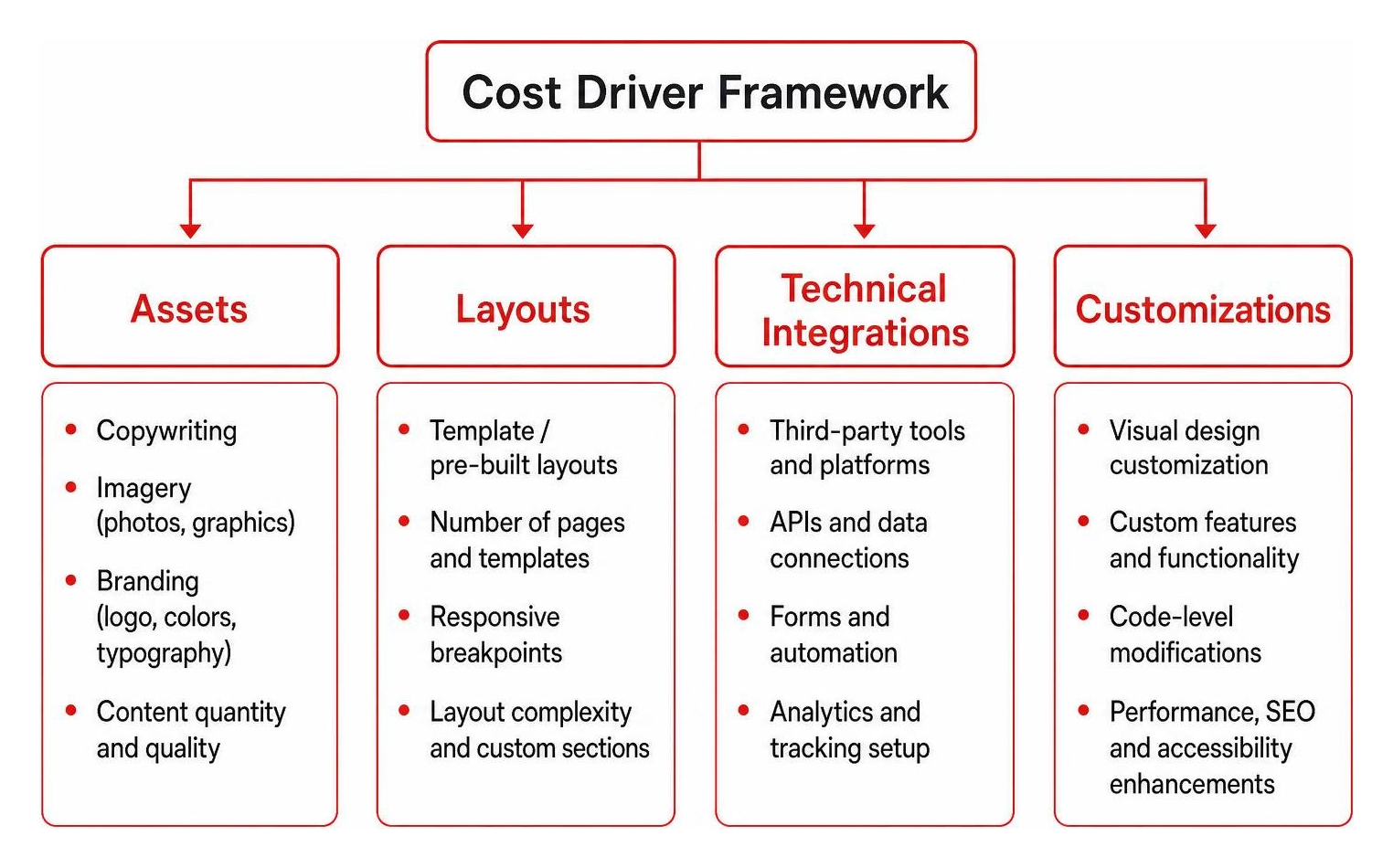
Template Themes vs. Custom Web Design
The structural foundation of your website is one of the biggest cost drivers:
- Pre-Built Template Approach: A developer installs an existing framework or commercial theme and adjusts colors, fonts, and imagery to match your branding. This keeps the build within a $500 to $1,500 range because the underlying layouts, grids, and mobile breakpoints are already coded.
- Custom Design Approach: A designer creates bespoke wireframes and mockups in tools like Figma before developing a dedicated theme tailored to your exact conversion goals. Opting for investing in high-impact custom design elevates your brand perception, removes unnecessary code bloat, and provides higher conversion potential, but it increases upfront production hours.
How Scope and Functionality Impact Simple Website Design Cost
Every interactive element added to a scope brief increases the hours needed for configuration, styling, and testing.

- Page Count: A lean 3-to-5-page website (Home, About, Services, Contact) requires fewer templates and less testing than a 15-page site with detailed sub-service landing pages.
- Content Production: If you provide polished, pre-edited copy and high-resolution photography, project costs drop significantly. If the designer must write copy, source licensed stock imagery, or optimize graphics, expect to add $500 to $1,500 to the total.
- Lead Capture & Dynamic Forms: A simple contact form takes minimal setup. However, multi-step quote calculators, conditional logic forms, and automated CRM integrations require additional hours.
- Appointment Booking & Scheduling: Integrating platforms like Calendly, Acuity, or direct calendar syncs requires API authentication, automated email notification setups, and custom styling.
- E-Commerce Elements: Adding transactional capabilities—even for just two or three digital products or service deposits—introduces payment gateway configurations (Stripe, PayPal), SSL hardening, tax rules, and receipt workflows, easily adding $500 to $2,000 to a basic scope.
How to Budget, Quote, and De-Risk Your Investment
Gathering quotes without a structured brief often leads to wildly divergent estimates. One provider might quote $400 while another quotes $4,000 for what seems like the same project. Exploring pricing dynamics for web development projects reveals that this variance usually happens because the underlying scope assumptions are completely different.
To protect your budget and ensure clear comparisons, follow a structured process before signing any agreement.
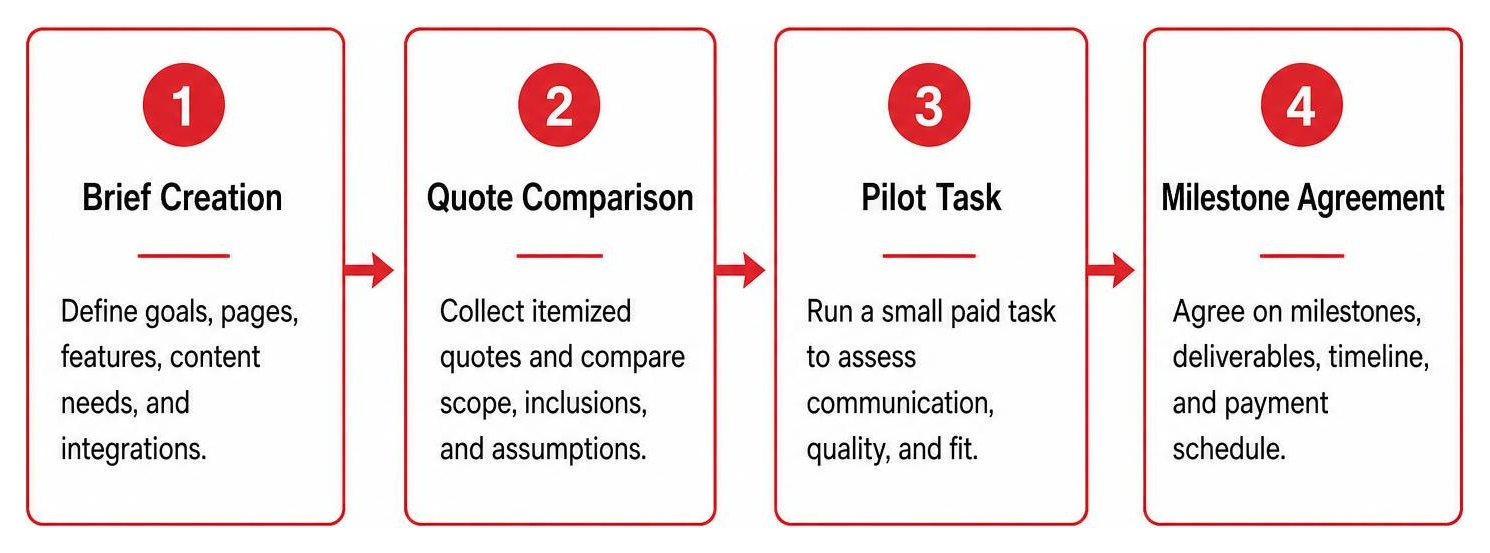
When vetting and choosing the right web design partner, request explicit answers to these operational questions:
- Is this estimate fixed-price or billed hourly?
- Are theme licenses, stock photos, and plugin subscriptions included in the quote or billed separately?
- Who is responsible for loading written content and optimizing images for mobile viewports?
- What specific security, caching, and on-page SEO tasks are completed prior to launch?
- What happens if I need revisions after the final review stage?
How Hourly Rates Translate into Simple Website Design Cost
Freelance designers and developers typically bill between $40 and $100 per hour depending on experience and geographic location, while specialized agencies bill between $100 and $200 per hour.
Understanding this formula makes clear why project scopes expand. A basic 5-page template-based site generally takes 15 to 30 professional hours to plan, style, populate, test, and deploy:
- 20 hours @ $50/hour (Junior Freelancer): $1,000
- 20 hours @ $85/hour (Mid-Weight Specialist): $1,700
- 25 hours @ $150/hour (Agency Production Team): $3,750
Evaluating transparent custom design pricing models helps you determine whether a fixed-price contract or an hourly model better aligns with your risk tolerance. Fixed-price contracts provide budget predictability, provided your scope document is clearly defined.
Red Flags in Low-Cost Quotes and Scoping Pitfalls
If a quote seems too good to be true, it usually is. Ultra-low estimates often rely on hidden fees or structural shortcuts that cost more to fix down the road.
Watch out for these critical warning signs in proposals:
- Vague Deliverables: Statements like “make the site look modern” without listing the exact pages, templates, and functional specifications.
- Unclear Asset Ownership: Agreements where the agency retains ownership of your domain name, hosting account, or custom codebase. You should always retain 100% intellectual property ownership of your digital assets.
- Zero Mobile Optimization: Quotes that treat responsive mobile styling as an “add-on” service. Over 50% of web traffic comes from mobile devices, making mobile responsiveness a non-negotiable baseline.
- Excluded Post-Launch Support: Contracts that end the moment the site goes live, leaving you without a warranty for broken links, form delivery failures, or layout issues discovered after deployment.
To de-risk your investment, consider starting with a small paid pilot task (such as a single landing page layout or a brand style tile) before committing to a complete multi-page build.
Frequently Asked Questions About Basic Website Pricing
How much does a basic 5-page small business website cost in 2026?
A standard 5-page brochure website (Home, About, Services, Blog/Gallery, Contact) built by an experienced professional typically costs between $800 and $2,500. This pricing assumes you provide the core text and images, the build utilizes a reliable modern framework or customized theme, and basic on-page SEO and contact forms are configured. Turnaround time for this scope is usually 2 to 4 weeks.
What recurring annual costs should I expect after launch?
For a simple, non-transactional business website, expect to budget $200 to $600 per year for essential operating services. This includes annual domain renewal ($15–$20), reliable shared or cloud web hosting ($100–$250), essential security/backup plugin licenses ($50–$150), and routine software updates. Adding dedicated monthly technical support plans will increase this baseline by $50 to $150 per month.
Can I build an effective business website for under $500?
Yes, provided you either handle the labor yourself using a DIY website builder or contract a developer for a tightly scoped single-page landing site. To stay under $500 with a professional designer, you must supply all finalized copy, high-resolution photography, and brand assets, while using a standard pre-built template without custom programming or complex third-party software integrations.
Conclusion
A simple website is one of the most critical marketing assets your business will ever own. While initial entry prices range from DIY platforms for a few dollars a month to several thousand dollars for agency builds, the real value lies in matching your investment to your business goals. Prioritize transparent project scopes, ensure full ownership of your assets, and budget for ongoing maintenance so your site remains secure, fast, and primed for growth.
At Zen Agency, we have spent more than 15 years helping businesses build high-performance web solutions that drive measurable ROI. For a deeper look at budgeting strategies and cost frameworks, explore our strategic website design budgeting guide to plan your next web project with confidence.