PPC Advertising 101: Learn the Basics
PPC Advertising 101: Learn the Basics
Why PPC Advertising Is One of the Fastest Ways to Grow Your Business
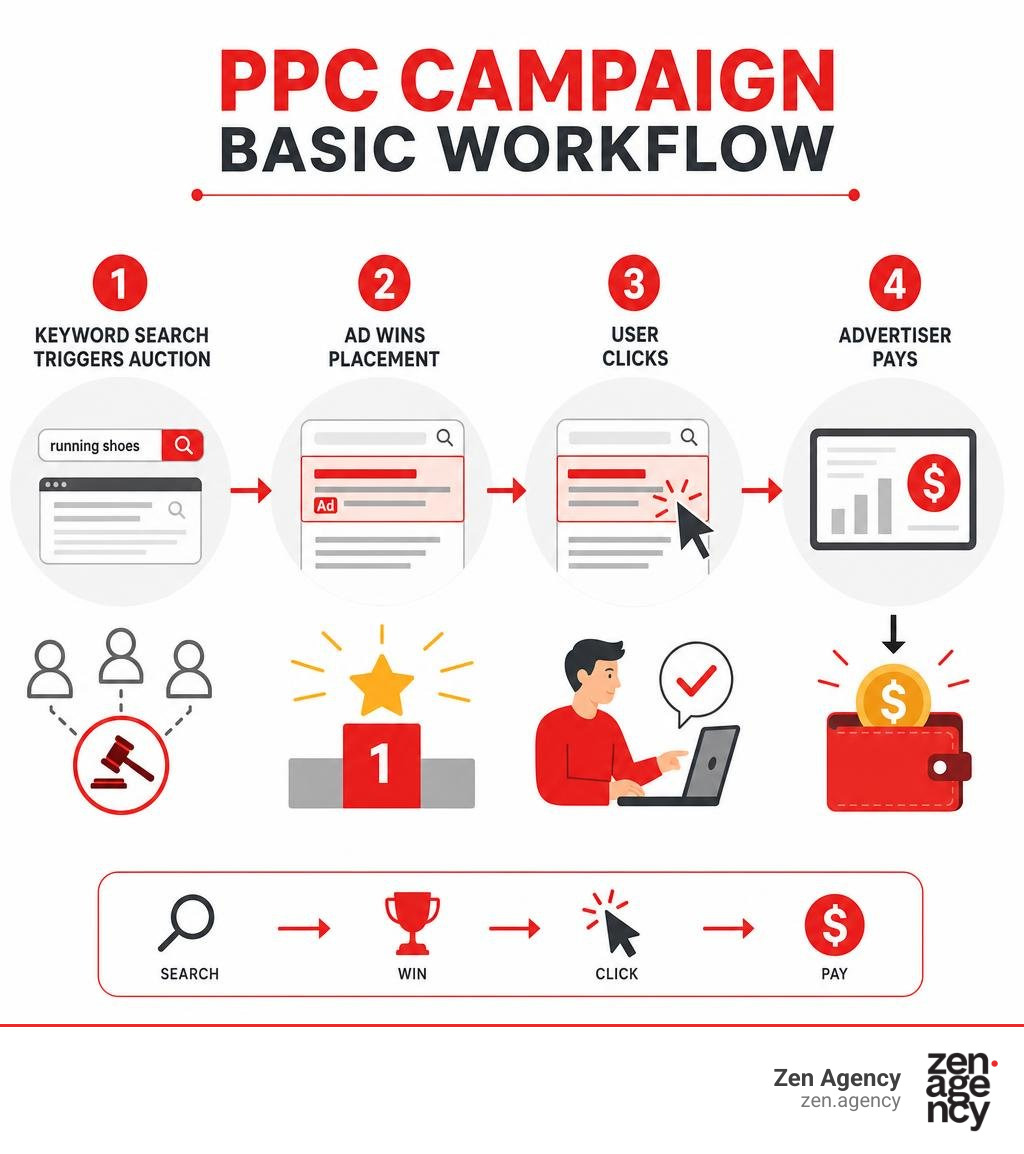
PPC advertising — short for pay-per-click advertising — is a digital marketing model where you pay only when someone clicks your ad. It puts your business at the top of search results instantly, without waiting months for SEO to kick in.
Here’s the quick answer:
| Question | Answer |
|---|---|
| What is PPC? | You place ads on platforms like Google or Meta, and pay only when someone clicks |
| Where do ads appear? | Search results, social media feeds, YouTube, display websites, and more |
| How much does it cost? | You set the budget — from $5/day to thousands |
| Who controls the ads? | You do — targeting, spend, and messaging are all adjustable |
| How fast do results come? | Traffic can start within hours of launching |
Here’s the reality most business owners face: finding new customers is hard. In fact, a 2025 Shopify survey found that 36% of store owners rank it as their top first-year challenge. And among store owners earning over $1 million per year, 31% say paid advertising is their most effective growth channel.
PPC levels the playing field. A small business with a smart campaign can outrank a much larger competitor — not by outspending them, but by outsmarting them.
This guide will walk you through everything: how the auction works, which platforms to use, what metrics matter, and how to avoid the mistakes that quietly drain budgets.
I’m Joseph Riviello, CEO and Founder of Zen Agency, and with over 22 years in digital marketing, I’ve helped businesses of all sizes build and scale PPC advertising strategies that drive real, measurable ROI. Let’s break it all down.
Demystifying PPC Advertising: Definition, SEO, and SEM Differences
To master ppc advertising, we first need to clear up the alphabet soup of digital marketing: PPC, SEO, and SEM. While they all aim to get your business in front of eager customers, they do so in very different ways.
- PPC (Pay-Per-Click): This is the specific pricing model we are talking about today. You bid on keywords or target audiences, and the platform displays your ad. You only pay when a user actually clicks on that ad. It is a highly targeted, highly controllable way to buy traffic.
- SEO (Search Engine Optimization): This is the art and science of earning organic traffic. You optimize your website’s content, technical setup, and authority so search engines rank you naturally. It costs nothing per click, but it takes significant time, effort, and patience to build.
- SEM (Search Engine Marketing): This is the broad umbrella term. Historically, SEM referred to both paid and organic search efforts. Today, most marketers use SEM specifically to describe paid search activities (like Google Search Ads).
The biggest mistake we see businesses make is choosing one and completely ignoring the other. We often see clients lean heavily on Google Paid Search Advertising Because Organic Traffic Is Taking Too Long. While that is a brilliant short-term play to generate immediate revenue, the ultimate goal should be a balanced approach where PPC and SEO feed each other. For instance, you can use high-converting keywords discovered in your PPC campaigns to guide your long-term organic content strategy.
To help you visualize how these channels stack up, let’s look at a quick comparison:
| Feature | PPC (Pay-Per-Click) | SEO (Search Engine Optimization) | SEM (Search Engine Marketing) |
|---|---|---|---|
| Cost Model | Pay-per-click | Free clicks (but requires labor/time) | Paid (often used interchangeably with PPC) |
| Speed of Results | Instant (within hours) | Slow (typically 3 to 6+ months) | Instant |
| Long-Term Value | Stops when budget runs out | Compounding equity over time | Stops when budget runs out |
| Placement | Top & bottom of SERPs, Social, Display | Middle of SERPs (Organic listings) | Top & bottom of SERPs |
| Control | High (choose exact copy, landing page, bid) | Low (Google decides how to display your page) | High |
For a deep dive into how these dynamics play out specifically in the e-commerce space, check out the comprehensive PPC Marketing: A Complete Ecommerce Guide (2026) – Shopify Canada.
Inside the Digital Auction: How Ad Placement and Costs Are Determined
Many beginners assume that the advertiser with the biggest bank account automatically gets the top spot. Fortunately, that’s not how modern ad networks operate. If it were, the web would be flooded with irrelevant, low-quality ads from giant corporations.
Instead, search engines use a sophisticated real-time bidding (RTB) system. This digital auction takes place in milliseconds—every single time someone types a query into Google or Bing. To win this auction and secure profitable ad placement, you must understand how the auction math works. It is all about managing what happens Beyond the Click A Guide to Comprehensive PPC Management.
The Mechanics of the Pay-Per-Click Auction
When a user searches for a term, the search engine looks at all advertisers bidding on that keyword. The system evaluates two primary numbers to determine where your ad ranks and how much you will actually pay: your Maximum Bid and your Quality Score.
Your Maximum Bid is the absolute highest amount you are willing to pay for a single click. However, you will rarely pay this full amount. Thanks to the Vickrey auction model used by Google, your actual CPC is calculated using the following formula:
$$\text{Actual CPC} = \left( \frac{\text{Ad Rank of the Competitor Below You}}{\text{Your Quality Score}} \right) + \$0.01$$
This means that if you have an incredibly high Quality Score, you can actually pay less than a competitor bidding more than you, while still beating them in ad placement! To gain complete control over your bidding strategies, read Google’s official documentation About Manual CPC bidding – Google Ads Help.
Quality Score and Ad Rank Explained
Your Ad Rank is the score that determines your ad position on the page. It is calculated by multiplying your Max Bid by your Quality Score.
$$\text{Ad Rank} = \text{Max Bid} \times \text{Quality Score}$$
Because Quality Score is the ultimate lever for lowering your costs and boosting your visibility, you must know what goes into it. Google measures Quality Score on a scale of 1 to 10 based on three core components:
- Expected Click-Through Rate (CTR): The likelihood that someone will click your ad when it is shown, based on historical performance.
- Ad Relevance: How closely your ad copy matches the user’s search query.
- Landing Page Experience: How fast, mobile-friendly, easy to navigate, and relevant your landing page is to the user who clicked.
If you match search intent perfectly, keep your ad copy tight, and send users to a lightning-fast, highly relevant page, Google rewards you with a high Quality Score and a lower actual cost-per-click.
Key Components of a High-Performing Campaign Strategy
Launching a campaign without a clear plan is the fastest way to turn your marketing budget into a donation to Google. To build campaigns that actually return profit, you need to look Beyond the Hype What to Look for in a Top-Tier PPC Management Service. A successful strategy relies on three foundational pillars: goal setting, keyword research, and landing page optimization.
Goal Setting and Keyword Research for PPC Advertising
Every successful campaign starts with SMART goals (Specific, Measurable, Achievable, Relevant, and Time-bound). Are you looking for raw lead generation, direct e-commerce sales, phone calls, or brand awareness? Your goal dictates your bidding strategy, ad formats, and tracking setup.
Once your goals are locked in, you must master keyword research. This is the art of finding the exact phrases your target audience uses when they are ready to buy. We break this down into three main categories:
- Short-Tail Keywords: Broad, high-volume terms (e.g., “shoes”). These are incredibly expensive and rarely convert well because the user’s intent is unclear.
- Long-Tail Keywords: Highly specific, lower-volume phrases (e.g., “size 9 red running shoes for flat feet”). These have much lower competition, lower CPCs, and incredibly high conversion rates because the searcher knows exactly what they want.
- Negative Keywords: The unsung heroes of PPC. These are terms you explicitly do not want to display for (e.g., “free,” “cheap,” “DIY”). Adding negative keywords prevents unqualified searchers from clicking your ads and wasting your budget.
For a step-by-step methodology on finding these high-value terms, explore our guide on Unlocking PPC Success A Guide to Effective Keyword Research.
Crafting Compelling Ad Copy and Landing Page Optimization
Once you have your keywords, you need to write ad copy that practically forces users to click. Excellent ad copy speaking directly to the user’s pain points, highlights a unique selling proposition (USP), and includes a crystal-clear Call to Action (CTA).
But getting the click is only half the battle. What happens after the click is where the money is made. You must send that traffic to a dedicated, conversion-focused landing page. A great landing page must:
- Load in under 3 seconds (every second of delay causes massive drop-offs).
- Provide an absolute message match (the headline of your landing page must match the promise of your ad).
- Be fully mobile-responsive (over 60% of PPC traffic now comes from mobile devices).
- Feature a single, frictionless action (like a simple form or a prominent buy button).
To study how to build and structure these campaigns from the ground up, check out How to Build Pay-per-Click Marketing Campaigns [+ Best PPC Platforms, Tools, and Software].
Choosing the Right Platforms and Ad Formats for Your Business
Not all PPC platforms are created equal. The right channel for your business depends entirely on where your audience hangs out and their frame of mind when they are online. If you are selling a complex B2B software solution, your approach will look vastly different than if you are selling trendy apparel. To design a tailored approach, we highly recommend reviewing The B2B PPC Playbook How to Win at Paid Search.
Search vs. Social Media and Display Networks
The major divide in paid media is between Search and Social/Display networks:
- Search Ads (High Intent): Users are actively looking for a solution. When someone searches for “emergency plumber in Scranton,” they have immediate, high-intent need. Search ads capture this demand perfectly.
- Social Media Ads (Demographic & Interest-Based): Users are browsing, not actively buying. Platforms like Meta (Facebook/Instagram) allow you to target users based on detailed demographics, interests, and behaviors. These are incredible for building awareness, introducing new products, and visual storytelling.
- Display Networks & Remarketing: Display ads are visual banners placed on partner websites across the web. While cold display ads typically have lower click-through rates (often 0.5-1%), they are incredibly powerful for remarketing—showing targeted ads to users who already visited your website but didn’t buy. Remarketing campaigns frequently achieve 50% to 100% higher conversion rates than cold traffic.

Google Ads, Microsoft Advertising, and Shopping Ads
For search campaigns, your two primary playgrounds are Google Ads and Microsoft Advertising:
- Google Ads: The undisputed king, commanding over 90% of the search market share. It offers unparalleled reach but comes with highly competitive auctions.
- Microsoft Advertising (Bing Ads): Often overlooked, but Bing consists of nearly 30% of desktop computer search traffic in the United States. Because there is less competition, CPCs are frequently much lower, making it a highly profitable channel for reaching older, higher-income demographics.
- Shopping Ads: If you run an e-commerce store, Shopping ads are mandatory. Instead of standard text, they display a product photo, title, price, and your store name directly at the top of search results. These ads rely on a live product feed syncing your inventory with the search engine. To understand how to feed your product data to Google, read the About Shopping ads – Google Ads Help.
If you sell physical products, you should also expand your reach into marketplace-specific advertising. Get started with our guide on Amazon PPC Made Easy for Every Seller.
Navigating the AI Era, Budget Pitfalls, and Click Fraud in 2026
We are living in the AI-first era of paid media. The days of manually adjusting bids by pennies every morning are gone. Today, the most successful advertisers are those who know how to collaborate with machine learning algorithms rather than fighting them. To understand this transition, see how we leverage Ad-Vantage AI How Smart Campaigns Win Big.
AI-Powered Smart Bidding and Privacy Changes
Modern ad networks utilize machine learning to analyze millions of real-time signals—such as user intent, device, location, timing, and historical browser patterns—to predict who is likely to convert.
- Smart Bidding: Instead of manual bidding, you set a target (like Target CPA or Target ROAS) and let Google’s AI dynamically adjust your bid for every single auction.
- Privacy & Server-Side Tracking: With browser privacy restrictions and the decline of traditional third-party cookies, standard browser-based tracking pixels are losing accuracy. In 2026, implementing server-side tracking is crucial to feed clean, accurate conversion data back into the AI models so they can optimize properly.
To understand how to navigate this automated landscape as a beginner, read PPC Management in the AI Era (2026): A Beginner’s Guide to Paid Advertising.
Common Budget-Draining Mistakes and Click Fraud Protection
While AI tools simplify campaign management, they can also drain your budget rapidly if left unguided. The most common budget-draining mistakes include:
- Failing to use negative keywords: Allowing broad match keywords to trigger your ads for completely irrelevant searches.
- Ignoring the learning phase: Making major budget or bid changes every couple of days, which constantly resets the AI’s learning process.
- Neglecting Click Fraud: Click fraud occurs when competitors, automated bots, or malicious publishers repeatedly click your ads to drain your budget.
To protect your budget from irrelevant traffic, you must master the art of negative exclusions. Check out our guide on Mastering Negative Keywords A Beginners Guide to Smarter PPC.
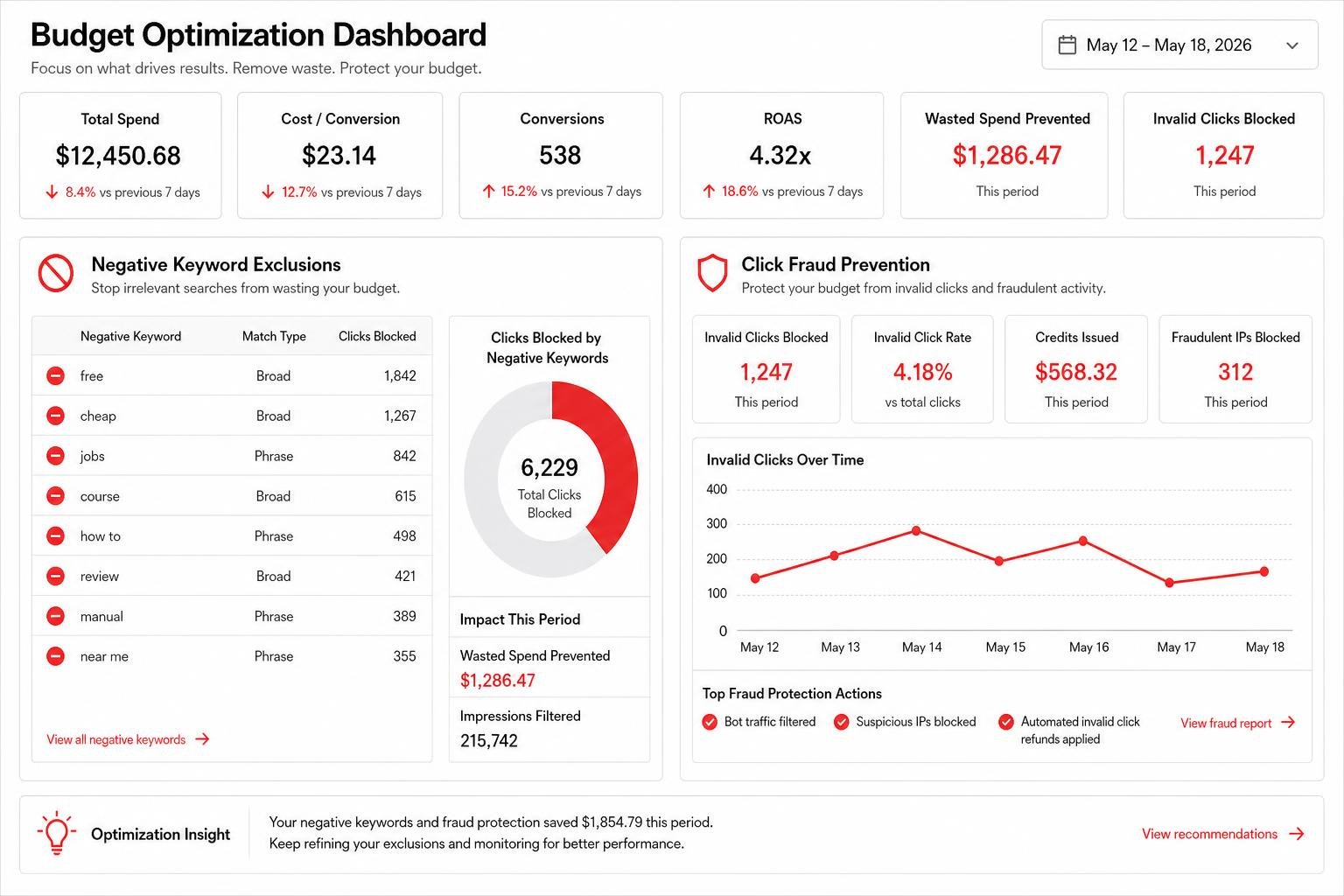
To combat click fraud, major ad platforms deploy automated detection systems that filter out “invalid clicks” and automatically credit your account. However, for highly competitive local industries (like legal or home services in areas like Wilkes-Barre or Scranton, PA), utilizing third-party fraud prevention software can add an extra layer of security.
Frequently Asked Questions About PPC
What is the difference between PPC and CPC?
PPC (Pay-Per-Click) is the overall advertising model or channel where you pay for user interactions rather than impressions. CPC (Cost-Per-Click) is the actual metric representing the price you pay for each individual click within your campaign.
How much should a small business spend on PPC advertising?
There is no one-size-fits-all answer, but we recommend starting with a dedicated testing budget of $500 to $1,500 per month. This allows you to gather enough data to see what works without overextending. Once you establish a profitable Return on Ad Spend (ROAS), you can confidently scale your budget.
What is a good Quality Score in Google Ads?
A Quality Score of 7 to 10 is considered excellent and generally earns you a discount on your cost-per-click. A score of 5 or 6 is average, while anything below 4 indicates that your keywords, ad copy, or landing page experience need immediate optimization.
Conclusion
Mastering ppc advertising is one of the most powerful moves you can make to scale your business. It bypasses the waiting game of organic search, putting your brand directly in front of customers at the exact moment they are ready to buy.
However, building profitable campaigns requires constant monitoring, deep keyword strategy, landing page optimization, and a clear understanding of AI-driven bidding. If you are struggling to scale your business, you don’t have to navigate this complex landscape alone.
At Zen Agency, we have been delivering enterprise-grade web development and digital marketing solutions since 2008. From our offices in Pennsylvania (including Wilkes-Barre and Scranton) to Billings, Montana, we help businesses across the USA maximize their visibility and ROI.
Ready to stop wasting ad spend and start driving real revenue? Contact us today to explore our professional PPC Management Services. Let’s grow your business together!