How to Grow Your Business Without Losing Your Mind
How to Grow Your Business Without Losing Your Mind
Why Most Businesses Struggle to Grow (And What Actually Works)
Business growth strategies are structured plans that help companies increase revenue, expand market share, and scale operations without burning out their teams or budgets.
Here are the most effective approaches at a glance:
| Strategy | What It Does | Best For |
|---|---|---|
| Market Penetration | Sell more to existing customers | Early-stage businesses |
| Market Expansion | Enter new markets or regions | Businesses with proven products |
| Product Development | Launch new offerings for current customers | Mid-stage growth |
| Strategic Partnerships | Grow through alliances and collaborations | Businesses needing faster reach |
| Acquisition | Buy other companies to expand | Mature businesses with capital |
| Digital Transformation | Use technology to scale operations | All business stages |
The hard truth? Only 25% of companies achieve sustainable growth over time. Most businesses grow by accident — reacting to opportunities instead of pursuing them with intention.
That gap between reactive and strategic is exactly where businesses lose momentum, waste budget, and plateau.
I’m Joseph Riviello, CEO and Founder of Zen Agency, and over my 22+ years in digital marketing I’ve helped companies of all sizes build and execute business growth strategies that actually move the needle. In the sections below, I’ll break down the exact frameworks, tools, and tactics that separate sustainable growers from the rest.
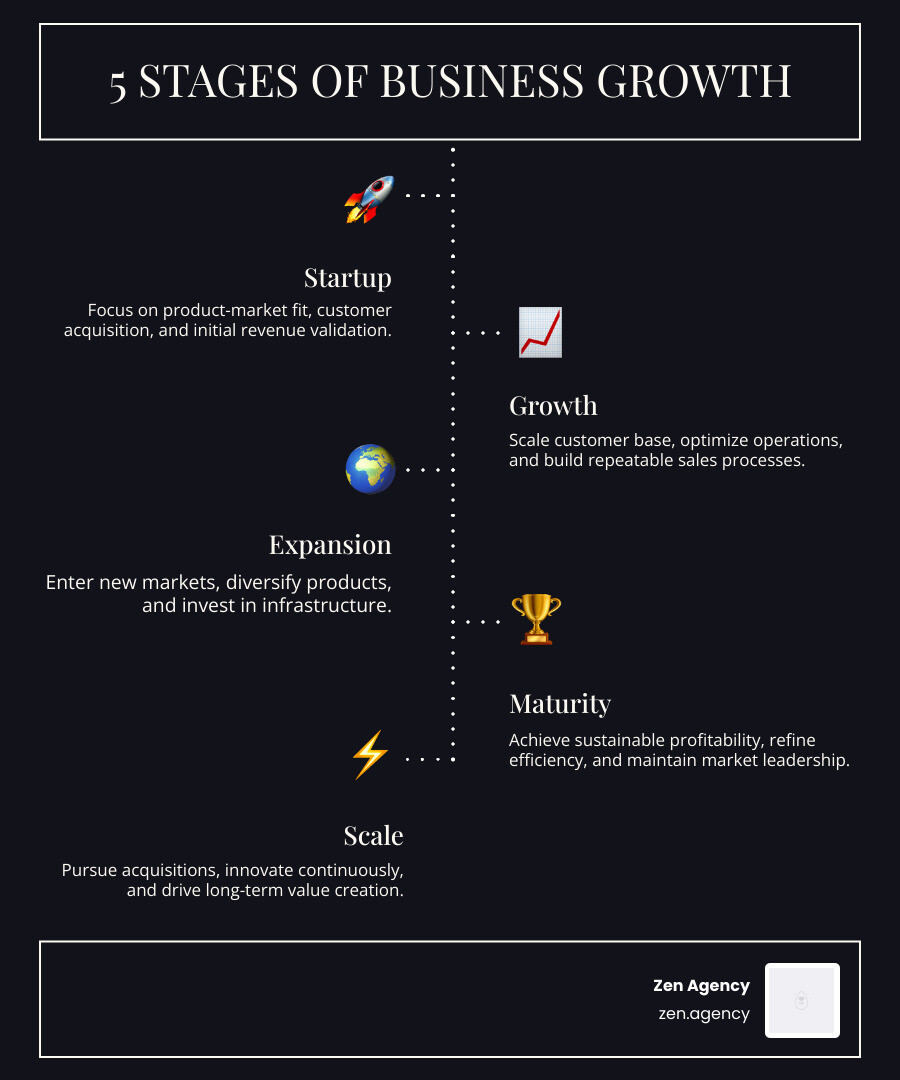
Basic Business growth strategies glossary:
Defining Modern Business Growth Strategies
When we talk about Business growth strategies, we aren’t just talking about “getting bigger.” We are talking about the deliberate path a company takes to increase its value. Research shows that 80% of growth typically comes from maximizing your core business—the things you already do well. The remaining 20% comes from exploring “adjacencies” or entirely new breakout ideas.
To navigate this, we look at four primary types of growth:
- Organic Growth: This is the most traditional method. It involves using internal resources to boost sales, such as using SEO-focused content to drive traffic. For example, some leading software companies report that over 70% of their organic traffic stems directly from educational blog content.
- Strategic Growth: This focuses on long-term initiatives like strategic partnerships or alliances. By teaming up with a complementary business, you can reach a new customer base without the cost of a full acquisition.
- Internal Growth: This is about “shrinking to grow.” It involves improving operational efficiency, reducing waste, and reallocating resources from underperforming areas into high-potential projects.
- Acquisition Growth: This is the fastest—and often most expensive—way to scale. It involves purchasing other companies to immediately gain their market share, technology, or talent.
Modern growth also requires a focus on “Total Shareholder Return” (TSR). Companies that integrate Environmental, Social, and Governance (ESG) factors into their core strategy often see a seven-point outperformance in TSR compared to those that don’t. Growth today isn’t just about the balance sheet; it’s about growing with purpose.
The Four Pillars of Scaling Effectively
Scaling a business in places like Wilkes-Barre or Scranton requires a solid foundation. You can’t just pour money into marketing and hope for the best. You need to balance your approach across these four pillars:
| Feature | Organic Growth | Acquisition Growth |
|---|---|---|
| Risk Level | Lower; built on existing strengths | Higher; involves integration risks |
| Speed | Gradual and steady | Rapid and immediate |
| Cost | Spread out over time | High upfront capital required |
| Culture | Preserves existing company DNA | Risk of “culture clash” |
1. Operational Efficiency
Before you scale, you must ensure your “house” is in order. Internal growth relies on reducing waste. If your processes are manual and slow, scaling will only amplify those inefficiencies. We focus on creating systems that allow you to do more with less.
2. Market Penetration and Development
Market penetration is often the least risky strategy. It involves selling more of your current products to your existing market—perhaps through loyalty programs or better customer feedback loops. Market development, on the other hand, takes those same products into new territories, like expanding a service from Wyoming, PA, to Billings, MT.
3. Product Diversification
Sometimes, the best way to grow is to give your customers something new. A classic example is the famous insulated cup brand that grew its sales from $70 million to $750 million simply by pivoting a rugged product to target a new, higher-discretionary-income demographic with fresh colors and marketing.
4. Talent Development
Your people are your greatest asset. Research indicates that transformations involving more than 20% of the workforce are twice as likely to generate excess shareholder returns. Investing in your team ensures that as the company grows, the culture remains strong and the execution stays sharp.
Proven Frameworks for Sustainable Expansion
Sustainable growth is rare—only about 10% of companies manage to maintain positive growth rates across an entire decade. To be part of that 10%, you need a framework that goes beyond gut instinct.

Successful companies often use “Scenario Planning” to prepare for market shifts. This involves looking at economic indicators, market research, and competitor data to create “what if” plans. This allows you to move boldly when others are hesitant. For instance, companies that make bold moves during economic downturns often see much steeper growth curves once the market recovers.
Digital Transformation as one of the Business growth strategies
In 2025, you cannot ignore digital transformation. This isn’t just about having a website; it’s about integrating technology into every part of your business.
- Cloud Services: Moving to the cloud allows for global scale. One major provider now holds 31% of the market because they made scaling accessible for everyone.
- AI and Automation: AI can scan thousands of data points to identify “adjacencies”—new areas where your business could thrive. Whether it’s using AI agents for customer support or autonomous workflows to handle invoicing, technology acts as a force multiplier.
Implementing Data-Driven Business growth strategies
If you can’t measure it, you can’t manage it. High-performing businesses track specific KPIs (Key Performance Indicators) to ensure their Business growth strategies are working.
- ROI and Revenue Growth: Are your marketing dollars actually bringing in more than they cost?
- Employee Engagement: Employee engagement is a leading indicator of productivity and customer loyalty.
- Real-Time Insights: Using predictive analytics allows you to see a slump coming before it hits your bank account, giving you time to pivot.
Common Pitfalls to Avoid When Scaling
Scaling is exciting, but it’s also dangerous. Many businesses in Pennsylvania and Montana fail because they try to grow too fast without the right support.
- The Cash Burn Trap: Growth requires capital, but “growth at all costs” often leads to bankruptcy. You must ensure your growth is profitable.
- Culture Dilution: As you hire quickly, it’s easy to lose the “soul” of the company. Growth outperformers put people at the heart of their strategy to prevent this.
- Over-Automation: While we love tech, over-automating can alienate customers. Keep humans in the loop for critical moments.
- Siloed Systems: Using ten different tools that don’t talk to each other creates “drag.” Agile organizations use integrated platforms to keep everyone on the same page.
- Reactive Management: If you are spending 70% of your time “putting out fires,” you aren’t leading—you’re reacting. A documented growth plan moves you from reactive to proactive.
Frequently Asked Questions about Scaling
What is the most effective growth strategy for small businesses?
For most small businesses, market penetration is the most effective starting point. It’s cheaper to sell more to someone who already trusts you than to find a brand-new customer. Focus on increasing the “Customer Lifetime Value” through better service, loyalty rewards, and upselling.
How do I measure the success of my growth plan?
Success should be measured by more than just top-line revenue. Look at your gross margins, customer acquisition cost (CAC), and retention rates. If your revenue is going up but your profit margins are shrinking, your growth strategy may be unsustainable.
When is the right time to pivot or divest?
The best time to pivot is when you have the data to show a plateau in your core business, or when an “adjacency” shows more momentum than your primary product. “Shrinking to grow”—divesting underperforming assets—is a hallmark of companies that survive for decades.
Conclusion
At Zen Agency, we understand that growing a business is a marathon, not a sprint. Whether you are located in Wilkes-Barre, Scranton, or Billings, the principles of sustainable growth remain the same: focus on your core, embrace technology, and never lose sight of your customers.
We specialize in providing enterprise-grade solutions and innovative strategies for businesses that are ready to scale but feel stuck. From custom web development to SEO services Pennsylvania, we help you increase visibility and profitability without losing your mind in the process.
Ready to take the next step? Let’s build a growth strategy that actually works for you.