Small Business Digital Marketing: How to Stand Out in a Crowded Digital World
Small Business Digital Marketing: How to Stand Out in a Crowded Digital World
Why Most Small Businesses Struggle to Get Results Online
Digital marketing for small businesses is how you get found, build trust, and turn strangers into paying customers — all online.
If you’re short on time, here’s what you need to know:
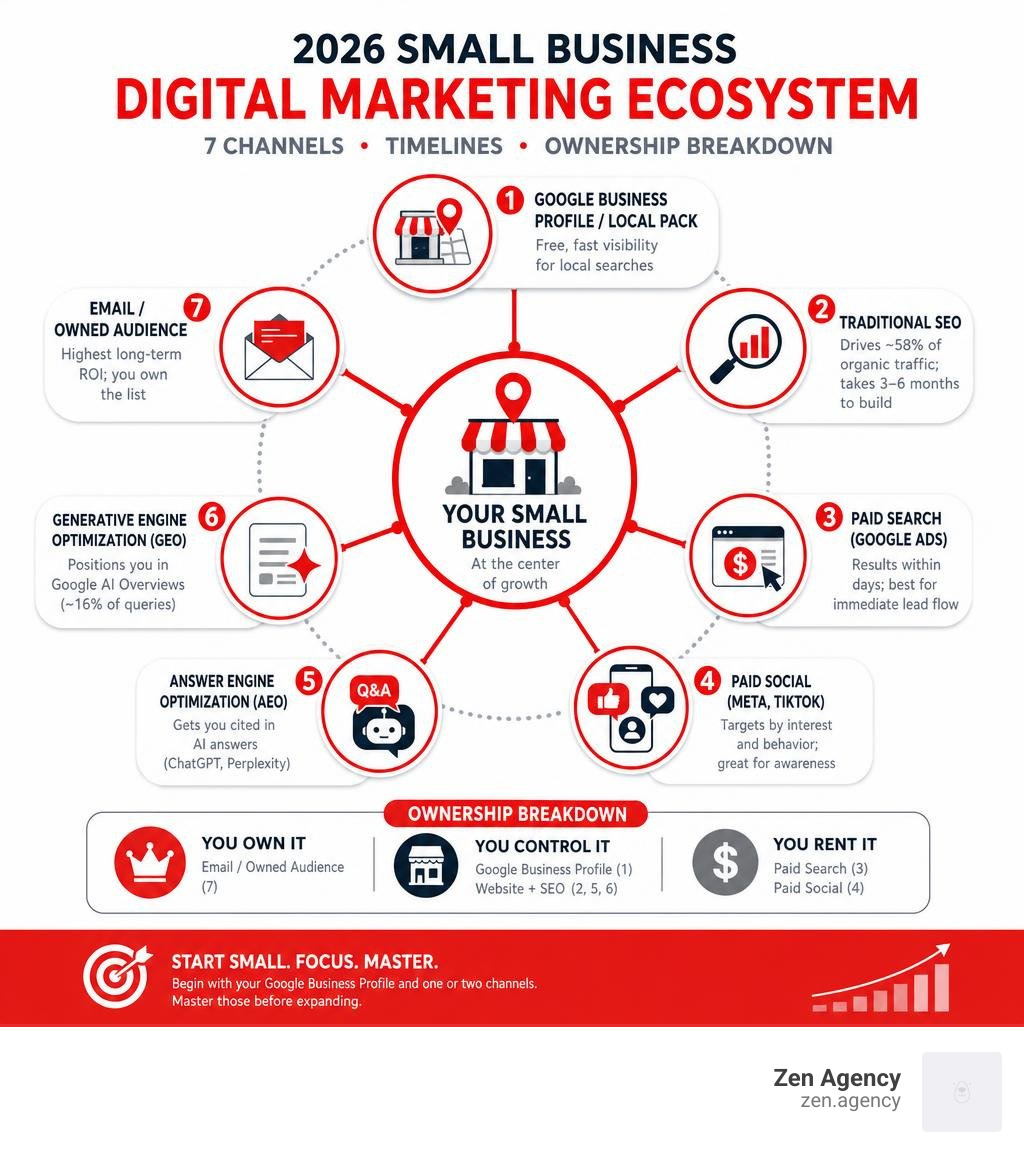
The core channels that work for small businesses in 2026:
- Google Business Profile / Local Pack – Free, fast visibility for local searches
- Traditional SEO – Drives ~58% of organic traffic; takes 3-6 months to build
- Paid Search (Google Ads) – Results within days; best for immediate lead flow
- Paid Social (Meta, TikTok) – Targets by interest and behavior; great for awareness
- Answer Engine Optimization (AEO) – Gets you cited in AI answers (ChatGPT, Perplexity)
- Generative Engine Optimization (GEO) – Positions you in Google AI Overviews (~16% of queries)
- Email / Owned Audience – Highest long-term ROI; you own the list
The short version: Start with your Google Business Profile and one or two channels. Master those before expanding.
Here’s the hard truth: most small businesses have a great product or service — but struggle to be seen online. You’re competing with larger companies that have bigger budgets, dedicated teams, and years of SEO authority built up. That gap feels impossible to close.
But it isn’t.
Digital marketing levels the playing field. A well-optimized local listing, a focused content strategy, or a targeted email campaign can outperform a national brand’s generic messaging — because you know your customers better than they ever will.
The challenge in 2026 is that the rules have shifted. Search now happens across Google, AI engines like ChatGPT and Perplexity, and platform-native search on TikTok and YouTube. Programs that ignore the AI layer are leaving an estimated 30-42% of search traffic untouched. At the same time, 67% of SMB leaders say community support has been critical to their survival — which means the businesses winning online are the ones building real connections, not just chasing clicks.
I’m Joseph Riviello, CEO and Founder of Zen Agency, and I’ve spent over 22 years helping businesses of all sizes grow through multi-channel digital marketing for small businesses strategies that focus on the full picture — traffic, leads, conversions, and revenue. This guide walks you through exactly what’s working right now, and how to build a sustainable system that grows with you.
What is Digital Marketing for Small Businesses and Why It Matters in 2026
At its core, digital marketing for small businesses is the practice of promoting your products or services using online channels. Unlike traditional advertising—such as print ads, billboards, or direct mail—digital marketing allows you to target specific audiences based on location, age, interests, and behaviors, all while tracking every dollar spent in real-time.
In 2026, having an online presence is no longer optional. It is the very foundation of business survival. Consumers do not just stumble into storefronts anymore; they research, compare, and validate businesses online before making a single move. In fact, 76% of consumers look for a company online before visiting a physical location, and 45% are highly likely to visit after finding a strong, active online presence.
Furthermore, community support remains a powerful driver of small business success, with 67% of SMB leaders reporting that community support has been vital to their company’s survival. However, community support in 2026 is initiated and nurtured online. Whether you are a local contractor in Wilkes-Barre, a boutique in Scranton, or a service provider in Billings, MT, your digital footprint dictates how easily your community can support you.
The search landscape is also evolving rapidly. Every single day, 15% of the searches Google processes are entirely new queries that have never been seen before. This constant shifts in consumer search behavior mean your digital marketing cannot be static. To capture this fluid demand, you must establish a brand that stands out across multiple search surfaces. For businesses looking to establish this foundation, resources like the PA Business One-Stop Shop on Building Your Brand Online provide excellent starting points for organizing your digital assets.
Why is Digital Marketing for Small Businesses Essential in 2026?
The short answer? Because search and buyer behavior have been completely transformed by artificial intelligence.
We are no longer just optimizing for a standard list of ten blue links on a Google search results page. In 2026, Google AI Overviews now appear on approximately 16% of all search queries. This means that for nearly one in six searches, an AI-generated summary answers the user’s question directly at the top of the screen, often pulling information from highly authoritative, structured small business websites.
This shift presents both a challenge and an incredible opportunity. While some traditional search traffic is diverted to these AI summaries, small businesses that adapt can achieve unprecedented visibility. AI search engines thrive on hyper-local, highly personalized, and direct answers.
This is where small businesses actually hold a massive advantage over enterprise corporations:
- Personalization and Agility: You can adapt your messaging, update your local offerings, and publish highly targeted content in a fraction of the time it takes a massive corporation to clear legal and brand guidelines.
- Hyper-Local Relevance: AI models and search algorithms favor local prominence and authentic customer sentiment. A complete, active local profile backed by real community reviews will consistently outrank a generic national landing page.
- Direct Customer Connections: You are closer to your customers. Through authentic social media interactions, personalized email flows, and active community engagement, you can build a level of trust that large brands simply cannot replicate.
By leveraging accessible digital tools, small businesses can go toe-to-toe with industry giants. You do not need a million-dollar budget; you need a smart, sequenced strategy that maximizes your unique strengths.
Comparing the Seven Core Marketing Channels in 2026
To build a successful strategy, you must first understand the landscape. Not all marketing channels are created equal. Some offer immediate leads but stop working the second you turn off the budget. Others take months to build momentum but continue to drive free leads for years.
The table below outlines how the seven core marketing channels compare across time-to-results, effort, ownership, and strategic fit in 2026:
| Channel | Time-to-Results | Effort Required | Ownership Level | Best Fit For |
|---|---|---|---|---|
| Paid Search (Google Ads) | Days (1-7) | High (Requires constant optimization) | Low (Rented land; stop paying, traffic stops) | Capturing high-intent buyers ready to purchase immediately |
| Paid Social (Meta, TikTok) | Days (1-7) | High (High ad fatigue, creative heavy) | Low (Rented land; subject to algorithm changes) | Building brand awareness and targeting specific demographics |
| Local Pack / Google Business Profile | 2-4 Weeks | Medium (Consistent updates & review generation) | Medium (Dependent on Google, but highly stable) | Local service providers and brick-and-mortar storefronts |
| Traditional SEO | 3-6 Months | High (Technical, content creation, link building) | High (You own your website assets and organic rankings) | Building long-term, compounding organic traffic and credibility |
| Answer Engine Optimization (AEO) | 4-12 Weeks | Medium (Structuring data, building FAQs) | High (Based on your owned, structured site content) | Being cited as a direct source in ChatGPT, Gemini, and Perplexity |
| Generative Engine Optimization (GEO) | 4-12 Weeks | Medium-High (E-E-A-T building, schema markup) | High (Based on site authority and structured data) | Appearing in Google AI Overviews for complex or informational queries |
| Email & Owned Audience | Immediate (Once list is built) | Medium (Automation setup & regular newsletters) | High (100% owned; no algorithm can block your access) | Customer retention, repeat sales, and nurturing cold leads |
Navigating these options can feel overwhelming, but mapping your business goals to the right channel is half the battle. For a deeper dive into selecting the perfect mix for your business stage, check out our comprehensive resource: The Only Digital Channel Marketing Guide You Will Ever Need.
Balancing Rented vs. Owned Channels for Sustainable Growth
A common trap many small businesses fall into is relying entirely on “rented” channels. They launch Google Ads or Meta campaigns, see immediate leads, and pour their entire budget into paid acquisition.
But what happens when ad costs rise, or a competitor outbids you? Suddenly, your Cost-Per-Acquisition (CPA) skyrockets, your margins shrink, and you are trapped paying a premium just to keep the lights on.
To build a sustainable business, you must balance fast, rented channels with slower, owned channels.
- Rented Channels (Paid Search & Paid Social): These are your fuel. They are fantastic for launching new services, capturing seasonal demand, or getting immediate traction while your organic foundation builds.
- Owned Channels (SEO, AEO, Email): These are your engine. They take time to build, but once they start running, they compound. They drive down your overall CPA and protect your business from market volatility.
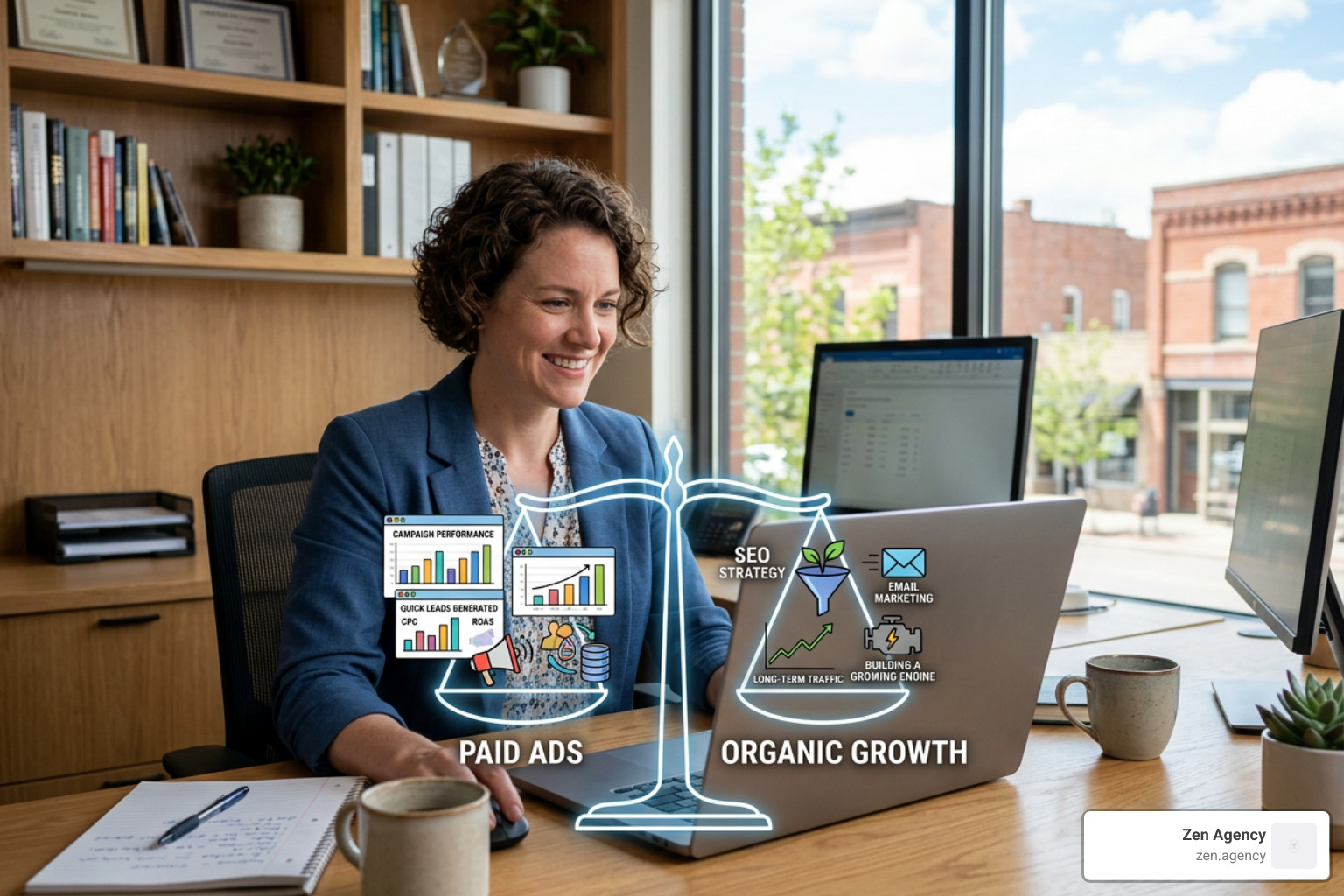
This balance is particularly critical when you consider customer retention. It costs five times as much to attract a new customer than it does to retain an existing one. If you only focus on paid acquisition, you are constantly filling a leaky bucket. By building an owned audience through email and high-quality content, you can turn a single purchase into a lifetime relationship.
To manage this balance effectively, we recommend using the 70/20/10 budget rule:
- 70% of your budget should go to proven, stable channels that drive predictable returns (e.g., Local SEO, optimized website maintenance, and your primary lead-generation channel).
- 20% of your budget should target emerging channels with high promise (e.g., AEO/GEO optimization or a new social platform where your audience is gathering).
- 10% of your budget should be reserved for pure experimentation (e.g., testing a highly creative campaign, partnering with a micro-influencer, or trying a new interactive tool).
By structuring your budget this way, you protect your baseline revenue while continuously positioning your brand for future growth. To learn more about optimizing your marketing spend, read our guide on How to Improve Marketing ROI and Make Your Budget Work Harder, and discover why a holistic approach is key in our article, Full Funnel Digital Marketing Is the Only Way to Fly.
Measuring Success and Tracking ROI
You cannot improve what you do not measure. Yet, nearly 60% of small business websites lack properly configured conversion tracking in Google Analytics 4 (GA4). They track vanity metrics like pageviews or social media “likes,” but have no idea which marketing channel actually drove a phone call, form fill, or sale.
To run a profitable digital marketing campaign, you must set up robust tracking from day one. This starts with configuring GA4, Google Search Console, and platform-specific tracking pixels.
When measuring success, ignore the noise and focus on these key metrics:
- Conversion Rate: The percentage of website visitors who take a desired action (e.g., filling out a contact form or calling your office).
- Cost Per Lead (CPL) / Cost Per Acquisition (CPA): Exactly how much marketing spend it takes to generate a qualified lead or a paying customer.
- Customer Lifetime Value (LTV): The total revenue a single customer brings to your business over their entire relationship with you.
- Source Attribution: Tracking exactly where your leads come from (e.g., Google organic search, a local map listing, or an email newsletter) so you can double down on what works and cut what doesn’t.
Understanding these metrics is essential to determining how much you should invest in your growth. If you are ready to evaluate pricing models and structures that fit your tracking needs, explore our analysis of Unpacking the Best Digital Marketing Pricing Packages in 2026.
Channel-Specific Tactics and Best Practices
To stand out in 2026, you cannot rely on generic, cookie-cutter marketing. Each channel requires a specific, tailored approach designed to match how modern consumers interact with online platforms.
Traditional SEO and Local Pack Optimization
Traditional Google SEO remains a powerhouse, driving approximately 58% of organic traffic for most small-to-medium-sized businesses. However, for local businesses, the real goldmine is the Google Local Pack—the map section that appears at the top of local search results.
The Local Pack generates over 40% of all clicks on local searches, and 28% of those local searches result in a purchase within 24 hours. If your business is not visible here, you are virtually invisible to local buyers.
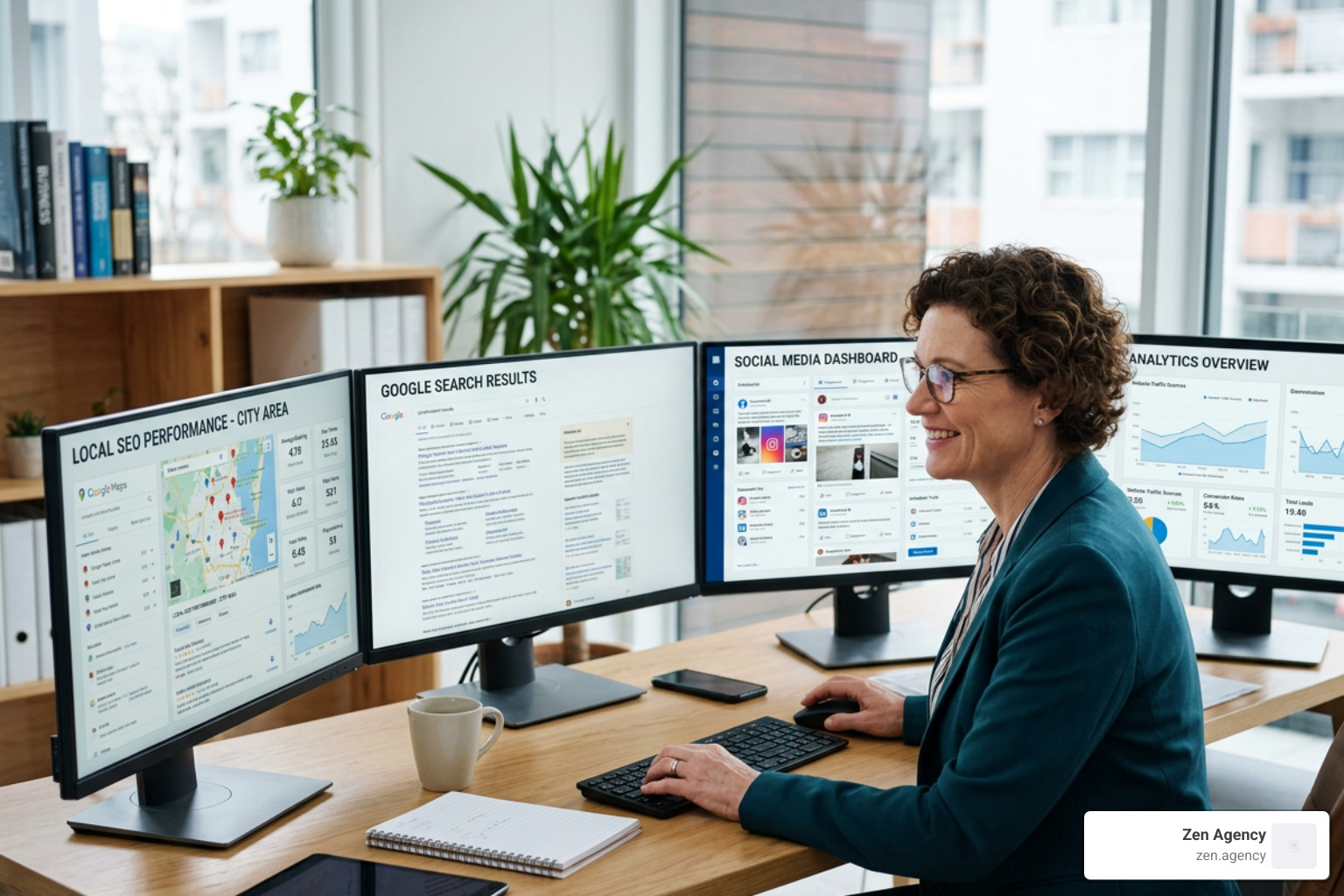
To dominate local search in Scranton, Wilkes-Barre, or Billings, MT, follow these best practices:
- Claim and Complete Your Google Business Profile (GBP): Ensure your business name, address, phone number (NAP), and operating hours are 100% accurate and consistent across the web. Complete profiles are 2.7 times more likely to be viewed as reputable by consumers.
- Optimize for “Near Me” Searches: Integrate localized keywords naturally into your website’s titles, headers, and meta descriptions (e.g., “HVAC repair in Scranton, PA” or “web design in Billings, MT”).
- Cultivate and Respond to Reviews: Regularly ask happy customers for Google reviews. Respond to every single review—both positive and negative—to show search engines and potential buyers that you are active and engaged.
- Leverage Local Directory Citations: Ensure your business is listed accurately on local directories, regional chamber of commerce sites, and business listings. Keeping your information consistent across these platforms helps search engines verify your physical location and boosts your authority in local search results.
By mastering these local signals, you can transition your business from digital obscurity to local dominance. To learn more about this journey, read our guide From Obscurity to Opportunity: Mastering Online Presence and Organic Traffic.
Navigating AI Search: Answer Engine Optimization (AEO) and Generative Engine Optimization (GEO)
As search behavior shifts toward conversational queries, small businesses must optimize for AI engines like ChatGPT, Perplexity, and Google Gemini. This dual-pronged approach is known as Answer Engine Optimization (AEO) and Generative Engine Optimization (GEO).
With 30-42% of search traffic now flowing through AI summaries and conversational interfaces, ignoring this layer means leaving a massive portion of your market on the table.
To optimize your website for AI search engines:
- Implement Schema Markup: Use structured schema markup (such as LocalBusiness, Product, and FAQ schema) to help AI web crawlers easily read, categorize, and understand your website’s data.
- Build Comprehensive FAQ Sections: AI engines love direct, clear answers. Create FAQ pages that address specific, long-tail questions your customers ask (e.g., “How much does a commercial roof replacement cost in Wilkes-Barre?”).
- Establish E-E-A-T (Experience, Expertise, Authoritativeness, Trustworthiness): AI models prioritize content written by real experts. Author bio pages, detailed case studies, and transparent, high-quality content are critical to proving your authority.
- Write in Natural, Conversational Language: Structure your content to match how people speak when using voice search or typing questions into an AI prompt.
Paid Search and Paid Social in the Era of AI
Paid advertising remains the fastest way to generate leads, but in 2026, success requires precision. Simply throwing money at Google Ads or Meta Ads without a clear strategy is a guaranteed way to burn your budget.
To maximize your paid ad performance:
- Use Negative Keywords Aggressively: In Google Ads, use negative keywords to filter out unqualified searches. For example, if you are a premium remodeling contractor, add terms like “cheap,” “DIY,” or “free” to your negative keyword list to avoid paying for bad-fit clicks.
- Focus on Lead Quality Over Volume: Optimize your campaigns for actual sales conversions rather than just clicks or form submissions.
- Combine SEO and Paid Ads: Running Google Ads alongside an active SEO strategy yields a 25% higher click-through rate (CTR) than running either channel alone. When users see your brand in both the paid and organic search results, trust increases dramatically.
- Create Mobile-First Vertical Video: On platforms like Meta, Instagram, and TikTok, short-form vertical video (9×16 format) reigns supreme. It mimics the natural way users hold their phones, making your ads feel organic and engaging.
For a deeper look into crafting high-converting social campaigns, check out our Social Media Marketing Guide 2026.
Email Marketing and Building an Owned Audience
Email marketing continues to deliver some of the highest returns of any digital marketing channel, often yielding a 4:1 average return ($4 for every $1 spent). It is one of the few channels where you have 100% ownership of your audience, completely free from the whims of search engine algorithms and social media updates.
Furthermore, over 50% of consumers report making a purchase from a marketing email at least once a month.
To build a high-converting email program:
- Create an Irresistible Lead Magnet: Offer a free resource, exclusive discount, or helpful guide in exchange for a visitor’s email address (e.g., “Download our Free 10-Point Home Winterization Checklist”).
- Segment Your Subscriber List: Group your subscribers based on their interests, location, or past purchase behavior. Sending a highly targeted email to a small segment will always outperform sending a generic blast to your entire list.
- Set Up Automated Flows: Build automated email sequences that trigger based on user actions. A welcome sequence for new subscribers, an abandoned cart sequence, and a customer reactivation sequence can run in the background, generating revenue on autopilot.
- Focus on Value First: Do not treat your email list as a non-stop sales pitch. Mix promotional offers with helpful tips, industry insights, and behind-the-scenes stories to build a loyal, engaged community.
For additional insights on structuring your general digital approach, you can explore the Salesforce Guide to Digital Marketing for Small Businesses.
Frequently Asked Questions about SMB Marketing
Navigating online marketing can spark many questions. Here are clear, direct answers to the most common questions small business owners ask.
What is the Minimum Budget for Digital Marketing for Small Businesses?
The ideal marketing budget depends heavily on your industry, location, and growth goals. However, most small businesses allocate 7-12% of their gross revenue to marketing.
To help you plan, we break down investments into three distinct tiers:
- Minimum Viable Budget ($300 – $500 / month): Best for very small or micro-businesses. This budget focuses entirely on essentials: maintaining a basic website, optimizing your free Google Business Profile, and running small, highly targeted local ad campaigns.
- Growth Budget ($1,000 – $2,500 / month): Designed for businesses looking to actively scale. This allows you to combine organic SEO, consistent content creation, and structured paid campaigns to capture active local market share.
- Scale Budget ($3,000 – $7,000+ / month): For businesses aiming to dominate their market aggressively. This tier supports comprehensive multi-channel campaigns, advanced conversion rate optimization (CRO), and dedicated management.
How Long Does It Take to See Results from Digital Marketing?
The timeline for digital marketing success depends entirely on the channels you choose:
- Paid Search and Paid Social: Can produce qualified leads within days of launching. However, these results stop the moment your budget is turned off.
- Google Business Profile and Local SEO: Typically shows noticeable improvements in local map rankings and phone calls within 2 to 4 weeks.
- Traditional SEO, AEO, and GEO: Require a long-term commitment. It generally takes 3 to 6 months of consistent technical optimization and content creation to see compounding organic traffic growth.
A balanced strategy uses paid ads for immediate lead flow while organic SEO builds a sustainable, long-term engine.
Should I Hire an Agency or Do It Myself?
The decision to DIY or hire professional help comes down to your internal capacity, technical expertise, and current business stage:
- The DIY Model: Best for pre-revenue startups or brand-new businesses with more time than money. You can handle your own basic social media posting, write simple blog articles, and set up your Google Business Profile for free.
- The Hybrid Model: Best for growing businesses. You might handle basic customer communication and social media in-house while partnering with specialist freelancers to manage technical tasks like web development or advanced SEO.
- The Agency Model: Best for scaling businesses that need professional execution without the overhead of hiring an entire in-house marketing team. An agency provides immediate access to a full suite of specialists—including developers, copywriters, SEO experts, and ad managers—allowing you to focus entirely on running your business.
Conclusion
In 2026, standing out in a crowded digital world is not about having the biggest budget. It is about having the smartest strategy. By sequencing your marketing efforts based on your business constraints, balancing your rented paid ads with compounding owned channels, and optimizing for the new AI search landscape, you can build a highly profitable, sustainable lead-generation engine.
At Zen Agency, we specialize in helping small-to-medium-sized businesses bridge the gap between obscurity and market leadership. Since 2008, we have delivered enterprise-grade web development, branding, and custom digital marketing services tailored to meet the real-world constraints of growing businesses. We do not believe in generic packages or vanity metrics; we build custom, results-driven strategies designed to maximize your visibility, profitability, and ROI.
Are you ready to stop guessing and start growing? Request a custom quote from Zen Agency today, and let’s build a digital marketing roadmap that positions your business for long-term success.