Unpacking the Best Digital Marketing Pricing Packages in 2026
What You’re Actually Paying For: Digital Marketing Pricing Packages Explained
Digital marketing pricing packages vary wildly — and if you’ve ever gotten three quotes from three different agencies and wondered why they look nothing alike, you’re not alone.
Here’s a quick snapshot of what businesses typically pay in 2026:
| Business Size | Typical Monthly Investment |
|---|---|
| Small business / startup | $1,000 – $5,000/month |
| SMB (growing) | $5,000 – $15,000/month |
| Mid-market | $15,000 – $50,000/month |
| Enterprise | $50,000 – $500,000+/month |
A few key things to know upfront:
- Most agency fees do not include ad spend — that’s a separate budget
- 88% of agencies don’t publish their pricing publicly; they use custom quotes
- Hourly rates average $25–$149/hour depending on the service and agency tier
- Most digital marketing takes 3–6 months to show measurable results
The range is this wide because pricing depends on your industry, goals, channels, agency experience, and location. A $1,500/month package and a $15,000/month package can both be “fair” — it comes down to scope and what you actually need.
I’m Joseph Riviello, CEO and Founder of Zen Agency, and over my 22 years in the industry I’ve seen every variation of digital marketing pricing packages — from underpowered starter plans to bloated enterprise retainers that don’t deliver. Below, I’ll break down exactly what drives costs, what each tier should include, and how to spot a bad deal before you sign.
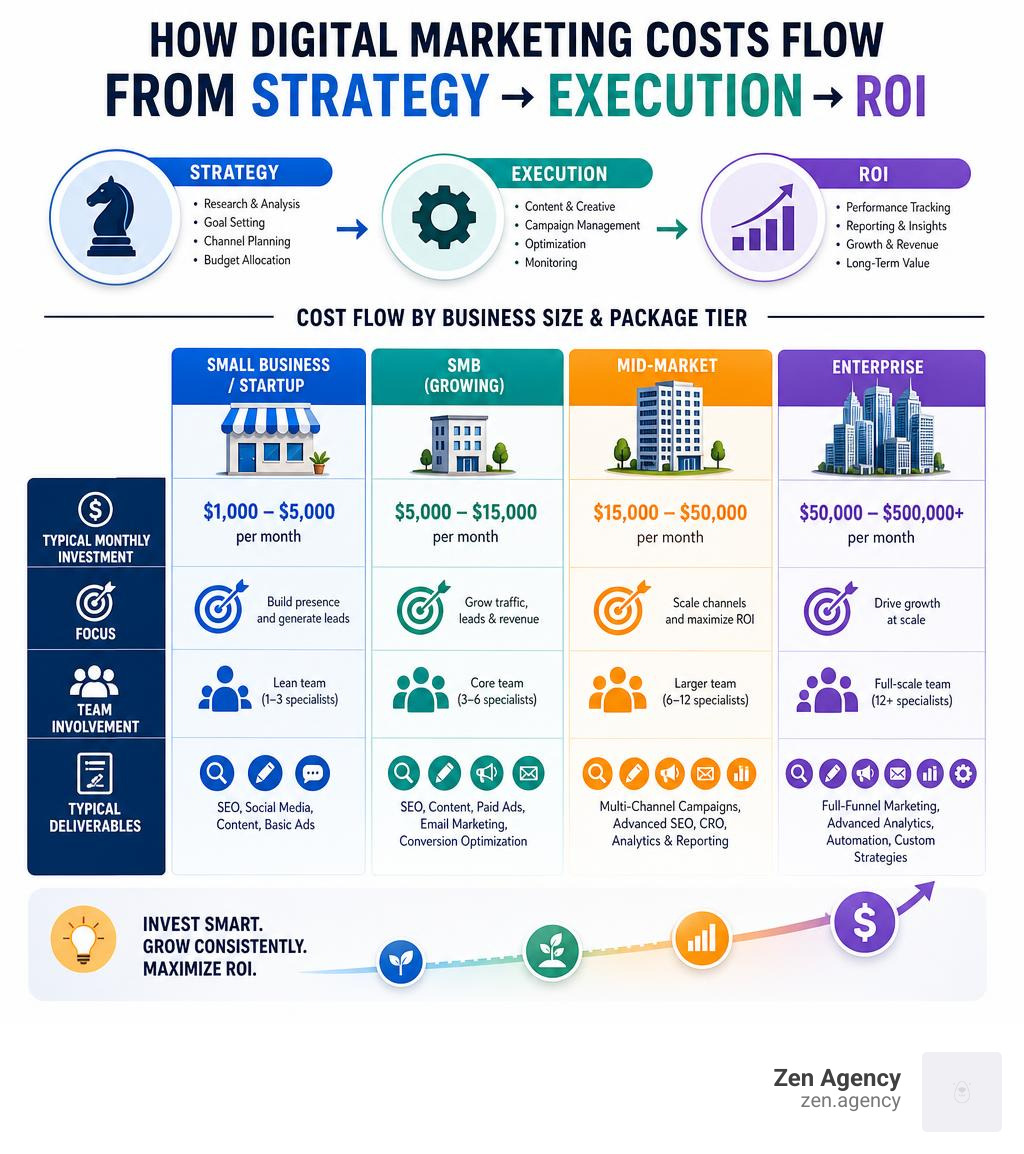
Digital Marketing Pricing Packages: 2026 Cost Benchmarks by Business Size
Digital marketing pricing is not one fixed number. It is a combination of strategy, labor, tools, creative production, campaign management, reporting, and sometimes paid media management.
According to 2026 digital marketing agency pricing data, agency pricing commonly falls between $5,000 and $50,000 per month, based on data across a very large pool of firms. That does not mean every business needs to spend that much. It means the market is broad, and your right number depends on the job your marketing has to do.
A local service business in Scranton or Wilkes-Barre may need local SEO, Google Business Profile optimization, paid search, and review generation. A growing ecommerce company in Pennsylvania or Montana may need SEO, paid social, lifecycle email, CRO, product photography, landing pages, and analytics. Same category. Very different workload.
Average Monthly Cost Ranges in 2026
Here are practical 2026 benchmarks:
| Pricing Category | Typical Range |
|---|---|
| Small business retainer | $1,000-$5,000/month |
| Most SMB retainers | $1,000-$10,000/month |
| Growth-focused SMB package | $5,000-$15,000/month |
| Mid-market omnichannel package | $15,000-$50,000/month |
| Enterprise digital marketing | $50,000+/month |
| General agency hourly rates | $25-$49/hour |
| Specialist hourly rates | $100-$149/hour |
| Project-based work | $1,000-$50,000+ |
The reason published prices are hard to find is simple: most agencies quote based on scope. In 2026, research shows that roughly 88% of agencies use custom quotes instead of publishing fixed prices. That can be frustrating, but it is not always a red flag. A custom quote is normal when the agency is building around your goals, sales cycle, market, and internal resources.
It becomes a red flag when the quote is vague. “Digital marketing package: $6,000/month” tells you almost nothing. “Technical SEO, 4 optimized pages, 2 landing pages, paid search management, monthly reporting, call tracking, and conversion recommendations” tells you much more.
How Small Business, SMB, and Enterprise Packages Differ
The bigger the company, the more complex the package usually becomes.
Small business packages often focus on one or two high-impact channels. For example:
- Local SEO
- Google Business Profile management
- Basic website maintenance
- Review monitoring
- Simple paid search campaigns
- Monthly reporting
This works well for businesses that need leads in a defined service area, such as Scranton PA, Kingston PA, Hazleton PA, Billings MT, or nearby markets.
SMB packages usually shift toward lead generation and channel coordination. These packages may include:
- SEO and content
- PPC management
- Paid social
- Landing pages
- Email marketing
- Analytics
- Conversion tracking
- Monthly strategy calls
Enterprise packages involve more moving parts:
- Multi-location marketing
- Multiple departments and stakeholders
- Advanced reporting
- CRM and attribution integrations
- Compliance needs
- Dedicated account teams
- Larger creative volume
- Deeper competitive research
At Zen Agency, we often see struggling-to-scale businesses hit a point where random marketing tasks stop working. That is when a more integrated strategy becomes necessary.
Service-Specific Price Ranges to Expect
Different services carry different costs because they require different skill sets. A technical SEO audit is not the same workload as daily paid media optimization or a full website rebuild.
Common monthly ranges in 2026 include:
| Service | Typical Monthly Range |
|---|---|
| Local SEO | $500-$3,000 |
| SEO | $1,000-$30,000 |
| PPC management | $1,500-$10,000 |
| Social media marketing | $1,000-$20,000 |
| Email marketing | $300-$5,000 |
| Content marketing | $4,000-$15,000 |
| CRO | $1,500-$10,000+ |
| Analytics and reporting | $500-$5,000+ |
| Website design or redesign | $3,500-$50,000+ project-based |
For broader pricing context, resources like Digital Marketing Pricing Data: Agency rates comparison can help you compare market ranges. Just remember: price tables are starting points, not strategy.
Common Pricing Models Agencies Use
Most digital marketing pricing packages are built around one of four pricing models: hourly, project-based, monthly retainer, or performance-based. Many agencies now use hybrids, such as a fixed retainer plus a bonus tied to results.
Hourly, Project-Based, Monthly Retainer, and Performance-Based Pricing
Hourly pricing is common for consulting, audits, technical fixes, and advisory work. It is flexible but can be unpredictable if the scope is not controlled.
Project-based pricing works for defined deliverables, such as:
- Website redesigns
- SEO audits
- Brand identity work
- Landing page builds
- Tracking setup
- Campaign launch packages
Monthly retainers are the most common model for ongoing marketing. Research indicates that 78% of digital agencies use retainer-based pricing as their primary model, up from 64% in 2023.
Performance-based pricing ties compensation to results. This may include:
- Cost per lead
- Cost per acquisition
- Revenue share
- Percentage of ad spend
- Fixed fee plus performance bonus
Performance pricing sounds attractive, but it requires clean tracking, shared definitions, and realistic attribution. Otherwise, everyone ends up arguing about who “caused” the sale. Very fun. Very avoidable.
When Retainers Make the Most Sense
Retainers make sense when the work is ongoing and optimization matters. SEO, PPC, content, email, social, and CRO all improve through iteration.
A retainer gives you:
- Predictable monthly budgeting
- Consistent reporting
- Continuous campaign learning
- Ongoing optimization
- Regular strategy adjustments
- Better long-term accountability
Most digital marketing efforts need 3-6 months to show measurable traction. PPC can produce early data in weeks, but SEO, content, and full-funnel campaigns need time to compound.
When Project-Based or Performance-Based Pricing Works Better
Project-based pricing is better when the beginning and end are obvious. For example:
- “Redesign these 10 landing pages”
- “Audit our SEO and provide a roadmap”
- “Set up conversion tracking”
- “Build an email welcome sequence”
Performance-based pricing can work when:
- Lead quality is clearly defined
- Sales attribution is clean
- The agency can influence the full funnel
- Baseline revenue is documented
- Both sides agree on exclusions
It is less effective when the client has a long sales cycle, poor CRM hygiene, inconsistent follow-up, or no clear definition of a qualified lead.
What’s Included in Entry-Level vs. Premium Packages
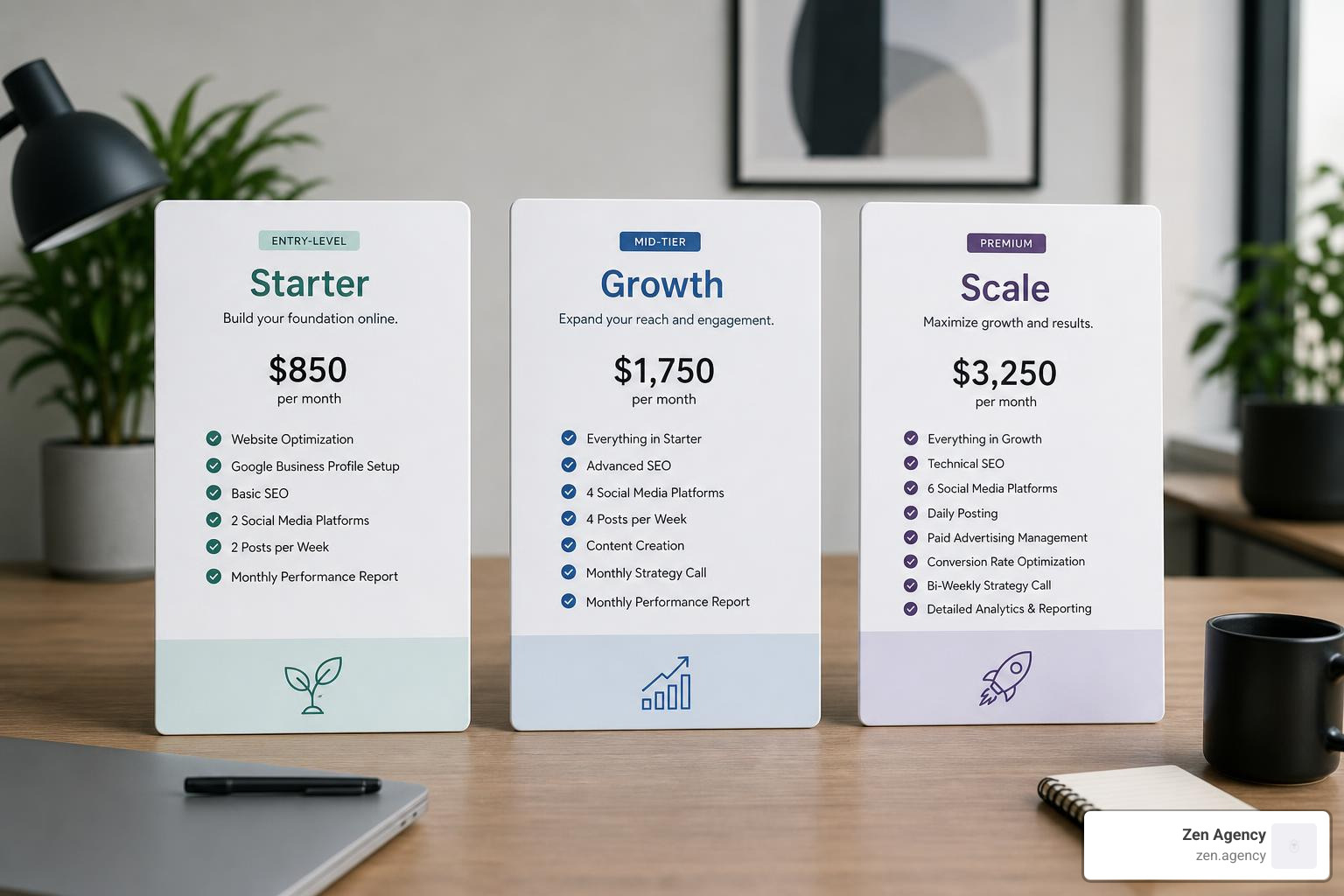
Not all packages are built equally. The difference between a $1,500/month plan and a $15,000/month plan is usually not just “more posts.” It is strategy depth, senior talent, creative output, analytics, speed, and integration.
| Package Tier | Best For | Common Inclusions | Typical Monthly Range |
|---|---|---|---|
| Entry-level | Local visibility, basic lead flow | Local SEO, basic reporting, simple ads, website maintenance | $1,000-$5,000 |
| Growth | SMB lead generation | SEO, PPC, content, email, landing pages, analytics | $5,000-$15,000 |
| Premium | Scaling and full-funnel growth | Multi-channel strategy, CRO, automation, attribution, advanced reporting | $15,000-$50,000+ |
How Digital Marketing Pricing Packages Change from Entry-Level to Premium
Entry-level packages are usually channel-specific. They might help you show up locally, run a small paid search campaign, or keep your website healthy.
Premium packages are more strategic. They connect channels across the buyer journey: awareness, traffic, conversion, nurture, and retention. That is why we often recommend thinking in terms of funnel coverage, not isolated services. Our guide on full-funnel digital marketing explains why this matters for serious growth.
Entry-Level Package Inclusions
Entry-level packages often include:
- Local SEO
- Basic keyword tracking
- Google Business Profile updates
- Monthly reports
- Website maintenance
- Basic technical SEO checks
- Simple paid ads management
- Limited social media posting
- Review monitoring
- Basic email newsletter support
These packages are useful when you need foundational visibility. They are not ideal if you need aggressive growth, complex lead nurturing, or multi-channel attribution.
Premium Package Inclusions
Premium packages usually include:
- Multi-channel strategy
- Advanced SEO
- Paid search and paid social
- Content strategy and production
- Landing page creation
- Email automation
- Conversion rate optimization
- CRM and analytics integration
- Executive reporting
- Attribution modeling
- Creative testing
- Ongoing strategic consulting
For businesses with long sales cycles, ecommerce funnels, or repeat-purchase opportunities, email automation can be a major ROI lever. We cover that in more detail in our advanced email marketing automation guide.
What Drives Digital Marketing Costs Up or Down
Pricing changes based on complexity. Two businesses can ask for “SEO and PPC” and require completely different levels of effort.
Key cost drivers include:
- Market competition
- Business location and service area
- Agency experience
- Specialist involvement
- Industry complexity
- Compliance requirements
- Number of channels
- Creative volume
- Website condition
- Tracking and analytics needs
- AI search and structured data needs
- Sales cycle length
Location, Experience, and Specialization
Agency location can affect pricing. Agencies in expensive major markets often charge more than agencies in regional markets. Offshore providers may charge less, but lower cost can come with tradeoffs in strategy, communication, quality control, and market understanding.
For businesses in Pennsylvania and Montana, local market knowledge matters. Ranking for a local service in Wilkes-Barre, Scranton, Kingston, Hazleton, or Billings is different from competing nationally. A good package should match the actual competitive environment.
Experience also matters. Senior strategists, technical SEO specialists, paid media experts, CRO analysts, developers, and copywriters cost more because they can solve harder problems faster.
Specialization can raise costs too. Ecommerce, B2B lead generation, healthcare-related marketing, multi-location campaigns, and complex CRM integrations all require more planning.
Ad Spend vs. Agency Management Fees
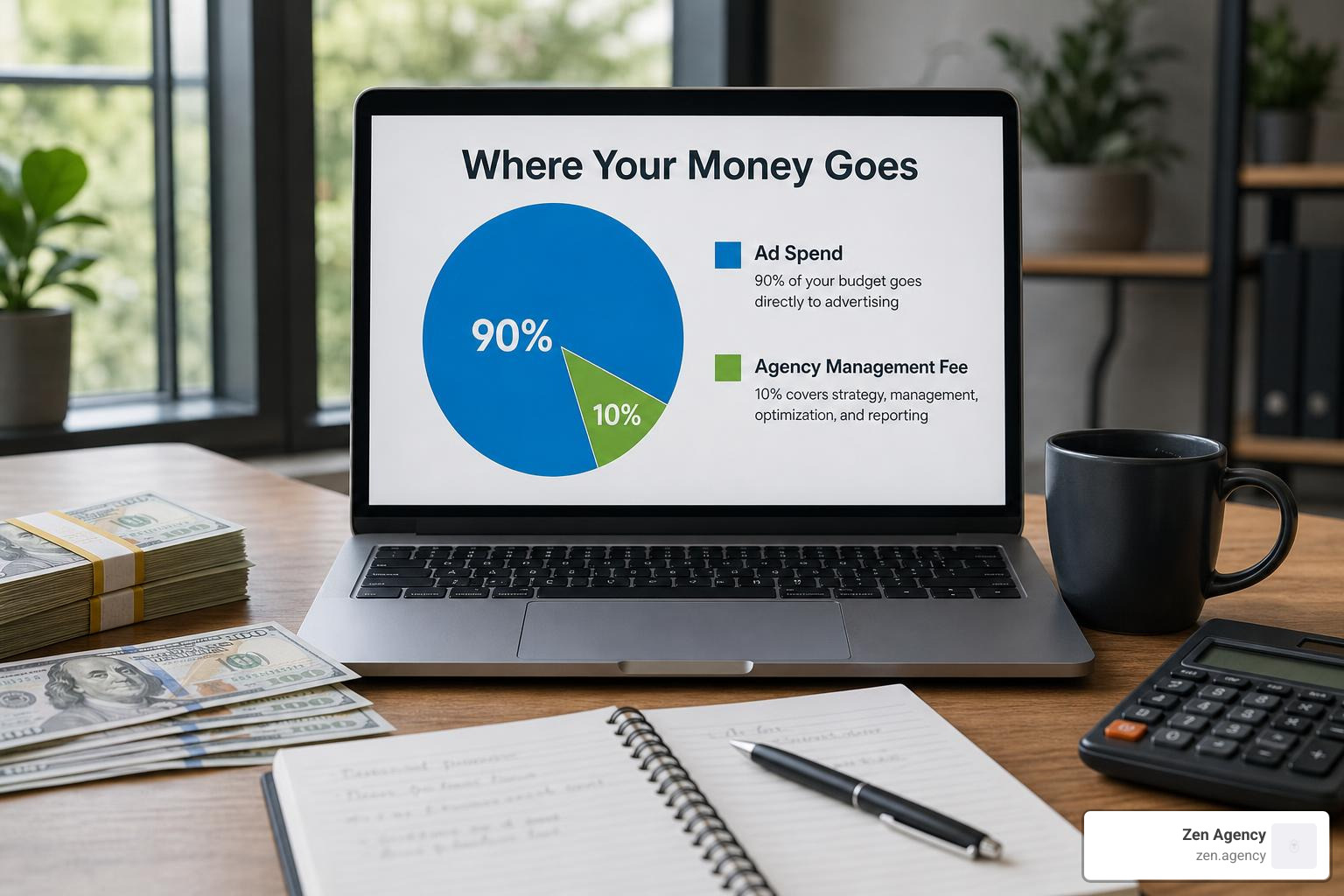
This is one of the biggest areas of confusion.
Your agency management fee pays for the people managing the strategy and campaigns. Your ad spend is the money paid to platforms for media placement.
For example:
| Cost Type | Example |
|---|---|
| PPC management fee | $2,000/month |
| Google Ads budget | $5,000/month |
| Landing page support | $1,000/month |
| Total monthly investment | $8,000/month |
Paid media management fees often range from 10%-20% of ad spend, especially when spend is significant. Some agencies use flat fees instead. Some use a hybrid.
Important: you should know whether your ad spend is billed directly to your own ad account or passed through the agency. We generally prefer clients maintain direct ownership and visibility whenever possible.
Hidden Costs and Fees to Watch For
Before signing, ask about:
- Setup fees
- Onboarding fees
- Software subscriptions
- Analytics tools
- Call tracking
- CRM integrations
- Landing page creation
- Ad creative production
- Copywriting limits
- Revision overages
- Rush fees
- Reporting upgrades
- Stock photography or video costs
- Platform markups
- Website plugin or hosting costs
None of these are automatically bad. The problem is surprise. Good pricing makes the total cost of ownership clear.
Scope Creep and Contract Fine Print
Scope creep happens when a package says one thing, but everyone assumes another. To avoid it, your agreement should define:
- Number of pages, posts, ads, or emails
- Number of revision rounds
- Channels included
- Meeting cadence
- Reporting format
- Approval timelines
- Data and account ownership
- Cancellation terms
- Dashboard access
- Intellectual property rights
- What happens if goals or scope change
If a proposal is vague, ask for specifics. If the agency resists specifics, keep your pen in your pocket.
How to Evaluate Pricing, Contracts, and ROI
A fair price is not always the lowest price. It is the price that matches the strategy, talent, deliverables, accountability, and expected business impact.
We recommend evaluating pricing through three lenses:
- Scope: What exactly is included?
- Capability: Who is doing the work?
- Return: How will success be measured?
For a deeper look at budget efficiency, read our guide on how to improve marketing ROI.
How to Compare Digital Marketing Pricing Packages Without Overpaying
Use this checklist:
- Get at least 3 comparable quotes
- Ask for a line-item scope of work
- Compare deliverables, not just prices
- Ask who will manage the account
- Confirm reporting frequency
- Ask what tools are included
- Clarify ad spend and platform fees
- Look for clear assumptions
- Ask about cancellation terms
- Watch for guaranteed ranking promises
- Avoid long lock-ins with vague deliverables
A strong proposal should explain why each channel is recommended. If every package looks like a menu from a diner with 147 items, something is off.
Typical Contract Lengths and Commitment Periods
Common contract structures include:
| Contract Type | Typical Use |
|---|---|
| Month-to-month | Paid media, consulting, flexible support |
| 3-month pilot | Testing agency fit and early traction |
| 6-month commitment | SEO, content, full-funnel campaigns |
| 12-month agreement | Enterprise, multi-location, larger integrations |
| Annual prepay | Sometimes discounted, but should be used carefully |
SEO often needs at least 6 months because technical fixes, content, authority building, and rankings take time. PPC can be evaluated faster, often within 2-4 weeks for early signals, but meaningful optimization still takes longer.
If you prepay annually, ask for a meaningful discount and clear performance checkpoints.
Realistic ROI by Pricing Tier
ROI depends on your offer, margins, close rate, sales cycle, and website conversion rate. Still, here are realistic expectations:
| Tier | Realistic ROI Expectation |
|---|---|
| Entry-level | Better visibility, basic lead flow, local presence improvements |
| Growth | Increased qualified traffic, stronger lead generation, better conversion tracking |
| Premium | Full-funnel growth, improved CAC, better attribution, stronger revenue forecasting |
| Enterprise | Scaled acquisition, multi-channel efficiency, deeper analytics, market expansion |
A healthy long-term target is often a 3:1 CLV:CAC ratio or better. In simple terms: if it costs $1 to acquire a customer, that customer should be worth at least $3 over their lifetime.
CRO can improve the economics of every channel. If you already have traffic, improving conversion rate may be more profitable than simply buying more clicks. Our conversion rate optimization guide explains how to approach this.
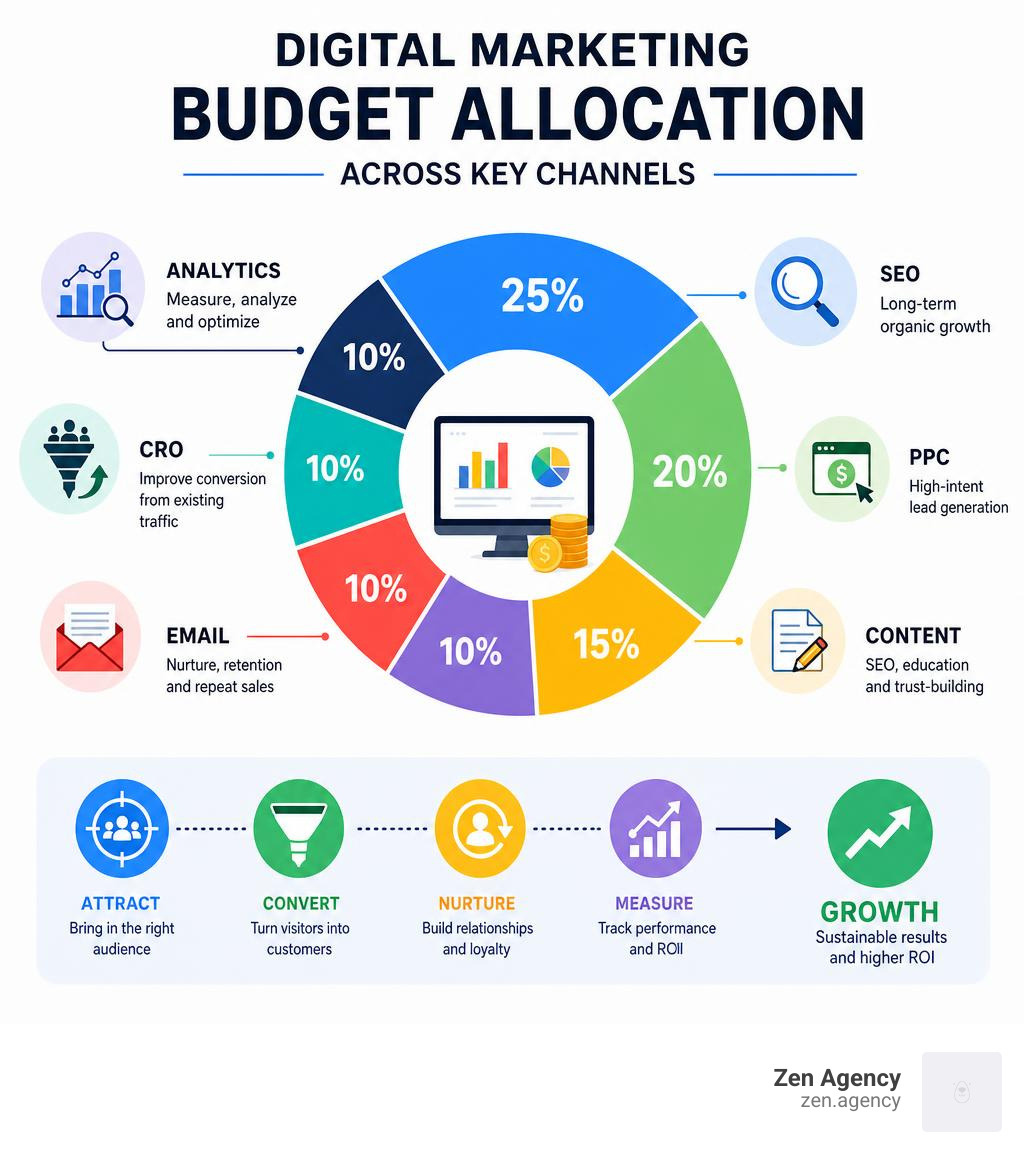
Budget Allocation by Channel
A practical digital marketing budget might include:
| Channel | Common Role |
|---|---|
| SEO | Long-term organic growth |
| Paid search | High-intent lead generation |
| Paid social | Awareness, retargeting, demand generation |
| Content | SEO, education, trust-building |
| Nurture, retention, repeat sales | |
| CRO | Better conversion from existing traffic |
| Analytics | Decision-making and attribution |
| Creative testing | Better ads, landing pages, and messaging |
| Contingency | Experiments and unexpected needs |
For more channel planning help, see our digital channel marketing guide.
Frequently Asked Questions About Digital Marketing Pricing Packages
What Is a Fair Monthly Budget for Digital Marketing in 2026?
For most SMBs, a fair monthly agency budget is $1,000-$10,000, depending on scope. Growth-focused businesses often invest $5,000-$15,000/month, while broader agency engagements commonly range from $5,000-$50,000/month.
As a rule of thumb:
- Established businesses may allocate 5%-10% of revenue to marketing
- Ecommerce brands may need 15%-30%
- Startups in aggressive growth phases may spend more
- Mature companies may spend less as a percentage of revenue
The right budget depends on your revenue goals, competition, sales cycle, and how quickly you need results.
Are Ad Budgets Included in Digital Marketing Packages?
Usually, no. Agency fees and ad budgets are separate.
Your package may include paid media management, but the actual media spend goes to platforms such as search engines or social networks. Always ask:
- Is ad spend included?
- Who owns the ad account?
- Is there a markup?
- Are platform fees passed through?
- What is the recommended minimum ad budget?
- How will paid media performance be reported?
Clean ownership and transparent billing prevent headaches later.
How Long Until a Digital Marketing Package Shows Results?
Typical timelines:
| Channel | Early Signals | Stronger Results |
|---|---|---|
| PPC | 2-4 weeks | 2-3 months |
| SEO | 2-3 months | 4-8 months |
| Content | 3-6 months | 6-12 months |
| 2-6 weeks | 2-4 months | |
| CRO | 4-8 weeks | Ongoing |
| Local SEO | 1-3 months | 3-6 months |
Most businesses should plan around a 3-6 month measurement window. Fast wins are possible, but sustainable growth usually comes from consistent execution.
Conclusion
The best digital marketing pricing packages are not the cheapest, the biggest, or the flashiest. They are the ones that match your goals, your market, your timeline, and your internal capacity.
A fair package should clearly explain:
- What is included
- What is not included
- How ad spend is handled
- Who owns the accounts
- How success is measured
- How long results should take
- What happens if the strategy needs to change
Since 2008, we have helped businesses use enterprise-grade web development, branding, and digital marketing strategies to increase visibility, profitability, and ROI. If your business is struggling to scale, the right package should not just “do marketing.” It should build a smarter growth system.
Ready to compare options with clarity? Explore our digital marketing services and let us help you build a package that fits your goals, not someone else’s template.