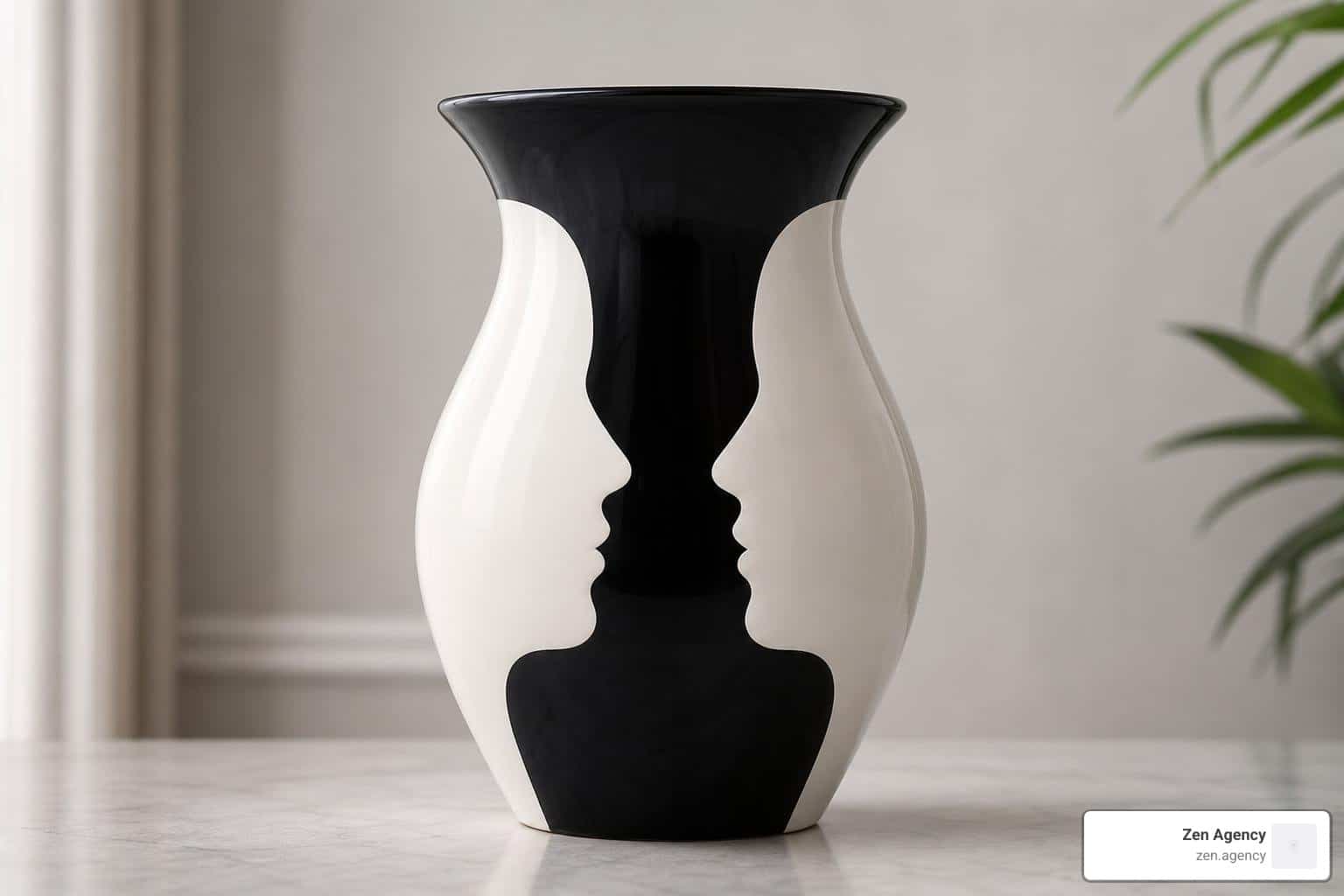
Seeing Double with Brilliant Examples of Positive and Negative Space
Seeing Double with Brilliant Examples of Positive and Negative Space
Why Positive and Negative Space Examples Are Worth Studying
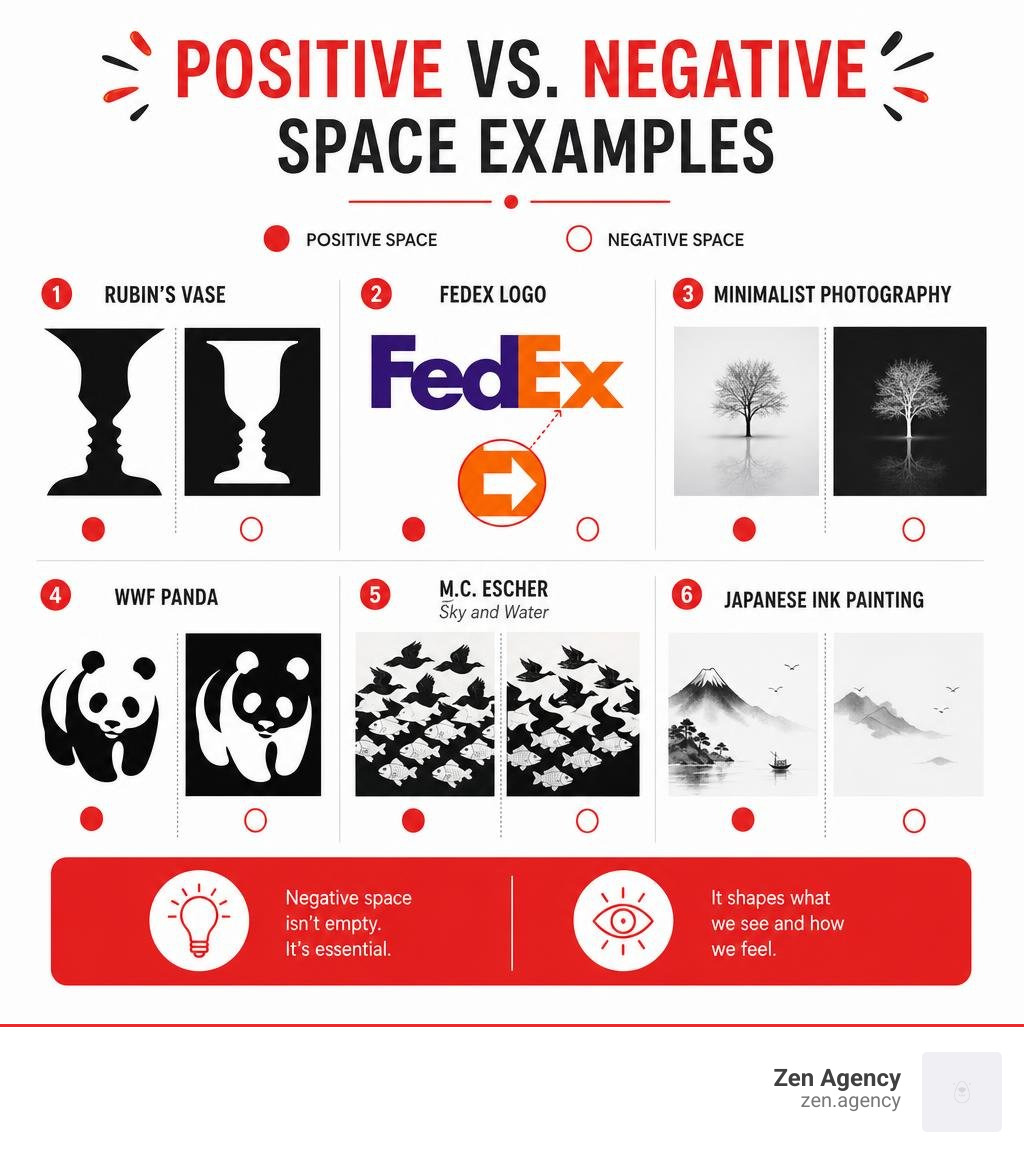
Positive and negative space examples are everywhere — from the FedEx logo’s hidden arrow to the famous vase-or-faces illusion you’ve probably seen a dozen times. Here’s a quick breakdown of the most recognizable ones:
| Example | Positive Space | Negative Space |
|---|---|---|
| Rubin’s Vase | Two facing profiles | A white vase |
| FedEx Logo | The letters “FedEx” | A hidden arrow between “E” and “x” |
| WWF Logo | Black panda patches | White space forming the full panda shape |
| M.C. Escher’s Sky and Water | Fish swimming left | Birds flying right (and vice versa) |
| Japanese ink paintings | Small detailed figures | Large empty areas of paper |
| Apple product pages | Product image and headline | Generous white space around everything |
These aren’t just clever tricks. They show how empty space shapes what you see just as much as the actual subject does.
Every composition — a logo, a website layout, a photograph, a painting — is built on the relationship between what’s there and what isn’t. Get that balance wrong and your design feels cluttered, weak, or confusing. Get it right and everything clicks.
I’m Joseph Riviello, CEO and Founder of Zen Agency, and with over 22 years in digital marketing and design strategy, I’ve seen how understanding positive and negative space examples can transform the way a brand communicates visually — and directly impact conversions and ROI. Let’s walk through the best examples across art, design, and the web so you can start applying these principles right away.
Understanding the Core Difference Between Positive and Negative Space
To master composition, we first have to strip away the idea that negative space is just “empty background.” In truth, negative space is an active, structural force.
When you look at an artwork or a web page, your brain naturally seeks a focal point. What is positive space? As explained in Positive & Negative Space in Art Explained, positive space represents the actual subjects or areas of primary interest—the figure in a portrait, the fruit in a still life, or the headline on a homepage. Negative space, conversely, is the area that surrounds and runs between those subjects.
This spatial dance is governed by Gestalt principles of visual perception. Originating in the early 20th century, Gestalt psychology explains that the human brain does not see elements in isolation; instead, we subconsciously organize visual inputs into unified systems. Our minds naturally group objects, close incomplete shapes, and separate foreground (figure) from background (ground).
Another critical concept to understand is visual weight. In a two-dimensional medium, different elements appear “heavier” than others. Visual weight is determined by several factors:
- Color and Saturation: Vibrant, highly saturated colors (with red being psychologically the “heaviest,” followed by blue and green) draw more attention than muted tones.
- Lightness and Darkness: Darker shades carry more visual weight. Placing darker shades at the bottom of a composition often feels more balanced because it mimics the natural pull of gravity.
- Complexity: Highly detailed, complex shapes require more cognitive processing time, making them feel heavier than simple geometric shapes.
- Density: Grouping elements closely together increases their collective visual density and weight.
To help visualize how these two forces interact, let’s compare their core characteristics:
| Characteristic | Positive Space (Figure) | Negative Space (Ground) |
|---|---|---|
| Primary Role | Delivers the main subject, content, or message | Frames, balances, and provides breathing room |
| Visual Weight | Typically heavy; commands immediate attention | Light to moderate; guides the viewer’s eye flow |
| Cognitive Function | Identifies what the viewer is looking at | Defines boundaries and establishes relationships |
| Color Properties | Often defined by contrasting hues and high detail | Can be any color, texture, gradient, or pattern |
Defining the Core Concepts with Positive and Negative Space Examples
Let’s look at how these rules function in the real world. Think of Rubin’s Vase, the classic optical illusion where you see either two silhouetted faces looking at each other or a white vase in the center. Neither shape is more “important” than the other; instead, they share a common border. Your brain switches back and forth between treating the faces as positive space and the vase as negative space.
In commercial design, the FedEx logo is perhaps the most celebrated of all positive and negative space examples. Designed by Lindon Leader in 1994, the logo features a clean, bold typeface. But if you look closely at the white space between the capital “E” and the lowercase “x,” a crisp, forward-pointing arrow emerges. This subtle addition was discovered halfway through a nine-month design process involving over 200 iterations. It works beautifully because it doesn’t crowd the layout; instead, it utilizes the existing negative space to deliver a second layer of meaning (representing forward movement and speed).
At Zen Agency, we apply these exact principles when crafting digital platforms. You can learn more info about UX design services to see how we structure digital products. In user experience design, we often refer to negative space as “white space.” However, despite the name, white space does not have to be white. It can be a solid dark color, a subtle background pattern, or even a soft color gradient.
The core takeaway from the Positive & Negative Space in Design Interactive Lesson is that space is not wasted space. As the legendary typographer Jan Tschichold famously wrote in 1930, white space should be treated as an active element of composition, not just a passive, empty background.
Famous Positive and Negative Space Examples Across Art History
Throughout art history, master creators have manipulated spatial balance to evoke emotion, challenge perception, and tell stories.
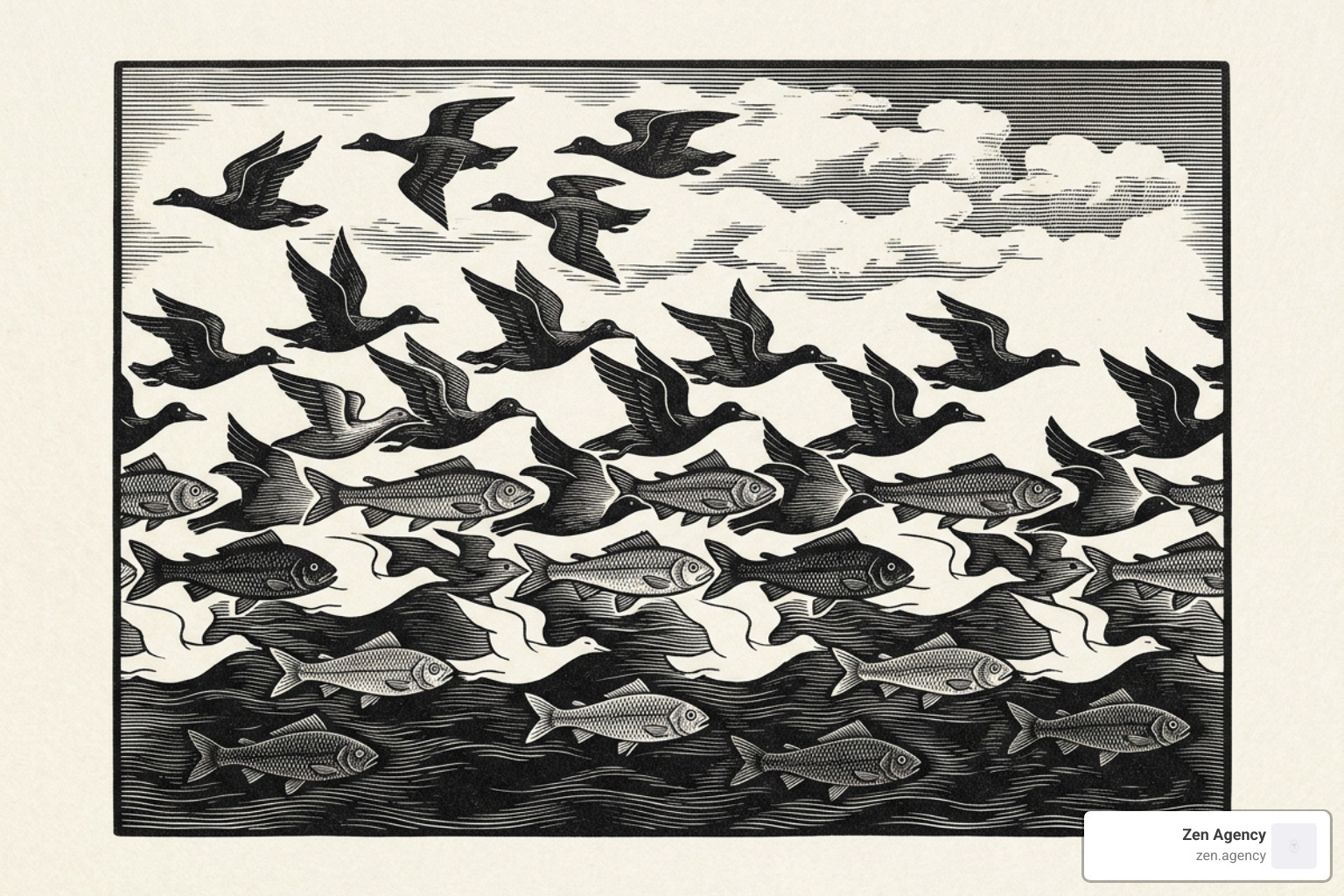
M.C. Escher
The Dutch graphic artist M.C. Escher was a master of figure-ground reversal. In his famous 1938 woodcut Sky and Water I, the top of the print features dark, detailed birds flying against a light background. As your eyes move downward, the negative space between the birds gradually transforms into positive shapes—specifically, light-colored fish swimming against a dark background. In the center of the composition, the fish and birds are perfectly integrated and indistinguishable in weight, creating a beautiful spatial puzzle.
Henri Matisse
Late in his career, when illness prevented him from painting, French artist Henri Matisse turned to “drawing with scissors.” His famous paper cut-outs treated positive and negative shapes with equal importance. As detailed in Positive & Negative Shapes: Essential Guide, Matisse would carefully arrange both the cut-out shapes (the positive forms) and the leftover paper scraps (the negative shapes) to create vibrant, balanced compositions. He proved that a great layout is defined as much by what you leave out as what you put in.
Japanese Notan
For centuries, Eastern art has embraced a spatial philosophy known as Notan (a Japanese word meaning “dark-light”). Unlike Western traditions that often treat the background as secondary to the subject, Notan treats positive and negative space as equal, inseparable halves of a whole. Think of the classic Yin and Yang symbol—it is a perfect demonstration of Notan, where neither side can exist without the other, creating absolute visual harmony.
Barbara Hepworth
The spatial relationship is not limited to flat, two-dimensional surfaces. In modern sculpture, British artist Barbara Hepworth revolutionized the medium by introducing “the hole” to her carved pieces. By carving smooth, organic openings directly through her stone and wood sculptures, Hepworth treated empty space as a physical element of the artwork, allowing light and the surrounding landscape to pass through and redefine the sculpture’s form.
Classic Optical Illusions as Positive and Negative Space Examples
To truly understand how our visual processing system handles spatial relationships, we can look at classic optical illusions.
The Rubin’s Vase illusion demonstrates how our brains assign “figure” and “ground” roles. Usually, the brain assigns the “figure” role to the shape that is more closed, detailed, or central. When these cues are perfectly balanced, our cognitive system experiences a playful tension, constantly shifting our focus.
This concept is explored deeply in What is Positive and Negative Space – The Virtual Instructor. When artists design silhouette art, they rely entirely on the boundary line where positive and negative space meet.
For example, in classic silhouette portraiture, the artist does not draw eyes, a nose, or a mouth. Instead, they cut out a dark profile against a light background. Because the negative space curves precisely around the edges of the face, our brains easily fill in the missing details, recognizing the subject instantly. This demonstrates that negative space can be used intentionally to define shapes without needing internal lines or shading.
How Different Art and Design Disciplines Apply Spatial Balance
Every creative discipline approaches positive and negative space with its own set of rules and tools, yet the underlying goal of achieving visual balance remains identical.

Graphic Design
In graphic and brand design, negative space is the secret weapon that elevates a standard logo into a memorable visual identity. Beyond the FedEx logo, look at the World Wildlife Fund (WWF) logo. It uses simple black patches to define a giant panda. There is no outline around the panda’s head or back; our minds use the surrounding white negative space to complete the form.
If you are looking to build a cohesive, memorable brand, check out more info about branding and graphic design services. We specialize in using spatial relationships to create clean, high-impact brand assets.
Photography
In photography, spatial balance dictates the emotional mood of the shot. A crowded landscape with overlapping trees and busy textures represents high positive space, conveying energy, chaos, or power.
Conversely, minimalist photography utilizes massive amounts of negative space—such as a tiny boat on a vast, calm ocean or a single bird in an empty sky. This technique shifts the focus entirely onto the subject, evoking feelings of peace, isolation, scale, or quiet contemplation. Photographers often use a shallow depth of field (blurring the background) to eliminate distracting positive space and turn a busy background into soft, clean negative space.
Web and UI Design
In digital design, negative space is the layout’s oxygen. Designers categorize space into two distinct types:
- Active Negative Space: This is space applied deliberately to draw focus to a specific element. For example, placing a single “Sign Up” button in the middle of a vast, empty section makes the button pop instantly. The emptiness acts as an active design tool.
- Passive Negative Space: This is the natural breathing room between elements—such as the margins between paragraphs, line-height spacing in text, or gaps between menu items. It organizes the content and prevents the layout from feeling cramped, even if the user doesn’t consciously notice it.
For a deeper dive into these spatial mechanics, we highly recommend reading Positive Space vs Negative Space: Mastering Visual Balance.
The Role of Negative Space in Modern Web and UI Design
When it comes to web design, the stakes are incredibly high. The way you distribute positive and negative space directly impacts how users interact with your business. Consider these industry statistics:
- First Impressions: 94% of first impressions about a website are design-related. If a visitor lands on a cluttered page, they will instantly feel overwhelmed and leave.
- Layout Clutter: 84.6% of professional designers state that overcrowded layouts are the single most common mistake small businesses make on their websites.
- Conversion Rates: A/B testing whitespace adjustments can improve conversion rates by up to 12%. By giving your calls-to-action (CTAs) room to breathe, you make it easier for users to take action.
- Responsive Design: 73.1% of visitors leave a website specifically because of non-responsive design. When a layout shrinks from a desktop screen to a mobile screen, the positive and negative spaces must shift dynamically to maintain readability.
As taught in the Open University’s module 3.1.5 Positive and negative space, clear contrast between figure and ground is essential for rapid communication. If a user has to search through a wall of text to find your contact details or product pricing, your design has failed.
At Zen Agency, we serve businesses across Pennsylvania (including Wilkes Barre, Scranton, Wyoming, Kingston, and Hazleton) and Montana (Billings), helping them scale by replacing cluttered, confusing layouts with clean, high-converting, responsive web designs.
Practical Techniques to Master Spatial Composition
If you want to train your eye to see and balance space like a professional, here are five highly effective techniques and exercises you can practice:
1. Notan Studies
To practice Notan, take a square piece of black paper and place it on a white background. Cut out organic or geometric shapes from the edges of the black square, then flip those cut-out pieces outward onto the white paper, creating mirrored positive and negative shapes. This classic exercise forces you to see dark and light values as equal partners in a composition.
2. The Squinting Technique
Whenever you are reviewing a design, a painting, or a photograph, step back and squint your eyes. Squinting blurs the fine details, allowing you to see the layout as basic masses of light and dark values. This makes it incredibly easy to see if one side of your composition is too heavy or if your negative space is distributed unevenly.
3. Use a Physical Viewfinder
Instead of relying on digital cropping tools, construct a physical viewfinder. Cut a small rectangular window (about 2×3 inches) out of a piece of stiff cardboard. Hold it up and look through it to frame different scenes in your daily life. This simple tool isolates shapes from their surroundings, helping you focus purely on how positive subjects interact with the surrounding negative space.
4. Thumbnail Sketches
Before committing to a final art project or website layout, sketch out three or four tiny “thumbnail” drawings (about 2 inches wide). Do not draw details; instead, block out the positive shapes in solid black and leave the negative space white. As discussed in Working with Negative and Positive Space – Urban Art, Diane Staver, this quick exercise helps you evaluate the overall layout and balance of your piece before spending hours on a design that might have a flawed spatial foundation.
5. Inverting Compositions
If you are working on a digital design or illustration, try flipping the canvas upside down or inverting the colors. By looking at the composition from an unfamiliar angle, your brain stops recognizing the subjects (like a face or a chair) and begins seeing them simply as abstract shapes. This allows you to evaluate the distribution of negative space with fresh, unbiased eyes.
Frequently Asked Questions About Spatial Design
What is the difference between positive and negative space?
Positive space is the primary subject or area of interest within a composition, whereas negative space is the empty area surrounding, between, and within those subjects. Together, they form the figure-ground relationship that allows our brains to visually process and interpret an image.
Can negative space be a color other than white?
Absolutely. Negative space is defined by its lack of primary subject matter, not its color. It can be black, a vibrant hue, a textured pattern, a soft gradient, or even a blurred background image. In web design, negative space is simply the empty layout area that provides breathing room for the content.
How does negative space improve website conversion rates?
Negative space improves conversion rates by reducing cognitive load and creating a clear visual hierarchy. By surrounding key elements—like a “Buy Now” button or a lead capture form—with generous white space, you draw the user’s eye directly to the action you want them to take, eliminating distractions and making the user experience seamless.
Conclusion
Mastering the balance between positive and negative space is the difference between a cluttered, forgettable design and a clean, high-impact masterpiece. Whether you are painting a canvas, framing a photograph, or launching a new e-commerce storefront, the space you leave empty is just as powerful as the content you put in.
At Zen Agency, we have been helping businesses scale since 2008 through custom web development, branding, and high-performance digital marketing. From our offices in Pennsylvania and Montana, we deliver enterprise-grade, visually stunning solutions designed to maximize your visibility and ROI.
Ready to transform your brand’s digital presence? Request a quote for custom design services today, and let’s build something beautiful together.