
Space in Art Definition and How to Draw It Like a Pro
Space in Art Definition and How to Draw It Like a Pro
Why the Space in Art Definition Matters More Than You Think
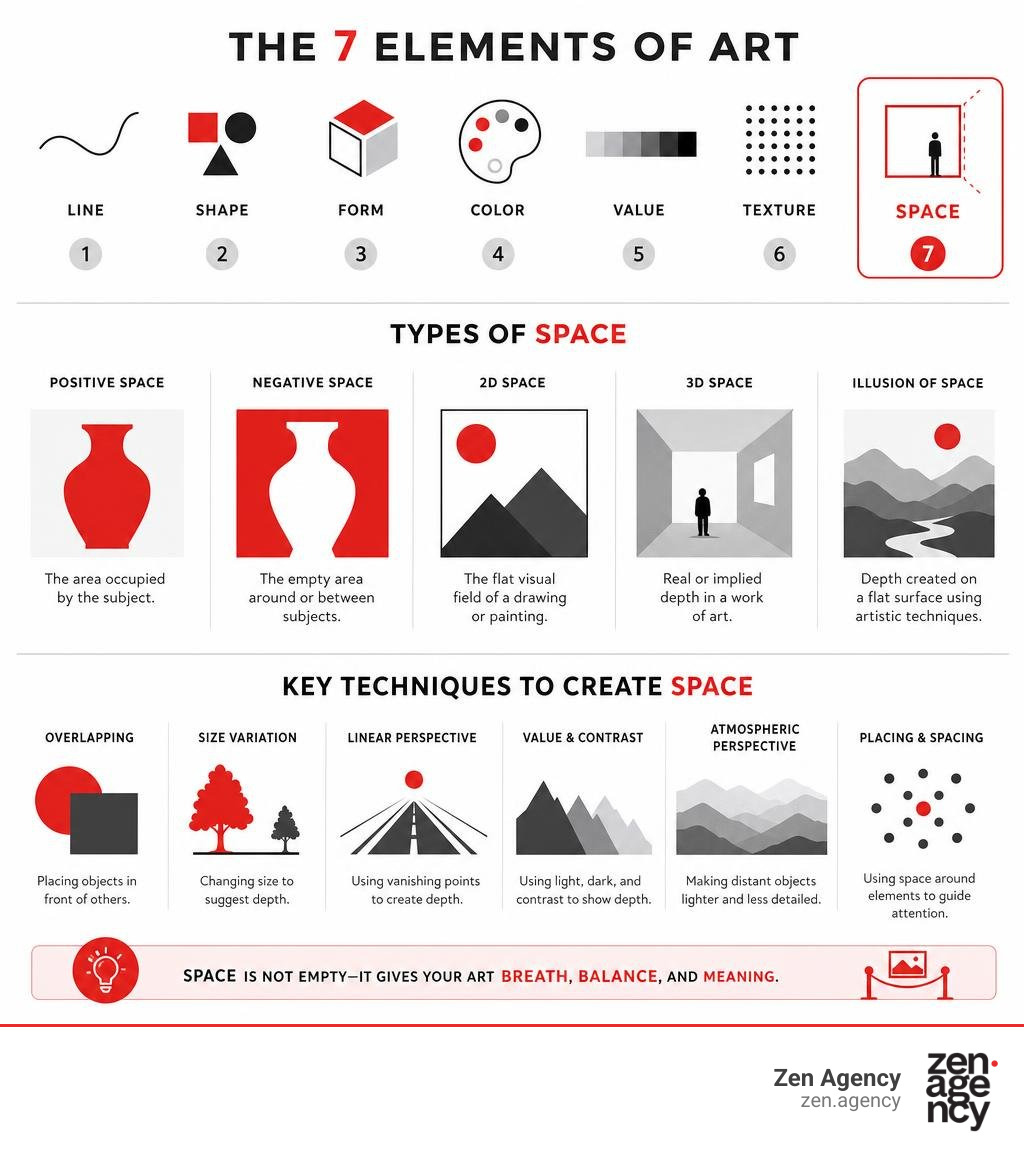
The space in art definition is simpler than it sounds: space is the area around, between, and within the elements of a composition — and it is one of the seven classic elements of art, alongside line, color, value, shape, texture, and form.
Here is a quick breakdown to answer the core question directly:
| Term | What It Means |
|---|---|
| Space (general) | All areas around, between, and within objects in an artwork |
| Positive space | The area occupied by the main subject or form |
| Negative space | The empty area surrounding or between subjects |
| 2D space | The flat visual field of a drawing or painting |
| 3D space | Real or implied depth in a work of art |
| Illusion of space | Depth created on a flat surface using artistic techniques |
Space is not just empty air. As architect Frank Lloyd Wright put it: “Space is the breath of art.” Every mark, shape, and figure in a composition exists in relation to the space around it — and that relationship shapes how viewers feel and what they focus on.
Whether you are an artist, a designer, or a business leader building a visual brand, understanding how space works gives you a powerful tool for guiding attention and communicating ideas.
I’m Joseph Riviello, CEO of Zen Agency, and over my 22+ years in digital marketing and design, I’ve seen how mastering the space in art definition — and applying its principles to visual branding — can transform how an audience perceives a business. Let’s break down everything you need to know.
What is the Space in Art Definition?
To truly grasp the space in art definition, we have to look at how this element functions across different mediums. At its most fundamental level, space refers to the distances or areas around, between, and within the components of an artwork. It is the literal or figurative “stage” upon which all other elements of art—like line, shape, and color—interact.
As detailed in What Is the Definition of Space in Art?, space can be positive or negative, open or closed, shallow or deep, and two-dimensional or three-dimensional.
In a two-dimensional visual field, such as a canvas, a sheet of paper, or a digital screen, the physical space is completely flat. Here, the artist’s goal is often to create an illusion of space, tricking the human brain into perceiving three-dimensional depth where none physically exists.
In contrast, three-dimensional art forms—like sculpture, architecture, and installation art—occupy actual, physical space. In these mediums, viewers can walk around, look under, or even step inside the artwork. The way the physical object interacts with its real-world environment is a crucial part of the artistic medium.
Whether actual or illusory, space is rarely a passive background. Instead, it is an active participant in how an artwork is read, establishing visual balance, directing eye flow, and conveying profound emotional or metaphysical ideas.
The Core Types of Space in Art
To utilize space effectively, we must first understand its different forms. Artists categorize space into several distinct types that dictate how a composition is structured and balanced.
| Type of Space | Primary Characteristics | Visual Impact |
|---|---|---|
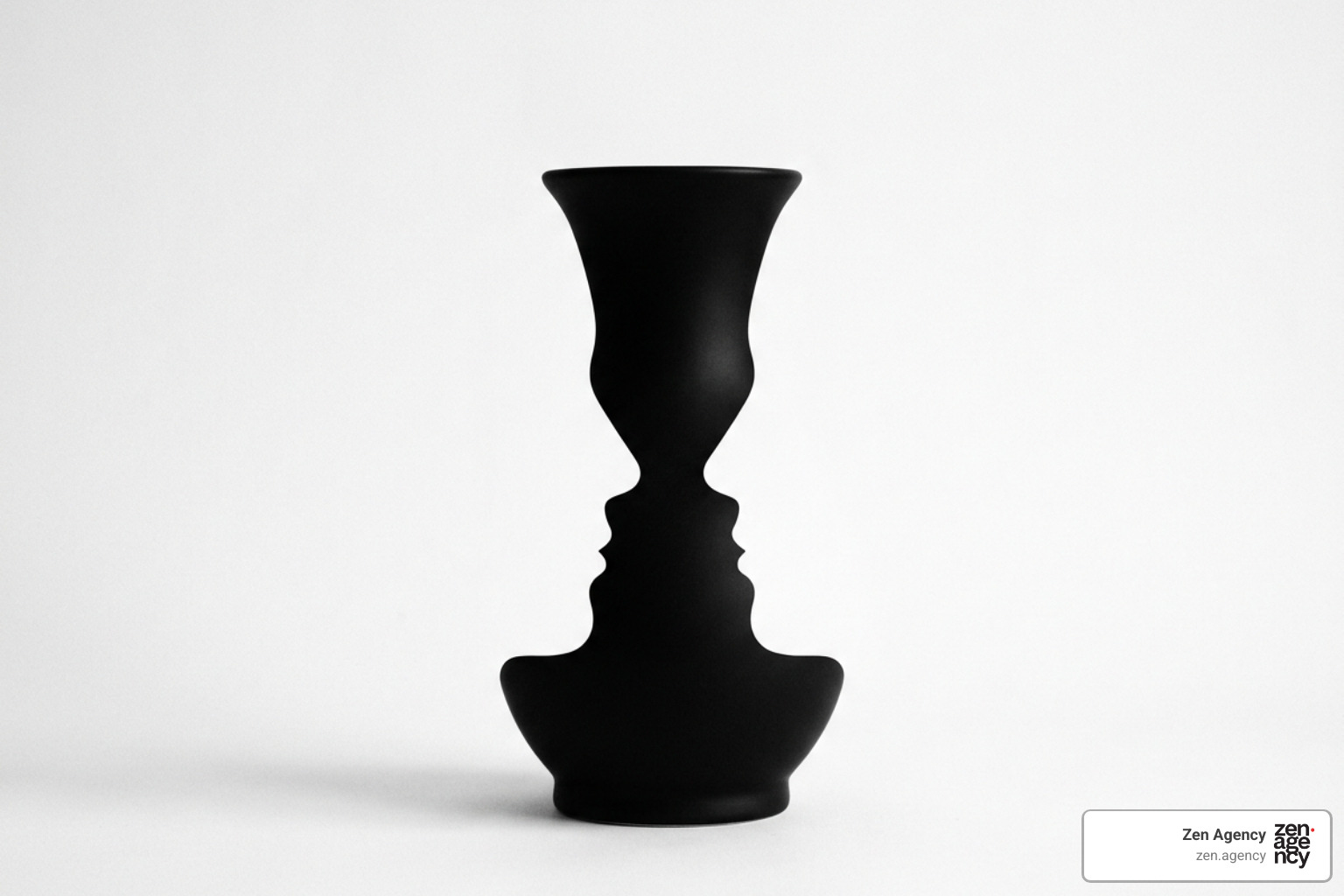
| Positive Space | Occupied by the main subject, forms, or figures. | Anchors the viewer’s attention; provides the “what” of the image. |
| Negative Space | The empty or unoccupied areas around and between subjects. | Provides breathing room; defines boundaries; creates balance. |
| Shallow Space | Limited depth; elements appear close to the picture plane. | Emphasizes flat patterns, decorative qualities, and abstract structures. |
| Deep Space | Expansive, receding depth; creates a vast environment. | Invites the viewer “into” the scene; mimics real-world vision. |
Positive and Negative Space in Art Definition
The relationship between positive and negative space is the cornerstone of great composition. Positive space refers to the primary subject of the piece—such as a figure in a portrait, a vase of flowers in a still life, or the physical bronze of a sculpture. Negative space, on the other hand, is the empty area surrounding, between, and within those subjects.
Far from being “wasted” space, negative space is a powerful tool for establishing visual weight and emotional tone. For instance, the master sculptor Henry Moore famously carved holes directly through his heavy bronze and stone figures. By introducing negative space into the center of his solid sculptures, he created a dynamic interplay where the surrounding environment became part of the artwork itself.
In two-dimensional art, manipulating this balance can dramatically alter the viewer’s emotional state. In some of Francisco Goya’s drawings, he placed small, isolated figures within disproportionately massive fields of empty, dark negative space. This stark imbalance instantly accentuates a feeling of vulnerability, loneliness, and isolation.
To see this concept in action across various visual mediums, you can explore some Seeing Double With Brilliant Examples Of Positive And Negative Space to see how artists turn negative space into a creative playground.
Shallow vs Deep Space in Art Definition
Another critical spatial decision is whether to use shallow or deep space.
Shallow space occurs when the artist limits the perceived depth of the image, keeping elements close to the flat surface of the canvas. This technique is highly visible in traditional Japanese woodblock prints, where flat, stylized shapes are stacked to create a decorative, pattern-focused layout. It is also the defining characteristic of Cubism, where modern artists rejected traditional depth to show multiple angles of an object simultaneously on a flat plane.
Conversely, deep space aims to replicate the vastness of the real world. Think of a classic landscape painting where rolling hills recede miles into the distance, eventually meeting a far-off horizon.
To learn more about how these spatial dynamics function as a core element of design, check out The Elements of Art – Space – The Virtual Instructor for a deeper dive into the mechanics of visual depth.
How Artists Create the Illusion of 3D Space on a 2D Canvas
Because a canvas or screen has only two physical dimensions (height and width), artists must use specific visual cues to trick our eyes into seeing a third dimension: depth.
To pull this off like a pro, artists rely on six classic techniques:
- Overlapping: Placing one object in front of another to show which is closer.
- Placement: Positioning objects lower on the page to make them seem closer, or higher up to make them recede.
- Size: Drawing closer objects larger and distant objects smaller.
- Detail: Rendering foreground elements with sharp clarity and background elements with soft, blurry textures.
- Color: Using warm, saturated colors for close objects, and cool, muted tones for things far away.
- Perspective: Utilizing mathematical line systems or atmospheric effects to suggest distance.
Linear and Atmospheric Perspective
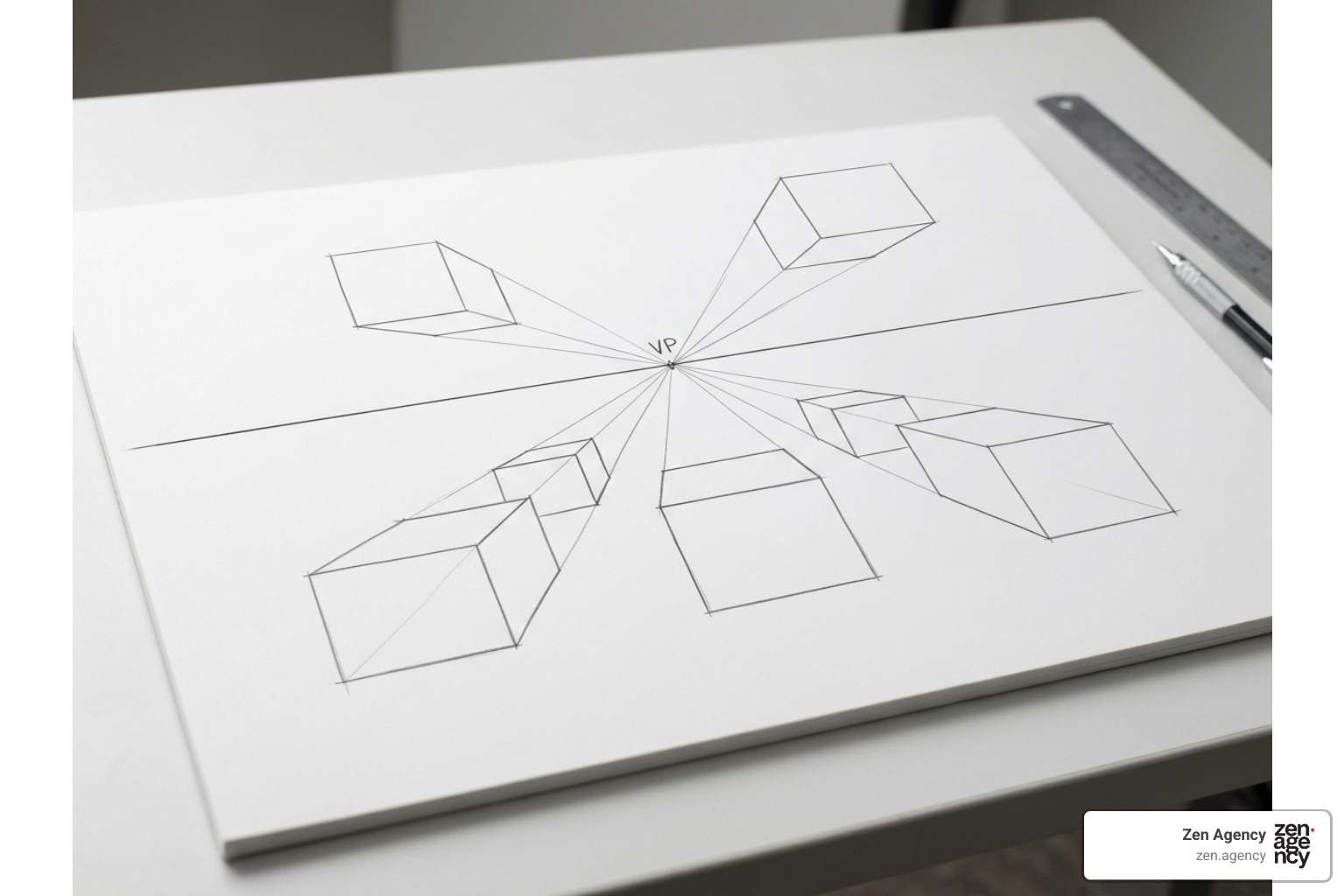
The most mathematically precise way to create depth is through linear perspective, a system formalized during the Italian Renaissance. This technique relies on a horizontal line (representing the viewer’s eye level) and one or more vanishing points where parallel lines appear to converge.
In Leonardo da Vinci’s The Last Supper, every major architectural line in the room converges perfectly at a single vanishing point behind the head of Christ, creating a convincing, lifelike room that draws the viewer’s eye straight to the focal point.
For a comprehensive guide on how to master these structural systems, check out Space in Art: Elements of Art.
While linear perspective uses structure, atmospheric perspective (or aerial perspective) uses the science of light. Because of dust, moisture, and air in the atmosphere, objects that are far away lose contrast, detail, and color saturation.
If you look at the landscape paintings of J.M.W. Turner, you will notice that the mountains in the far background are painted with incredibly soft edges, light values, and cool blue tones. This perfectly mimics how our eyes perceive distant objects in the real world. Artists also combine this with chiaroscuro—the dramatic arrangement of light and shadow—to give individual forms a sense of three-dimensional volume and weight within that space.
Size, Overlapping, and Placement Techniques
If perspective feels a bit too technical, you can easily build a believable sense of depth using simpler spatial relationships: size, overlapping, and placement.
- Size: Our brains expect objects of a known size to shrink as they move away. By drawing a row of trees that get progressively smaller, you instantly create a road that stretches backward.
- Overlapping: This is the simplest way to show depth. If Shape A covers part of Shape B, the viewer’s brain instantly registers Shape A as being in front.
- Placement: In a standard composition, the canvas is divided into the foreground (bottom), middle ground (middle), and background (top). Objects placed lower on the picture plane feel closer to our feet, while objects placed higher up automatically recede toward the horizon.
By combining these three techniques, you establish a clear visual hierarchy, guiding the viewer’s eye smoothly through your composition from front to back.
The Historical Evolution of Space in Art
The way humans represent space has changed dramatically over the centuries, reflecting shifts in technology, philosophy, and cultural values.
During the Middle Ages, European religious art largely ignored realistic depth. Artists utilized flat spatial orderings because the spiritual importance of a figure was far more valuable than visual realism. A king or saint would be drawn twice the size of a peasant, regardless of where they were standing in the scene. Space was symbolic, not physical.
This changed entirely during the Renaissance. With a renewed focus on humanism, science, and mathematics, artists sought to capture the world exactly as it was experienced. The development of linear perspective transformed painting, turning the flat canvas into a “window” into a three-dimensional world.
By the late 19th and early 20th centuries, however, avant-garde movements began to rebel against this window-like illusion. Artists felt that photography had mastered the job of capturing reality, freeing painters to explore the unique, flat physical reality of the canvas itself.
As explored in What Is Space in Art? Examples and Definition – Artsper Magazine, modern movements like Cubism, Expressionism, and Abstract Expressionism dissolved traditional perspective entirely. Instead, they focused on simpler relationships between positive and negative space. Mark Rothko flattened space into massive, glowing color fields designed to envelop the viewer in a pure, contemplative emotional state, proving that flat space could be just as spiritually profound as the vast landscapes of the past.
Space Beyond the Canvas: Sculpture, Installations, and Outer Space
As art moved into the contemporary era, artists began to step off the two-dimensional canvas entirely, treating physical space itself as their primary medium.
In installation art, creators manipulate real space to alter the viewer’s sensory experience. For example, light artist James Turrell designs immersive rooms filled with intense, saturated colored light that dissolves physical corners and walls, making viewers feel as though they are walking through a solid cloud of color.
Similarly, sculptor Anish Kapoor’s monumental work Leviathan filled the entire interior space of the Grand Palais in Paris, forcing visitors to walk inside a massive, bulbous PVC structure. Kapoor created a physical “space within a space,” completely transforming how viewers interacted with the historic building’s scale.
Taking this concept to the ultimate extreme, some artists have literally looked to outer space as both a canvas and a theme. According to Space art – Wikipedia, the genre of astronomical art emerged as technology allowed us to observe the night sky in detail, with pioneers like Chesley Bonestell painting incredibly accurate, realistic visions of alien worlds.
Eventually, artists didn’t just paint space—they went there:
- 1965: Soviet cosmonaut Alexei Leonov produced the very first drawing in outer space, sketching an orbital sunrise onboard the Voskhod 2 spacecraft.
- 1986: Four original oil paintings by artist Ellery Kurtz were flown into orbit aboard the Space Shuttle Columbia (STS-61-C).
- 1993: Arthur Woods’ Cosmic Dancer, an aluminum sculpture specifically designed for a weightless environment, was launched to the Mir space station, where cosmonauts watched it float and spin freely in zero gravity.
Whether managing the delicate balance of a webpage layout or launching a sculpture into low Earth orbit, space remains the ultimate frontier of human creativity.
Frequently Asked Questions about Space in Art
What is the difference between positive and negative space?
Positive space is the actual subject or form within an artwork (like a person, a tree, or a building). Negative space is the empty area surrounding, between, and within those subjects. Balancing the two is crucial for creating visual harmony and ensuring your composition doesn’t feel too cluttered or awkwardly empty.
How do you create depth in a drawing?
You can easily create the illusion of depth by using six classic techniques: overlapping objects, placing distant objects higher on the page, drawing closer things larger, reducing details in the background, using cooler and lighter colors for distant elements (atmospheric perspective), and using linear perspective lines that lead to a vanishing point.
Why is space considered an active element of art?
Space is active because it directly controls how a viewer’s eyes move across a piece. By adjusting the amount of negative space around a subject, an artist can create a sense of calm, highlight a specific focal point, or evoke powerful emotions like loneliness, freedom, or tension.
Conclusion
Understanding the space in art definition is not just an academic exercise for painters—it is a foundational principle of all great visual communication. Whether you are arranging shapes on a canvas, structuring a physical sculpture, or designing a high-converting website, how you manage the space between your elements dictates how your audience feels, thinks, and takes action.
At Zen Agency, we apply these exact artistic principles to the digital world. Through our professional branding and graphic design services, we help businesses build clean, visually balanced, and highly effective brand identities. We know that strategic use of space—often called “white space” in design—is what separates a cluttered, confusing website from a beautiful, intuitive user experience that drives conversions and boosts your ROI.
If you are ready to scale your business with enterprise-grade web development, custom branding, and cutting-edge digital marketing strategies, we are here to help. Reach out to Zen Agency today, and let’s build something incredible together!