The Only Digital Channel Marketing Guide You Will Ever Need
Why Digital Channel Marketing Is the Growth Engine Your Business Can’t Ignore
Digital channel marketing is the practice of promoting your brand, products, or services through online platforms — including search engines, social media, email, video, and paid advertising — to reach and convert your target audience.
Here are the core digital marketing channels at a glance:
| Channel | Primary Goal | Best For |
|---|---|---|
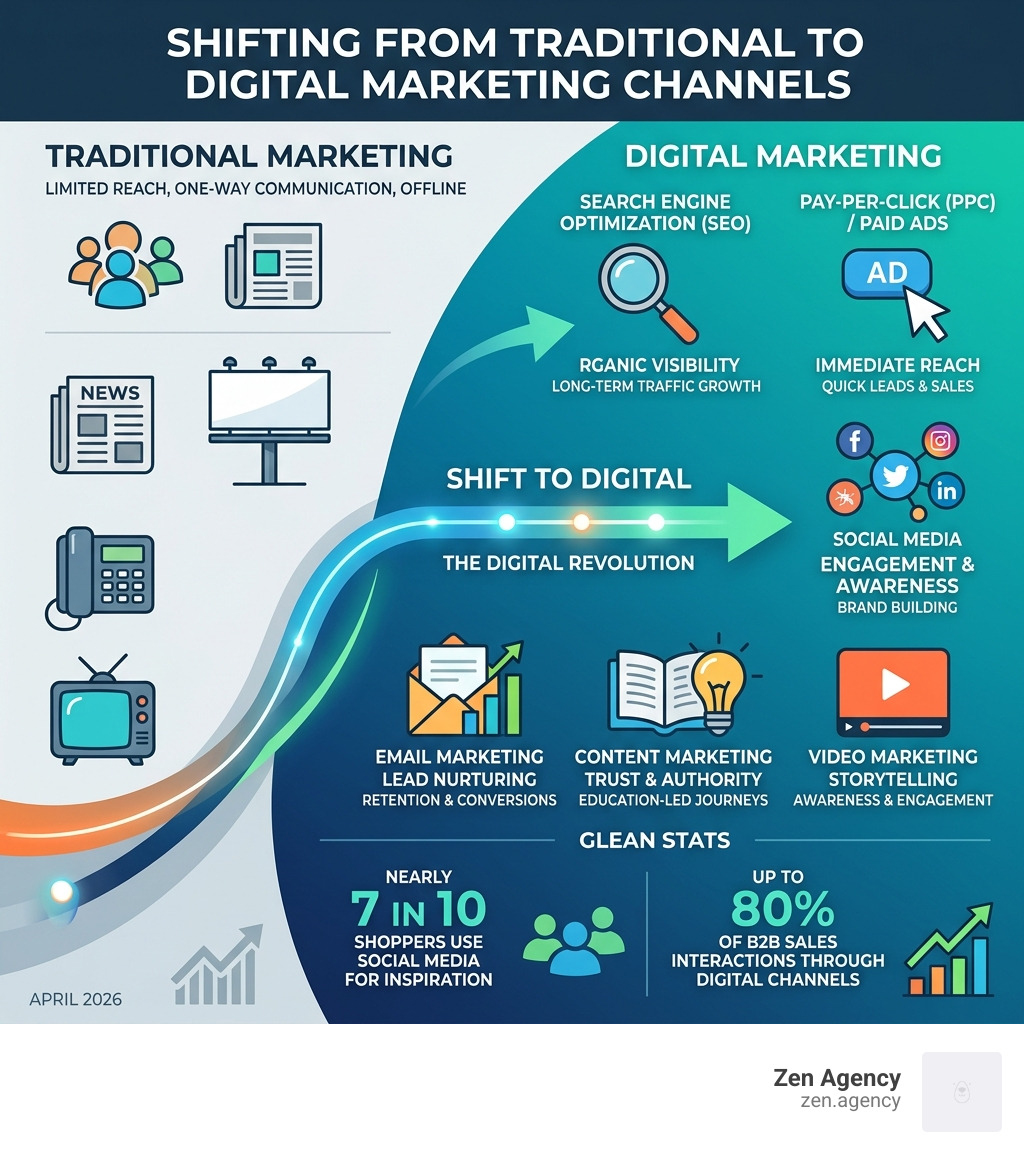
| SEO | Organic visibility | Long-term traffic growth |
| PPC / Paid Ads | Immediate reach | Quick leads and sales |
| Social Media | Engagement & awareness | Brand building, B2C & B2B |
| Email Marketing | Lead nurturing | Retention and conversions |
| Content Marketing | Trust and authority | Education-led buying journeys |
| Video Marketing | Storytelling | Awareness and engagement |
| Affiliate / Influencer | Peer-driven reach | Word-of-mouth at scale |
The numbers make a clear case. Nearly 7 in 10 shoppers turn to social media for buying inspiration. Email returns up to £35 for every £1 spent. And according to Gartner, 80% of B2B sales interactions are now expected to happen through digital channels.
Yet despite all this opportunity, most businesses are leaving money on the table — spreading budgets thin, picking channels at random, and measuring the wrong things.
That’s exactly the problem this guide solves.
I’m Joseph Riviello, CEO and Founder of Zen Agency, and over my 22+ years leading digital channel marketing strategies, I’ve helped companies across industries cut through the noise, scale their online presence, and turn underperforming campaigns into real revenue engines. Let’s get into it.
Defining Digital Channel Marketing and Its Evolution
As we navigate the landscape of April 2026, it is clear that digital channel marketing has transitioned from a “nice-to-have” department to the very heart of business operations. Unlike traditional marketing—think billboards in Scranton or print ads in Montana—digital channels allow for real-time performance measurement and instant strategy pivots.
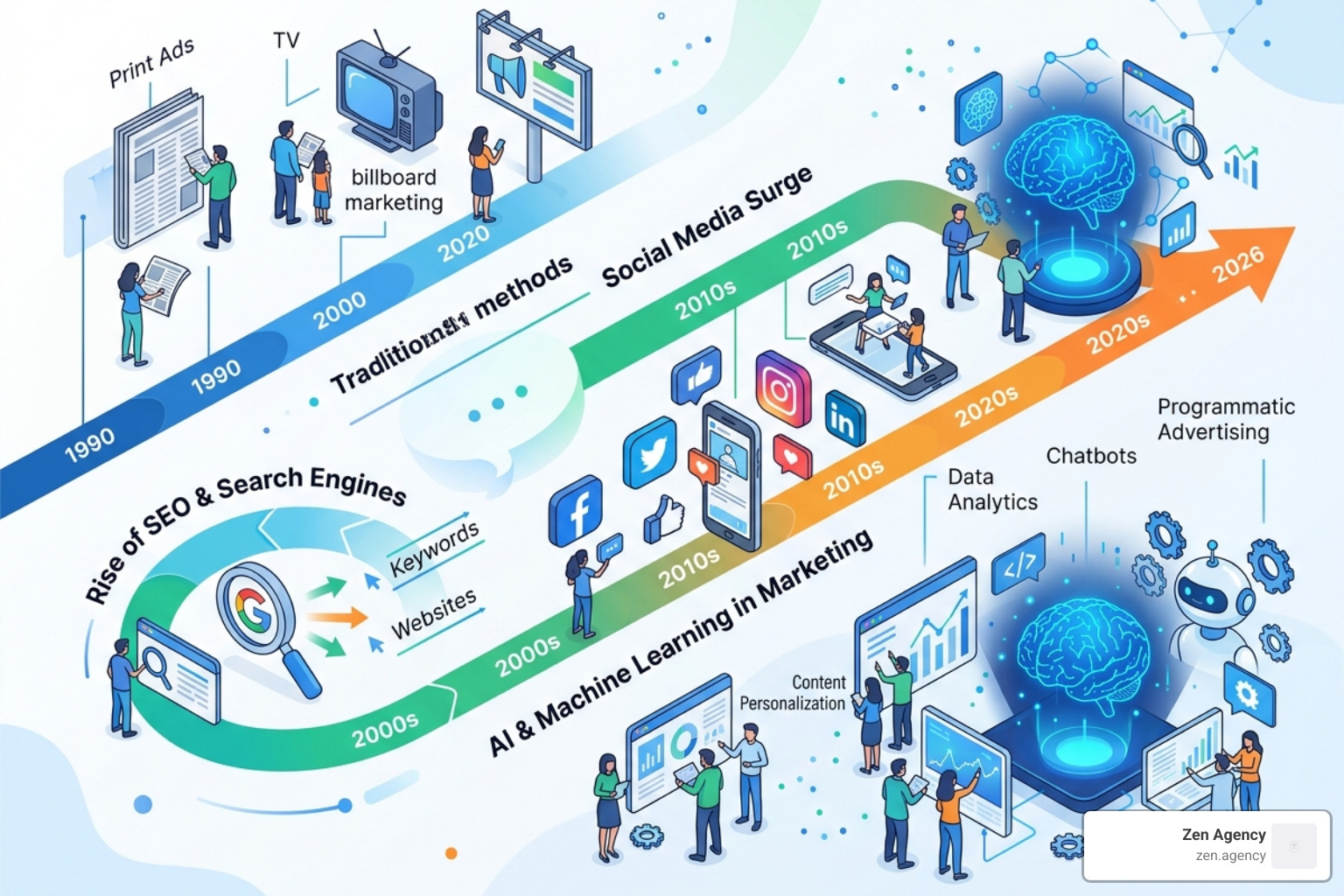
The journey began in the 1990s with the birth of search engines and early email. Today, it has evolved into a complex ecosystem of Internet-based technologies powered by big data and AI. The primary advantage we see at Zen Agency is the ability to target specific audiences with surgical precision. While a TV ad might reach everyone in Wilkes-Barre, a digital campaign can target only the people currently looking for your specific solution.
| Feature | Traditional Marketing | Digital Channel Marketing |
|---|---|---|
| Targeting | Broad / Geographic | Specific / Behavioral |
| Cost | High entry barrier | Scalable and flexible |
| Measurement | Estimated / Delayed | Real-time / Precise |
| Engagement | One-way | Interactive / Two-way |
Success in 2026 requires a Marketing Channel Strategy that is customer-centric and channel-agnostic. It’s no longer about being everywhere; it’s about being where your customers are with the right message at the right time.
The Most Effective Digital Marketing Channels in 2026
In our experience serving clients from Wyoming, PA to Billings, MT, we’ve found that the most successful businesses don’t just “do” marketing; they build an interconnected multi-channel marketing ecosystem.
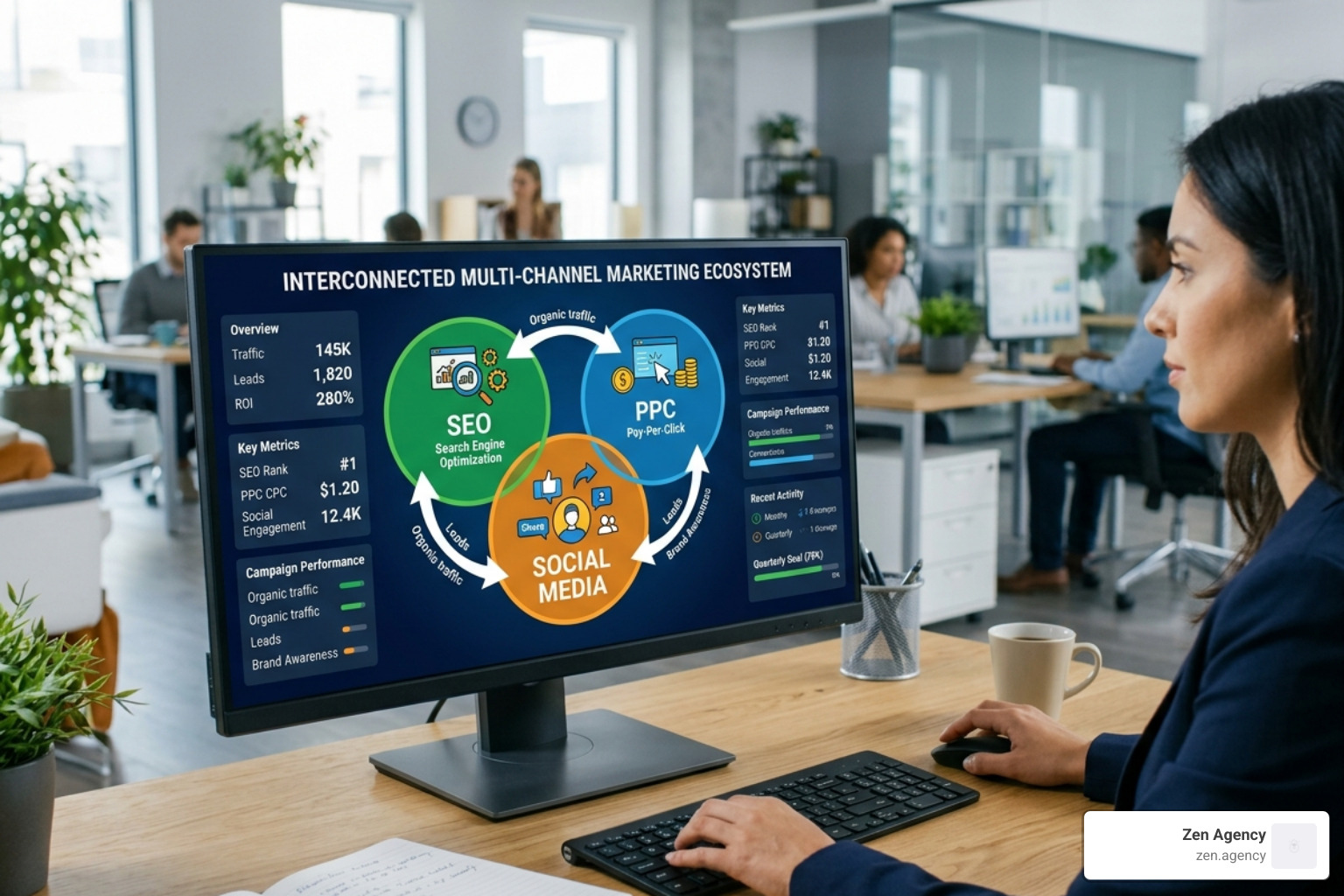
The heavy hitters remain SEO, PPC, Social Media, Email, and Content Marketing. However, the way these channels interact has changed. For instance, your social media presence now directly influences your brand’s search authority, and your email segments are often used to build “lookalike” audiences for paid ads. For those looking to scale, exploring comprehensive digital marketing services is the first step toward building this synergy.
Search Engine Optimization (SEO) as a Core Digital Channel Marketing Pillar
SEO is the marathon of digital channel marketing. It’s about building long-term value that doesn’t disappear the moment you stop paying for ads. In 2026, organic traffic is driven by “Searcher Intent.” Google doesn’t just look for keywords; it looks for the best answer to a user’s problem.
Effective SEO involves:
- Keyword Research: Identifying high-volume, low-competition terms that your audience in Pennsylvania or Montana is actually using.
- On-Page Optimization: Ensuring your title tags, meta descriptions, and headings are optimized for both humans and bots.
- Technical SEO: Improving site speed and mobile-friendliness. Did you know bounce rates can increase by 123% if a page takes 10 seconds to load?
- Featured Snippets: Aiming for “Position Zero” by providing direct, concise answers to common questions.
At Zen Agency, our search engine optimization services focus on creating high-quality, long-form content (averaging 1,447 words for top results) that establishes your brand as a thought leader.
Paid Advertising and Programmatic Strategies
While SEO is the marathon, PPC is the sprint. Paid advertising via Google Ads and social media platforms provides immediate visibility. The big shift in 2026 is the rise of programmatic advertising—using AI to automate the buying of ad space in real-time.
This allows us to bid on ad placements that are most likely to convert, based on thousands of data points. PPC users are often 50% more likely to purchase than organic visitors because the ads are shown to people with high “buying intent.” Our PPC management services leverage these AI-driven targeting methods to ensure every dollar of your budget is working toward a positive ROI.
Social Media and Influencer Partnerships
With 63.9% of the global population using social media for over two hours daily, this channel is non-negotiable. However, the strategy differs wildly depending on your business model:
- B2B: LinkedIn is the king here. 81% of B2B buyers research on LinkedIn, and employee advocacy is huge—individual employees often have 10x more connections than company pages.
- B2C: Platforms like TikTok and Instagram dominate, driven by short-form video and peer recommendations.
Influencer marketing has more than tripled since 2019 because 69% of consumers trust influencer recommendations over brand advertisements. To stand out, your social presence needs high-end branding and graphic design services to ensure your visual identity is consistent and professional across all platforms.
Emerging Trends: AI, Voice Search, and Video
The “next big thing” is already here. Generative AI is changing how we create content, while voice search is changing how we find it.
According to Semrush’s guide on digital channels, video engages multiple senses more effectively than text, making it a powerhouse for storytelling. Whether it’s a “behind-the-scenes” look at your Scranton office or a high-production product launch, content photography and video services are essential for keeping eyes on your brand.
Optimizing for Voice Search and Video in Digital Channel Marketing
Voice search is no longer a gimmick; 30% of internet users use voice assistants weekly. To optimize for this, we focus on:
- Natural Language Processing: Writing content that sounds like a conversation.
- FAQ Pages: Answering “Who, What, Where, and How” questions directly.
- YouTube SEO: Optimizing video titles and descriptions, as video is 53x more likely to rank on the first page of Google.
Because over 50% of web traffic is now mobile, having a responsive website design is a prerequisite for any of these emerging trends to actually drive conversions.
Integrating Multiple Channels for Maximum Impact
An “omnichannel” approach ensures that whether a customer finds you on LinkedIn, sees a Google Ad, or receives an email, the experience is seamless. This requires deep user experience design and information architecture to map the customer journey correctly.
Integration means your email marketing nurtures the leads your PPC ads generated, while your SEO content provides the answers your social media followers are asking for. This synergy is what creates “Maximum Impact.”
Measuring Success: KPIs and Data Analytics
You can’t manage what you can’t measure. In 2026, we move beyond “vanity metrics” like likes and follows to focus on the numbers that actually impact your bottom line.
Key Performance Indicators (KPIs) to track include:
- ROI (Return on Investment): For every dollar spent, how much did you make?
- CAC (Customer Acquisition Cost): How much does it cost to get one new customer?
- CLV (Customer Lifetime Value): How much is a customer worth over the entire duration of your relationship?
- Conversion Rate: The percentage of visitors who take a desired action.
If your traffic is high but your sales are low, you likely need conversion rate optimization services to fix the leaks in your sales funnel.
Frequently Asked Questions about Digital Marketing
What is the difference between B2B and B2C digital marketing?
B2B (Business-to-Business) marketing typically involves longer sales cycles and focuses on building logic-based relationships and ROI. The content is often educational (whitepapers, webinars). B2C (Business-to-Consumer) is usually more transactional and emotional, focusing on quick wins, entertainment, and immediate needs.
How do I choose the right digital marketing channels for my budget?
Start with audience research. Where does your target customer hang out? If you have a limited budget, focus on high-ROI “non-negotiables” like SEO and Email Marketing. Email, for example, can return up to 4,200% ROI. Test small, analyze the data, and scale what works.
What skills are essential for digital marketers in 2026?
Today’s marketer must be a “hybrid.” You need the strategic communication skills of a traditional marketer, the data analysis skills of a scientist, and proficiency with AI tools to automate and optimize campaigns. Adaptability is the most valuable trait, as platform algorithms change almost weekly.
Conclusion
Navigating digital channel marketing can feel overwhelming, but you don’t have to do it alone. Since 2008, Zen Agency has been providing enterprise-grade solutions to businesses that are ready to scale. From our offices in Wilkes-Barre and Scranton to our teams in Montana, we specialize in custom website development and innovative strategies that drive real results.
Whether you need a complete brand overhaul or a data-driven SEO strategy, we have the expertise to increase your visibility and ROI. Ready to turn your digital channels into a revenue-generating machine? Request a quote for your digital marketing strategy today and let’s start growing.