The Ultimate Guide to B2B SaaS Lead Gen Success
The Ultimate Guide to B2B SaaS Lead Gen Success
Understanding the B2B SaaS Lead Generation Landscape
B2B SaaS lead generation strategies are the structured methods software companies use to attract, qualify, and convert business buyers into paying customers — and getting them right is one of the hardest challenges in modern marketing.
Here are the most effective B2B SaaS lead generation strategies to know:
- Define your Ideal Customer Profile (ICP) – Target the right companies with firmographic and behavioral data
- Product-led growth (PLG) – Use freemium models and free trials to let your product sell itself
- Content marketing and SEO – Publish high-value content that ranks and drives organic leads
- Cold outreach and email sequences – Run multi-touch, personalized campaigns across email and LinkedIn
- Paid advertising (PPC/LinkedIn Ads) – Capture high-intent buyers with targeted paid campaigns
- Account-Based Marketing (ABM) – Focus resources on high-value accounts that match your ICP
- Gated content and lead magnets – Exchange valuable resources for contact information
- Competitor conquesting – Target buyers actively comparing alternatives
- Referral programs – Incentivize existing customers to refer qualified leads
- AI-powered automation – Use AI tools to score, prioritize, and personalize outreach at scale
The stakes are real. A staggering 91% of B2B marketers rank effective lead generation as their single top priority — yet most SaaS companies still struggle to build a pipeline that grows predictably.
The problem isn’t a lack of tactics. There are hundreds of strategies out there. The problem is knowing which ones fit your business, your budget, and your growth stage — and then executing them with discipline.
B2B SaaS is uniquely challenging. You’re dealing with longer sales cycles, multiple decision-makers, narrower target markets, and buyers who prefer to research independently rather than talk to a sales rep. A strategy that works for an e-commerce brand or a traditional B2B services firm simply won’t translate.
This guide cuts through the noise and gives you a clear, practical playbook.
I’m Joseph Riviello, CEO and Founder of Zen Agency, with over 22 years of experience helping companies scale through integrated digital marketing strategies — including developing and refining B2B SaaS lead generation strategies for clients across competitive markets. The frameworks and recommendations in this guide are drawn from real-world experience building pipelines that drive measurable revenue, not just vanity metrics.
Key b2b saas lead generation strategies vocabulary:
- appointment setting lead generation companies
- b2b lead generation and appointment setting
- lead generation leads
In Software as a Service (SaaS), lead generation isn’t just about filling a bucket; it’s about building a sustainable engine for recurring revenue. Unlike traditional B2B models where a one-time sale might sustain a business for months, SaaS relies on the long-term health of subscription models. This means your b2b saas lead generation strategies must account for the lifetime value (LTV) of a customer from the very first touchpoint.
The landscape has shifted dramatically. Today’s buyers are “self-service” oriented. Research from Gartner suggests that B2B buyers spend only 17% of their time actually meeting with potential suppliers. The rest of their time is spent researching, comparing, and forming opinions independently. This is why 91% of B2B marketers list effective lead gen as their top priority—because if you aren’t visible during that 83% of independent research time, you’ve already lost the deal.
Furthermore, SaaS decisions are rarely made by one person. You’re often dealing with multi-stakeholder committees—legal, IT, finance, and the end-users—all of whom have different concerns. This results in longer sales cycles (typically 30–180 days) and a narrower target market compared to B2C. To succeed, we must move beyond “spray and pray” and focus on precision.

15 Proven B2B SaaS Lead Generation Strategies for 2025 and Beyond
To build a predictable pipeline, we recommend focusing on a handful of high-impact strategies rather than trying to do everything at once. Success starts with a rock-solid Ideal Customer Profile (ICP).
The Foundation: ICP and Data
Before launching any campaign, you must define your ICP using three pillars:
- Firmographics: Industry, company size (headcount), and revenue.
- Technographics: What other software are they using? If your tool integrates with Salesforce, companies using Salesforce are your primary targets.
- Intent Data: Are they actively searching for terms like “best CRM for startups” or visiting your pricing page?
Top Strategies for Success
- Account-Based Marketing (ABM): Instead of broad campaigns, treat individual high-value accounts as markets of one. LinkedIn ABM campaigns have been shown to generate 5x more pipeline than broad awareness efforts.
- Social Proof and Reviews: Buyers trust their peers more than your marketing team. Since 92% of buyers rely on social proof before buying, having a strong presence on G2 is non-negotiable.
- Referral Programs: Incentivize your happiest customers to do the selling for you. Referral leads typically have higher conversion rates and lower acquisition costs.
- Re-engaging Past Clients: Don’t ignore the “closed-lost” files in your CRM. A prospect who wasn’t ready six months ago might have the budget and the pain point today.
Product-Led Growth as a Core B2B SaaS Lead Generation Strategy
Product-Led Growth (PLG) is perhaps the most powerful of all b2b saas lead generation strategies. It turns your software into its own salesperson. By offering a freemium model or a free trial, you lower the barrier to entry and let the user experience the “Aha! moment” themselves.
Research shows an average sales conversion rate of nearly 20% for opt-in trials where no credit card is required. The goal is frictionless onboarding and a short “time-to-value.” If a user can see results within minutes, they are far more likely to become a Product Qualified Lead (PQL).
Companies like Slack and Mailchimp have mastered this. They provide a functional base product that captures thousands of users, who then naturally upgrade as they hit usage limits or require advanced features.
Content Marketing and SEO for Organic B2B SaaS Lead Generation Strategies
Organic search is a powerhouse for SaaS. In fact, SEO generates 34% of leads on average for B2B marketers. However, it’s not just about ranking for any keyword; it’s about ranking for the right ones.
We use tools like Ahrefs and Moz to identify long-tail keywords that signal high buying intent—think “best accounting software for mid-sized firms” rather than just “accounting.” Staying compliant with Google Search Central guidelines is essential to ensure your content remains visible through algorithm updates.
Content shouldn’t just be “thought leadership”; it should solve real problems. Companies with updated blogs generate 67% more leads than those without. Use gated content like ROI calculators, whitepapers, and webinars to capture contact information from visitors who find your free advice valuable.
Paid Acquisition and Competitor Conquesting for B2B SaaS Lead Generation Strategies
Paid channels offer the speed that SEO lacks. While organic takes months, PPC can generate leads today. 84% of brands see good results with PPC ads, provided they target the right platforms.
LinkedIn is the gold standard for B2B; 40% of marketers say LinkedIn is the most effective platform for lead generation. It allows you to target by job title, industry, and even specific company names. For search intent, Google Ads and Microsoft Ads are essential.
One of our favorite “under-the-radar” b2b saas lead generation strategies is competitor conquesting. By targeting keywords related to your competitors (e.g., “[Competitor Name] alternatives” or “[Competitor Name] pricing”), you can reach buyers who are already in the consideration phase. Build comparison landing pages that honestly highlight where your solution wins. You can also expand your reach using platforms like Adroll for retargeting or Outbrain for native content distribution.
Measuring Success and Avoiding Common SaaS Marketing Pitfalls
You can’t manage what you don’t measure. In SaaS, we look beyond simple lead counts to understand the health of the pipeline.
| Lead Type | Definition | Best Used For |
|---|---|---|
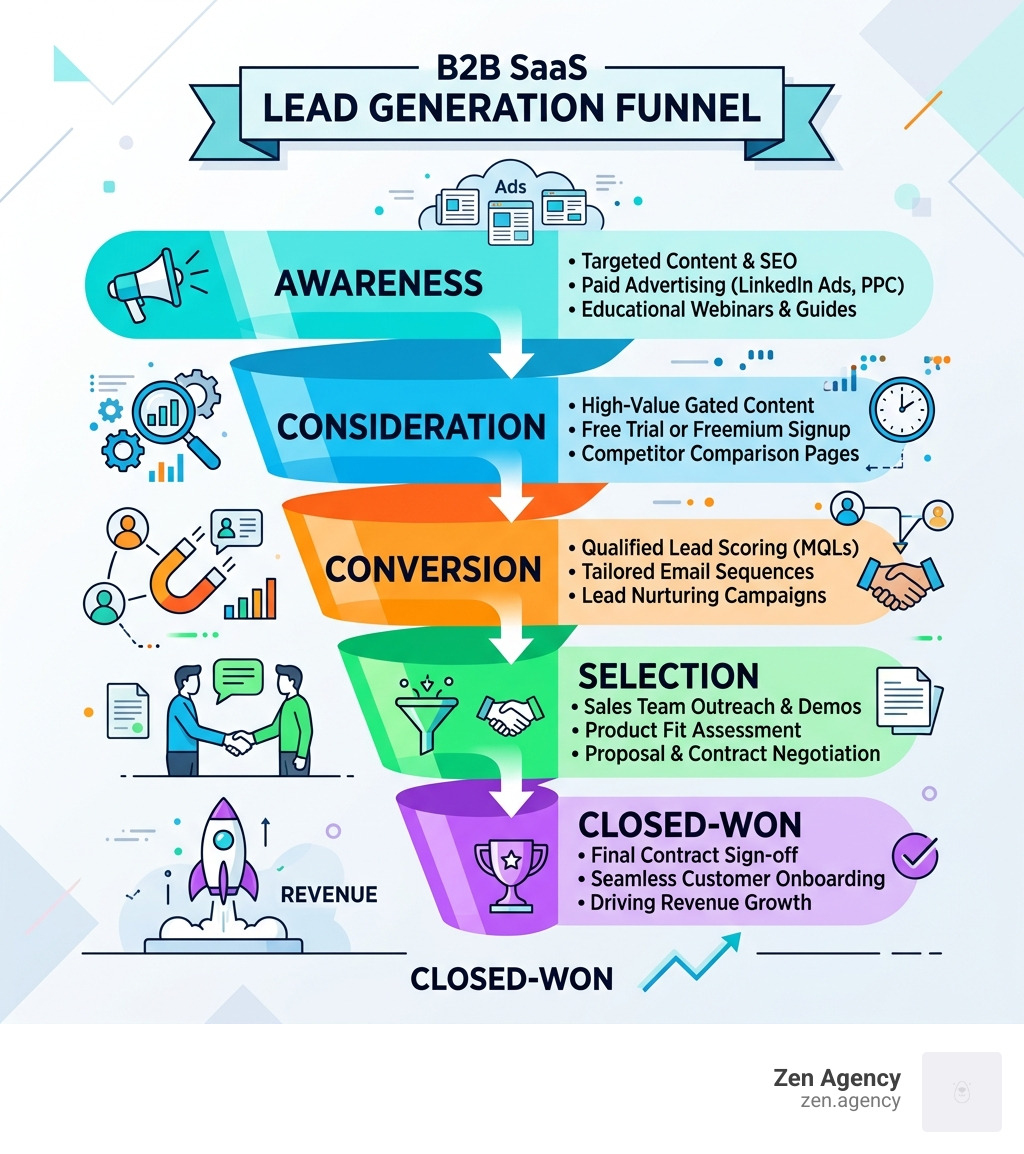
| MQL (Marketing Qualified) | Engaged with content (e.g., downloaded an eBook) | Nurture sequences |
| SQL (Sales Qualified) | Hand-raiser (e.g., requested a demo) | Direct sales outreach |
| PQL (Product Qualified) | Active user of a free trial/freemium | Conversion to paid |
The “golden metrics” for SaaS include:
- Customer Acquisition Cost (CAC): How much you spend to get one new customer.
- LTV to CAC Ratio: For a sustainable business, your customer’s lifetime value should be at least 3x the cost to acquire them.
- Pipeline Velocity: How fast leads move from first touch to closed-won.
Speed is a massive factor here. Connecting with leads within 60 seconds increases conversion by 391%. If you wait hours to follow up on a demo request, your prospect has already moved on to a competitor.
Common pitfalls include overcomplicated lead forms (every extra field drops conversion by 10-15%) and vanity metrics. Don’t brag about “impressions” if they aren’t turning into revenue. Also, 8.5% of cold emails receive a response—it’s a numbers game, but only if the targeting is human-centric and personalized.
Leveraging the Modern SaaS Tech Stack and AI Automation
In 2025, manual lead generation is a recipe for stagnation. 64% of marketers are already using AI for lead generation, and for good reason. AI can process thousands of behavioral signals that a human would miss.
A modern tech stack should include:
- CRM and Automation: HubSpot or Marketo to manage the database and nurture leads.
- Prospecting: LinkedIn Sales Navigator for identifying decision-makers.
- Monitoring: Keep an eye on “Dark Social”—the private communities and Slack groups where buyers actually talk. Engaging in communities like Online Geniuses or the Reddit B2B Marketing community can provide high-intent leads that never show up in traditional tracking.
- API Marketplaces: Listing your product on API marketplaces can attract technical buyers looking for specific integrations.
Frequently Asked Questions About B2B SaaS Lead Generation
What is the most cost-effective channel for early-stage SaaS?
For most early-stage startups, cold email combined with a hyper-specific ICP is the most cost-effective. It requires low upfront capital and provides immediate feedback on your messaging. Once you find what resonates, you can scale into paid ads or content.
How long does it take to see results from B2B SEO?
SEO is a long-game strategy. While you might see some movement in 90 days, it typically takes 6 to 12 months of consistent publishing and optimization to generate a predictable stream of organic leads.
Why do most SaaS lead generation pipelines fail?
Most fail because of “volume over quality.” Companies focus on getting as many leads as possible, resulting in “garbage” leads that sales can’t close. Success requires alignment between marketing and sales on what a “qualified” lead actually looks like.
Conclusion
Building a successful SaaS business requires more than just great code; it requires a systematic approach to growth. By implementing these b2b saas lead generation strategies, you can move away from erratic growth and toward a predictable, scalable revenue engine.
At Zen Agency, we specialize in providing enterprise-grade solutions for businesses that are struggling to scale. Since 2008, we have helped companies across the USA—from Wilkes Barre and Scranton to Billings, MT—increase their visibility and ROI through innovative digital marketing and custom web development. Whether you need a more robust tech stack or a refined content strategy, we focus on the metrics that actually drive your bottom line.
Ready to stop guessing and start growing? More info about lead generation services is just a click away. Let’s build a pipeline that compounds over time.