How to Improve Lead Quality Without Losing Your Mind
Why Most Businesses Struggle to Improve Lead Quality (And What to Do About It)
If you want to improve lead quality, here’s the fastest way to start:
- Define what a good lead looks like — use objective criteria like company size, job title, budget, and buying timeline
- Filter out poor-fit prospects before they click — use pricing in ad headlines, negative keywords, and audience exclusions
- Add qualifying questions to your forms — even one or two extra fields can separate serious buyers from tire-kickers
- Align marketing and sales on one shared definition — if sales and marketing disagree on what “qualified” means, your pipeline will always be messy
- Feed lead quality data back to your ad platforms — uploading qualified leads as offline conversions trains Google to find more people like your best customers
- Track cost per qualified lead, not just cost per lead — volume metrics hide the real cost of bad leads
Here’s the uncomfortable truth: more leads don’t automatically mean more revenue.
Most businesses measure success by how many leads come in. But if those leads are the wrong fit, have no budget, or can’t be reached, they don’t just fail to convert — they actively drain your team’s time and your marketing budget.
The research backs this up. More than 75% of companies are pushing for aggressive growth even as budgets tighten and lead quality declines. Meanwhile, sales reps are frustrated, pipelines are bloated with dead ends, and marketers are under pressure to hit volume targets that were never the right goal in the first place.
The fix isn’t generating more leads. It’s generating better ones.
I’m Joseph Riviello, CEO and Founder of Zen Agency, and over my 22+ years leading digital marketing strategy, I’ve helped businesses across industries improve lead quality by fixing the systems, signals, and targeting decisions that sit behind every campaign. This guide walks you through the exact process.
Improve Lead Quality by Defining What a Good Lead Actually Is
If we do not define quality, every lead looks “pretty good” in a dashboard. That is where chaos begins.
A clean lead qualification framework usually comes down to four things: fit, intent, accuracy, and readiness. When we combine those with a clear ideal customer profile and buyer journey stages, we stop relying on vibes and start making better decisions.
The 4 traits of a high-quality lead: fit, intent, accuracy, and readiness
A high-quality lead is not just someone who filled out a form. It is someone who is likely to become revenue.
Here is how we define the four core traits:
- Fit: Does this person or company match our ideal customer profile? Think industry, company size, geography, use case, budget range, and role.
- Intent: Are they showing real buying interest? Pricing page visits, demo requests, comparison-page views, and high-intent search terms matter more than a random ebook download.
- Accuracy: Is the data real and usable? Fake emails, wrong phone numbers, duplicate records, and messy job titles ruin follow-up and reporting.
- Readiness: Are they at the right stage to buy? Someone researching for next year is different from someone actively evaluating vendors this month.
In B2B especially, these signals matter because the average sales cycle is about 2.1 months. If we pass weak leads into a longer sales process, we multiply wasted effort.
For a deeper foundation on lead generation strategy, see our Beginner’s Guide to Lead Generation Leads and Navigating the Lead Landscape B2B vs B2C Strategies.
Objective criteria beat gut feel every time
One of the best ways to improve lead quality is to make qualification as objective as possible.
Good criteria include:
- Company is within our service area
- Business matches target industry or business type
- Contact has the right level of authority
- Budget meets a minimum threshold
- Timeline falls within a realistic buying window
- Contact details are valid
- Inquiry type matches what we actually sell
This matters because subjective qualification creates bias. One sales rep may call a lead promising, while another says it is junk. Objective criteria reduce that noise.
For example, a business might qualify only companies above a certain size, or only organizations that meet financing or purchasing requirements. The exact rule changes by business, but the principle stays the same: document it.
Disqualification matters too. If you do not serve individuals, say so. If you only work in certain markets, say so. If a lead is outside your scope, route them to a nurture track or politely disqualify them instead of clogging your pipeline.
Why lead quality matters more than lead volume
Lead quality is a profit lever because it affects almost every metric that matters:
- Customer acquisition cost
- Sales productivity
- Contact rate
- Close rate
- Pipeline velocity
- Cost per sale
- Return on ad spend
Low-quality leads waste media budget and train platforms poorly. By default, Google Ads treats every form fill as equally valuable. That is obviously not true. If we tell the platform that junk leads are “conversions,” it goes and finds more junk leads. Congratulations, the robot learned the wrong lesson.
That is why quality beats volume. Ten solid leads can be worth far more than 100 low-fit contacts.
For more on turning traffic into revenue, read Convert More Leads B2B CRO for Digital Dominance.
Align Marketing and Sales Around One Qualification Standard
Marketing and sales often want the same thing but use different scoreboards. Marketing gets measured on lead volume. Sales gets measured on closed revenue. Guess what happens next? Tension.

Build a shared definition of “qualified”
To improve lead quality, both teams need a shared definition for each stage:
- Inquiry: any raw lead
- MQL: meets agreed fit and engagement thresholds
- SQL: shows sales-ready intent and qualifies for outreach
- SAL: sales has reviewed and accepted the lead
- Opportunity: active deal with real potential
This shared framework should include:
- Required firmographic fit
- Required contact data
- Intent thresholds
- Readiness indicators
- Handoff rules
- Response-time expectations
A simple service-level agreement helps. Marketing agrees what gets passed. Sales agrees how quickly it will be worked. Then both teams review outcomes together.
Turn sales feedback into better forms, targeting, and routing
Sales feedback is one of the best sources of lead-quality truth.
Look for patterns like:
- Leads from outside your service area
- Students, job seekers, or competitors filling forms
- Contacts with no buying authority
- Prospects asking for features or price points you do not offer
- Bad phone numbers or fake emails
- Repeated objections about budget or timing
Once we see patterns, we can fix them upstream:
- Add a form field for company size or timeline
- Clarify service area in ads and landing pages
- Exclude irrelevant keywords
- Route poor-fit leads into nurture instead of sales
- Adjust ad messaging so it attracts decision-makers
If you need help building a cleaner outreach pipeline, our B2B Lead Generation and Appointment Setting guide goes deeper.
Score and segment leads so the pipeline stays clean
Lead scoring helps us rank leads based on likelihood to become revenue. Segmentation helps us act on those scores.
A simple scoring model can combine:
- Behavioral signals: pricing page, demo request, repeat visits
- Firmographic signals: industry, size, title, location
- Intent signals: comparison searches, bottom-funnel content engagement
- Readiness signals: timeline, budget, request type
Example scoring:
| Stage | Typical criteria |
|---|---|
| MQL | Good fit plus moderate engagement |
| SQL | Good fit plus high-intent action like demo or quote request |
| SAL | Sales reviewed and confirmed valid outreach target |
Dynamic scoring is even better. A lead should not keep a high score forever if engagement fades. Pipelines get messy when old leads stay artificially “hot.”
Pre-Qualify Prospects Before They Click
The best junk lead is the one that never enters your CRM.
Use ad creative to filter out poor-fit prospects
Ad creative is not just for clicks. It is for qualification.
We can pre-qualify by being more specific about:
- Pricing or starting costs
- Business type served
- Service area
- Buyer type
- Delivery model
- Timeline expectations
One useful stat from the research: adding pricing to Google Ads headlines increased B2B lead qualification by 27%. That may reduce clicks, but often improves the kind of clicks you get.
Clear messaging attracts the right people and repels the wrong ones. That is good marketing, not being rude.
Refine targeting with intent and exclusion signals
To improve lead quality, target narrower and smarter:
- Use high-intent keywords instead of broad research terms
- Add negative keywords like “free,” “DIY,” or “jobs” where relevant
- Exclude poor-fit audiences
- Focus on decision-makers when platforms allow job-title or role targeting
- Restrict geographies to your real service areas
- Block free-email domains on B2B forms when appropriate
This is especially important when budgets are tight. Broad campaigns can create the illusion of scale while quietly flooding your sales team with nonsense.
Match content and CTAs to buyer readiness
A person reading a basic educational article is not always ready for a sales call. A visitor on your pricing or comparison page may be.
That is why content and CTA alignment matters:
- Awareness content -> newsletter, guide, checklist
- Consideration content -> webinar, case study, consultation
- Decision content -> demo, quote, strategy call
If every page screams “Book a demo now,” you may force early-stage visitors into forms that produce weak leads. Better segmentation creates stronger intent signals.
You can explore this in our More info about lead generation services and How to Capture B2C Leads Without Breaking the Bank.
Capture Better Data at the Form Stage
Lead forms are where quality often rises or falls. Too short, and quality drops. Too long, and conversions drop. Fun.
How to optimize forms without crushing conversion rates
The goal is balance.
Useful qualifying fields include:
- Work email
- Company name
- Job title
- Company size
- Budget range
- Purchase timeline
- Primary need or use case
Best practices:
- Ask only what you will actually use
- Put high-friction fields later in the form
- Use conditional logic to reveal follow-up questions only when needed
- Test shorter versus longer forms by quality, not just completion rate
- Use dropdowns or picklists where possible
A form with fewer conversions but better leads can be a major win.
Add real-time validation and enrichment at the point of capture
Bad data should be stopped at the door.
Real-time validation and enrichment can help with:
- Email verification
- Phone validation
- Address or company standardization
- Duplicate prevention
- Job title normalization
- Firmographic enrichment
This makes the CRM cleaner and improves routing, scoring, and reporting. It also reduces the classic nightmare of five versions of the same company with five slightly different names.
Using standardized fields instead of open text helps a lot. “VP Marketing,” “Vice President of Marketing,” and “marketing boss person” should not become three separate categories.
For outside perspective on source validation, see How to improve lead quality: 7 proven strategies and Lead Quality Guide To Improve Conversions And Sales .
Prevent lead quality decay with automation and CRM integration
Lead quality does not only depend on who fills out the form. It also depends on what happens next.
Automation reduces decay by:
- Routing leads instantly
- Assigning owners automatically
- Triggering alerts
- Syncing data into the CRM in real time
- Launching follow-up workflows
- Updating lifecycle stages consistently
Research suggests about 80% of businesses say they increased lead generation after implementing automation. But the bigger point is that automation also protects lead quality. Fast follow-up improves contact rates. Consistent routing prevents leads from getting lost. Standard workflows keep the funnel cleaner.
If a lead waits two days for a response, even a good lead can become a bad one.
Close the Feedback Loop With Offline Conversions and Better KPIs
This is where many businesses leave money on the table.
How offline conversions help improve lead quality in paid campaigns
Offline conversions let us send downstream outcomes back to ad platforms.
Instead of telling Google only that a form was filled out, we can tell it:
- This lead was qualified
- This lead was contacted
- This lead became an opportunity
- This lead became closed-won revenue
That matters because ad platforms optimize based on the signals we provide. If all leads count the same, the system learns the wrong audience patterns. If qualified leads count more, the platform can optimize toward better prospects.
One of the strongest stats in the research: only 13% of businesses are giving Google Ads feedback on lead quality. That means most advertisers are still training campaigns on shallow conversion data.
A practical setup for offline conversion tracking
A simple setup looks like this:
- Capture the click ID from the ad platform, such as GCLID for Google Ads
- Store it in your form and CRM when the lead is created
- Define what counts as a qualified lead using objective criteria
- Record the timestamp when a lead reaches that stage
- Import that conversion back into the ad platform
- Later, add deeper stages like opportunity or closed-won with value
You can start manually with uploads if needed. Then move to automated syncing as volume increases.
Best practice: start by uploading qualified leads first, not just all inquiries and not necessarily closed sales right away. Why? Because qualified leads happen sooner, which gives the platform faster learning signals than waiting through a longer sales cycle.
Track the KPIs that reveal true lead quality ROI
If we only track cost per lead, we can make bad decisions very quickly.
Better KPIs include:
- Cost per qualified lead
- MQL-to-SQL conversion rate
- Sales acceptance rate
- Contact rate
- Opportunity rate
- Win rate
- Cost per sale
- Return on ad spend
- Pipeline velocity
- Revenue by lead source
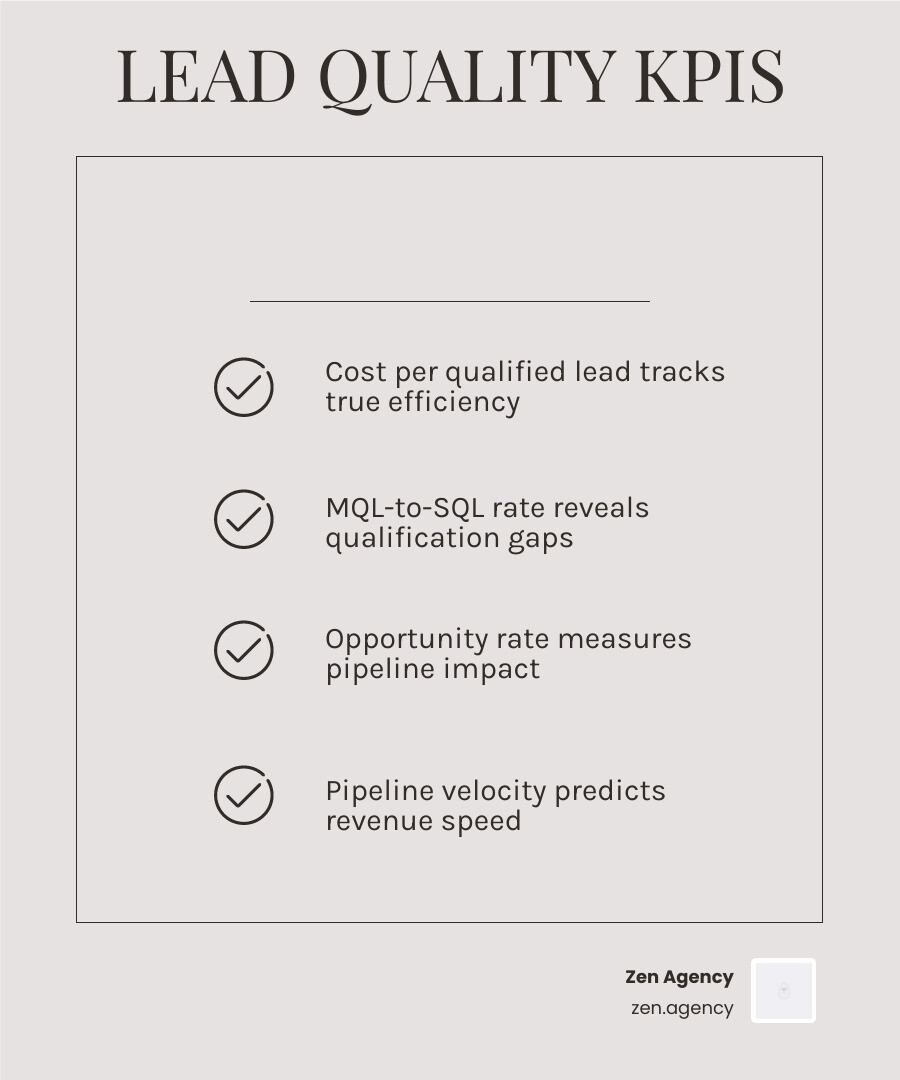
These metrics show whether your lead-generation system is actually creating pipeline and profit, not just form fills.
Don’t ignore compliance and data governance
Lead quality also depends on trust, data hygiene, and process discipline.
Important governance practices include:
- Clear consent capture
- Lawful data handling under GDPR and CCPA where applicable
- Data retention rules
- Audit trails for changes
- Controlled field definitions
- Standard naming conventions
- Access controls
Without governance, your scoring, reporting, and automation drift over time. Good quality management principles matter here. The American Society for Quality (ASQ) – University of Scranton provides a useful quality-management framework mindset: define the process, reduce variation, and improve it systematically.
In plain English: if your CRM is a junk drawer, your funnel will act like one.
Frequently Asked Questions About How to Improve Lead Quality
What are the fastest ways to improve lead quality this quarter?
Start with the highest-impact fixes:
- Add negative keywords
- Clarify who you serve in ads and landing pages
- Add one or two qualifying form fields
- Tighten routing and response speed
- Build a regular sales feedback review
- Start tracking qualified leads separately from raw leads
These changes are usually faster than rebuilding your entire funnel.
Should you optimize for qualified leads or closed sales first?
Usually, qualified leads first.
Closed sales are the best signal, but they take longer. Since many B2B sales cycles stretch across months, starting with qualified lead imports gives platforms faster feedback. Then, once tracking is stable, add opportunity and closed-won stages for deeper optimization.
Think of it as phased measurement: first teach the system what “good” looks like, then teach it what “great” looks like.
How often should lead scoring and qualification rules be updated?
At minimum, review them quarterly.
Also review when:
- Your ICP changes
- Sales notices new bad-fit patterns
- A campaign source starts underperforming
- Close rates change by segment
- Product or service offerings shift
Back-test scoring against closed-won deals whenever possible. A lead model should evolve with the market, not sit untouched for years like an office plant everyone forgot to water.
Conclusion
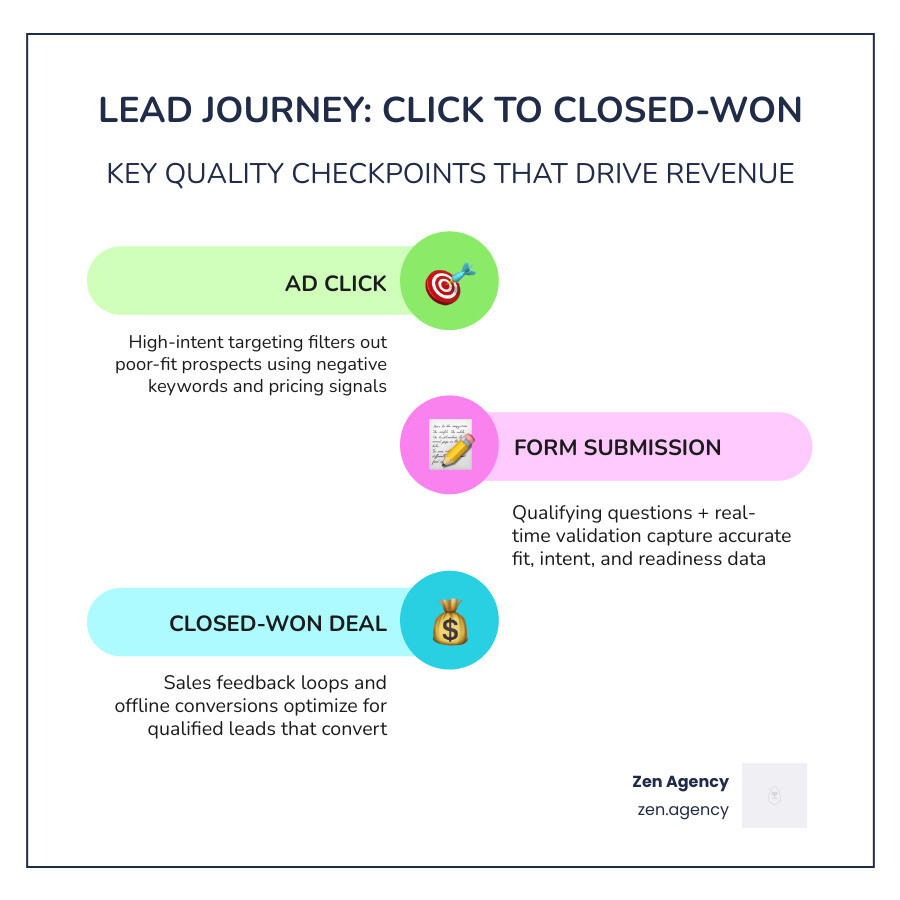
To improve lead quality, we need more than a better form or a sharper ad. We need process discipline from click to closed-won.
That means:
- Defining quality clearly
- Aligning marketing and sales
- Pre-qualifying traffic before the click
- Capturing cleaner data
- Automating routing and follow-up
- Sending offline conversion feedback to ad platforms
- Measuring success by qualified pipeline and revenue, not raw lead counts
A cleaner funnel is easier to manage, easier to scale, and far better for ROI.
If you want help building a lead-generation system that attracts better-fit prospects and turns them into revenue, explore our lead generation services and our The Ultimate Guide to B2B SaaS Lead Gen Success.
And if your current pipeline feels like a haunted house full of ghost leads, we should probably talk.