Beginner’s Guide to Lead Generation Leads
What Are Lead Generation Leads (And Why They Matter for Your Business)
Lead generation leads are potential customers who have shown interest in your product or service — typically by sharing their contact information in exchange for something valuable.
Here’s a quick breakdown:
| Term | What It Means |
|---|---|
| Lead | A person or business that has expressed interest in what you offer |
| Lead Generation | The process of attracting and capturing those interested people |
| Lead Generation Leads | The actual prospects produced by your lead generation efforts |
| Qualified Lead | A lead that matches your ideal customer and is likely to buy |
In simple terms: lead generation turns strangers into prospects, and prospects into paying customers.
There are four main types of leads you’ll encounter:
- MQL (Marketing Qualified Lead) — interested, but not yet ready to buy
- SQL (Sales Qualified Lead) — ready to talk to your sales team
- PQL (Product Qualified Lead) — already using your product (e.g., free trial)
- Service Qualified Lead — an existing customer open to an upsell
Without a steady flow of quality leads, business growth stalls. It doesn’t matter how good your product is — if the right people don’t know about it, you won’t scale.
The challenge most businesses face isn’t just getting leads. It’s getting the right leads — people who actually want what you’re selling, have the budget for it, and are ready to act.
I’m Joseph Riviello, CEO and Founder of Zen Agency, and over my 22+ years in digital marketing I’ve helped businesses of all sizes build reliable systems for lead generation leads that drive real, measurable revenue growth. In this guide, I’ll walk you through everything you need to know — from the basics to the strategies that actually work.
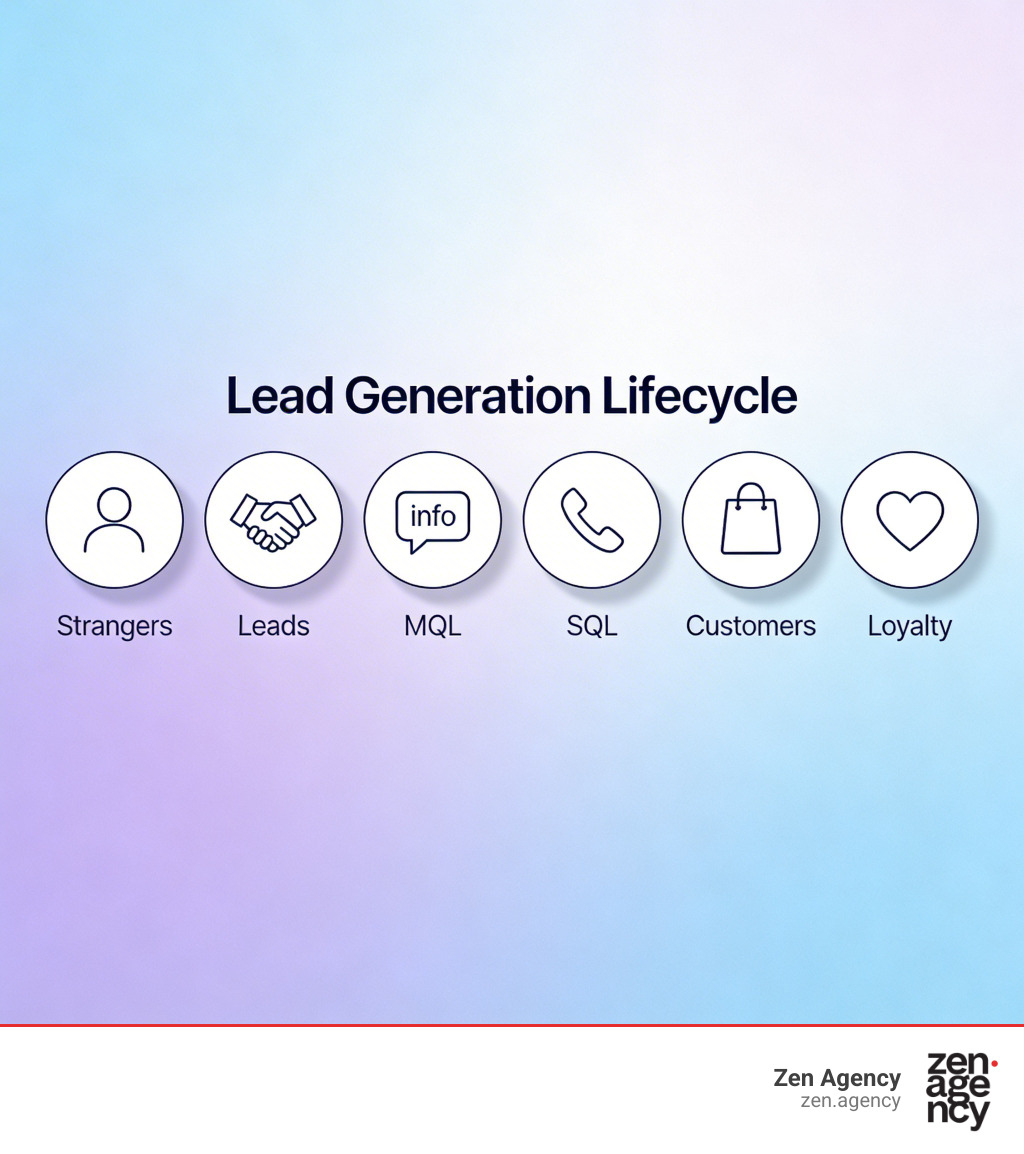
Terms related to lead generation leads:
Understanding Lead Generation Leads
When we talk about lead generation leads, we are essentially talking about the fuel that keeps your sales engine running. At its core, lead generation is the initiation of consumer interest or inquiry into products or services of a business. It is a strategy we use to identify and target the right potential customers so they don’t just wander past our digital storefront but actually stop and say, “Tell me more.”
In the modern digital economy, this process has moved far beyond just “finding names.” It involves sophisticated prospect identification and data collection. We aren’t just looking for an email address; we are looking for intent. Every time someone downloads a guide, signs up for a newsletter, or requests a quote, they are providing data that helps us understand if they are a good fit for our business.

Successful lead generation is about building a lead generation funnel that converts. This funnel takes a wide audience and narrows it down through conversion tracking. By monitoring where our lead generation leads come from—whether it’s a search on Google in Scranton or a LinkedIn ad seen in Billings—we can treat marketing as a revenue driver rather than just a cost center.
Why Businesses Need High-Quality Lead Generation Leads
Why do we emphasize “high-quality” so much? Because 100 unqualified leads are far less valuable than 10 qualified ones. If your sales team spends all day calling people who can’t afford your service or don’t need it, you’re losing money.
High-quality lead generation leads provide:
- Predictable Business Growth: When you know how many leads you generate each month, you can forecast your revenue.
- Improved ROI: By focusing on qualified prospects, you spend your marketing budget where it’s most likely to return a profit.
- Customer Loyalty: Leads who are a perfect fit for your business often turn into long-term, loyal customers.
- Sales Efficiency: Your sales team stays happy and productive because they are talking to people who actually want to buy.
The Step-by-Step Lead Generation Process
Generating lead generation leads isn’t a one-and-done event; it’s a repeatable process. We like to break it down into five key stages:
- Content Creation: We start by creating valuable content (blogs, videos, or tools) tailored to our target audience’s challenges.
- Discovery: Prospects find this content through promotion channels like SEO, social media, or paid ads.
- Call-to-Action (CTA): We include a clear instruction—like “Download Now” or “Get a Quote”—that encourages the visitor to take action.
- Form Submission: The visitor fills out a form, exchanging their contact details for the value we offered. This is the moment a stranger becomes a lead.
- Lead Nurturing & CRM Integration: We don’t just let the lead sit there. We use CRM tools to nurture their interest with personalized follow-ups until they are ready to buy.
Categorizing and Qualifying Prospects
Not all lead generation leads are created equal. If you treat a person who just downloaded a “beginner’s guide” the same as someone who clicked “request a demo,” you’re going to have a bad time. We categorize leads to ensure we’re providing the right information at the right time.
Comparing Lead Types
| Lead Type | Description | Readiness |
|---|---|---|
| MQL | Marketing Qualified Lead; has engaged with marketing but isn’t ready for a sales call. | Low/Medium |
| SQL | Sales Qualified Lead; has been vetted and is ready for a direct sales conversation. | High |
| PQL | Product Qualified Lead; has used a free version or trial and shown value-based interest. | Very High |
| Service Qualified | An existing customer who has expressed interest in additional services. | High (Upsell) |
To do this effectively, we must develop buyer personas—detailed profiles of our ideal customers based on industry, company size, and job function.
The BANT Framework for Lead Qualification
One of the most classic and effective ways we qualify lead generation leads is using the BANT framework. It helps us determine prospect readiness by asking four simple questions:
- Budget: Does the prospect have the financial resources to invest in our solution?
- Authority: Does this person have the power to make the final purchasing decision?
- Need: Does the prospect have a specific problem that our product or service can solve?
- Timing: Is there a near-term need to purchase, or are they just browsing for next year?
By applying BANT, we filter out the “window shoppers” and prioritize the leads that are ready to move the needle for our business.
Lead Scoring vs. Lead Grading
While they sound similar, lead scoring and grading serve different purposes in managing lead generation leads.
Lead Scoring is about behavior. We assign numerical values based on what a lead does. For example, downloading a case study might be worth 20 points, while visiting the homepage is only worth 2 points. It measures interest levels.
Lead Grading is about fit. We assign a grade (like A through F) based on how well the lead matches our Ideal Customer Profile (ICP). If we only serve large enterprises in Pennsylvania, a lead from a Fortune 500 company in Wilkes-Barre gets an “A,” regardless of whether they’ve visited our site once or ten times.
We recommend using both together. A lead with an “A” grade and a high score is your “gold” prospect.
Strategies for Capturing Prospects
To keep your pipeline full of lead generation leads, you need a mix of “pull” and “push” tactics.
Inbound vs. Outbound Marketing
Inbound marketing is the “pull.” It’s about attracting prospects through using content marketing for lead generation. Think of it as a quiet, one-on-one chat. You provide value, and the lead comes to you. It’s less intrusive and excellent for building long-term trust.
Outbound marketing is the “push.” This includes things like cold calling, direct mail, or using paid ads for lead generation. While some find outbound “shouty,” it can be incredibly effective for B2B companies in locations like Billings or Scranton when it’s highly targeted and professional.
Effective Strategies for Generating Lead Generation Leads
If you want to dominate your local market, you should focus on these core pillars:
- SEO (Search Engine Optimization): SEO leads have a nearly 15% close rate—much higher than traditional outbound methods. By ranking for keywords your customers are searching for, you capture them at the moment of intent.
- Gated Assets: Offering an ebook, whitepaper, or checklist in exchange for an email is a tried-and-true method for capturing MQLs.
- Email Marketing: Don’t listen to the skeptics; email is alive and well. 60% of consumers say emails influence their purchase decisions, and businesses see an average ROI of $36 to $40 for every dollar spent.
- Webinars: Utilizing webinars for lead generation allows you to demonstrate expertise and capture high-intent leads who are willing to spend 30-60 minutes with your brand.
- Referral Programs: Building a referral program to drive lead generation is one of the fastest ways to get high-quality leads. A lead from a trusted friend is almost always pre-qualified.
Leveraging LinkedIn and Local Services Ads
For businesses in our service areas like Wyoming PA or Montana, two specific tools stand out for generating lead generation leads.
LinkedIn Lead Gen Forms are a game-changer for B2B. LinkedIn is 277% more effective for lead generation than Facebook and Twitter. These forms auto-populate with a user’s profile data, meaning they can sign up with just two clicks. It removes the friction that usually kills mobile conversion rates.
Google Local Services Ads (LSA) are essential for local service businesses (plumbers, lawyers, roofers). Unlike traditional PPC where you pay for clicks, LSAs work on a pay-per-lead model. You only pay when a customer actually contacts you through the ad. Plus, you can earn the Google Guarantee or Google Screened badge, which provides instant credibility.
Frequently Asked Questions about Lead Generation
How does lead generation differ for B2B vs. B2C?
The main difference lies in the complexity of the sale. B2B (Business-to-Business) usually involves a longer sales cycle, higher price points, and multiple decision-makers. The triggers are rational—ROI, efficiency, and logic.
B2C (Business-to-Consumer) is often more emotional and faster. A consumer might see a social media ad for a cool gadget and buy it within minutes. B2C lead generation often focuses on “demand generation”—creating a buzz that leads to a quick sale.
What are common mistakes in lead generation?
We’ve seen it all, but these are the most common “lead killers”:
- Too many form fields: Asking for a phone number, address, and blood type on the first interaction will scare people away. Keep it to 3-5 fields.
- Poor follow-up: If you don’t contact a lead within the first hour (or even minutes), the chances of converting them drop significantly.
- Ignoring A/B Testing: You should always be testing your calls-to-action and landing pages. Even a small change in color or wording can double your leads.
- Unqualified Traffic: Driving thousands of visitors to your site doesn’t matter if they aren’t your target audience. Focus on quality over quantity.
How do you measure and optimize lead generation campaigns?
You can’t improve what you don’t measure. We look at several key metrics:
- Conversion Rate: What percentage of visitors actually become leads?
- Cost Per Lead (CPL): How much are we spending to get one lead?
- Lead-to-Sale Ratio: How many of our leads actually become paying customers?
- ROI: Is the revenue generated by these leads higher than the cost of the campaign?
Regularly auditing your program and using lead generation automation can help streamline these measurements and free up your time for strategy.
Conclusion
Mastering lead generation leads is the difference between a business that survives and one that thrives. Whether you are a local business in Scranton looking to fill your calendar or an enterprise trying to scale nationally, having a structured, data-driven approach to capturing and qualifying prospects is non-negotiable.
At Zen Agency, we specialize in providing enterprise-grade solutions that help businesses increase their visibility and profitability. Since 2008, we’ve been the partner of choice for companies that are struggling to scale and need innovative strategies to boost their ROI. From custom web development to advanced lead generation funnels, we have the tools and expertise to turn your website into a lead-generating machine.
Ready to stop chasing prospects and start attracting them? We’re here to help you build a system that works while you sleep.