
The Ultimate Guide to Brand Guideline Creation
Why Brand Consistency Starts With a Clear Rulebook
Brand guideline creation is the process of documenting how your company presents itself across every customer touchpoint—from your logo and colors to your voice and messaging. Without these rules, your brand becomes inconsistent, confusing, and forgettable, no matter how much you invest in marketing.
Quick Answer: The Essential Steps for Brand Guideline Creation
- Define your brand strategy – Mission, values, target audience, and brand personality
- Build your visual identity – Logo rules, color palette with exact codes, typography standards
- Establish your brand voice – Tone, messaging examples, and writing guidelines
- Document usage rules – Dos and don’ts for all brand assets across channels
- Create application guidelines – Standards for digital, print, and social media
- Set governance protocols – Approval processes and third-party usage rules
- Make it accessible – Store guidelines where teams can easily find and use them
- Maintain as a living document – Update regularly as your brand evolves
People personify brands. Just as we’re more inclined to trust friends with stable, consistent personalities, we’re more likely to trust brands that always look and feel the same. This isn’t just theory—it’s backed by data. On average, it takes 6-8 interactions before consumers consider making a purchase. If your brand looks different at each touchpoint, you’re essentially starting from zero every single time.
The world’s most recognizable brands didn’t achieve their status by accident. They developed and enforced strict brand guidelines that govern everything from the exact shade of red on a can to the tone of voice in a tweet. These guidelines act as an instruction manual, ensuring that whether a customer sees your brand on a billboard, website, or business card, they instantly recognize it as yours.
Without brand guidelines, even the most talented teams create inconsistent work. A freelance designer might stretch your logo. An agency partner might use the wrong colors. Your sales team might present materials that look nothing like your website. Each inconsistency chips away at recognition, dilutes your message, and ultimately costs you money in lost opportunities and wasted revisions.
Brand guidelines solve this problem by creating a single source of truth. They specify the exact colors (with HEX, RGB, and CMYK codes), define minimum logo sizes and clear space requirements, establish typography hierarchies, outline imagery styles, document your brand voice with real examples, and provide templates that make consistency easy. When done right, they empower every team member, freelancer, and partner to represent your brand correctly without constant oversight.
I’m Joseph Riviello, and over the past 22 years, I’ve led brand guideline creation for hundreds of companies at Zen Agency, helping them transform inconsistent identities into powerful, recognizable brands that drive revenue. My approach combines strategic thinking with practical documentation that teams actually use, not PDFs that sit forgotten on a server.
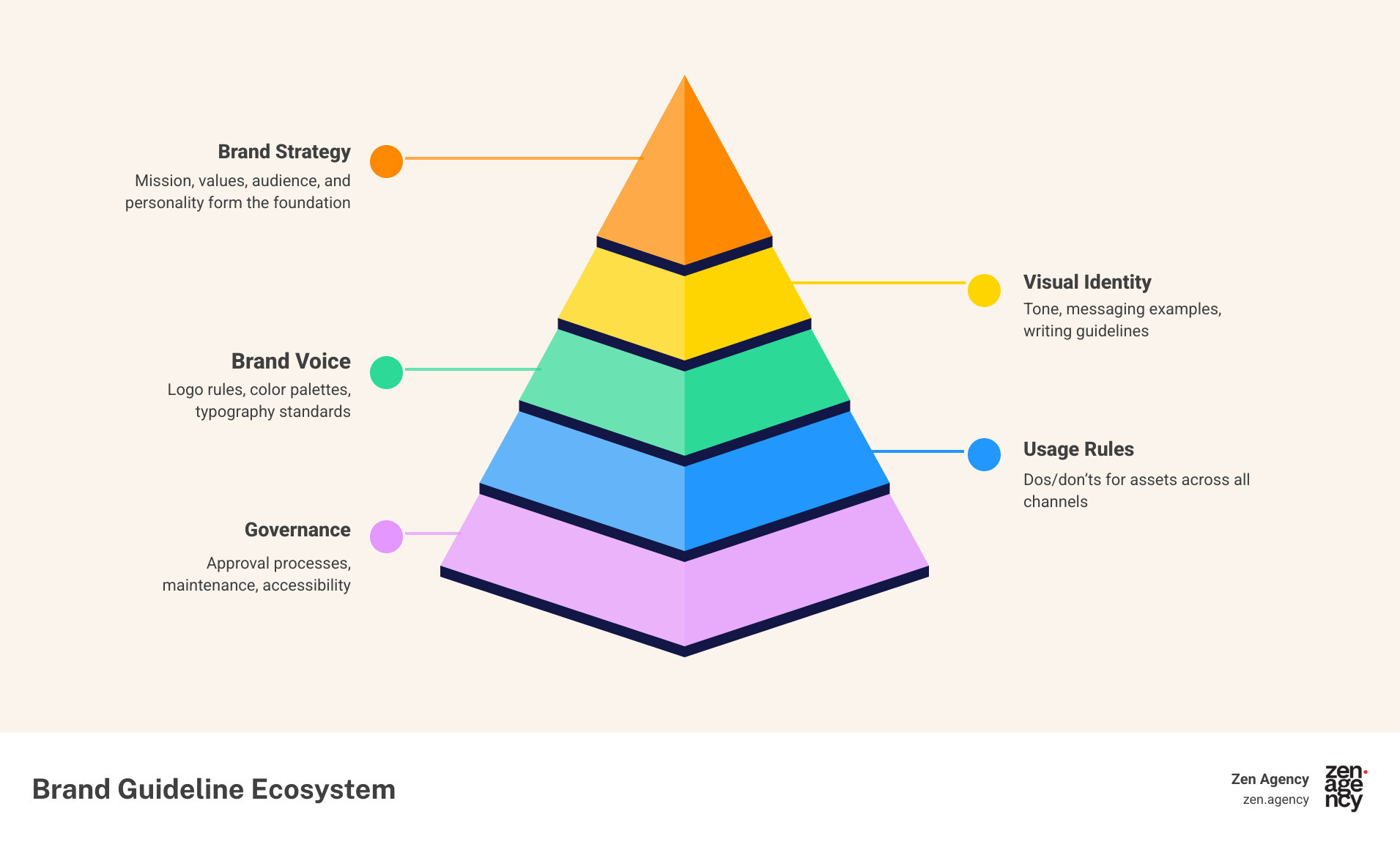
Why Brand Guidelines are Essential for Business Growth
In our decades of experience serving clients from Scranton to Billings, we’ve seen one truth remain constant: growth requires trust, and trust requires consistency. we’re more likely to trust brands that always look and feel the same because stability signals professional competence.
When we talk about brand guideline creation, we aren’t just talking about a “pretty PDF.” We are talking about the engine for your business growth. Consider these key benefits:
- Instant Brand Recognition: Did you know that studies found that brands using a signature color increase recognition by 80%? If your “signature blue” looks like “navy” on your website but “sky blue” on your business cards, you are losing that 80% boost.
- Faster Scaling: As you hire more team members or work with external agencies, you can’t be in every meeting. Guidelines allow you to scale without diluting your message.
- Increased Revenue: Consistency isn’t just a design preference; it’s a financial strategy. Brand Consistency: Why It’s Essential for Your Business Success lies in the fact that a unified brand presence can significantly increase revenue by making your marketing more effective.
- Customer Loyalty: When customers know exactly what to expect from you, they are more likely to stay. In fact, 43% of people spend more money on brands they are loyal to.
- Professionalism: Why Branding Matters: How a Strong Brand Drives Business Growth is often seen in the “perceived value.” A brand that looks polished and consistent can often command higher prices than a competitor that looks disorganized.
Defining Your Core Identity and Strategy
Before we pick out fonts or draw logos, we have to dig into the “soul” of the business. Successful brand guideline creation starts with a strategic foundation. If you don’t know who you are, how can you tell a designer what you should look like?
We recommend starting with The Ultimate Guide to Building a Memorable Brand Identity to ensure you have these four pillars in place:
- Mission Statement: Why does your business exist beyond making money? (e.g., “To simplify digital marketing for small businesses in Pennsylvania.”)
- Core Values: What principles guide your decisions? Are you innovative, sustainable, or perhaps fiercely customer-centric?
- Brand Personality: If your brand were a person, who would they be? Are they the “wise professor,” the “adventurous explorer,” or the “sassy best friend”?
- Market Differentiator: What makes you different from everyone else in Wilkes-Barre or Wyoming, PA?
To get these right, we often suggest using a free persona tool to visualize your ideal customer. Understanding your audience is the only way to ensure your brand story resonates. It’s important to remember Branding vs Marketing: What’s the Difference and Why It Matters; branding is the who, while marketing is the how.
The Role of Strategy in Brand Guideline Creation
Strategy is the “why” behind every “what.” When we assist clients with brand guideline creation, we don’t just pick a color because it’s pretty. We pick it because it aligns with the brand’s value proposition.
A thorough strategic foundation includes:
- Competitive Audit: What do your competitors look like? If everyone in your niche is using green, maybe you should use orange to stand out.
- Buyer Personas: Detailed profiles of who you are talking to.
- Long-term Vision: Where do you want to be in 10 years? Your guidelines should be able to grow with you.
For a deeper dive into making sure your brand works everywhere, check out How to Create a Brand Style Guide for Consistency Across Platforms.
Establishing Brand Voice and Tone
Your brand doesn’t just have a face; it has a voice. Have you ever talked to someone whose appearance didn’t match their personality? It’s jarring. The same applies to your business.
In your guidelines, you should define:
- Voice: This is your brand’s permanent personality (e.g., Professional, Authoritative, Witty).
- Tone: This is how the voice adapts to situations. Your tone on a “404 Error” page might be lighthearted, while your tone in a legal contract should be formal.
- Branded Terms: Are there specific words you always use? Are there words you never use? (e.g., We call our customers “partners,” not “clients.”)
- Editorial Standards: Do you use the Oxford comma? (We do, and we’ll fight for it!)
Include “This, Not That” examples. For instance:
- Say: “We’re here to help you grow.”
- Don’t Say: “Our proprietary algorithms facilitate enterprise-level scalability.”
Step-by-Step Brand Guideline Creation for Visual Assets
Now we get to the “visual” part of brand guideline creation. This is where your strategy takes physical form.
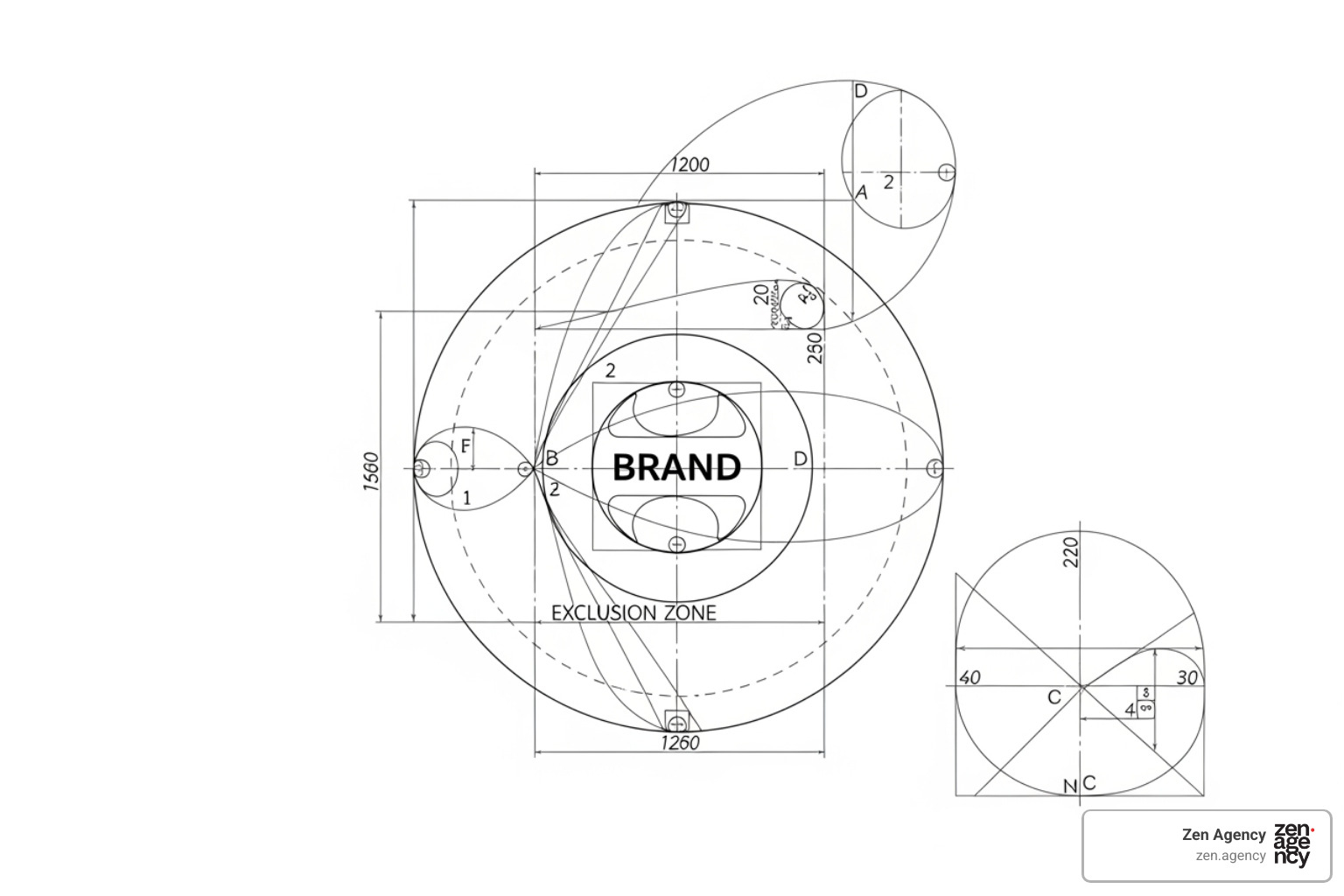
A comprehensive Brand Identity Design requires more than just a logo. You need a full ecosystem. When Creating a Visual Style Guide for Your Business, you must consider how these elements work in both digital and print environments.
Mastering Logo Usage and Spacing Rules
Your logo is your most valuable visual asset. Protect it! Your guidelines should include:
- Clear Space: The “breathing room” around the logo where no other elements are allowed. Usually, this is measured by a portion of the logo itself (like the height of the “Z” in our logo).
- Minimum Size: The smallest size the logo can be before it becomes a blurry mess.
- Variations: Do you have a horizontal version? A stacked version? An icon-only version for social media profile pictures?
- Logo Dos and Don’ts: This is our favorite part. Show examples of your logo being stretched, recolored, or placed on a busy background—then put a giant red “X” over them.
For inspiration, look at the NASA brand guide. It is a masterclass in precision, detailing how the logo should appear on everything from a letterhead to a space shuttle.
Selecting Typography and Color Palettes
Typography and color are the “mood setters” of your brand. As we mentioned, studies found that brands using a signature color increase recognition by 80%.
When Choosing the Right Colors for Your Brand Identity, you must provide codes for every medium:
| Color Type | Usage | Example |
|---|---|---|
| HEX | Web/Digital | #FF5733 |
| RGB | Screens/Video | 255, 87, 51 |
| CMYK | Professional Printing | 0, 80, 95, 0 |
| Pantone | Color Matching System | PMS 172 C |
Don’t forget Accessibility. Ensure your color combinations have enough contrast for people with visual impairments. This isn’t just a “nice to do”—it’s essential for modern digital standards.
Next, let’s talk about The Role of Typography in Branding: Fonts That Speak Your Brand’s Language. You should typically select:
- Primary Font: For headlines and big statements.
- Secondary Font: For body text and readability.
- System Font: A “fallback” font like Arial or Helvetica for when your fancy brand font isn’t available (like in a standard email).
Frequently Asked Questions about Brand Guidelines
What is the difference between a brand guide and a style guide?
While people often use these terms interchangeably, there is a subtle difference. A brand guide (or brand book) is often more comprehensive, covering the brand’s history, mission, and “vibe.” A style guide is often more tactical, focusing specifically on design rules or writing standards.
In Graphic Design vs Branding: What’s the Difference for Your Business, think of the brand guide as the “Constitution” and the style guide as the “Local Ordinances.” One defines the spirit; the other defines the specific laws.
How often should brand guidelines be updated?
Your brand is a living organism, not a fossil. We recommend a “check-up” every year, with a more thorough review every 3-5 years. You might need an update if:
- You are launching a new product line.
- You’ve gone through a merger or acquisition.
- Your target audience has shifted.
- Design trends have made your current look feel dated (looking at you, 2010-era gradients!).
Always use version control. Ensure everyone is using “BrandGuidelinesV2.2″ and not an old version from five years ago.
What are the most common mistakes in brand guideline creation?
We’ve seen it all. Here are the pitfalls to avoid:
- Being Too Restrictive: If your rules are so strict that designers can’t be creative, they will eventually ignore the rules entirely.
- Lack of Examples: Don’t just tell people what to do; show them.
- Ignoring Accessibility: If your “brand yellow” text is unreadable on a white background, your brand is failing its users.
- Making it Hard to Find: If your guidelines are buried in a sub-folder of a sub-folder on a private server, no one will use them. Use a centralized, cloud-based hub.
- Missing the “Why”: People are more likely to follow rules if they understand the strategic reason behind them.
Conclusion
Brand guideline creation is one of the most significant investments you can make in your business’s future. It turns your visual identity from a collection of files into a strategic asset that builds trust, drives recognition, and fuels growth.
At Zen Agency, we specialize in providing enterprise-grade solutions for businesses that are ready to scale. Whether you’re in Scranton, PA, or Billings, MT, we understand that your brand needs to work across every platform—from high-converting websites to social media and print. Our mission is to help you increase visibility and ROI through innovative strategies that actually work in the real world.
Ready to stop the “brand drift” and start building a cohesive identity that wins? We can help you create a “living” brand system that empowers your team and protects your identity.