The Ultimate Guide to Brand Alignment Consulting and Channel Control
The Ultimate Guide to Brand Alignment Consulting and Channel Control
Why Brand Alignment Consulting Is the Missing Link Between Strategy and Growth
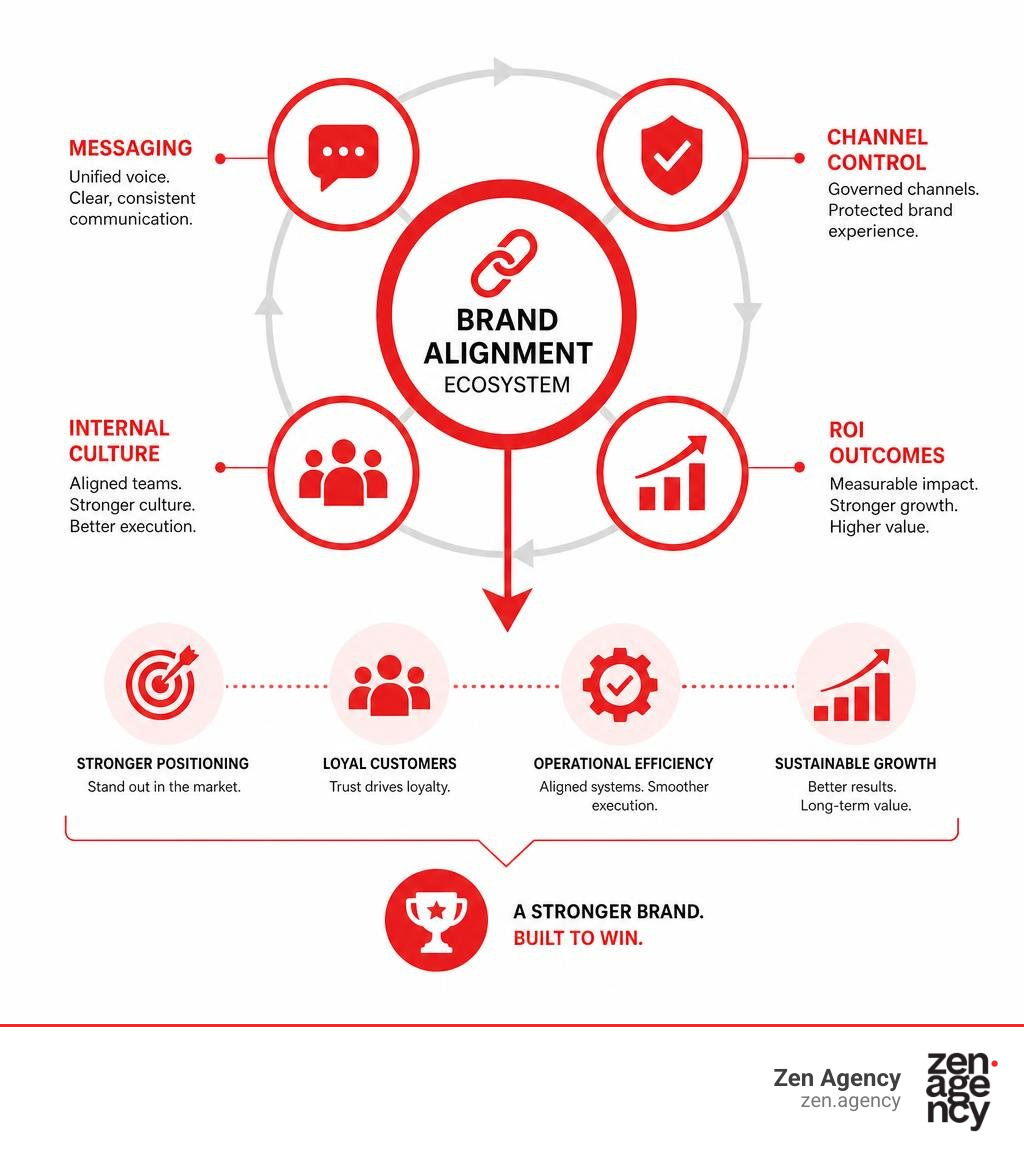
Brand alignment consulting is the process of ensuring your internal brand identity — your values, messaging, and strategy — matches how your customers, employees, and market actually experience your company.
If you’re trying to decide whether you need it, here’s a quick breakdown:
| What It Solves | What You Get |
|---|---|
| Inconsistent messaging across teams and channels | A unified brand voice and messaging architecture |
| Rising customer acquisition costs | Up to 30% reduction in CAC through consistent positioning |
| Weak marketplace control (MAP violations, unauthorized sellers) | Structured channel governance and enforcement |
| Poor talent attraction and retention | A stronger employer brand that draws qualified applicants |
| Flat revenue despite marketing spend | Up to 33% revenue lift from consistent brand presentation |
| Low enterprise valuation | Potential 1.7x–2x EBITDA multiple growth in 12–18 months |
Most companies don’t realize they have a brand alignment problem. They see rising acquisition costs, declining sales, and teams pulling in different directions — but they blame the symptoms, not the root cause.
The root cause is almost always a gap between what a brand says it stands for and what customers, employees, and partners actually experience.
Think of it like poorly aligned tires. The car still moves, but it fights itself the whole way — wasting fuel, wearing unevenly, and eventually breaking down. An unaligned brand does the same thing to your business.
The good news? Brand alignment is diagnosable, fixable, and measurable.
I’m Joseph Riviello, CEO and Founder of Zen Agency, and with over 22 years of experience helping companies scale through holistic digital strategies, brand alignment consulting is one of the most high-leverage engagements I’ve seen transform both revenue and enterprise value for our clients. This guide covers everything you need to know to get it right.
Brand alignment consulting definitions:
What Is Brand Alignment and Why Does It Matter for Enterprise Value?
At its core, brand alignment is the degree of consistency between your internal business operations and your external market presence. When your business model, marketing campaigns, product delivery, and corporate messaging are fully synchronized, growth feels natural. When they are fractured, you pay a heavy “misalignment tax” in the form of wasted marketing spend, frustrated sales teams, and confused customers.
From an enterprise value perspective, brand alignment is not just a creative exercise; it is a direct multiplier of financial performance. Organizations with strategic brand alignment are more than four times more likely to be healthy, high-performing, and capable of sustaining long-term success.
Consider the financial impact: maintaining a consistent brand presentation across all customer touchpoints can boost revenue by up to 33%. Furthermore, companies that clarify decision rights, establish proper brand structures, and implement unified operating systems frequently experience enterprise valuation increases of 1.7x to 2x. This is equivalent to a 15% to 20% EBITDA multiple growth within a 12-to-18-month period.
When your brand promise is clear and consistently executed, you spend less money convincing skeptical buyers. To dive deeper into building a foundation that lasts, check out our step-by-step guide on How To Build A Brand That Lasts A Step By Step Strategy Guide.
Distinguishing Brand Alignment from Strategy, Identity, and Employer Branding
It is common to confuse brand alignment with other branding disciplines. While they are closely related, they serve different functions in your business ecosystem:
- Brand Strategy: This is your long-term blueprint. It defines who you are, your target audience, your positioning, and how you plan to compete in the market.
- Brand Identity: This is the visual and verbal execution of your strategy. It includes your logo, typography, color palette, and style guides. To see how this comes to life, read our breakdown of Brand Identity Design.
- Employer Branding: This is how you position your company to job seekers and current employees. It is your reputation as a place to work.
- Brand Alignment: This is the connective tissue. It is the ongoing process of ensuring your brand strategy, brand identity, and employer branding are actively integrated into your day-to-day operations, marketing channels, and customer experiences.
Without brand alignment, you might have a beautiful visual identity designed by a great team, but your sales representatives might still describe your services in three completely different ways. Alignment ensures that the promise made by your marketing team is actually delivered by your operations team.
The Cost of Misalignment: Red Flags and Warning Signs
How do you know if your company has a brand alignment problem? Misalignment rarely announces itself with a single catastrophic event. Instead, it quietly erodes your margins and confuses your market.
Watch out for these common warning signs:
- Message Drift: Your website says one thing, your sales decks say another, and your customer service representatives use entirely different language.
- Rising Customer Acquisition Costs (CAC) with Flat Sales: You are pouring money into paid ads and SEO, but your conversions are stalling because your messaging does not resonate or feels contradictory.
- Confused Buyers: Prospective customers ask basic, repetitive questions about what you actually do or how you differ from competitors.
- High Employee Turnover: Your internal culture does not match the inspiring “mission and values” page on your website, leading to cynicism and disengagement.
- The “We’ve Always Done It This Way” Trap: Teams resist updating their workflows or messaging because they are disconnected from the broader corporate vision.
If these red flags sound familiar, it is highly likely that your operational reality has drifted away from your brand promise. Working with specialized partners can help you diagnose these gaps; learn more about selecting the right team in our guide on How To Pick Brand Strategy Companies That Actually Get You.
The Core Frameworks of Brand Alignment Consulting
Resolving deep-seated misalignment requires a structured, objective approach. Professional brand alignment consulting relies on clear frameworks to audit, restructure, and govern how a brand behaves internally and externally.
A standard engagement starts with a thorough brand audit, followed by competitive and market intelligence gathering, and finally, the implementation of governance systems. You can explore how mid-market companies navigate this structured process by reviewing Brand Alignment Services for Mid-Market Companies | The Brand Auditors LLC .
Operationalizing Your Message with Brand Alignment Consulting Frameworks
To move from high-level theory to daily execution, consultants use practical tools and canvases to organize a brand’s narrative assets.
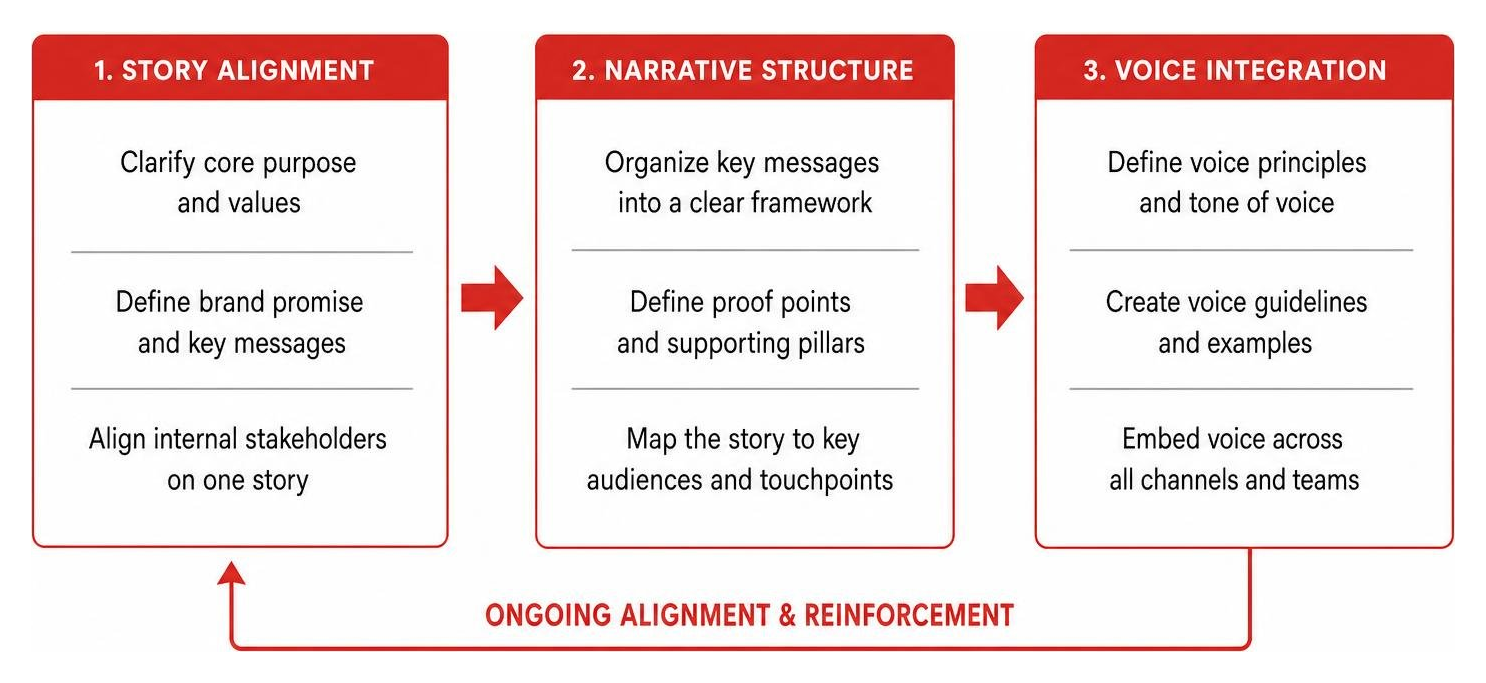
Three popular frameworks used to achieve this operational consistency include:
- The CORE Rubric: A diagnostic tool used to evaluate whether your messaging is Consistent, Operational, Resonant, and Engaging across every department.
- The Story Integrity Canvas: A single, practical source of truth that combines your brand story, narrative structure, and voice guidelines. It acts as a reference point for internal content creators and external agency partners.
- The Experience Design Process: A collaborative methodology that map out the entire customer journey. Instead of a top-down approach, it invites diverse stakeholders to identify critical touchpoints where the brand promise must be actively delivered.
By combining these frameworks, companies can build comprehensive brand guidelines that go far beyond basic logo usage rules. To learn more about setting these standards, read The Ultimate Guide To Brand Guideline Creation. For those looking for structured, turn-key consulting packages that utilize these exact canvases, The Full Alignment Plan Consulting Package | Story Aligned offers an excellent blueprint of how these engagements are run.
Internal Culture and Employee Engagement as Organizational Currency
You cannot align your brand externally if your team is disconnected internally. Within your organization, your brand promise is your currency. It drives deeper connections, boosts morale, and ensures that everyone is pulling in the same direction.
This is particularly true for professional services and scaling enterprises, where recruiting and talent retention are major business challenges. In fact, three out of four job seekers check a company’s reputation and employer brand before even applying. Companies with strong employer brands receive 50% more qualified applicants and reduce their cost-per-hire by up to 50%.
When your internal culture is aligned with your external promise, your employees become your strongest brand advocates. To achieve this, leadership must actively model the brand’s values, and regional or business unit leaders must be equipped with turn-key training tools.
Instead of relying on dry, top-down presentations, successful internal alignment often uses interactive workshops and physical activation kits to help teams practice delivering the brand promise in real-world scenarios. This collaborative, hands-on approach is highly effective; you can read about the philosophy of embedded coaching and team upskilling in GUIDE, COACH, AND ENABLER – by Q. Malandrino .
Channel Control: Protecting Brand Equity and Revenue Across Marketplaces
For companies selling physical products, brand alignment is not just about words and visuals — it is about physical and digital channel control. In the modern e-commerce landscape, unauthorized sellers, grey market distribution leaks, and Minimum Advertised Price (MAP) violations can rapidly destroy years of brand equity.
If your products are scattered across Amazon, Walmart, and eBay at wildly different prices, your brand presentation is fractured. This inconsistency causes cognitive dissonance for consumers and damages your relationships with authorized brick-and-mortar retailers who cannot compete with unauthorized online price undercutting.
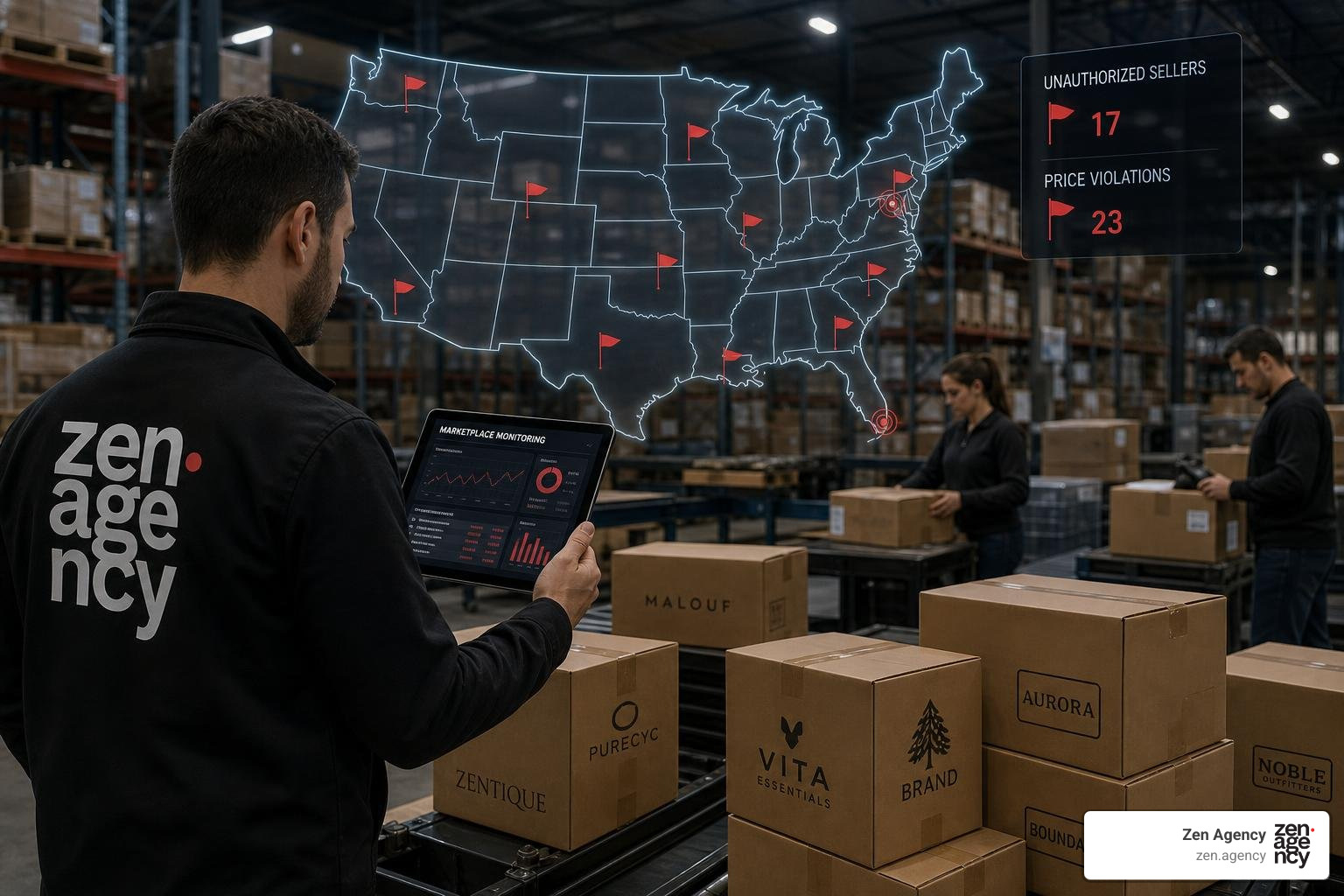
To maintain a healthy brand, companies must implement strict marketplace enforcement strategies. For professional insights into how organizations monitor and enforce these digital channels, you can explore the resources provided by Brand Alignment .
Combating MAP Violations and Unauthorized Sellers
Most brands react only when they lose the Buy Box on Amazon or spot a glaring MAP violation. By then, the damage to their pricing integrity has already occurred. Effective channel control requires a proactive, systematic approach that combines automated monitoring with root-cause supply chain investigations.
Consider these real-world results from structured marketplace alignment and enforcement programs:
- Etude House achieved a remarkable 98% reduction in unauthorized inventory stock on Amazon USA within one year of implementing a dedicated alignment and brand protection strategy.
- BioLab experienced a 99% reduction in MAP issues among authorized sellers within just 30 days of launching their enforcement program.
- Cricket saw a dramatic 90%+ reduction in unauthorized inventory on their Amazon listings within six months, while their Buy Box percentage soared to 95%+.
These successes are not achieved through manual, sporadic tracking. They require establishing a clear reseller matrix, drafting legally enforceable MAP policies, and shutting down the upstream supply chain leaks that allow unauthorized sellers to acquire inventory in the first place.
Building these strategic, protective networks often involves structuring robust distribution agreements. To learn more about designing secure commercial alliances, read about Strategic Partnerships – Star Brands Consulting Group .
Scaling Brand Alignment Consulting in the Age of AI and Digital Transformation
As we navigate 2026, the speed of content creation has accelerated exponentially due to generative AI. While AI-assisted workflows allow companies to produce marketing assets at a fraction of the cost, they also introduce a massive risk: message drift.
Without a shared, highly structured brand alignment system, AI tools inevitably flatten and dilute your brand voice. They default to generic industry jargon, slowly stripping away the unique differentiators that make your business stand out in a saturated market.
To protect your brand in an AI-powered search landscape, your alignment guidelines must be directly integrated into your digital infrastructure. This means:
- Feeding your custom-engineered Story Integrity Canvas directly into your AI writing prompts as system instructions.
- Establishing clear content review guardrails that define which high-stakes assets require human-in-the-loop validation.
- Optimizing your digital platforms so that your visual and tonal positioning remains perfectly consistent across every device and channel.
This technical integration of brand and digital execution is exactly why modern businesses require more than just a traditional design agency. For a deeper look at why digital-first branding is essential for modern scaling, read our article on Beyond Logos Why Your Business Needs A Digital Branding Agency.
Measuring the ROI of Brand Alignment Initiatives
Because branding is often viewed as a creative discipline, executives frequently ask: How do we measure the tangible return on investment of a brand alignment consulting engagement?
The ROI of brand alignment is highly quantitative and directly visible on your balance sheet. By eliminating inconsistent messaging, stabilizing marketplace pricing, and unifying your internal team, you directly impact both top-line revenue and bottom-line efficiency.
Here is a comparison of key business metrics between aligned and misaligned organizations:
| Business Metric | Misaligned Brand (The “Misalignment Tax”) | Aligned Brand (The “Alignment Multiplier”) |
|---|---|---|
| Customer Acquisition Cost (CAC) | High; marketing spend is wasted on confusing or mismatched campaigns. | Up to 30% lower CAC due to clear, high-converting positioning. |
| Annual Revenue Growth | Stagnant or slow; inconsistent presentation dilutes market trust. | Up to 33% higher revenue growth driven by consistent touchpoints. |
| Marketing Budget Efficiency | 10% to 20% of budget wasted on redundant or off-brand content. | Minimal waste; clear governance and reusable narrative frameworks. |
| Talent Acquisition Costs | High cost-per-hire; struggles to attract top-tier applicants. | 50% lower cost-per-hire; 50% more qualified applicants. |
| E-Commerce Buy Box Ownership | Low (often under 60%) due to unauthorized resellers undercutting prices. | High (95%+) due to structured marketplace enforcement. |
| Enterprise Valuation | Standard industry EBITDA multiples. | 1.7x to 2x valuation multiplier (15% to 20% EBITDA growth). |
Frequently Asked Questions About Brand Alignment
What are the typical deliverables of a brand alignment consulting engagement?
A comprehensive brand alignment consulting project delivers highly practical, operational assets designed to guide your team’s daily decisions. Typical deliverables include:
- A Brand Audit Report: A detailed diagnostic showing exactly where your messaging, visual identity, and customer experience are currently fractured or misaligned.
- A Unified Messaging Architecture: A structured document providing standardized language, differentiators, and core value propositions for your sales, marketing, and operations teams.
- A Story Integrity Canvas: A single-page reference tool that combines your brand story, narrative structure, and voice guidelines.
- Governance and Review Guidelines: Clear rules defining who owns brand decisions, how content should be reviewed, and where human-in-the-loop oversight is required for AI workflows.
To see how custom rules and structures help you maintain complete control over your corporate identity, explore Your Brand Your Rules A Guide To Custom Identity Design.
How long does a brand alignment audit typically take?
A standard brand alignment audit typically takes between 4 to 8 weeks, depending on the size and complexity of the organization.
During the first 2 to 3 weeks, consultants focus on data collection and stakeholder interviews. This involves interviewing internal leadership, sales reps, and customer-facing staff, as well as gathering direct feedback from current and former clients. The remaining weeks are spent analyzing the data, identifying message drift patterns, and compiling the actionable recommendations for your final Brand Audit Report.
Can brand alignment help resolve marketplace pricing conflicts?
Yes. In fact, true brand alignment is impossible without marketplace pricing integrity. A brand alignment consulting engagement helps resolve these conflicts by auditing your upstream supply chain to locate distribution leaks, establishing a clear authorized reseller matrix, and implementing automated MAP monitoring and enforcement systems to protect your Buy Box performance.
Conclusion
In a highly competitive digital marketplace, you cannot afford to have a brand that fights itself. Misalignment is a quiet profit killer that drives up your customer acquisition costs, dilutes your market presence, and confuses your internal team.
Achieving true brand alignment requires a holistic approach that bridges the gap between high-level brand strategy, internal company culture, and technical digital execution. Whether you are looking to scale your business, protect your marketplace pricing, or prepare your company for a high-value acquisition, aligning your brand is the most reliable way to unlock sustainable, long-term growth.
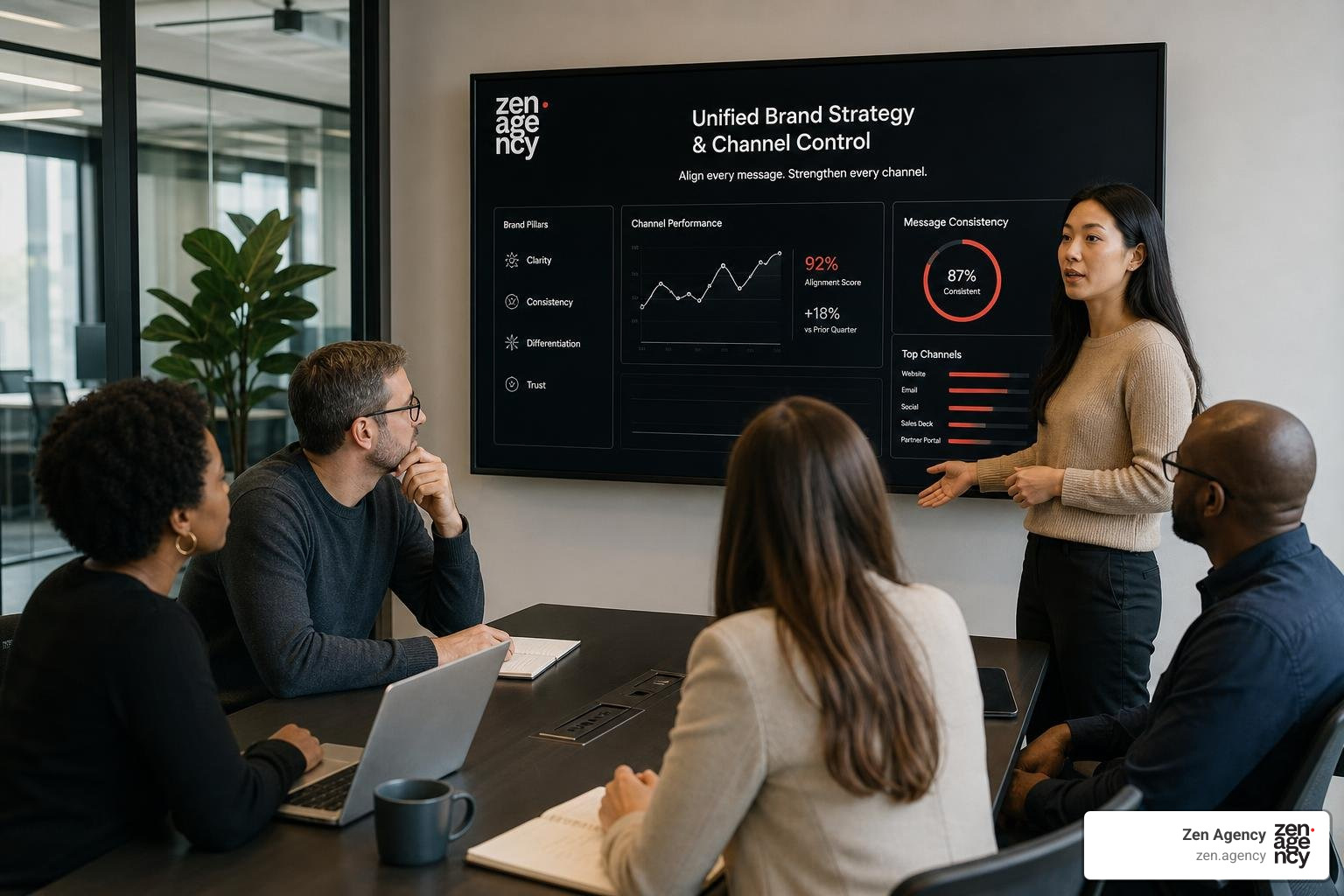
At Zen Agency, we specialize in delivering enterprise-grade brand strategy, custom web development, and digital marketing solutions designed specifically for businesses looking to scale efficiently. From our offices in Pennsylvania and Montana, we help companies across the USA eliminate message drift, reclaim marketplace control, and maximize their ROI.
Ready to build a well-aligned brand that supports scalable growth? Partner with Zen Agency for Enterprise-Grade Branding Services and let’s start a conversation today.