Branding and Promotion: The Ultimate Marketing Marriage
Branding and Promotion: The Ultimate Marketing Marriage
Why Branding and Promotion Belong Together in Your Marketing Strategy
Branding and promotion are two of the most important forces in marketing — but most businesses treat them as the same thing, and that confusion costs real money.
Here’s the quick answer:
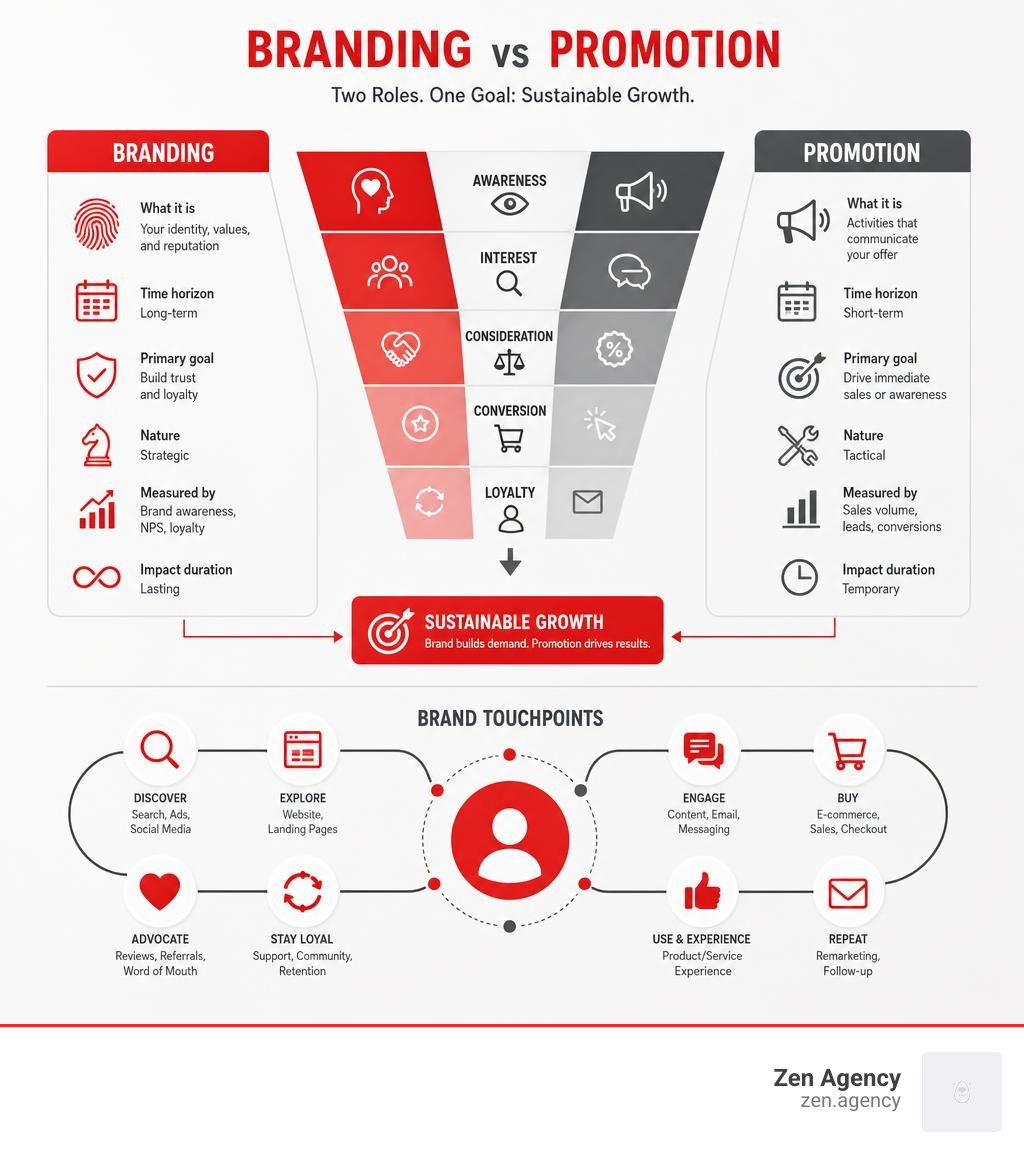
| Branding | Promotion | |
|---|---|---|
| What it is | Your identity, values, and reputation | Activities that communicate your offer |
| Time horizon | Long-term | Short-term |
| Primary goal | Build trust and loyalty | Drive immediate sales or awareness |
| Nature | Strategic | Tactical |
| Measured by | Brand awareness, NPS, loyalty | Sales volume, leads, conversions |
| Impact duration | Lasting | Temporary |
Think of it this way: branding is who you are, and promotion is how you tell people about it.
A strong brand makes every promotional campaign work harder. Promotions without a brand behind them are just noise — easy to ignore and impossible to remember. Research backs this up: consistent brand presentation alone can increase revenue by up to 33%, and the world’s most valuable brands have outperformed major stock indexes over 20 years.
I’m Joseph Riviello, CEO and Founder of Zen Agency, and over my 22+ years in digital marketing I’ve helped companies of all sizes untangle exactly this problem — building the brand foundation that makes branding and promotion work as a unified system rather than two disconnected budgets. In the sections below, we’ll break down how each one works, where they overlap, and how to use both to grow.
Branding and promotion terms at a glance:
Decoding Branding and Promotion: The Core Differences
To run a highly profitable business in 2026, you cannot afford to confuse strategic planning with tactical execution.
Think of your business as a ship. Branding is the design, structural integrity, and destination of the vessel. Promotion is the fuel, the sails, and the megaphone used to tell people at the dock to climb aboard. If you try to promote a business that has no clear brand identity, you are essentially pouring expensive fuel into a ship that has a massive leak and no captain.
The core difference lies in their fundamental nature:
- Branding is strategic. It is the deliberate, ongoing work of defining who your business is for, what you promise, and how you look and sound. It establishes the internal compass that guides every single business decision.
- Promotion is tactical. It is execution-focused. It involves the direct, active communication channels—such as social media ads, seasonal discounts, email blasts, and public relations—designed to grab attention and drive action.
To help visualize this division of labor, let’s look at how these elements stack up across eight distinct business dimensions:
| Dimension | Branding | Promotion |
|---|---|---|
| Primary Focus | Shaping perception and building relationships | Driving immediate action and transactions |
| Timeframe | Long-term and continuous | Short-term and campaign-based |
| Nature | Strategic, foundational, and internal-facing | Tactical, execution-focused, and external-facing |
| Core Goals | Customer loyalty, emotional connection, equity | Lead generation, immediate sales, product awareness |
| Time Horizon | Years and decades | Days, weeks, or months |
| Approach | Pull (attracting customers via shared values) | Push (driving offers to audiences via channels) |
| Measurement | NPS, brand recall, sentiment, branded search | Conversions, click-through rates, revenue spikes |
| Duration of Impact | Permanent (accumulates over time) | Temporary (fades once the campaign budget stops) |
Understanding this difference is the secret to building a highly valuable asset. If you want to dive deeper into how to define your business’s unique voice and visual guidelines before launching your next push, explore our comprehensive guide on how to build a custom identity design.
What is Branding?
Branding is the emotional, psychological, and visual anchor of your company. It is not just a fancy logo or a pretty color palette. A brand is the specific position your business occupies in your customer’s mind.
At its core, branding is about deliberate pairing. Every time a customer interacts with your business, they associate that experience with an outcome. Good branding occurs when you consistently pair your business with positive experiences, high quality, and shared values. When you do this repeatedly, those positive associations accumulate like compound interest.
Consider this: a 2025 Edelman report found that trust in a brand is now equal to value and quality in a customer’s purchasing decision. In fact, 80% of people say they trust the brands they actively use—which is higher than the percentage of people who trust media, government, NGOs, or even their own employers.
Furthermore, brand trust has a massive financial payoff: it influences 68% of customers to pay a premium price for products. When customers trust your brand, they stop price-shopping you against three local competitors. Instead, they choose you because of who you are.
To build this kind of emotional connection, you must establish a clear brand identity. This includes your:
- Mission and Values: Why do you exist beyond making money?
- Brand Voice and Tone: How do you speak to your audience? Are you authoritative, rebellious, or warm and reassuring?
- Visual Assets: Your logo, typography, and color palette.
- Brand Promise: What is the consistent experience you guarantee to every customer?
If you are starting from square one, you can learn the exact steps to establish these foundations in this guide on how to build a brand from scratch.
What is Promotion?
If branding is the “who” and the “why,” promotion is the “how” and the “now.”
Promotion refers to the active marketing communication activities that put your brand, products, or services in front of your target audience. Its primary goal is to generate short-term sales, immediate revenue, and rapid audience awareness.
Without promotion, your brilliant brand remains a well-kept secret. Promotion is the engine that drives the customer journey forward by creating immediate touchpoints. The average consumer needs to see a company’s message more than five times before it becomes ingrained in their thoughts. Promotional campaigns provide those repeated exposures.
Tactical promotional activities include:
- Paid Advertising: Google Ads, social media campaigns, and local print media.
- Sales Promotions: Limited-time discounts, “buy one, get one” offers, and seasonal sales.
- Public Relations & Sponsorships: Press releases, community event sponsorships, and charity partnerships.
- Direct Marketing: Highly targeted email campaigns, SMS marketing, and personalized mailers.
- Physical Promotion: Fleet vehicle wraps, branded apparel, and promotional giveaway items.
While branding acts as a pull strategy—drawing people in because they align with your identity—promotion is a push strategy. It actively places an offer in front of a consumer to prompt an immediate transaction. However, promotion is temporary. The moment you stop funding your ad campaigns or end your seasonal sale, the immediate influx of leads will dry up. That is why it must be supported by a lasting brand.
How Branding and Promotion Work Together in Harmony
When branding and promotion are perfectly aligned, they create a self-reinforcing growth loop.
Promotion introduces your business to new audiences, driving traffic and immediate sales. Once those customers enter your ecosystem, your branding takes over. The exceptional customer experience, the consistent visual identity, and the clear brand values turn those one-time buyers into loyal brand advocates.

This integrated marketing strategy ensures that every dollar you spend on short-term promotions yields a long-term return. When your promotional messages match your actual brand experience, you build deep brand trust.
To see how to structure this long-term relationship step-by-step, take a look at our playbook on how to build a brand that lasts.
Integrating Branding and Promotion for Long-Term Growth
To achieve sustainable, highly profitable business growth, you must balance your marketing budget between long-term brand building and short-term promotional campaigns.
A strong brand identity directly gives your business pricing power. When you have successfully communicated your unique value proposition, you reduce the price elasticity of your demand. This means your customers become less sensitive to price increases because they trust your brand’s quality and values.
In fact, 79% of shoppers state they are more likely to purchase from brands whose values align with their own, and 64% of customers buy, choose, or avoid brands based entirely on their beliefs about what is happening in society.
When you integrate branding into your promotions, you aren’t just selling a commodity; you are selling an identity. For example, instead of running a generic promotional ad that says “Buy our widgets for 10% off,” an integrated campaign might say, “Join our mission to reduce plastic waste—get our eco-friendly, lifetime-guaranteed widget today.”
By shifting the conversation from price to values, you build customer loyalty that survives long after the discount ends. If you want to learn how modern hypergrowth brands are executing this balance, check out these expert insights on how to grow your brand in 2026.
Common Mistakes When Confusing Branding and Promotion
The most common mistake we see businesses make is treating a promotional campaign as a substitute for a brand strategy. This confusion leads to several critical business traps:
- The Commodity Trap: If you only promote discounts and low prices, you teach your audience to value you only for your cheapness. You become a commodity, forced to compete in a race to the bottom against massive corporations.
- Starting with the Logo: Many business owners think “branding” just means hiring a cheap designer to make a logo. A logo without an underlying brand strategy is just decoration. It does not communicate a promise, define an audience, or establish a voice.
- Extreme Short-Termism: Relying solely on short-term promotional ads creates a highly unstable business model. Your revenue spikes when you run ads, but plummets the second you turn them off because you haven’t built any organic brand equity.
- Brand Dilution and Customer Friction: If your promotions do not align with your brand voice, you create friction. For example, if a high-end, luxury spa starts blasting aggressive, spammy, discount-heavy text messages, it completely erodes their premium brand image.
Strategic Execution: Channels, Metrics, and Scale
Executing an integrated branding and promotion strategy requires selecting the right channels for your business scale and geographic footprint.
In 2026, digital media platforms are highly democratized. Polished visuals are now the bare minimum. To stand out, businesses must focus on creating a consistent pattern of positive encounters across every single touchpoint—whether that is a social media video, a local search listing, or a physical interaction.
For service-based and trade businesses operating in our local regions—such as Scranton, Wilkes-Barre, Wyoming PA, or Billings MT—physical brand touchpoints are incredibly powerful.
One of the most effective, high-yield brand promotion methods is professional fleet branding. According to the Outdoor Advertising Association of America, a single wrapped commercial vehicle can generate 30,000 to 70,000 impressions per day.
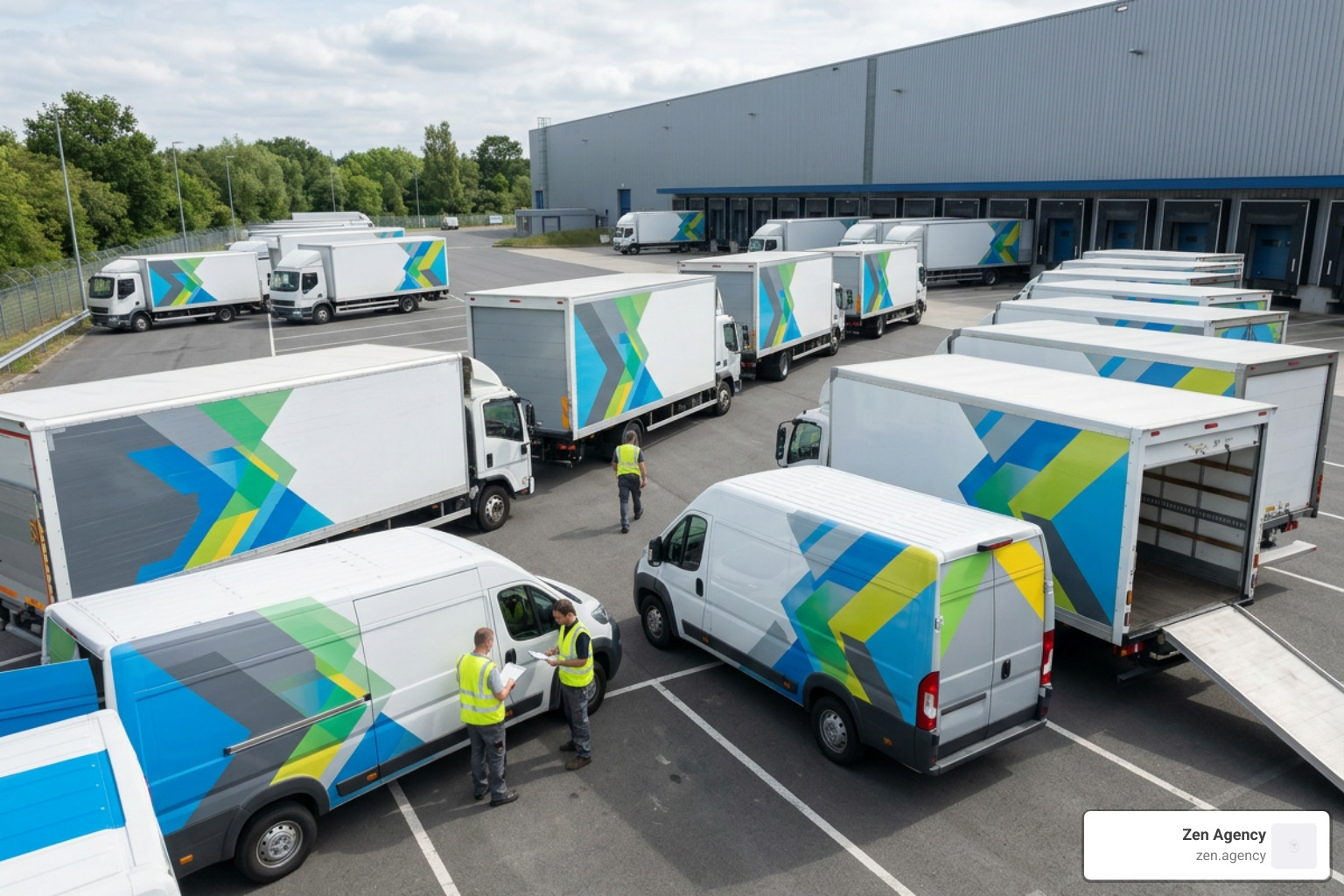
When a beautifully wrapped service truck drives down Interstate 81 in Pennsylvania or through the streets of Billings, Montana, it acts as a moving billboard. If that wrap is designed with a consistent, professional brand identity, it builds rapid local familiarity and trust.
To find the right partners to help you execute these multi-channel campaigns, review our curated resource on the ultimate list of brand promotion companies.
Small Business vs. Corporate Approaches
Small businesses cannot—and should not—approach branding and promotion the same way large corporations do.
Enterprise brands have the luxury of spending millions on “pure” brand awareness campaigns with no immediate call to action. Small businesses, operating under tighter resource constraints, must make their branding dollars work double-time.
For a small business in Pennsylvania or Montana, your brand strategy must be highly focused. You should:
- Define a Hyper-Specific Unique Selling Proposition (USP): Do not try to be everything to everyone. Find the empty quadrant in your local market. If your competitors are slow but cheap, build your brand on being the fastest, most reliable service in town.
- Leverage Agile Channels: Use low-cost, high-flexibility digital channels like highly targeted local social media ads, search engine optimization (SEO), and personalized email marketing to promote your brand.
- Focus on Culture and Authenticity: 73% of consumers say their trust in a brand increases when it authentically reflects today’s culture. Small businesses have a massive advantage here—you can react quickly, show real behind-the-scenes human stories, and build genuine community connections that corporate giants can only dream of.
To master these growth-stage brand strategies, you can study the brand strategy playbook designed specifically for growth leaders.
Measuring Success: Metrics for Both Worlds
Because branding and promotion have different goals, they must be measured using entirely different key performance indicators (KPIs).
If you try to measure your long-term branding efforts using short-term promotional metrics (like immediate conversion rates), you will mistakenly conclude that your branding isn’t working. Conversely, if you only track brand metrics, you won’t know if your business is generating enough immediate cash flow to survive.
Here is how to measure both sides of the coin:
Branding Metrics (The Long Game)
- Net Promoter Score (NPS): Measures customer loyalty and their likelihood to recommend your business to others.
- Branded Search Volume: How many people are typing your exact business name into Google? This is the most objective measure of brand awareness.
- Customer Lifetime Value (CLV): The total revenue a single customer generates over their entire relationship with your business.
- Sentiment Analysis: Monitoring social media and local review platforms to see if customer mentions are overwhelmingly positive, neutral, or negative.
Promotional Metrics (The Short Game)
- Conversion Rates: The percentage of ad clickers or website visitors who take a specific action (like calling for an estimate or buying a product).
- Cost Per Lead (CPL) / Cost Per Acquisition (CPA): Exactly how much marketing spend is required to generate one new lead or customer.
- Return on Ad Spend (ROAS): The direct revenue generated divided by the budget spent on a specific ad campaign.
- Sales Volume Spikes: Immediate increases in sales during a specific promotional period or holiday discount event.
Balancing these metrics requires a team that understands how digital systems connect. To understand why having a dedicated partner matters, read our analysis on why your business needs a digital branding agency.
Frequently Asked Questions
What is the main difference between branding and promotion?
The main difference is their time horizon and strategic focus. Branding is a long-term, continuous strategy focused on building your business’s identity, values, reputation, and customer trust. Promotion consists of short-term, tactical marketing activities (like ads, discounts, and campaigns) designed to drive immediate transactional goals, such as sales and lead generation.
Can a business succeed with promotion but no branding?
Only in the very short term, and usually at a high cost. Without a strong brand, your business falls into the “commodity trap,” where you must constantly compete on price, eroding your profit margins. You will suffer from low customer retention, high customer acquisition costs, and extreme vulnerability to competitors who build actual brand loyalty.
How often should a business refresh its branding and promotion strategies?
Promotional strategies should be reviewed and optimized weekly or monthly based on campaign performance and seasonal lifecycles. Branding strategies, however, are built to last. You should conduct a brand audit every 5 to 7 years, or when you experience major market shifts, strategic drift, or a significant merger. A brand refresh modernizes your visuals while keeping your core identity intact, whereas a full rebrand completely overhauls your strategy from the ground up.
Conclusion
At the end of the day, branding and promotion are not competing philosophies. They are two halves of the same growth engine.
Promotion gets your business on the radar, driving the immediate visibility and cash flow you need to thrive today. Branding ensures that once customers find you, they stay with you, building the long-term loyalty, pricing power, and organic reputation you need to scale tomorrow.
At Zen Agency, we have been helping businesses across Pennsylvania, Montana, and the United States bridge this gap since 2008. We don’t just design beautiful logos or run isolated ad campaigns. We build enterprise-grade, integrated digital marketing and branding strategies that work in perfect harmony to increase your visibility, profitability, and long-term ROI.
Are you ready to stop wasting money on disconnected marketing tactics and build a brand that makes every promotion work harder? Partner with Zen Agency for professional branding and graphic design services.