Unlocking PPC Success: A Guide to Effective Keyword Research
Unlocking PPC Success: A Guide to Effective Keyword Research
The Foundation: Understanding Keyword Research PPC
Keyword research PPC is the process of finding the right words and phrases people type into search engines like Google when they’re looking for products or services like yours. It’s about knowing exactly what your potential customers are searching for.
This isn’t just a basic step. It’s the backbone of any successful paid advertising campaign. It determines if your ads reach the right people at the right time.
Why is PPC keyword research so important?
- It increases your return on investment (ROI).
- It reduces wasted ad spend on irrelevant clicks.
- It helps you create ads that truly connect with your audience.
- It can lower your ad costs by improving your Quality Score.
Without solid keyword research, your ads might show up for the wrong searches. Or they might not show up at all. This guide will show you how to master this crucial skill. You’ll learn to find high-value keywords and build campaigns that deliver real results.
I’m Joseph Riviello, CEO and Founder of Zen Agency™. With over two decades in digital marketing, I’ve seen how crucial effective Keyword research PPC is for scaling businesses and driving profitability. My passion is to help companies achieve exceptional online presence and revenue through smart, holistic strategies.
Now, let’s dive into the core concepts.
Easy Keyword research PPC glossary:
The Fundamentals of Keyword Research PPC
When we talk about Keyword research PPC, we are looking for the “treasure map” that leads directly to a sale. Unlike organic search, where you might be happy with someone just reading your blog, in PPC, every click costs money. We want those clicks to count.
PPC vs. SEO Keyword Research
While they share some DNA, the goals of PPC and SEO keyword research are quite different. SEO is a marathon; it focuses on long-term visibility and often targets informational queries. PPC is a sprint; it prioritizes commercial intent and immediate traffic.
| Feature | PPC Keyword Research | SEO Keyword Research |
|---|---|---|
| Primary Goal | Immediate conversions and ROI | Long-term organic visibility |
| Intent Focus | High commercial/transactional intent | Informational and educational intent |
| Cost | Pay-per-click (direct cost) | Time and resource investment |
| Speed of Results | Instant (as soon as the ad is live) | Months to see significant movement |
| Control | High control over landing pages/ads | Limited control over SERP appearance |
The Power of Commercial Intent
In PPC, we are hunting for “buyer keywords.” For example, if you run a plumbing business in Scranton or Wilkes-Barre, the keyword “how to fix a leaky faucet” is great for a blog post (SEO). However, “emergency plumber near me” is what you want to bid on for PPC. That searcher has a problem and is ready to pay for a solution right now.
Quality Score and ROI
Google doesn’t just show the ad of the highest bidder. They want to show the most relevant ad. This is where Quality Scores and ROI come into play. A high Quality Score—determined by your ad’s relevance to the keyword and the quality of your landing page—can actually lower your cost-per-click (CPC).
According to Statista, the average CPC in the United States is $1.05. By focusing on highly relevant keywords, we can maximize budget efficiency and ensure we aren’t overpaying for traffic.
Essential Tools for High-Intent Keyword Discovery
To find the best keywords, we need the right tools. While our brains are the best at understanding human nuance, these tools provide the data we need to back up our gut feelings.
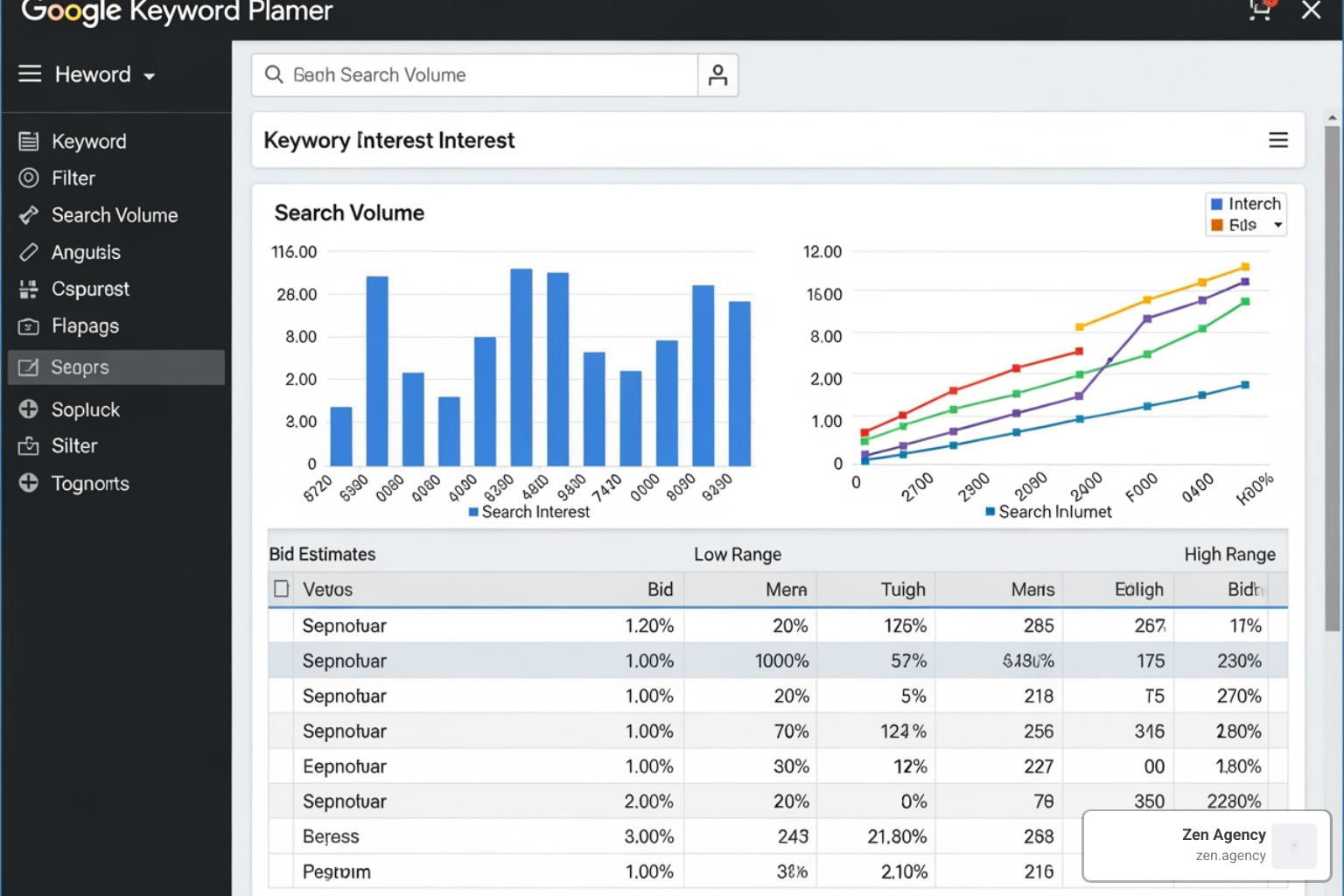
- Google Ads Keyword Planner: This is the gold standard for starting out. It’s a free tool that provides search volume, trends, and bid estimates. When you begin, Google Ads Keyword Planner helps you cast a wide net to see what’s possible.
- Semrush: This is a powerhouse for “Keyword Magic.” It allows us to see billions of related terms and niche topics. It’s particularly useful for identifying “question” keywords that can be used for specific ad groups.
- SpyFu: Ever wonder what your neighbors in Billings, MT, are bidding on? SpyFu allows you to “spy” on competitor keywords. You can see which terms they’ve bid on consistently over the years, which usually indicates those terms are profitable.
- Ahrefs: While often thought of as an SEO tool, Ahrefs is incredible for analyzing the “keyword difficulty” and seeing the exact search queries that trigger competitor ads.
- Keywords Everywhere: This is a handy browser extension that shows you search volume and CPC data right on the Google search results page.
- Soovle and Other Discovery Tools: If you’re feeling stuck, tools like Soovle are fantastic for generating long-tail variations and seeing what people are searching for across different platforms like Amazon or YouTube.
Automation tools are also becoming essential. They can help handle bidding automatically and alert us when a high-value keyword starts trending, saving hours of manual labor.
A Step-by-Step Process for Keyword Research PPC
Success in PPC isn’t about bidding on a thousand random words. It’s about a structured process. Here is how we approach it at Zen Agency.
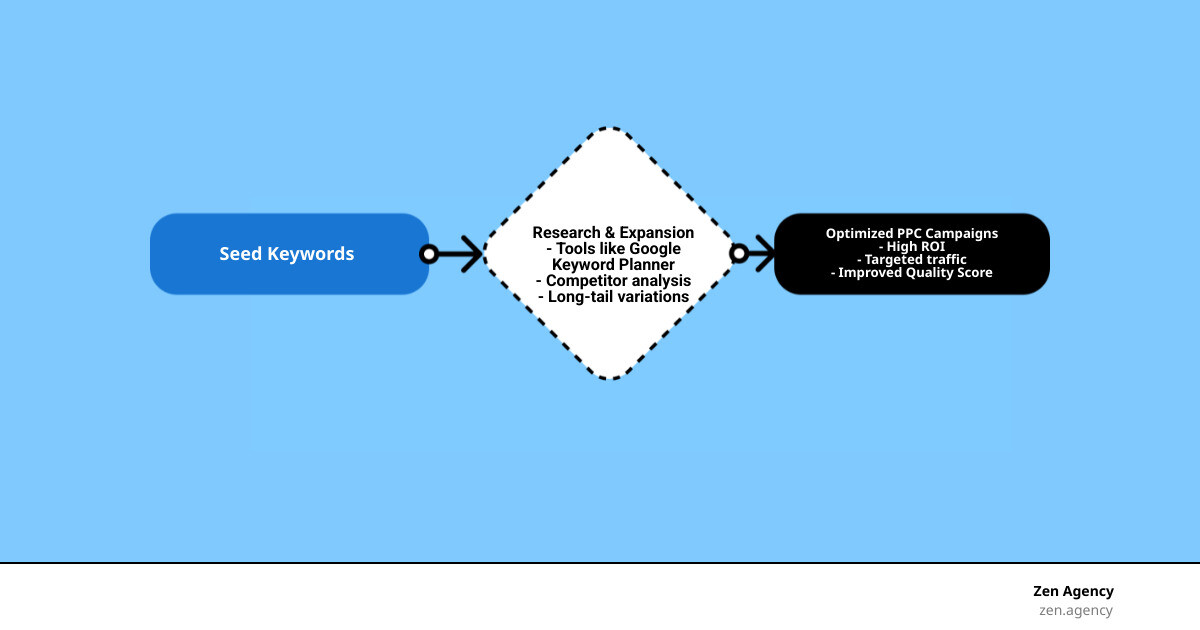
1. Brainstorming Seed Keywords
We start by thinking like the customer. If you were looking for custom web development in Wyoming, PA, what would you type? We list out the core products, the problems they solve, and the brand names. These are our “seed keywords.”
2. Expanding the List
Once we have our seeds, we use tools to grow the list. A great technique is “concatenation.” This involves merging columns of words to create every possible variation. For example:
- Column A: “Buy”, “Cheap”, “Best”
- Column B: “Running Shoes”, “Sneakers”, “Athletic Footwear”
- Result: “Buy Running Shoes”, “Best Sneakers”, etc.
Tools like mergewords make this incredibly fast. You can also use simple Excel formulas to build these lists.
3. Filtering by Search Intent
Not all keywords are created equal. We must filter the list to ensure we are understanding search intent correctly. Research shows that 37% of PPC specialists struggle with identifying the true intent behind a keyword. We categorize keywords into the stages of the buyer journey:
- Informational: “What is a CRM?” (Low conversion probability)
- Commercial Investigation: “Best CRM for small business” (Medium probability)
- Transactional: “Buy CRM software online” (High probability)
Prioritizing High-Intent Terms
We always prioritize transactional queries. These are the “bottom-of-the-funnel” terms. We also look for product-specific terms (e.g., “iPhone 15 Pro Max 256GB”) and long-tail keywords. Long-tail keywords (phrases with 3+ words) often have lower search volume but much higher conversion rates because they are so specific.
Leveraging AI in Keyword Research PPC
AI has changed the game. In fact, 88% of PPC specialists now use AI tools like ChatGPT in their research. We use AI to:
- Generate long-tail keyword ideas we might have missed.
- Cluster search terms into logical themes.
- Perform predictive analysis on which terms might trend next.
While AI is a powerful assistant, we always review its suggestions. About 38% of specialists report that keyword tools (including AI) sometimes provide irrelevant or overly broad suggestions. Human oversight is still the “secret sauce.”
Advanced Strategies: Match Types and Negative Keywords
Once you have your keywords, you need to tell Google exactly how to use them. This is done through “match types.”
Understanding Match Types
- Broad Match: This is the default. Your ad might show for searches that are related to your keyword. It offers the widest reach but can lead to wasted spend if not monitored closely.
- Phrase Match: Your ad shows for searches that include the meaning of your keyword. It’s more targeted than broad match.
- Exact Match: This gives you the most control. Your ad only shows for searches that have the same meaning or intent as your keyword.
It is vital to Assign a match type to each keyword to control your budget. Many experts warn that overusing broad match can be a major mistake for accounts with smaller budgets.
The Power of Negative Keywords
Negative keywords are the unsung heroes of PPC. These are words you don’t want to show up for. For example, if you sell “luxury watches,” you should add “free,” “cheap,” and “repair” as negative keywords.
Why? Because someone searching for a “free luxury watch” is not your customer. By using negative keyword lists, you prevent wasted ad spend and keep your CTR (click-through rate) high. We recommend reviewing your search terms report weekly to find new negatives to add.
Organizing Keywords into Ad Groups
Organization is everything. We prefer using Single Theme Ad Groups (STAGs). This is a method where you group a small number of very closely related keywords (usually 10-20) into one ad group.
About 40% of PPC specialists prefer STAGs because they allow for incredible “message match.” If someone searches for “summer dresses,” they see an ad about “summer dresses” and land on a page full of… you guessed it… summer dresses. This relevance leads to higher Quality Scores and better conversion rates.
Frequently Asked Questions about PPC Keywords
What is the difference between PPC and SEO keywords?
The main difference is intent and speed. Keyword research PPC focuses on commercial intent—people ready to buy right now. SEO keywords often target informational queries to build brand authority over time. Also, you pay for every PPC click, whereas organic SEO clicks are “free” (though the labor to get them isn’t!).
How often should I conduct PPC keyword research?
It’s not a “set it and forget it” task. Statistics show that 57% of specialists conduct keyword research weekly, while 38% do it monthly. Continuous monitoring is essential to catch new trends, adjust for seasonality (like the winter rush in Montana), and spot new competitor moves.
Why are negative keywords so important?
They act as your campaign’s “bodyguards.” They block irrelevant traffic that would otherwise eat up your budget. By filtering out non-buyers, you improve your ROI and ensure your ads are only shown to qualified leads.
Conclusion: Partnering for PPC Success
At Zen Agency, we know that running a successful PPC campaign is both an art and a science. Since 2008, we’ve been providing enterprise-grade solutions to businesses that are struggling to scale. Whether you are in Scranton, Wilkes-Barre, or Billings, our goal is the same: to increase your visibility and ROI through innovative strategies.
Effective Keyword research PPC is the first step toward that growth. It requires a deep understanding of your audience, a strategic use of tools, and constant optimization. We don’t just care about the click; we care about what happens after the click.
If you’re ready to stop wasting ad spend and start driving real revenue, we’re here to help. Our team specializes in custom digital marketing strategies that turn search data into business success.
Ready to take your campaigns to the next level? Explore our Expert PPC Management Services and let’s start building your path to profitability today.