What Effective Copywriting for Healthcare Actually Looks Like in Practice
What Effective Copywriting for Healthcare Looks Like in Practice
Effective copywriting for healthcare translates complex clinical science into clear, empathetic, and persuasive messaging that drives patient and provider action while maintaining strict regulatory compliance.
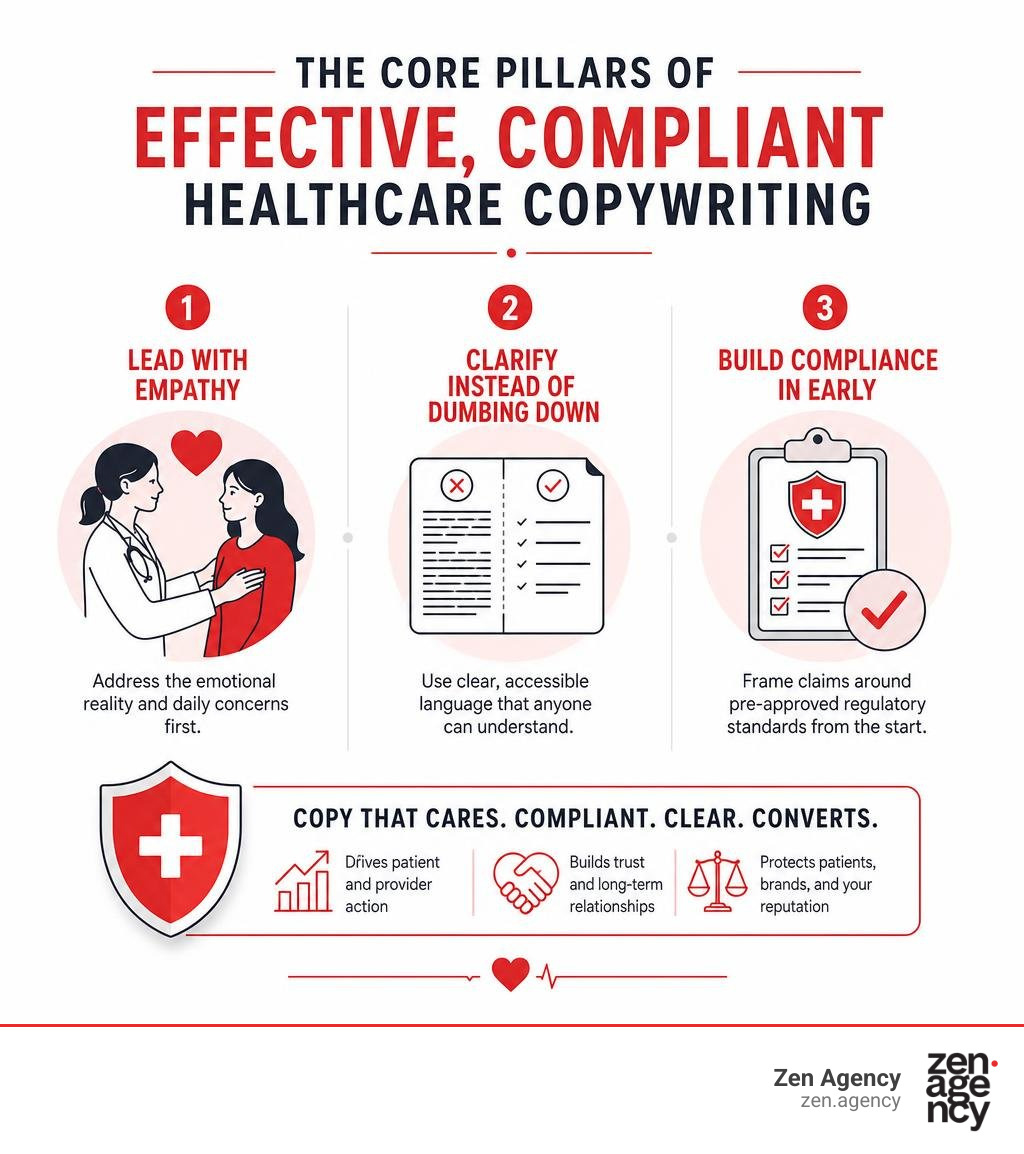
To turn complex medical offers into high-performing digital assets, follow these three core principles:
- Lead with empathy: Address the specific emotional reality and daily concerns of the patient or provider before introducing technical features.
- Clarify instead of dumbing down: Replace dense corporate jargon and acronyms with plain, accessible language that anyone can understand.
- Build compliance in early: Frame claims around pre-approved regulatory standards from the start rather than retroactively editing out the human voice during legal review.
When executed properly, emotionally engaging healthcare copy delivers up to a 47% increase in conversion rates, improves brand recognition by 68%, and yields an average 5.2x return on marketing investment.
I’m Joseph Riviello, CEO and Founder of Zen Agency, with over 22 years of experience helping companies scale revenue and market share through holistic digital marketing and strategic copywriting for healthcare. Below, we will break down the frameworks and actionable steps you need to transform your medical messaging into a measurable growth engine.
What Sets Copywriting for Healthcare Apart from Traditional Marketing
Marketing a medical practice, healthtech platform, or wellness product is nothing like selling consumer electronics or software. In healthcare, the stakes involve personal well-being, clinical safety, and significant regulatory oversight. Search engines treat healthcare content under strict Your Money or Your Life (YMYL) guidelines, requiring demonstrated Experience, Expertise, Authoritativeness, and Trustworthiness (E-E-A-T).
Healthcare marketing operates within tight guardrails established by regulatory bodies like the Food and Drug Administration (FDA), Federal Trade Commission (FTC), and the Health Insurance Portability and Accountability Act (HIPAA). Every claim must be substantiated with clinical evidence, and sensitive patient communication requires deep emotional nuance.
To navigate these demands, organizations must understand how commercial healthcare communication differs from standard scientific writing and how to properly align their strategic messaging. Organizations often explore distinct career pathways and competencies to identify whether their immediate need is technical documentation or commercial conversion writing.
Medical Writing vs. Copywriting for Healthcare
A common point of confusion is the distinction between medical writing and medical copywriting. While both require scientific literacy, their core objectives, audiences, and deliverables are fundamentally different.
Medical writing focuses on objective, technical, and regulatory documentation. It involves drafting clinical trial protocols, investigator brochures, regulatory dossiers, and peer-reviewed research papers where the goal is educational and regulatory compliance without promotional bias. In contrast, copywriting for healthcare focuses on persuasion, user engagement, and measurable action. It translates clinical evidence into benefit-driven language across landing pages, ad funnels, emails, and patient portals to encourage behaviors like scheduling an exam, adopting a digital health tool, or requesting a consultation.
| Dimension | Medical Writing | Copywriting for Healthcare |
|---|---|---|
| Primary Objective | Impartial documentation and regulatory compliance | Audience engagement, education, and conversion |
| Tone & Style | Academic, technical, and strictly neutral | Empathetic, conversational, and persuasive |
| Target Audience | Regulators, researchers, and clinical investigators | Patients, caregivers, clinicians, and hospital buyers |
| Core Deliverables | Clinical study reports, CSRs, and journal manuscripts | Web pages, email funnels, paid ads, and sales enablement decks |
| Call to Action (CTA) | None (purely informational) | Clear, specific, and conversion-focused |
Balancing Clinical Accuracy with Patient Empathy
Patients seeking medical information are frequently stressed, anxious, or overwhelmed. Presenting them with cold, clinical terminology creates emotional distance and increases bounce rates. Conversely, relying on overly emotional, unverified wellness fluff destroys clinical credibility.
The solution is a balanced tone known as “informed warmth.” Think of this as the digital equivalent of an excellent bedside manner: compassionate, accessible, and grounded in clinical authority. By pairing verified medical facts with empathetic messaging, brands build lasting credibility. Clear, consistent messaging not only improves brand recognition by 68% but also reassures prospective patients that they are in safe hands. If your broader branding strategy needs an overhaul to reflect this balance, our guide on how to build a brand that lasts provides actionable steps for establishing long-term trust.
Overcoming the Core Traps in Healthcare Messaging

Healthcare organizations frequently fall into predictable organizational traps that strip personality, engagement, and persuasive power from their marketing assets. This often leaves marketing teams with copy that sounds like it was drafted by an anxious committee on a dreary afternoon. Overcoming these hurdles is essential to capturing the 5.2x return on marketing investment that persuasive, high-performing copy delivers.
Navigating the Compliance Reflex Without Diluting Humanity
The “Compliance Reflex” occurs when teams, out of fear of regulatory penalties, preemptively strip all conversational energy from their copy before legal teams even review it. This results in hyper-qualified, passive-voice corporate padding that bores readers.
The fix is proactive compliance: writing the necessary regulatory standards directly into the creative concept from day one. Treat regulatory boundaries like poetic constraints—parameters that focus your message rather than destroy it. When copywriters understand pre-approved structure-function language and Medical, Legal, and Regulatory (MLR) rules upfront, they can craft clear, plain-language copy that glides through legal review while preserving its human voice.

Breaking the Expertise Curse and Translating Jargon
The “Expertise Curse” occurs when clinicians, scientists, and product developers become so immersed in their specialized knowledge that they forget what it feels like to be an outsider. They lead with hardware specs, biochemical pathways, or operational jargon rather than direct benefits.
To break this curse, apply the “So What?” Ladder:
- Feature: “Our diagnostic platform features an AI-driven predictive algorithm with 99.2% sensitivity.”
- So what? “It catches subtle anomalies earlier during routine imaging reviews.”
- So what? “Clinicians spend less time double-checking scans and reduce diagnostic errors.”
- Human Benefit: “You get faster, highly accurate diagnoses, giving your patients answers when days matter most.”
Aligning Stakeholder Reviews with a Single Source of Truth
The “Stakeholder Scramble” is a major workflow bottleneck in healthcare organizations. A draft is routed through clinical leads, legal counsel, regulatory directors, product managers, and executive leadership. Each stakeholder inserts revisions, adds qualifiers, and dilutes the voice until the final product reads like an annual compliance report.
To solve this, develop a One-Page Messaging Guide before writing a single line of copy. This document defines:
- The target persona and their primary emotional driver.
- The single key takeaway of the campaign.
- Voice attributes with explicit “We Are / We Are Not” guardrails (e.g., “We are authoritative, but we are not clinical or detached”).
- Pre-approved claim parameters and required substantiation references.
By establishing this framework early, subjective internal edits transform into objective evaluations aligned with pre-agreed standards. For teams managing multiple product lines or complex corporate structures, mastering the ultimate guide to brand alignment consulting can help streamline multi-channel messaging and governance.
Strategic Nuances Across HealthTech, Supplements, and B2B Sectors

Different healthcare sectors demand tailored messaging frameworks. Whether you are selling digital health software, nutraceuticals, or hospital enterprise systems, your direct-response approach must reflect your audience’s unique decision-making environment. If you want to explore crafting human-centered copy across specialized markets, explore our bespoke copywriting services for non-boring content.
HealthTech and AI-Driven Medical Solutions
In healthtech, products are often revolutionary, but the marketing is bogged down by buzzwords like “paradigm-shifting AI platform” and “synergistic health workflows.”
When writing for healthtech buyers:
- Focus on workflow relief: Frame clinical AI not as speculative technology, but as a reliable tool that reduces administrative burden and physician burnout.
- Quantify clinical utility: Highlight tangible outcomes, such as decreasing door-to-provider time, cutting charting hours, or speeding up payer denial overturns.
- Maintain human authenticity: Avoid generic AI-generated marketing tropes that feel detached from actual patient care.
Supplements and Nutraceuticals: The Informed Warmth Framework
Nutraceutical copy operates under strict FDA and FTC guidelines that prohibit claiming a product can diagnose, treat, cure, or prevent any disease. Marketing teams often struggle here, either defaulting to dry biochemistry lectures or ungrounded wellness hype.
The key is combining pre-approved structure-function claims with consumer empathy:
- Acknowledge the consumer’s emotional reality: Speak to everyday wellness goals, morning energy levels, or the peace of mind that comes with regular lab check-ups.
- Use approved functional language: Frame benefits around supporting natural physiological processes (e.g., “supports cardiovascular health” rather than “lowers cholesterol”).
- Adopt an accessible, educational voice: Present ingredients like an approachable, knowledgeable local pharmacist who explains how each nutrient works in plain English.
B2B Hospital Procurement and Healthcare Professional Messaging
Hospital procurement teams and clinicians evaluate purchases with extreme scrutiny. They must weigh clinical efficacy against budgetary constraints, risk mitigation, and operational implementation.
To convert B2B healthcare decision-makers:
- Align clinical metrics with financial outcomes: Show how reducing patient length of stay or readmission rates directly recaptures revenue and prevents payer penalties.
- Embed proactive objection-handling: Address integration friction, Electronic Health Record (EHR) compatibility, staff onboarding timelines, and data security up front.
- Respect clinical time: Keep B2B healthcare copy concise, skimmable, and directly linked to published, peer-reviewed clinical studies.
Five Practical Steps to Improve Your Healthcare Copy This Week
Transforming your healthcare marketing does not require a six-month brand overhaul. You can make immediate, high-impact improvements to your current website and collateral using these practical audit steps.
1. The Read-Aloud and Acronym Audit
Read your primary web pages out loud. If a sentence makes you run out of breath, sounds overly formal, or resembles a legal disclaimer, rewrite it to sound like a conversation with an intelligent friend. Next, scan your first two paragraphs: if you have more than two unexplained clinical acronyms, eliminate or define them immediately.
2. Retiring Corporate Jargon and Vague Buzzwords
Search your website copy for the word “solutions.” In almost every instance, it acts as lazy corporate filler that obscures what your product or service actually does. Replace phrases like “innovative patient-care solutions” with precise descriptions of your service: “in-home physical therapy for post-surgical recovery.”
3. Applying the “Non-Expert Comprehension Test”
Take your core value proposition or a key case study and give it to someone completely outside the healthcare sector—such as a friend or family member. Ask them to explain what you sell and why it matters in their own words. If they struggle to identify the practical benefit within 30 seconds, your messaging is buried beneath clinical weeds.
4. Shifting Social and Content Focus to Problem-Solving
Audit your recent social media posts, email newsletters, and blog articles. If more than 30% of your content focuses on internal corporate announcements, award nominations, or executive hires, flip the ratio. Dedicate 80% of your content calendar to answering specific patient questions, addressing clinical pain points, and breaking down complex health topics into actionable advice.
5. Executing High-Impact Copywriting for Healthcare on Digital Channels
Structure your digital marketing assets to guide prospective patients and buyers naturally through the awareness-to-action funnel. Pair search-optimized informational content with dedicated direct-response landing pages and automated lifecycle email sequences. For medical practices and B2B health firms looking to accelerate pipeline growth, combining clear copy with proven appointment setting lead generation strategies ensures qualified prospects smoothly convert into scheduled consultations.
Frequently Asked Questions About Healthcare Copywriting
How do healthcare copywriters handle strict regulatory reviews without sounding robotic?
Successful copywriters collaborate with Medical, Legal, and Regulatory (MLR) teams before drafting copy. By identifying approved claim parameters and necessary substantiation early, writers build compliance directly into the messaging rather than pasting awkward legal disclaimers over creative copy after the fact. Plain, straightforward language is also easier for compliance officers to approve because it eliminates confusing ambiguity.
What backgrounds and skills make the most effective healthcare copywriters?
The best healthcare copywriters blend scientific literacy with conversion copywriting frameworks. Many hold backgrounds in clinical fields (such as nursing, pharmacy, or biology) or bring extensive marketing experience in heavily regulated industries. Crucial skills include subject-matter expert (SME) interviewing, direct-response structuring, empathy-driven audience research, and strict adherence to regulatory guidelines like HIPAA, FDA, and FTC rules.
How do you write persuasive copy for supplements without making illegal disease claims?
Supplements copy must focus on structure-function support and overall wellness benefits rather than diagnosing, treating, or preventing specific medical conditions. Persuasive copy addresses the consumer’s daily routines, emotional lifestyle goals, and peace of mind while highlighting third-party lab testing, ingredient bioavailability, and clinical literature in an accessible, educational manner.
Elevate Your Healthcare Copy with Zen Agency
Writing effective healthcare copy requires balancing clinical precision, regulatory compliance, and persuasive storytelling. When these elements align, your messaging builds authentic patient trust, engages busy clinicians, and turns digital traffic into measurable revenue.
Since 2008, Zen Agency has provided enterprise-grade digital marketing, branding, and custom web development strategies designed to help scaling businesses maximize their visibility, conversions, and ROI. Whether you need to overhaul your digital patient experience, align cross-channel messaging, or launch compliant conversion funnels, explore our comprehensive healthcare content and digital marketing services to discover how we can help your healthcare brand thrive.