The Complete Guide to Comparing Branding Service Providers
What Are Branding Services — and Why Do They Matter?
Branding services are the specialized strategies, systems, and creative work that shape how your business is perceived — by customers, competitors, and the market at large. If you’re trying to understand what’s included, here’s a quick breakdown:
What branding services typically include:
- Brand strategy — defining your purpose, positioning, and target audience
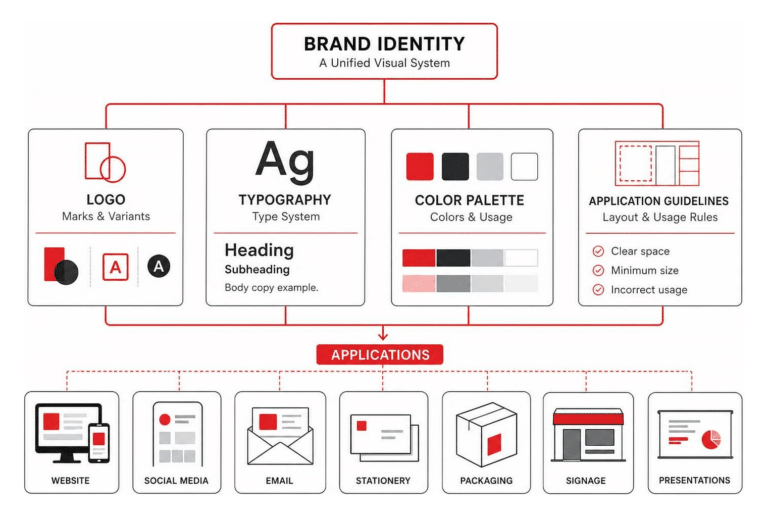
- Visual identity — logo, color palette, typography, and design systems
- Brand architecture — how your products, sub-brands, or services relate to each other
- Messaging platforms — the language, tone, and story your brand tells
- Brand guidelines — the rulebook for consistent communication across every touchpoint
- Ongoing brand management — adapting and protecting your brand as markets evolve
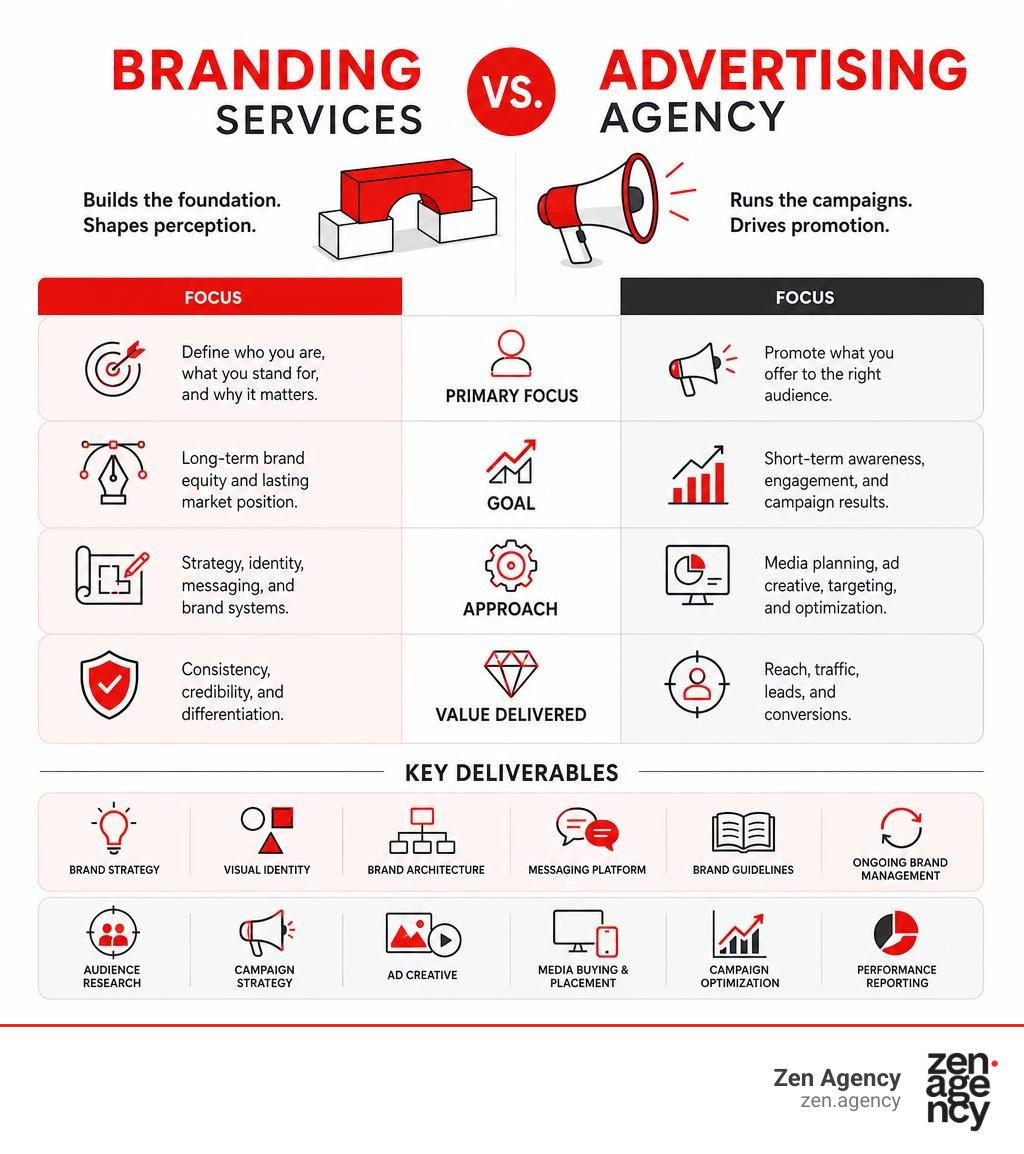
Branding is not the same as advertising. Advertising runs campaigns. Branding builds the foundation those campaigns run on.
A strong brand can be worth more than all of a company’s physical assets combined. Coca-Cola’s brand equity alone was valued at $63.5 billion — representing nearly half of its total market value. That’s the power of strategic, long-term brand investment.
I’m Joseph Riviello, CEO of Zen Agency, and over 22 years leading digital strategy I’ve seen how branding services separate businesses that scale from those that stall. This guide will help you compare your options clearly and make the right call for your business.
Understanding the Core Scope of Professional Branding Services
When businesses decide to elevate their presence, they often ask what professional branding services actually deliver. Is it just a polished logo and a catchy slogan, or is there a deeper framework at play?
In practice, full-service professional branding encompasses the strategic, visual, and verbal foundation of your entire organization. It aligns internal culture with external perception, ensuring that every touchpoint—from your eCommerce checkout flow to your corporate sales presentation—delivers a unified message. When you invest in comprehensive branding services, you are establishing a repeatable system for customer trust, long-term positioning, and scalable market growth.
Strategic Branding Services vs Advertising Campaigns
One of the most frequent points of confusion for business leaders is distinguishing between a branding partner and an advertising agency. While both serve critical functions within integrated marketing communications, their objectives, timelines, and execution metrics differ fundamental ways.
Branding agencies focus on long-term value, equity, and strategic foundation. They build the core identity, define the audience positioning, and codify the rules of engagement. Advertising agencies, on the other hand, take that existing brand identity and push short- to medium-term paid media campaigns designed to generate immediate direct leads or sales. Imagine a manufacturer whose physical production facilities are suddenly lost—if their brand equity in the consumer’s mind remains pristine, the company can contract production elsewhere and survive. The physical asset disappears, but the brand memory retains value. That foundational resilience is the work of strategic branding.
| Dimension | Strategic Branding Services | Advertising Campaigns |
|---|---|---|
| Primary Goal | Build long-term brand equity and customer perception | Drive immediate traffic, sales leads, or conversions |
| Timeline Horizon | Multi-year strategy and permanent foundation | Campaign-based (weeks to months) |
| Core Deliverables | Brand identity systems, architecture, tone, guidelines | Ad creatives, media buying, promotional landing pages |
| Success Metrics | Brand value, customer retention, market share, brand awareness | Cost-per-click (CPC), ROAS, conversion rate, immediate sales |
| Operational Scope | Defines who you are and why you matter | Promotes what you sell right now across paid channels |
When choosing between providers, you need to assess whether your organization requires foundational brand positioning or tactical promotional distribution. Often, the best results occur when a solid brand strategy dictates how paid media campaigns are designed and delivered.
Key Deliverables Covered by Comprehensive Branding Services
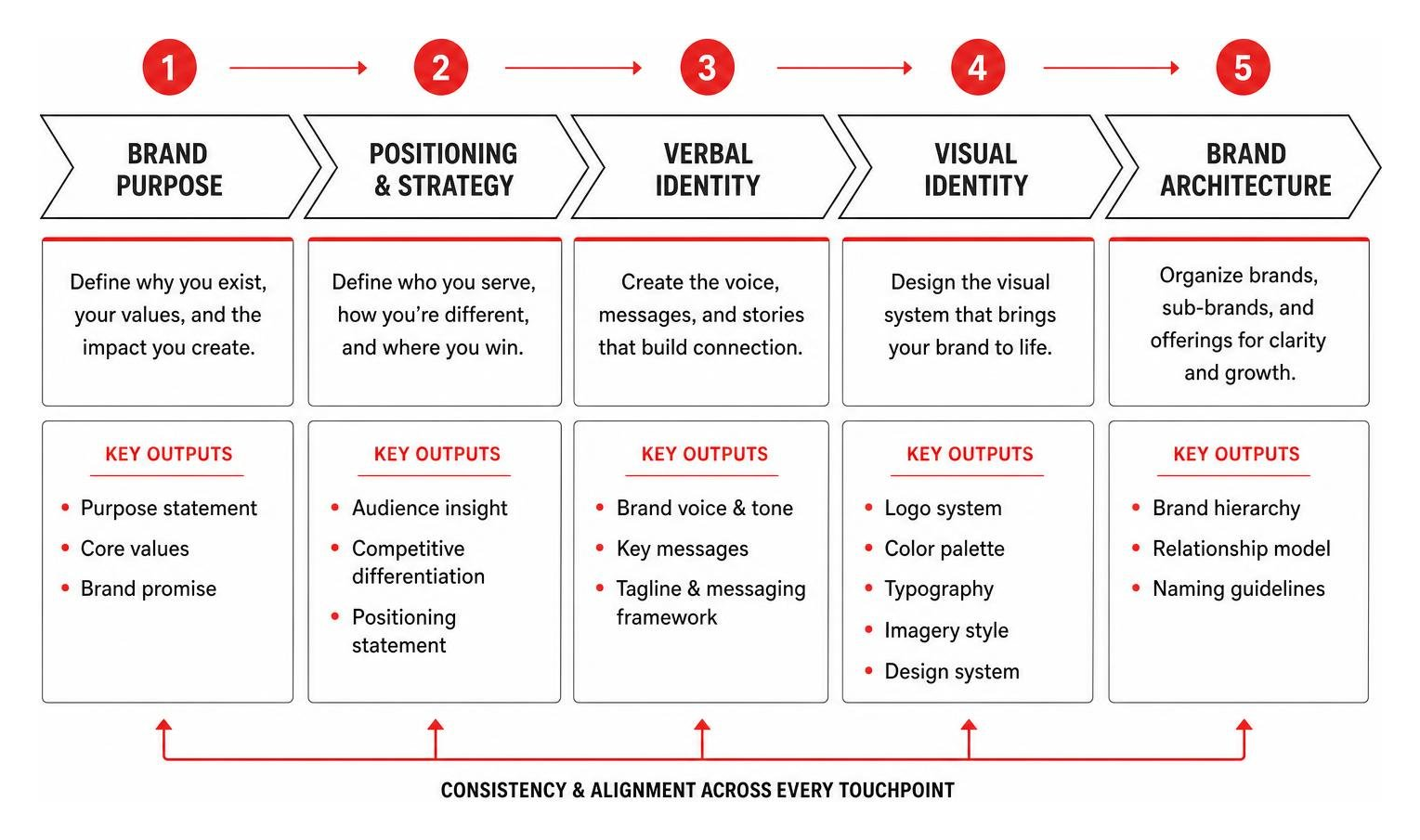
When you partner with a top-tier agency, you receive tangible systems and frameworks designed to scale across teams. A complete branding package moves through multiple strategic phases:
- Brand Strategy & Positioning Platform: Synthesizes competitor benchmarking, buyer personas, value propositions, and core brand promises.
- Visual Identity Systems: Includes scalable logo suites, primary and secondary color palettes, dynamic typography hierarchies, and customized digital assets.
- Brand Architecture Framework: Organizes complex service lines or sub-brands into clear masterbrand or house-of-brands relationships.
- Verbal Identity & Messaging Rules: Establishes voice tone, core taglines, copy frameworks, and localized messaging guidelines.
- Comprehensive Brand Guidelines: Consolidates all rules into detailed document suites that ensure consistency across print, digital, and internal operations.
Establishing bulletproof guidelines is mandatory to avoid brand dilution across touchpoints. For a deeper look into structuring these standards, explore The Ultimate Guide to Brand Guideline Creation.
Core Components of an Effective Branding Strategy
A logo alone cannot do the heavy lifting of customer acquisition or retention. An effective strategy relies on several interconnected layers working in harmony.
Defining Brand Purpose and Visual Identity
At the heart of every enduring business is a clear brand purpose—a reason for existing beyond simply generating revenue. Brand purpose informs your corporate values, which directly drive public market perception and customer loyalty. When your purpose is clear, crafting a compelling visual identity becomes a natural extension of your company’s ethos rather than an arbitrary aesthetic exercise.
Visual identity systems translate your brand purpose into tangible design choices. The choice of typography conveys authority or playfulness; the color spectrum triggers psychological cues; custom imagery reinforces trust and authenticity. For businesses seeking to stand out in crowded digital markets, investing in tailored design systems is non-negotiable. To learn more about crafting custom design assets, review our detailed guide on Brand Identity Design and discover how creative systems capture consumer mindshare.
Structuring Brand Architecture and Naming Frameworks
As companies expand through product launches, acquisitions, or diversification, managing brand relationships becomes complex. Strategic branding services solve this through brand architecture—the logical structuring of portfolio offerings.
Organizations generally choose between three primary architecture strategies:
- Branded House: A masterbrand dominates all offerings (e.g., Virgin, FedEx). This concentrates brand equity into a single parent brand.
- House of Brands: Independent individual brands operate beneath an unseen parent entity (e.g., Procter & Gamble, Unilever). This insulates individual products and targets wildly different demographics.
- Endorsed or Hybrid Structure: Sub-brands retain individual identities while leaning on masterbrand equity (e.g., Marriott Bonvoy, Courtyard by Marriott).
Alongside architecture, naming frameworks are vital when rolling out new products or pivoting service lines. Choosing a name requires balancing trademark availability, linguistic resonance, domain portfolio acquisition, and digital search potential. If you are currently navigating brand expansion or corporate renaming, read our strategy guide Beyond Brainstorming: Mastering the Art of Brand Naming.
Building Competitive Advantage and Long-Term Brand Equity
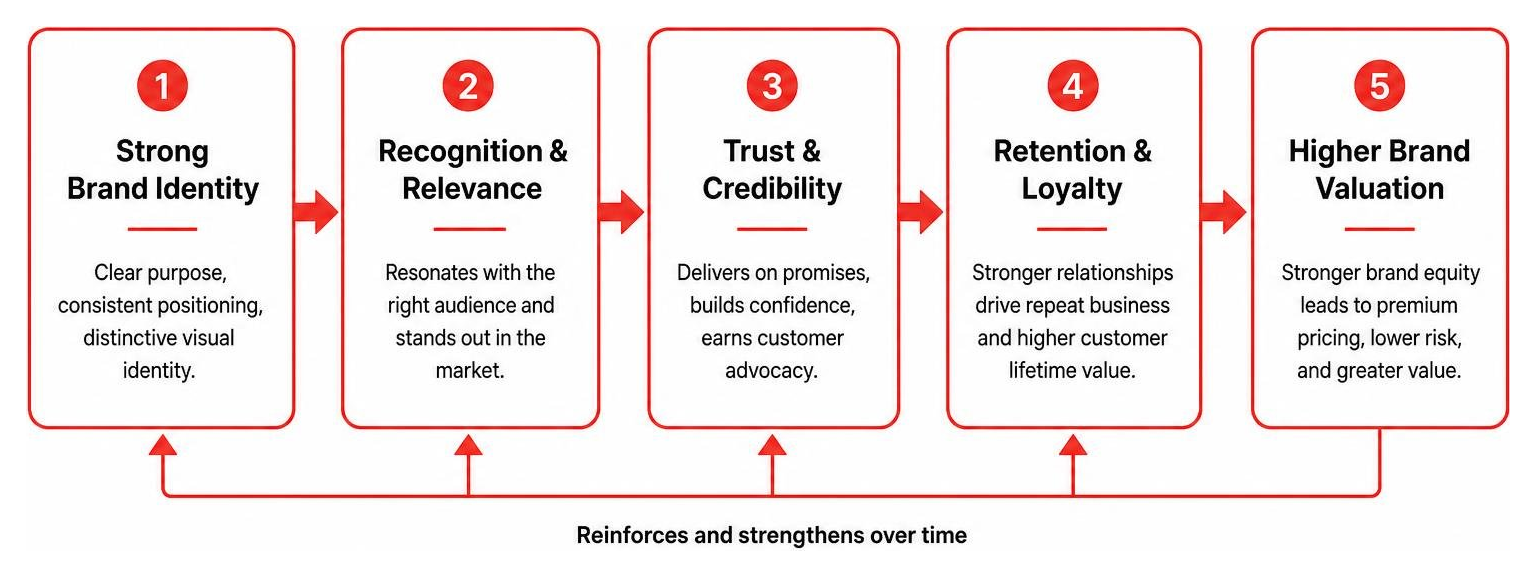
Why do consumers pay a premium for specific brands when generic equivalents offer identical functional specifications? The answer lies in brand equity – the accumulated commercial value that flows from consumer perception, recognition, and emotional connection.
Market Dominance and Target Audience Engagement
Building market dominance is rarely about having the biggest ad budget; it is about establishing distinct brand positioning that competitors cannot replicate. When professional branding services define your unique value proposition, every marketing campaign achieves greater efficiency because your messaging resonates deeply with your target audience.
Customer retention and brand equity grow together. A well-articulated brand reduces customer acquisition costs over time by creating organic brand advocacy and high lifetime value (LTV). When customers share your brand’s values, repeat purchases become automatic. Business owners seeking step-by-step frameworks for enduring market positioning can check out our resource on How to Build a Brand That Lasts: A Step-by-Step Strategy Guide.
Measuring Brand Valuation and Financial Impact
Brand equity is not merely a theoretical marketing concept; it is an intangible asset on corporate balance sheets. Financial analysts measure brand value by calculating the additional revenue generated by a branded product compared to an unbranded generic equivalent, factored alongside market share, customer loyalty metrics, and growth forecasts.
The financial power of brand value is illustrated by historic shifts among global industry leaders:
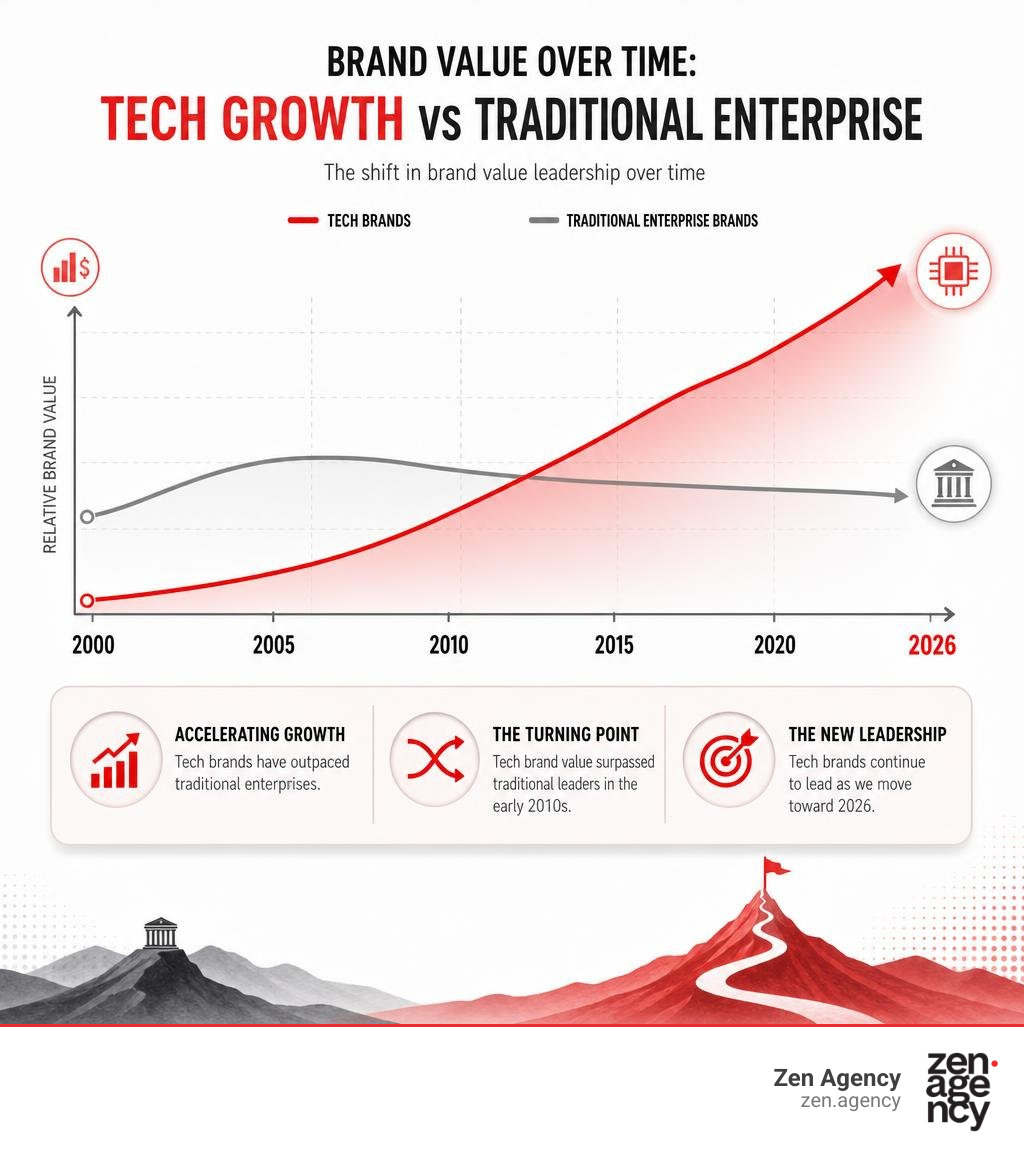
For 13 consecutive years, Coca-Cola held the top position on Interbrand’s global valuation list, with its brand equity reaching $63.5 billion – accounting for nearly half of its total market capitalization. However, rapid technology adoption reshaped brand equity valuations worldwide. Apple achieved a staggering brand valuation surge of 43% year-over-year to hit $170.3 billion, surpassing long-standing consumer goods giants to claim the top global spot.
This transformation highlighted a broader economic trend: technology companies quickly dominated the brand value rankings, with Apple, Google, and Microsoft occupying three of the top five global spots in key valuation benchmarks. Meanwhile, traditional brand powerhouses like Coca-Cola saw slight valuation pullbacks (such as dropping 4% down to $78.4 billion during the same historical shift), reinforcing that maintaining brand equity requires continuous adaptation to digital channels and evolving market trends.
Why Market Leaders Seek External Agency Support
A common misconception is that enterprise brands with extensive internal marketing departments no longer need external agency guidance. In reality, market leaders regularly engage external branding services to stay competitive.

Navigating Technology Trends and Sector Shifts
The rapid acceleration of digital channels, AI technologies, user experience design, and interactive mobile platforms demands constant adaptation. External branding partners bring multi-industry exposure, strategic distance, and specialized technical expertise that internal teams—often buried in day-to-day execution—cannot easily replicate.
Modern tech brands like Apple continuously refine their ecosystem messaging, user experience frameworks, and touchpoint identity systems. Digital channels require brand assets to perform dynamically on web platforms, mobile user interfaces, and interactive applications. For modern organizations, partnering with specialized agencies guarantees that identity standards scale across sophisticated technology channels. To explore how modern digital systems elevate brand strategy, see Beyond Logos: Why Your Business Needs a Digital Branding Agency.
Integrated Marketing Communications and Multi-Agency Strategy
Enterprise brands frequently maintain multi-agency ecosystems. For example, a global brand might engage ten specialized agencies worldwide to crowdsource diverse creative concepts for a single global initiative while maintaining centralized strategic supervision.
Within Integrated Marketing Communications (IMC), strategic branding agencies establish foundational platforms that guide regional execution, public relations, and promotional media partners. When strategic branding and tactical execution work in harmony, advertising campaigns reinforce core brand values without fragmenting the customer experience. To dive deeper into aligning tactical promotion with enterprise strategy, see our analysis on Branding and Promotion: The Ultimate Marketing Marriage.
Evaluating In-House Teams vs. External Agency Partners
Deciding whether to build an in-house brand strategy unit or hire an external branding agency is a major milestone for growing businesses.
Internal Capabilities vs Agency Objectivity
Internal creative teams offer unmatched familiarity with company culture and daily operations. However, internal teams can suffer from “brand myopia”—an organizational echo chamber where long-standing internal assumptions prevent creative breakthroughs or objective assessment of customer feedback.
External branding agencies provide critical third-party objectivity. Unencumbered by corporate politics or historical biases, an agency offers fresh strategic perspectives, uncovers hidden market positioning opportunities, and challenges leadership assumptions constructively. Furthermore, accessing a full team of senior strategists, copywriters, creative directors, UI/UX designers, and brand architects through an agency is typically far more cost-effective than hiring equivalent full-time internal talent.
When evaluating external strategy options, read our guide on How to Pick Brand Strategy Companies That Actually Get You.
Pricing Models, Retainers, and Selection Criteria
When shopping for branding services, you will encounter several common pricing structures:
- Project-Based Pricing: A fixed investment fee covering specific scopes, deliverables, and milestones (ideal for complete rebrands or initial identity design).
- Monthly Retainer: A recurring monthly arrangement covering continuous brand governance, touchpoint adaptation, and ongoing strategic consulting.
- Value-Based Pricing: Pricing tailored to the financial scale and projected business growth generated by the branding transformation.
To compare different service tiers and agency capabilities effectively, review our benchmark guide on The 5 Best Company Branding Services Compared.
Frequently Asked Questions about Branding Services
Why do established global brands still hire branding agencies?
Even market leaders with global recognition rely on external branding partners to remain relevant. Market dynamics shift rapidly, consumer expectations evolve across tech channels, and internal teams often lose strategic objectivity over time. External agencies bring specialized cross-industry expertise, agility, and creative friction, helping legacy brands adapt to modern audiences while protecting billions of dollars in established brand equity.
How is brand equity measured and calculated?
Brand equity is calculated by evaluating financial performance, customer choice metrics, and market premium value. Financial analysts examine the surplus margin a company earns over generic, unbranded competitors. Key inputs include customer retention rates, net promoter scores (NPS), trademark strength, market capitalization, and the percentage of purchase decisions directly driven by brand awareness (as demonstrated by global valuation leader Apple and beverage market leaders like Coca-Cola).
How do branding services differ from standard graphic design?
Standard graphic design focuses primarily on immediate visual execution—creating a standalone visual asset like a flyer, banner, or basic logo file based on specific instructions. Branding services, by contrast, provide a comprehensive strategic foundation. They conduct market research, define brand positioning, craft verbal messaging architecture, develop scalable visual systems, establish brand guidelines, and align touchpoints to drive long-term business equity and profit growth.
Strategic Next Steps for Scaling Your Brand Equity
Your brand is your business’s most valuable asset. It establishes your positioning, builds target audience trust, protects profit margins, and drives long-term shareholder valuation. Choosing the right partner for branding services is one of the most consequential growth decisions your leadership team will make.
At Zen Agency, we bring over 18 years of specialized expertise across digital marketing, custom web development, and high-impact visual strategy. We partner with growth-minded organizations to transform fragmented brand assets into unified, enterprise-grade brand platforms that drive measurable ROI.
Ready to position your organization for sustainable market dominance? Explore our comprehensive suite of Professional Branding & Graphic Design Services, or contact our strategic consulting team at Zen Agency today to request your custom branding proposal.