The B2B PPC Playbook: How to Win at Paid Search
Why Your B2B Business Needs a Paid Search Playbook
B2B PPC management is the strategic oversight and optimization of pay-per-click advertising campaigns designed to generate qualified leads and drive revenue for business-to-business companies. It’s a discipline that moves far beyond simple keyword bidding. Unlike B2C advertising, which often targets impulse buys, B2B PPC is a long-term game of chess, requiring a deep understanding of complex buying journeys. This strategic approach is essential because B2B PPC requires:
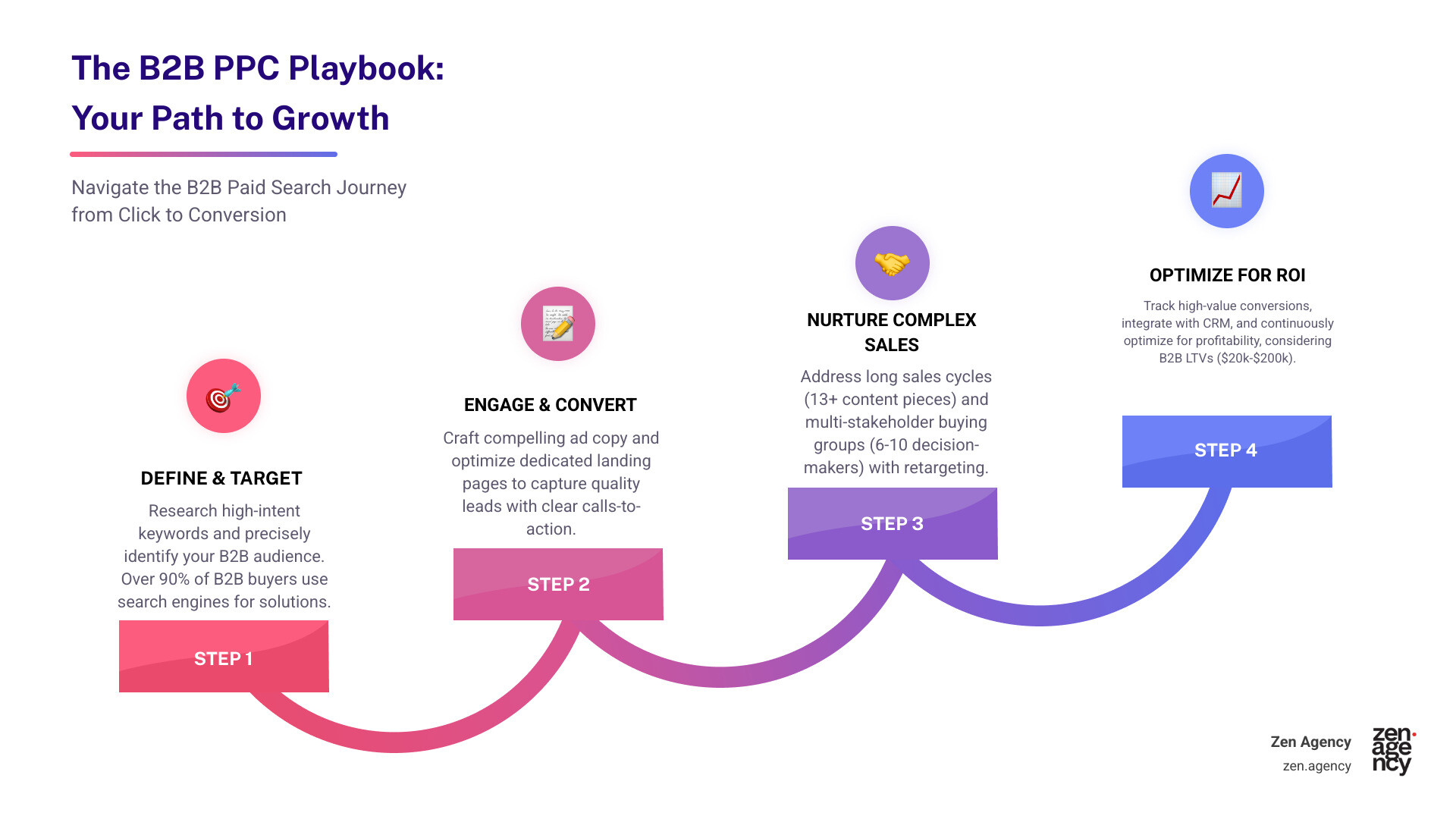
- Longer nurturing cycles – B2B buyers are researchers. They consume an average of 13+ pieces of content before even considering a conversation with sales. Your PPC strategy must support this journey, offering valuable content like whitepapers, webinars, and case studies at different stages, rather than just pushing for a quick sale.
- Multi-stakeholder targeting – The decision to purchase a new software or service isn’t made by one person. The average B2B buying group includes 6-10 decision-makers, each with their own priorities. The CFO cares about ROI, the IT Director worries about integration, and the end-user wants a simple interface. Your campaigns must speak to these varied personas.
- Higher-value conversions – While a B2C sale might be $100, B2B customer lifetime values (LTV) often range from $20,000 to over $200,000. This high value fundamentally changes the economics of paid search and what constitutes a successful campaign.
- Strategic budget allocation – With such high LTV, B2B companies can afford a much higher Cost Per Acquisition (CPA). Even with a modest 10% profit margin, a CPA of over $1,000 can still be highly profitable. This allows for bidding on competitive, high-intent keywords that would be unsustainable in B2C.
- Continuous optimization – Success in B2B PPC demands relentless, data-driven adjustments. This means constantly analyzing performance data to refine keywords, test new ad copy, optimize landing pages for conversions, and adjust bidding strategies to maximize return on ad spend (ROAS).
When your ideal B2B client needs a solution, where do they start? They’re searching Google. Over 90% of B2B buyers use search engines during their decision-making process. If you’re not appearing in those top sponsored spots with a strategic approach, your chances of winning their business drop dramatically.
The reality is stark: paid media is projected to generate 30% of the pipeline for B2B SaaS companies in 2025, and businesses earn an average of $8 for every $1.60 spent on Google Ads. But here’s the catch – those returns only materialize when you move beyond “set it and forget it” campaigns. B2B PPC isn’t about impulse clicks; it’s about nurturing interest across long sales cycles, reaching multiple stakeholders, and aligning every dollar spent with measurable business outcomes.
As Joseph Riviello, CEO and Founder of Zen Agency™, I’ve spent over 22 years helping B2B companies transform their paid search from a budget drain into a predictable revenue engine through strategic b2b ppc management. The difference between success and failure comes down to having a systematic playbook that accounts for the unique complexities of business-to-business marketing.
The B2B vs. B2C PPC Divide: A Different Ballgame
PPC advertising is a powerful tool, but its application differs significantly between B2B (business-to-business) and B2C (business-to-consumer) markets. Ignoring these distinctions in your b2b ppc management strategy is like bringing a knife to a gunfight – you’re simply not equipped for the challenge. While both aim to drive clicks and conversions, the underlying psychology, sales cycles, and value propositions are worlds apart.
For B2C, the focus is often on emotional appeals, immediate gratification, and impulse buys. Think about an ad for a new pair of sneakers: it’s about desire, style, and a quick purchase. The average e-commerce transaction might be worth $85 to $120, meaning a low cost per acquisition (CPA) of under $125 is necessary just to break even.
But in the B2B world, we’re dealing with rational decisions, considered purchases, and a collective buying process. A business isn’t buying a new software solution because it’s “pretty”; they’re buying it because it solves a critical problem, improves efficiency, or boosts their bottom line. This fundamental difference shapes every aspect of a successful B2B PPC strategy. If you’re managing PPC for a local business, understanding these nuances is crucial, whether you’re in Wilkes Barre, Scranton, or Billings. More info about PPC for different business types can help clarify these distinctions.
Key Differences in B2B PPC Management vs. B2C
Let’s explore the core distinctions that define effective b2b ppc management:
- Longer Sales Cycle: This is perhaps the most significant difference. B2C purchases are often quick, while B2B sales cycles can stretch for months, even years. This extended timeline means your PPC efforts must be structured as a multi-touchpoint strategy. An initial click on a top-of-funnel ad might lead to a blog post download. Weeks later, a retargeting ad on LinkedIn could offer them a detailed case study. It’s about building a relationship over time, not forcing a one-time transaction.
- Multiple Stakeholders: Forget impulse buyers. In B2B, you’re often pitching to entire committees. The average B2B buying group now includes 6–10 stakeholders, each with different concerns and priorities. Consider a campaign for a cybersecurity solution. One ad might target IT Managers with messaging about ‘easy integration and threat detection,’ while another ad targets CFOs with copy focused on ‘reducing financial risk and ensuring compliance.’ Both lead to custom landing pages that address their specific concerns.
- Higher Customer Lifetime Value (LTV): While a B2C customer might spend a few hundred dollars, the lifetime value (LTV) for B2B companies is often between $20,000 and $200,000. This high LTV is the engine that powers B2B PPC, justifying the investment in comprehensive content, sophisticated targeting, and higher bids required to attract the right enterprise clients.
- Higher Cost Per Acquisition (CPA): Because of the high LTV, B2B companies can afford a much higher CPA. This doesn’t mean being wasteful; it means having the strategic freedom to pursue the most valuable leads. While a B2C marketer might balk at a $150 click, for a B2B company selling a $50,000/year subscription, that click could be the start of a multi-million dollar relationship.
- Lead Quality Over Quantity: In B2B, a thousand unqualified clicks are worthless. We prioritize marketing-qualified leads (MQLs) and sales-qualified leads (SQLs) that actually convert into pipeline and revenue. By integrating PPC platforms with CRM systems, we can track which keywords and campaigns are not just generating form fills, but are actually creating a sales pipeline and closed-won deals. This focus on revenue impact is the hallmark of sophisticated b2b ppc management.
The Impact of the B2B Sales Funnel on PPC
The elongated B2B sales cycle necessitates a PPC strategy that aligns with each stage of the buyer’s journey. We can’t expect a bottom-of-funnel conversion from a top-of-funnel search query.
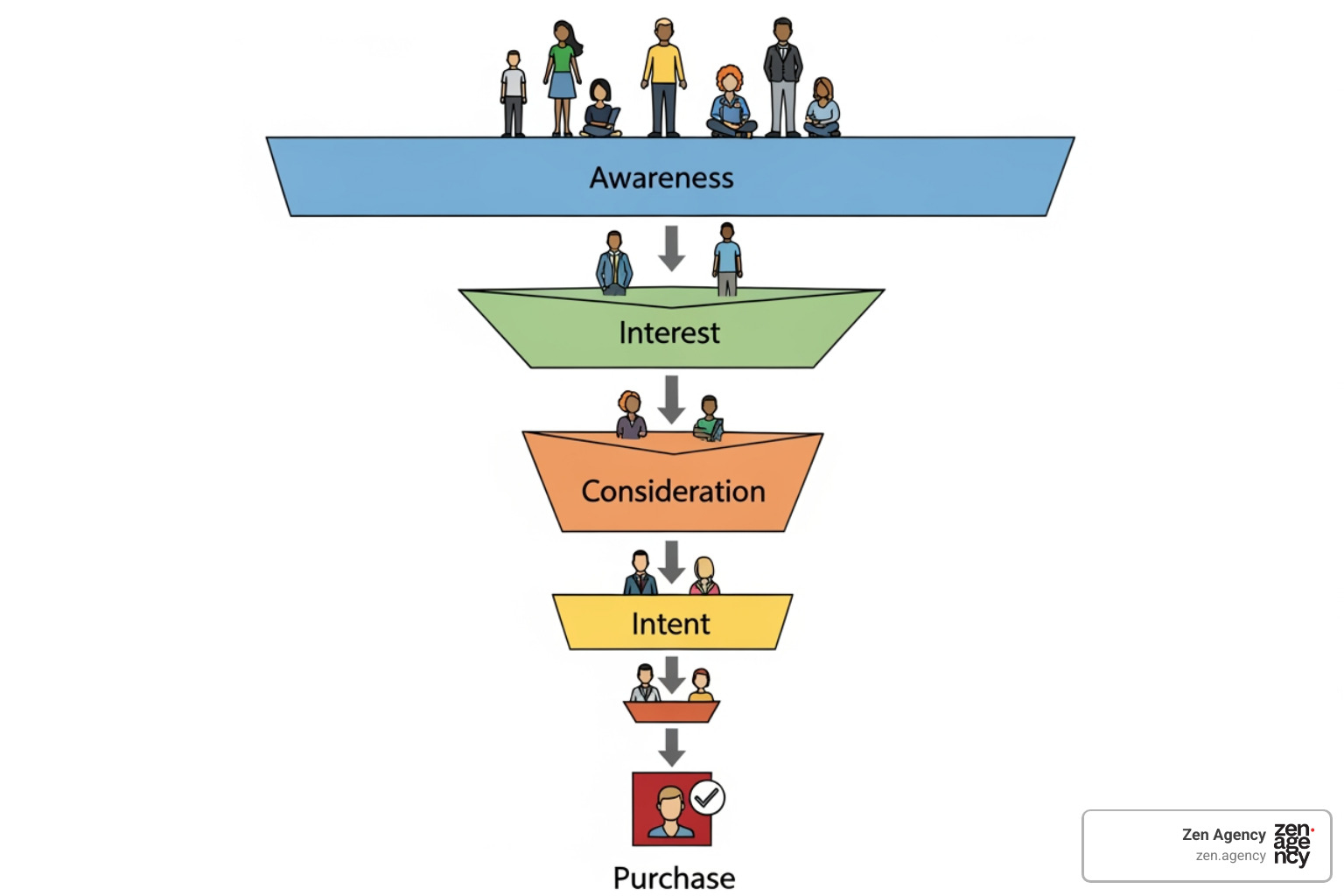
- Top-of-Funnel (TOFU) Content: At this stage, buyers are identifying a problem or exploring solutions. Keywords are often broad and problem-based, like ‘how to improve remote team collaboration’ or ‘what is cloud data warehousing’. Our PPC campaigns here focus on brand awareness and educational content, aiming to provide answers and introduce your brand as a helpful resource through blog posts, guides, or informational videos.
- Middle-of-Funnel (MOFU) Nurturing: Here, prospects are evaluating options. We use retargeting campaigns and more specific search terms to offer whitepapers, case studies, or webinars. Keywords might include ‘[competitor name] alternatives,’ ‘salesforce vs hubspot,’ or ‘best project management software.’ The goal is to nurture interest and demonstrate expertise with comparison guides and in-depth content.
- Bottom-of-Funnel (BOFU) Intent: These are high-intent buyers ready to make a decision. Our PPC efforts here focus on direct conversion—demo requests, free trials, or consultations. Keywords are highly specific and signal immediate purchase intent, such as ‘[your brand name] pricing,’ ‘get a demo for [your product],’ or ‘contact sales for [your service].’ Ads should be direct, with strong calls-to-action driving users to conversion-optimized landing pages.
Building Your Strategic B2B PPC Foundation
A strong b2b ppc management strategy begins with a solid foundation. This isn’t about throwing darts blindfolded; it’s about meticulous planning, deep understanding of your audience, and choosing the right channels to reach them. Our goal is to develop comprehensive campaign strategies that are built for the entire sales funnel, not just the initial click.
First, we define clear, SMART (Specific, Measurable, Achievable, Relevant, Time-bound) campaign objectives. Are we aiming for lead generation, pipeline acceleration, or brand awareness? Each objective will dictate different tactics and measurement metrics. For a SaaS company in Montana, for example, the objective might be to generate 50 MQLs per month for a new software feature.
Next, audience research is paramount. We create detailed buyer personas, delving into their firmographics (company size, industry, revenue), job titles, seniority levels, and specific pain points. Understanding who we’re trying to reach—and what keeps them up at night—allows us to craft highly relevant messages. We don’t just guess; we use data to build custom segments, leverage first-party CRM data, and apply exclusion lists to save budget and improve lead quality.
Choosing the Most Effective B2B PPC Channels
In the B2B landscape, not all PPC channels are created equal. A successful strategy often involves a multi-channel approach, leveraging each platform’s unique strengths to engage prospects across the entire sales funnel. Here’s a breakdown of the primary channels for B2B advertising:
| PPC Channel | Primary B2B Use Case | Best For |
|---|---|---|
| Google Ads | Capturing high-intent search traffic. | Reaching users actively searching for solutions, products, or services like yours (Bottom-of-Funnel). |
| LinkedIn Ads | Precise audience targeting based on job title, industry, company size, and seniority. | Account-Based Marketing (ABM), lead generation with valuable content, and reaching specific decision-makers (Middle-of-Funnel). |
| YouTube Ads | Building brand awareness and thought leadership through video content. | Engaging audiences at the top of the funnel, explaining complex solutions visually, and retargeting website visitors. |
| Microsoft Ads | Reaching a slightly different, often more established professional audience on the Bing network. | Supplementing Google Ads campaigns, often at a lower cost-per-click (CPC), and capturing an overlooked segment of the market. |
Mastering B2B Keyword Research and Targeting
Your keyword strategy is the bedrock of your search campaigns. In B2B, it’s less about volume and more about relevance and intent. A successful approach involves:
- Search Intent Analysis: Understanding why a user is searching is critical. Are they looking for information (e.g., “what is CRM”), comparing options (e.g., “best CRM for small business”), or ready to buy (e.g., “salesforce demo”)? Aligning your keywords and ad copy with this intent is key.
- Long-Tail vs. Short-Tail Keywords: While broad, short-tail keywords like “marketing automation” have high search volume, they are also highly competitive and often have low conversion rates. Long-tail keywords, such as “marketing automation software for B2B SaaS companies,” are far more specific. They have lower volume but attract highly qualified traffic with clear intent, leading to better conversion rates and a higher ROI.
- Competitor Keyword Analysis: Analyzing which keywords your competitors are bidding on can reveal valuable opportunities and gaps in your own strategy. Tools like SEMrush or Ahrefs can provide insights into their top-performing keywords, ad copy, and landing pages, allowing you to refine your approach.
- Using Negative Keywords to Reduce Waste: Just as important as the keywords you target are the ones you exclude. Negative keywords prevent your ads from showing for irrelevant searches, saving your budget for qualified prospects. For example, a B2B software company would add negative keywords like “free,” “jobs,” “training,” and “resume” to avoid clicks from job seekers or students.