How Amazon PPC Campaigns Drive Long-Term Marketplace Dominance
How an Amazon PPC Campaign Builds Lasting Marketplace Growth
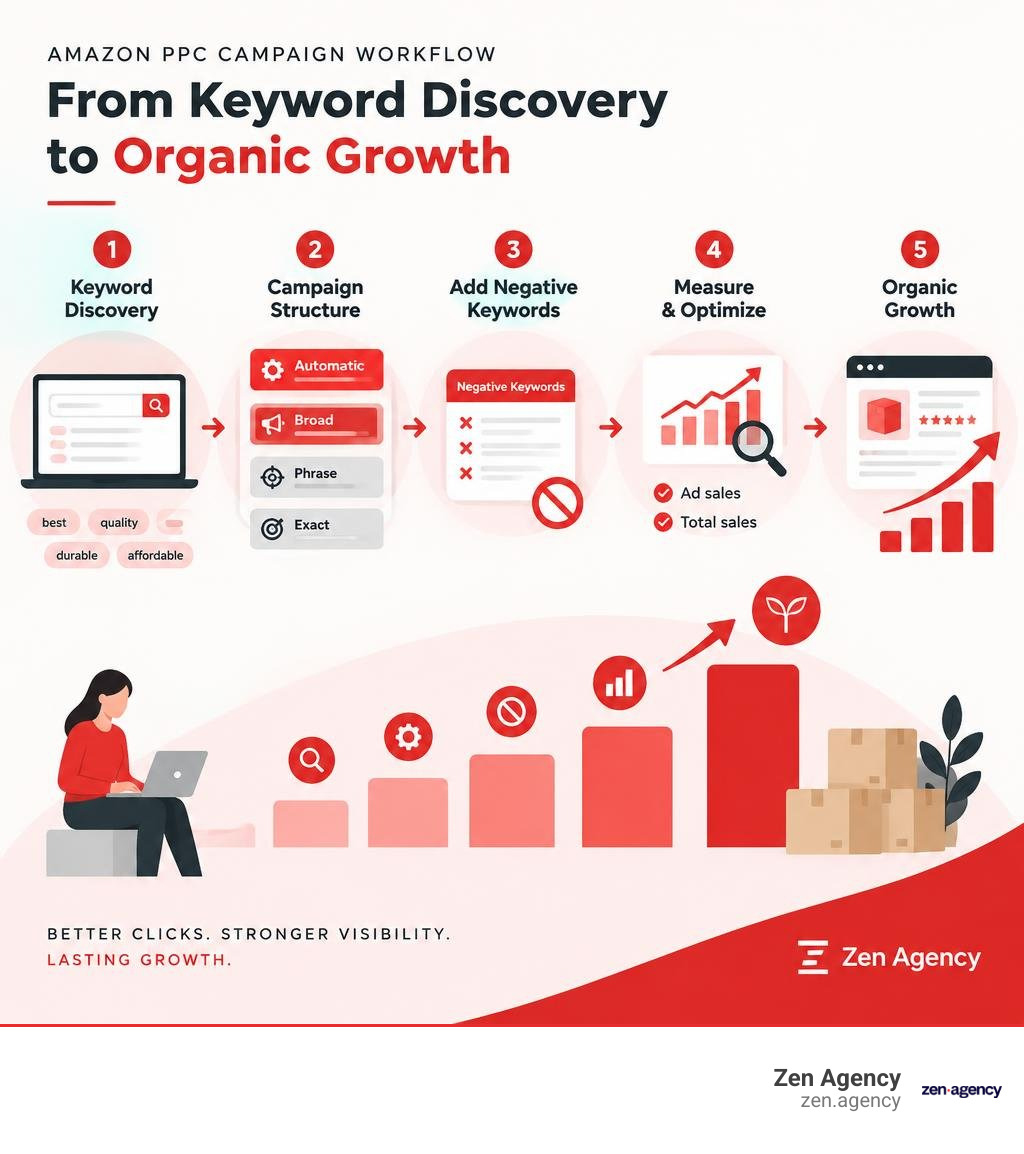
To manage an Amazon PPC campaign profitably, start by separating campaigns by purpose: use automatic and broad targeting to find search terms, move proven terms into phrase and exact-match campaigns, and add negative keywords to stop irrelevant clicks. Then measure spend against both ad-attributed sales and total Amazon sales so you can grow visibility without sacrificing margin.
Amazon ads are more expensive than they were a few years ago. Average U.S. CPC reached about $1.15 in 2026, so default bids and unstructured campaigns can burn budget quickly. A smarter approach turns paid clicks into sales velocity, stronger keyword relevance, and more organic visibility over time.
The goal is not simply the lowest ACoS. It is building a repeatable system that finds profitable demand, protects winning products, and helps your brand earn a larger share of valuable search results.
I am Joseph Riviello, CEO and Founder of Zen Agency, with more than 22 years of digital marketing leadership experience helping businesses connect traffic, conversions, and revenue. In this guide, I will show how a disciplined Amazon PPC campaign can support profitable growth and long-term marketplace presence.
Simple guide to amazon ppc campaign:
Core Ad Types in an Amazon PPC Campaign
Amazon offers a rich suite of advertising formats designed to engage shoppers at various touchpoints across their buying journey. Choosing the right mix is essential for maximizing return on ad spend (RoAS) while scaling revenue. Rather than spreading your budget equally across every format, you must allocate capital based on conversion efficiency and intent. Understanding Amazon PPC made easy for every seller starts with recognizing how each ad format serves a distinct purpose within your broader advertising architecture.
For the vast majority of brands, allocating 70% to 80% of your total ad budget to Sponsored Products ensures direct sales velocity, while reserving 10% to 20% for Sponsored Brands and 5% to 10% for Sponsored Display provides brand defense and retargeting coverage.
Sponsored Products for High-Converting Direct Sales
Sponsored Products are the primary workhorses of marketplace advertising. These ads blend natively into search results pages and individual product detail pages, displaying a standard product image, star rating, Prime badge, and price.
Because they appear precisely when a customer is searching for a specific product, Sponsored Products deliver conversion rates that are typically 2 to 5 times higher than other ad types. You can target shoppers using two primary methods:
- Keyword Targeting: Matching shopper search terms via broad, phrase, or exact match types.
- Product Targeting (ASIN Targeting): Placing your ad directly on competitor listings or cross-selling on your own complementary catalog pages.
Sponsored Brands and Video for Brand Discovery
Sponsored Brands—available to sellers enrolled in Amazon Brand Registry—occupy prime digital real estate at the very top of search result pages. These ads feature your custom logo, a compelling headline, and multiple products, driving traffic directly to your dedicated Amazon Storefront or custom product collection page.
Within this category, Sponsored Brands Video has become one of the highest-performing ad placements on the platform. Video ads auto-play silently as shoppers scroll search results, demonstrating product functionality and building immediate trust. Data shows Sponsored Brands Video campaigns average a 16% Advertising Cost of Sales (ACoS), compared to 24% for standard static Sponsored Brand banner ads. Overall, Sponsored Brands reliably generate 10% to 20% of total ad-attributed sales.
Sponsored Display and Retargeting Off-Amazon
Sponsored Display expands your reach beyond basic search results. These ads appear on product detail pages below the buy box, on customer review pages, in right-rail placements, and across third-party websites and apps via the official advertising platform.
Sponsored Display is designed for two main objectives:
- Competitor Conquesting: Bidding on competitor ASIN detail pages to intercept traffic with a lower price point or superior value proposition.
- Audience Retargeting: Serving display ads to shoppers who previously viewed your product detail page within the last 30 days but did not make a purchase.
Because Sponsored Display captures shoppers further up the funnel or off-platform, typical ACoS benchmarks run higher, often landing between 40% and 60%+.
Structuring Your Account for Maximum Efficiency
An unorganized account leads to budget cannibalization, uncontrolled ad spend, and skewed performance reporting. If your campaign names read like random notes, auditing performance becomes nearly impossible.
To maintain total clarity, we implement a standardized naming architecture:
[Brand/ASIN] | [Ad Type] | [Targeting Match Type] | [Funnel Stage] | [Launch Date]
For example: HYDRATE-01 | SP | EXACT | SCALING | 2026-09.
| Campaign Tier | Primary Objective | Match / Targeting Types Used | Target Bid Strategy | Budget Allocation |
|---|---|---|---|---|
| Discovery | Search term & competitor exploration | Auto targeting, Broad match, Category targeting | Low dynamic bids (down-only) | 15% – 20% |
| Harvesting | Validating converting search terms | Phrase match, ASIN targeting | Moderate dynamic bids | 20% – 30% |
| Scaling | Maximizing sales velocity on top keywords | Exact match | Aggressive manual bids & placement boosts | 50% – 65% |
Building a Profitable Amazon PPC Campaign Funnel
Achieving sustainable profitability requires structuring your campaigns into a three-tier funnel: discovery, harvesting, and scaling. This systematic workflow prevents keyword overlap and directs your ad budget toward proven, profitable search queries.
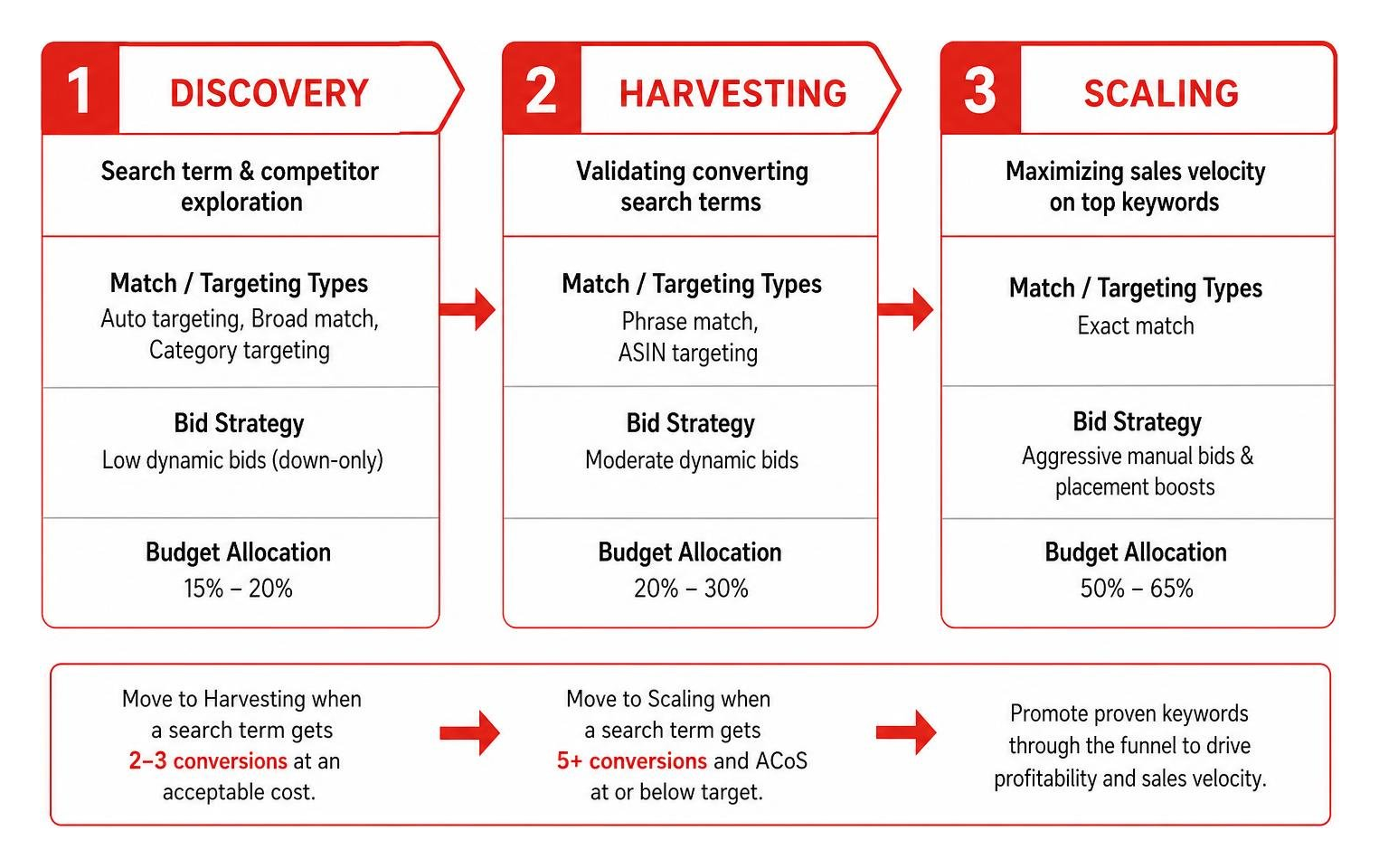
- Discovery Stage (Auto & Broad): Set up automatic targeting campaigns alongside broad match keyword groups. Keep bids low and conservative. The purpose here is not immediate high-margin profitability, but rather gathering valuable customer search data.
- Harvesting Stage (Phrase): When an auto or broad search term generates 2 to 3 conversions at an acceptable cost, graduate that keyword into a phrase match harvesting campaign with dedicated budget control.
- Scaling Stage (Exact): Once a keyword proves itself with 5 or more conversions and an ACoS at or below your target threshold, move it into an exact match scaling campaign. Here, apply aggressive bids and uncapped budgets to capture maximum market share.
Setting up isolated campaigns helps avoid common e-commerce PPC mistakes to avoid in 2025 and beyond, such as letting discovery campaigns eat the budget meant for your top revenue-generating keywords.
Negative Keyword Architecture and Spend Control
Negative keywords represent your strongest defensive mechanism against wasted ad spend. When a customer searches for a term on your negative list, your ad is excluded from the auction, preserving your budget for high-intent shoppers.
A proactive negative keyword strategy can reduce wasted ad spend by 15% to 25% without modifying a single keyword bid. While the average, unoptimized Amazon account uses fewer than 20 negative keywords, highly optimized accounts maintain active lists containing 200 to 500+ negative terms.
To execute proper spend hygiene:
- Weekly Search Term Audits: Review your search term reports weekly. Identify any search term that generates 15 to 20 clicks with zero orders and immediately add it as a Negative Exact target.
- Brand & Feature Exclusions: If you sell premium stainless steel garlic presses, immediately add terms like “plastic,” “electric,” “cheap,” and “disposable” as Negative Phrase matches across your discovery campaigns.
- Cross-Campaign Negation: When you graduate a search term from your discovery campaign to your exact-match scaling campaign, add that keyword as a negative exact match in the discovery campaign. This ensures campaigns never compete against each other in the internal auction.
Keyword Research, Match Types, and Bid Optimization Strategies
Effective keyword research requires discovering the exact language shoppers use when searching for your products. Begin with seed keyword brainstorming, expand using Amazon search bar autocomplete suggestions, and run competitor reverse-ASIN lookups to reveal terms generating organic and paid traffic for top-ranking listings.
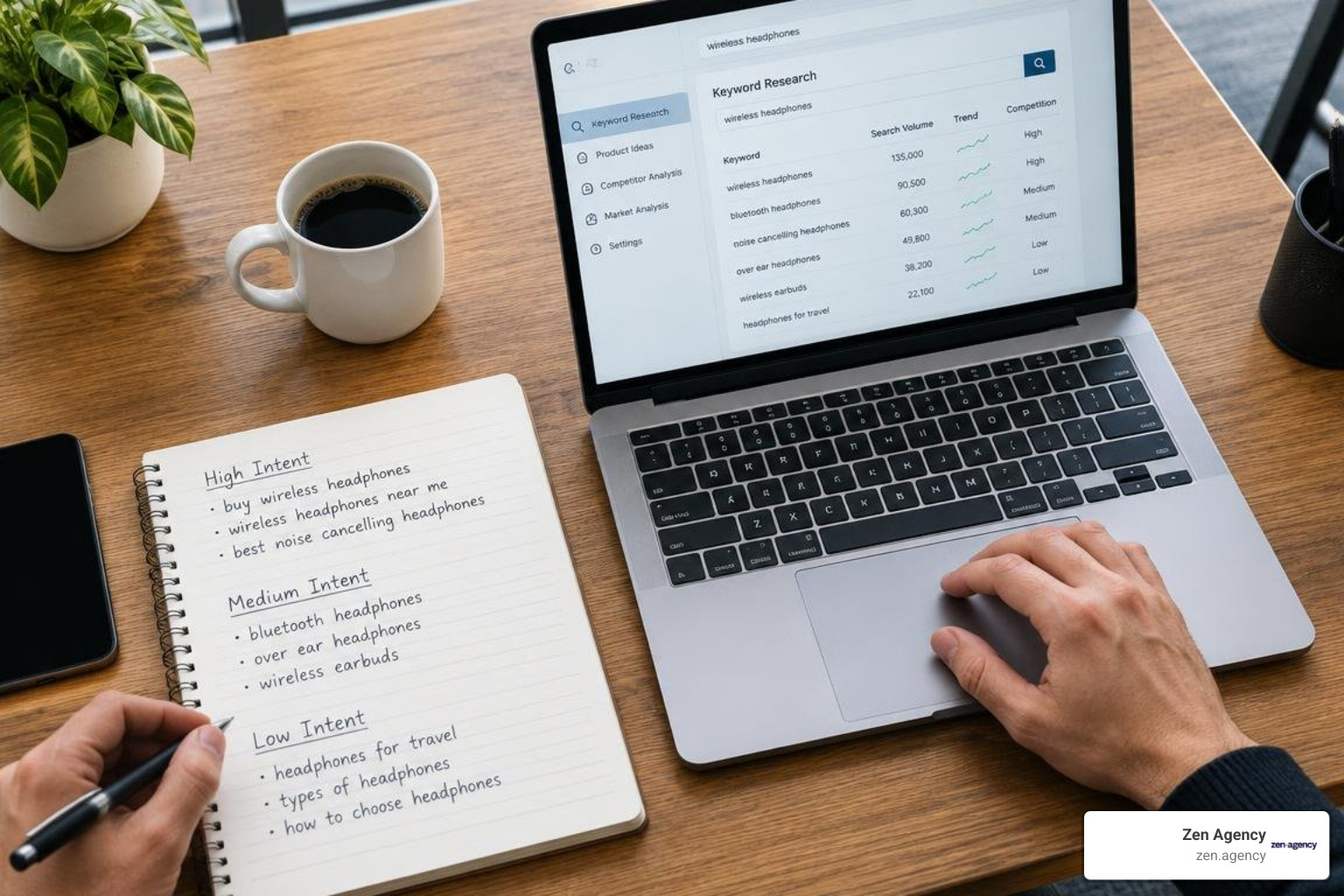
Segment your harvested keywords by search intent:
- High Intent (Commercial): Specific queries with purchase intent (e.g., “insulated stainless steel water bottle 32oz”).
- Medium Intent (Category): Broader product searches (e.g., “water bottle”).
- Low Intent (Informational/Browsing): Generic queries (e.g., “fitness gifts”).
Match Type Selection: Broad, Phrase, and Exact
Choosing the correct match type allows you to control the balance between impression volume and targeting precision:
- Broad Match: Matches user searches containing your keyword terms in any order, along with synonyms, misspellings, and related variations. Broad match is ideal for wide-net discovery, but requires strict negative keyword monitoring to avoid irrelevant clicks.
- Phrase Match: Matches queries that contain your exact keyword phrase in its specified order, though additional words may appear before or after. Phrase match provides a balance of search volume and relevance.
- Exact Match: Matches only the exact search query or close grammatical variations (such as singular/plural forms). Exact match yields the highest conversion rates and lowest wasted spend, making it the required home for your scaling campaigns.
Dynamic Bidding and Placement Adjustments
Amazon gives advertisers powerful bid optimization settings to modify how bids are placed in real-time auctions:
- Dynamic Bids – Down Only: Amazon lowers your bid in real time (up to 100%) when a click is less likely to convert into a sale. This is the safest, most cost-effective option for new campaign launches and testing phases.
- Dynamic Bids – Up and Down: Amazon raises your bid by up to 100% for top-of-search placements and up to 50% for other placements when conversion likelihood is high, while reducing bids when conversion probability drops. Use this only for validated, high-converting exact-match campaigns.
- Fixed Bids: Amazon uses your exact bid for every auction regardless of conversion signals. This approach provides strict budget predictability but lacks algorithmic flexibility.
In addition to dynamic bidding, utilize Placement Adjustments to boost bids by 20% to 50%+ for “Top of Search (First Page)” placements on top-converting keywords. Top-of-search placements consistently yield the highest click-through and conversion rates.
Finally, consider implementing Dayparting schedules. If your historical analytics reveal that conversion rates drop sharply between 2:00 AM and 6:00 AM, lowering bids during those off-peak hours and increasing them during prime evening shopping windows (6:00 PM to 10:00 PM) will stretch your budget further.
Calculating Profitability: CPC, ACoS, and TACoS Benchmarks
Evaluating campaign performance requires a firm grasp of essential financial metrics. As explored in our breakdown on the cost of PPC advertising: what e-commerce brands need to know, profitability depends on your unit economics, profit margins, and marketplace dynamics.
Average cost-per-click rates and advertising efficiency vary significantly by international marketplace:
- Amazon US: Average CPC is $1.15; average ACoS is 22%.
- Amazon CA: Average ACoS is 20%.
- Amazon UK: Average ACoS is 19%.
- Amazon DE: Average ACoS is 17%.
- Amazon UAE: Average CPC is $0.48 (approx. 60% lower than US); average ACoS is 13%.
- Amazon JP: Average CPC is $0.38 (approx. 70% lower than US); average ACoS is 11%.
To establish your financial guardrails, calculate your Break-Even ACoS, which equals your gross profit margin before advertising spend. If an item sells for $50 and your cost of goods sold (COGS), Amazon FBA fees, and operating expenses total $30, your profit margin is $20 (40%). Your break-even ACoS is 40%. Any campaign operating below 40% ACoS generates net profit.
Measuring Total Performance Beyond Direct Ad Metrics
While ACoS measures direct ad efficiency, evaluating campaign success on ACoS alone presents an incomplete picture of brand performance.
$$text{ACoS} = frac{text{Ad Spend}}{text{Ad-Attributed Sales}} times 100$$
$$text{TACoS (Total Advertising Cost of Sales)} = frac{text{Total Ad Spend}}{text{Total Amazon Sales (Organic + Ad)}} times 100$$
TACoS illustrates how advertising dollars accelerate your entire business. Paid sales generate review volume and sales velocity, signaling product relevance to Amazon’s A10 ranking algorithm. As organic keyword rankings rise, organic sales expand, which naturally lowers your TACoS over time. A healthy, scaling brand typically sees TACoS compress from 15% to 20% during launch down to a sustainable 8% to 12% as products mature.
Launching a New Amazon PPC Campaign vs Scaling Mature Products
Advertising strategies must adapt across a product’s lifecycle, aligning with best PPC practices for e-commerce startups and mature brands alike:
- Launch Phase (Months 1–3): Focus on driving impressions, clicks, initial reviews, and sales velocity. Target an aggressive ACoS between 35% and 55% (often break-even or a slight initial loss). Dedicate up to 30% to 40% of target product revenue to advertising.
- Growth Phase (Months 4–6): Transition keyword harvesting from broad to exact match, expand negative lists, and tighten bid rules. Target an ACoS of 22% to 30%.
- Maturity Phase (Months 7+): Prioritize baseline profitability and organic ranking defense. For a mature product with 40% gross margins, an ACoS of 15% to 22% (with an average target of 18%) is healthy and sustainable. Ad spend should represent 10% to 15% of total revenue.
Frequently Asked Questions About Amazon PPC
What is a good ACoS for Amazon PPC in 2026?
A “good” ACoS depends directly on your product’s gross profit margin and lifecycle stage. For a mature product operating with a 40% profit margin, an ACoS between 15% and 22% is considered strong and sustainable, with 18% serving as an industry benchmark. During a product launch, an ACoS between 35% and 50% is acceptable to establish keyword indexing and sales velocity.
How much should a business budget for Amazon advertising?
Established brands generally budget 10% to 15% of their total Amazon monthly revenue for ongoing PPC management. For new product launches or competitive catalog expansions, allocate 25% to 40% of forecasted revenue during the initial 60 to 90 days. On a tactical level, start testing new campaigns with daily budgets of $20 to $50 per campaign tier before scaling winners.
How do Amazon PPC ads improve organic keyword rankings?
Amazon’s search ranking algorithm prioritizes sales velocity, keyword conversion rates, and revenue history. When an ad drives conversions for a specific search term, Amazon’s algorithm registers the product as highly relevant for that keyword query. This boost in sales velocity lifts your organic search rank for that term, creating a flywheel effect where paid advertising systematically fuels long-term organic growth.
Conclusion

Dominating Amazon search results requires a shift from passive bid maintenance to active, structured campaign management. By building a disciplined three-tier funnel (discovery, harvesting, scaling), maintaining aggressive negative keyword lists, and tracking TACoS rather than ACoS in isolation, you can transform paid clicks into lasting marketplace equity. In documented brand rollouts, implementing a structured PPC strategy has helped scale revenues by over 270% within three months.
At Zen Agency, we build scalable, data-driven advertising engines for brands looking to expand market share and maximize margins. Explore our expert PPC management services to turn your Amazon ad spend into a predictable, long-term growth driver.