The Exact Checklist for Vetting an Amazon PPC Advertising Agency
Choose an Amazon PPC Advertising Agency That Can Grow Profitably
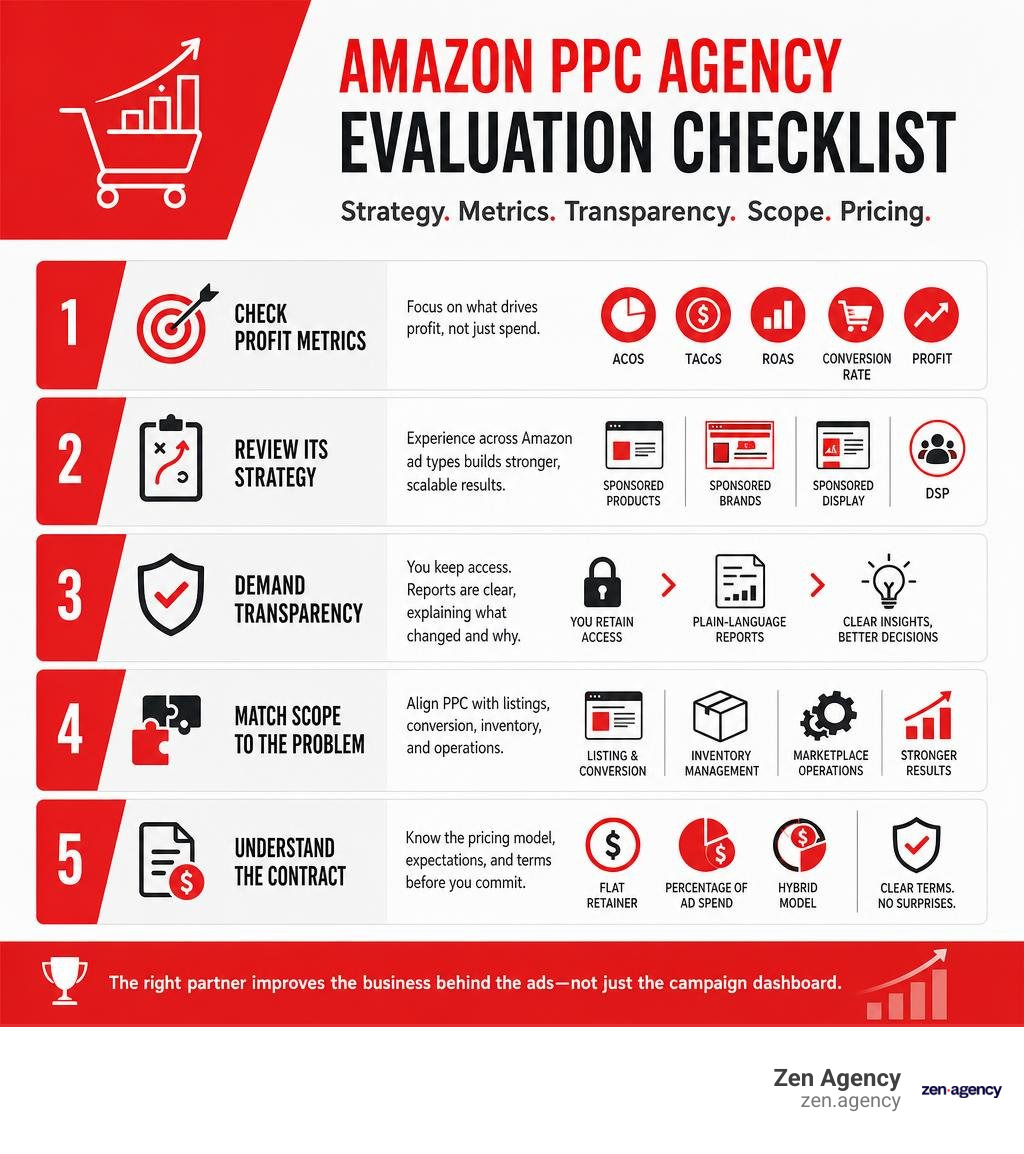
The right Amazon PPC advertising agency should do more than lower ad costs. It should show how it will improve profitable sales by connecting campaign structure, keyword targeting, listing conversion, inventory, and clear reporting. Before you hire, ask for proof of results in accounts like yours, transparent pricing, access to your ad data, and a plan built around your margins and growth goals.
Use this quick filter:
- Check profit metrics: The agency should discuss ACOS, TACoS, ROAS, conversion rate, and profit, not just clicks or ad sales.
- Review its strategy: Look for experience with Sponsored Products, Sponsored Brands, Sponsored Display, and, when appropriate, DSP.
- Demand transparency: You should retain account access and receive plain-language reports that explain what changed and why.
- Match the scope to the problem: If weak listings or stockouts hurt ad results, consider a partner that can align PPC with conversion optimization and marketplace operations.
- Understand the contract: Compare flat retainers, percentage-of-spend fees, and hybrid models. Avoid vague deliverables and long lock-ins before the agency has earned trust.
Amazon ads can create visibility and sales momentum, but high spend alone is not growth. A strong partner treats PPC as part of a larger system: attracting qualified shoppers, converting them on a retail-ready listing, and protecting margins as budgets scale.
I am Joseph Riviello, CEO and Founder of Zen Agency, with more than 22 years of digital marketing leadership experience focused on connecting traffic, conversion, and revenue. That broad view is essential when evaluating an Amazon PPC advertising agency, because the best choice improves the business behind the ads, not only the campaign dashboard.
Amazon ppc advertising agency word roundup:
Why Brands Choose an Amazon PPC Advertising Agency Over In-House Management
Selling on Amazon has evolved from a simple product-listing exercise into a competitive marketplace where ad management requires constant attention. Years ago, a seller could launch a basic auto-campaign, set a few manual keyword bids, and reliably generate sales. Today, retail media networks dominate digital commerce, and paid placements dictate search result visibility across desktop, mobile, and voice-assisted devices.
When brands hit a plateau, internal teams often find themselves overwhelmed by the sheer volume of campaign maintenance, bid optimization, search-term harvesting, and catalog management. Deciding whether to hire an internal advertising manager or partner with an outside team is a major operational milestone.

Signs Your Brand Needs an Amazon PPC Advertising Agency
Knowing when to seek outside support prevents expensive budget drain and missed market share. Here are clear indicators that your brand has outgrown self-management:
- Stagnant or Creeping ACOS: Your advertising cost of sales continues to climb while ad-attributed revenue plateaus, signaling bid inefficiency or keyword exhaustion.
- Severe Keyword Bleed: Your broad-match and automatic campaigns are spending heavily on irrelevant search queries that fail to convert, indicating a lack of negative keyword hygiene.
- Catalog Expansion Pains: You are launching new SKUs, variations, or product lines, but lack the bandwidth to build structured campaign hierarchies for each product lifecycle phase.
- Inventory Misalignment: Paid campaigns frequently drive high traffic to low-stock or out-of-stock ASINs, wasting precious budget and damaging listing rank.
- Lack of Advanced Format Usage: Your team sticks purely to basic Sponsored Products, completely missing high-return opportunities across Sponsored Brands video, Sponsored Display, and Amazon DSP.
If your advertising efforts feel reactive rather than intentional, discovering how amazon ppc made easy for every seller can simplify complex structures and restore profitability.
Comparing In-House Resource Costs vs. Agency Specialization
Building an internal Amazon advertising department requires substantial capital beyond just base salaries. A dedicated in-house media manager commands a significant payroll, benefits package, and ongoing training investment. Furthermore, that individual requires enterprise-level keyword tracking tools, automated bid management software, and anomaly detection suites—software subscriptions that easily cost thousands of dollars per month.
Conversely, a specialized retail media agency spreads enterprise technology investments across its entire client portfolio while providing immediate access to a deep bench of seasoned strategists, data analysts, and creative designers. Understanding the cost of ppc advertising what e commerce brands need to know helps founders compare true operational overhead against agency partnership retainers.
| Resource Factor | In-House Advertising Team | Specialized PPC Agency |
|---|---|---|
| Direct Overhead | Full salary, benefits, payroll tax, onboarding | Predictable monthly retainer or spend tier |
| Software & Tooling | Direct enterprise software subscription costs | Included within agency technology stack |
| Talent Redundancy | High risk (single point of operational failure) | Multi-strategist coverage and cross-account learning |
| Marketplace Agility | Limited to historical in-house experience | Informed by aggregated cross-category data |
The Essential Vetting Checklist for Hiring a Top Partner
Vetting an advertising partner requires looking past charismatic sales pitches and focusing on operational frameworks, data transparency, and structural discipline. A dependable partner builds custom growth roadmaps aligned with your product margins and supply chain realities.
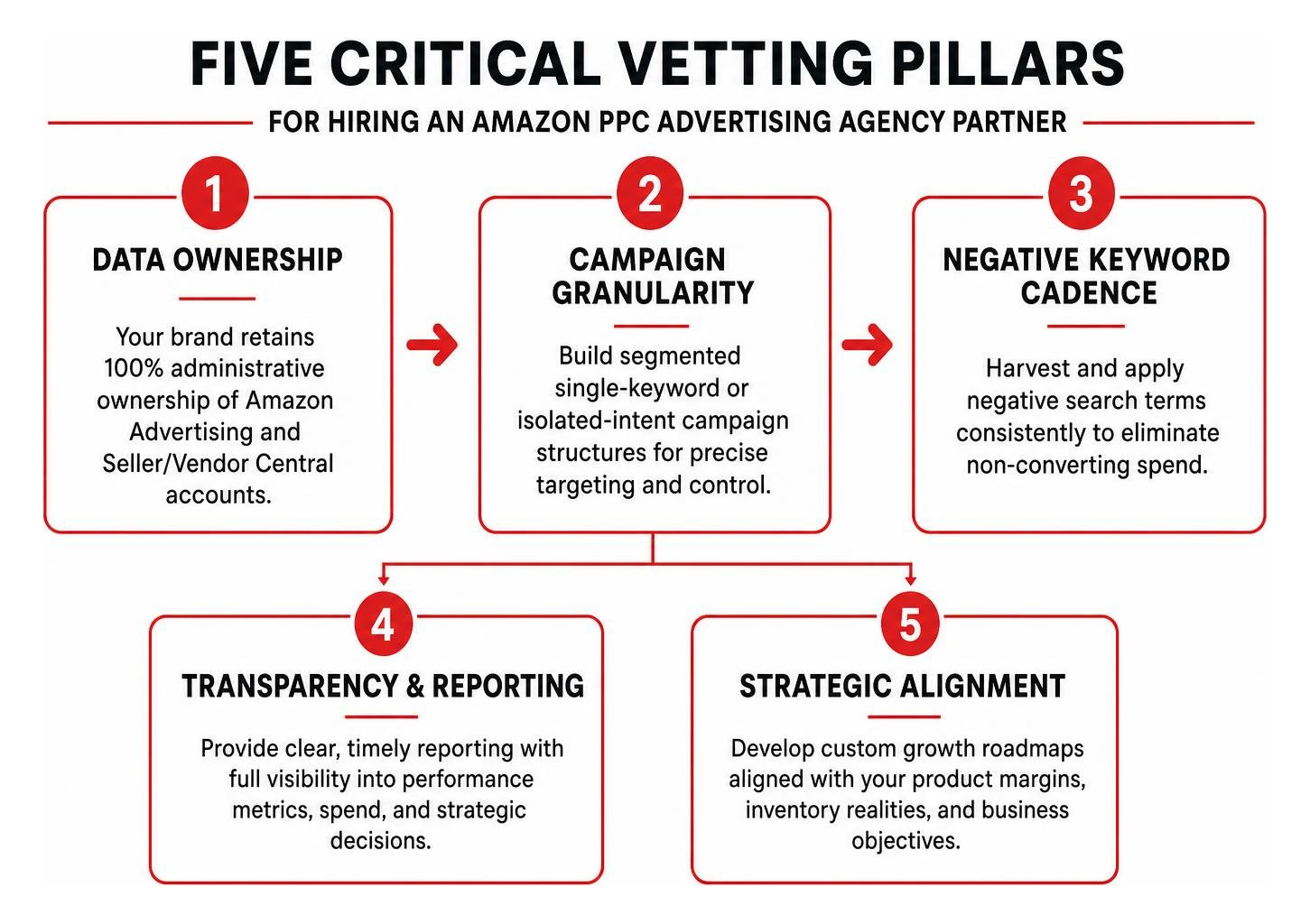
Use this checklist during your agency discovery calls:
- Data Ownership: Does your brand retain 100% administrative ownership of your Amazon Advertising Console and Seller/Vendor Central accounts?
- Campaign Granularity: Does the agency build segmented single-keyword or isolated-intent campaign structures rather than dumping hundreds of targets into single ad groups?
- Negative Keyword Cadence: How often are negative search terms harvested and applied to eliminate non-converting spend?
- Inventory Syncing: What mechanisms are in place to throttle ad spend when stock levels dip below designated thresholds?
- Blended Reporting: Does the agency evaluate blended TACoS alongside channel-specific ACOS to measure true bottom-line impact?
- Listing Audits: Does the agency inspect conversion rate drivers, including main image quality, A+ Content, and backend search terms, before scaling ad spend?
1. Full-Funnel Campaign Architecture and Ad Format Expertise
Amazon’s ad platform offers a diverse ecosystem of ad formats designed to capture shoppers at every stage of the buying journey. An agency that only relies on Sponsored Products auto-campaigns leaves substantial revenue on the table. A mature partner implements a tiered, full-funnel approach that guides potential buyers from awareness to conversion and brand loyalty.
A comprehensive full-funnel architecture incorporates:
- Sponsored Products: The foundational driver of high-intent conversion, utilizing exact-match discovery, competitor ASIN targeting, and defensive brand isolation.
- Sponsored Brands & Video: Highly visual placements capturing premium search real estate above top-of-search results, driving traffic directly to custom Storefront sub-pages.
- Sponsored Display: Off-Amazon and on-Amazon targeting that re-engages shoppers who viewed your product detail pages but did not complete a purchase.
- Amazon DSP (Demand-Side Platform): Programmatic display and streaming video advertising that reaches audiences based on first-party shopping behavior across Amazon, Twitch, and Prime Video.
Top-tier agencies understand that beyond the click a guide to comprehensive ppc management requires structuring campaigns so that top-of-funnel discovery feeds bottom-of-funnel conversions without cannibalizing organic margins.
2. Mastery of Critical Performance Metrics (ACOS, TACoS, ROAS)
A reliable agency does not hide behind isolated vanity metrics. In retail media, driving millions of impressions or high gross ad sales means nothing if your business loses money on every unit shipped. A skilled partner evaluates your unit economics, Amazon referral fees, FBA fulfillment costs, and cost of goods sold (COGS) to calculate realistic efficiency targets.
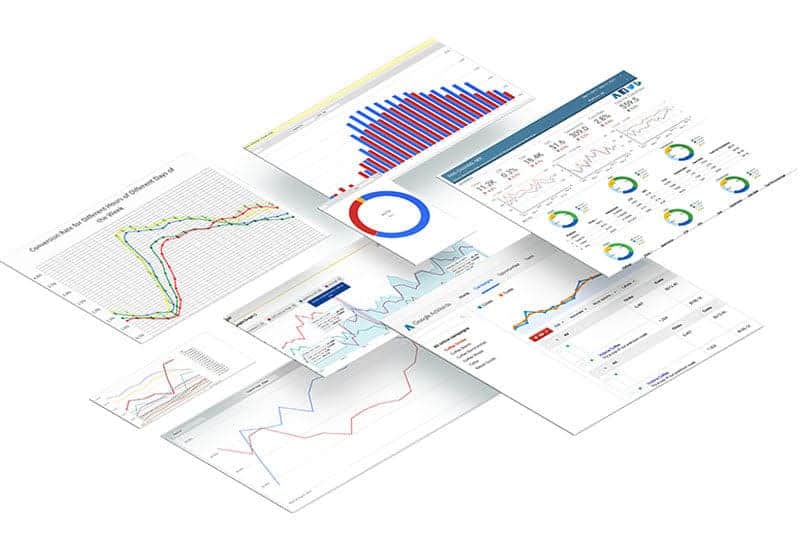
Evaluating performance requires understanding three primary indicators:
- ACOS (Advertising Cost of Sales): The percentage of direct ad revenue spent on advertising (
Ad Spend / Ad Revenue * 100). A target ACOS of 15–25% typically reflects strong operational profitability for mature listings, while 25–35% accommodates moderate growth phases. - TACoS (Total Advertising Cost of Sales): The ratio of ad spend to total gross revenue (
Ad Spend / Total Revenue * 100). Monitoring TACoS ensures advertising accelerates organic search momentum rather than propping up an unprofitable catalog. A healthy, scaling account often targets a blended TACoS between 10% and 15%. - ROAS (Return on Ad Spend): The inverse of ACOS (
Ad Revenue / Ad Spend), measuring immediate gross return per dollar invested.
Learning how to track and measure ppc success for small businesses ensures that you and your agency evaluate the same financial benchmarks every reporting cycle.
3. Algorithmic SEO and Conversion Rate Optimization Alignment
Paid advertising and organic marketplace ranking operate within a continuous feedback loop on Amazon. When an ad drives a conversion, Amazon’s ranking algorithm registers an increase in sales velocity for that specific search term. That velocity boost improves organic rank, generating non-paid sales that lower your blended TACoS over time.
However, pouring PPC traffic onto a listing with poor creative, low review counts, or weak bullet points simply burns cash. A top-tier agency evaluates retail readiness before aggressive budget deployment:
Integrating your marketplace advertising with organic optimization creates compound efficiency. When evaluating prospective partners, ensure they understand how seo and ppc can work together for maximum results by aligning backend search terms, product title keywords, and visual A+ content with top-converting paid search queries.
4. Transparent Pricing Models and Contract Flexibility
Agency pricing structures should align with your business growth rather than incentivize reckless ad spend. During your evaluation process, review fee structures carefully to identify potential conflicts of interest.
Common agency pricing models include:
- Flat Monthly Retainer: A fixed monthly management fee based on catalog size and campaign complexity. This model provides budget predictability and eliminates the temptation for an agency to inflate your ad spend merely to collect higher fees.
- Percentage of Ad Spend: A tiered percentage fee (typically 8% to 15%) that scales with your ad budget. While common, ensure this model includes performance guardrails so the agency focuses on efficiency rather than unchecked budget growth.
- Hybrid (Base Retainer + Performance Incentive): A lower base monthly fee combined with a bonus tied to achieving specific TACoS, revenue growth, or net profit milestones.
- Contract Flexibility: Avoid signing rigid 12-month lock-in agreements upfront. High-performing agencies typically provide 60- to 90-day initial onboarding terms followed by flexible 30-day rolling agreements.
Using a structured best pay per click agencies reviewed the definitive partner evaluation checklist allows you to assess commercial contract terms objectively across multiple agency proposals.
5. How to Test Strategy During the Amazon PPC Advertising Agency Pitch
The discovery phase and initial account audit provide the best window into an agency’s technical depth. When a prospective partner offers a preliminary growth audit, look beyond generic slide decks and examine their specific strategic observations.
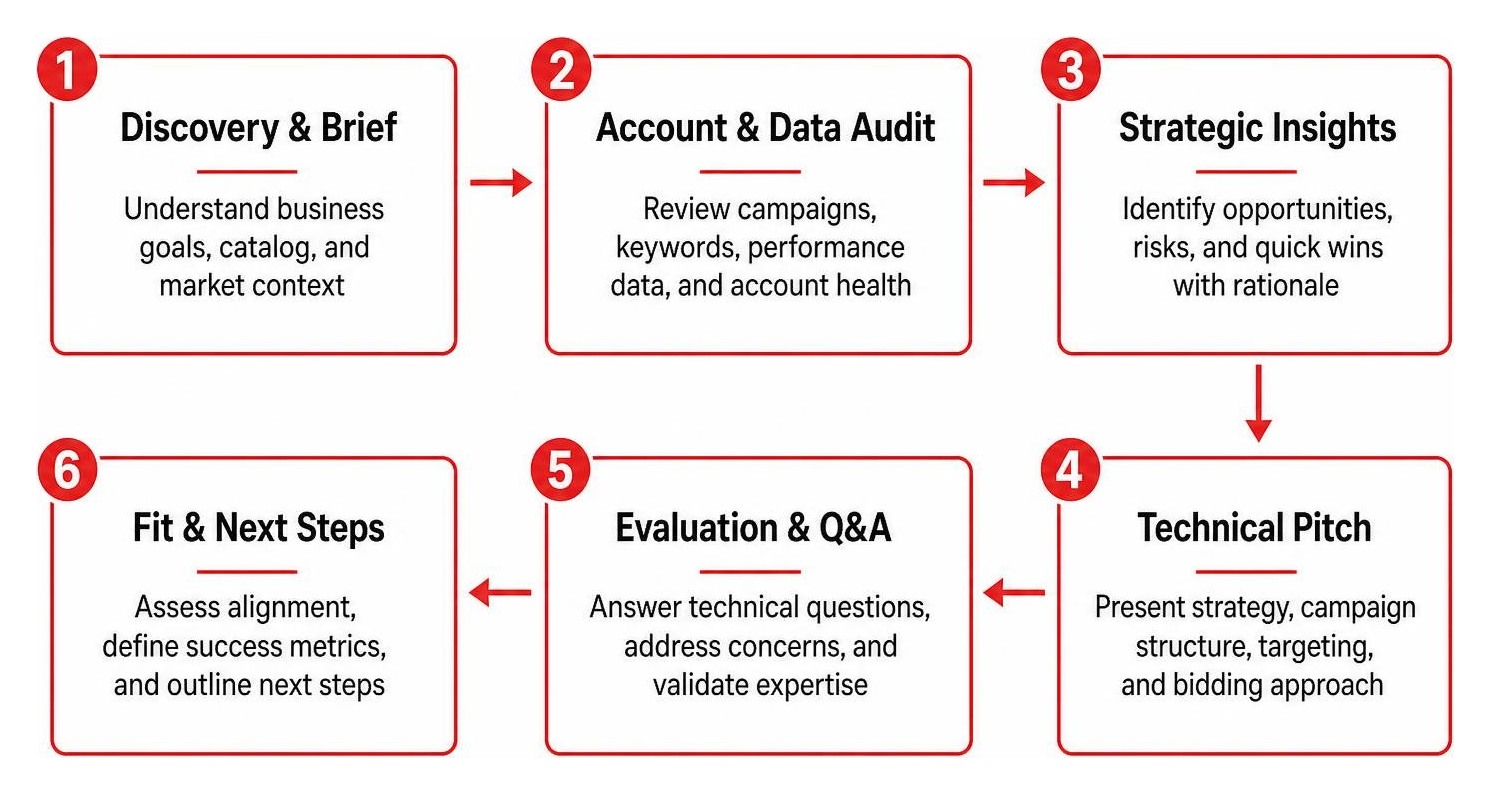
During the pitch, challenge the agency with these technical evaluation questions:
- Campaign Isolation: “How do you separate brand-defense keywords from non-branded discovery and competitor-conquesting targets in your bidding structure?”
- Negative Keyword Automation: “What exact match and phrase match negative workflows do you establish to prevent wasted spend across broad-match discovery campaigns?”
- Bidding Technology vs. Human Oversight: “Do you rely entirely on third-party black-box automation, or do dedicated human strategists review bid adjustments and dayparting schedules weekly?”
- Anomaly Detection: “How quickly does your team identify sudden conversion drops caused by lost buy-boxes, hijackers, or listing suppressions?”
- ASIN-Level Profitability: “How do you adjust campaign aggression when a product’s manufacturing cost increases or FBA storage fees rise during Q4 peak season?”
Red Flags and Costly Pitfalls to Avoid
Hiring the wrong agency wastes advertising capital, stalls sales momentum, and disrupts inventory health. Knowing the warning signs saves months of frustration and protects brand equity.

Over-Reliance on Vanity Metrics Over Bottom-Line Profitability
Be cautious of agencies that highlight massive increases in “ad-attributed sales” without reporting overall account profitability or TACoS. A common trick involves over-bidding on branded search terms—keywords your existing customers already use to find your products.
While branded campaigns show high ROAS on paper, they often cannibalize organic sales you would have received anyway, inflating the agency’s performance dashboard while shrinking net profit margins. Demand clear reporting that isolates branded vs. non-branded ad spend.
Siloed Advertising Management Without Inventory Awareness
Advertising cannot run in an operational vacuum. If an agency aggressively increases bids on a fast-selling ASIN without monitoring available warehouse units or inbound supply shipments, you risk stocking out.
Stockouts destroy Amazon organic search rankings, hand market share directly to competitors, and cause the platform’s algorithm to penalize listing relevance once inventory is restocked. A competent partner maintains active communication with your logistics team to throttle or boost campaigns in sync with inventory levels.
Frequently Asked Questions About Amazon Advertising Management
How long does it typically take to see measurable ROI from a new agency partner?
Most accounts experience initial efficiency improvements within the first 30 to 45 days as the agency restructures messy campaigns, eliminates negative search-term waste, and recalculates unprofitable bids.
Sustainable scaling and compound organic ranking gains typically materialize within 60 to 90 days as continuous conversion data trains Amazon’s search algorithm and refines audience targeting models.
What is the standard fee structure for retail media management?
Management fees vary based on catalog scale, monthly ad spend, and service scope:
- Small Accounts ($5,000–$20,000 monthly spend): Flat retainers typically range from $1,500 to $3,500 per month.
- Mid-Market Accounts ($20,000–$100,000 monthly spend): Hybrid structures or spend percentages between 8% and 12% ($3,000–$9,000/month).
- Enterprise Accounts ($100,000+ monthly spend): Scaled percentage tiers (often 4% to 8%) or custom retainer models, frequently incorporating Amazon DSP and multi-marketplace expansion management.
How does Amazon PPC directly impact organic keyword rankings?
Amazon’s search algorithm ranks products based primarily on customer purchase behavior and sales velocity. When paid campaigns drive consistent conversions on target keywords, the algorithm interprets that listing as highly relevant to shoppers searching for those terms.
As a result, your product earns higher organic search placements, generating free organic traffic that balances total advertising costs and lowers long-term TACoS.
Conclusion
Choosing the right advertising partner is one of the most critical decisions an e-commerce brand will make. A truly capable partner operates as an extension of your leadership team, aligning campaign architecture, keyword targeting, listing conversion, and supply chain logistics into a single, scalable growth engine.
By establishing clear expectations around data ownership, blended TACoS profitability, and transparent communication, you position your brand to win market share while protecting bottom-line margins.
If your business is ready to replace wasted ad spend with predictable, scalable marketplace revenue, explore our enterprise-grade digital marketing services ppc management to build a customized growth strategy tailored to your business goals.