From Ghost Town to Goldmine: A Modern Guide to Optimizing Your Online Presence
How to Optimize Your Online Presence in 2026
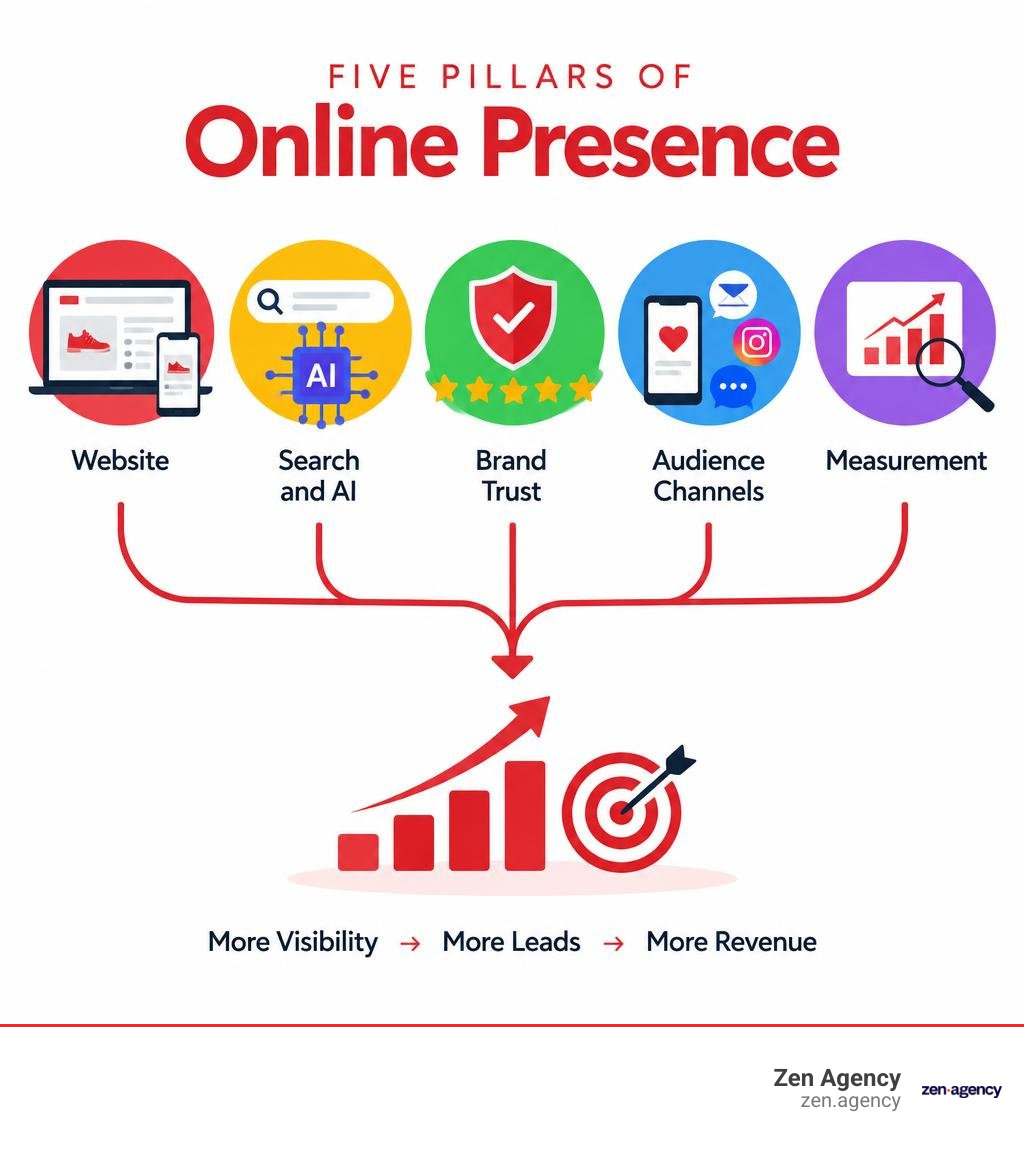
To improve your brand’s visibility online, start with a fast, mobile-friendly website that makes it easy to find your best products or services. Fix search indexing issues, publish useful answers to customer questions, and keep your brand details consistent across your site and other channels. Then use email and social media to bring people back, and track which visits turn into leads and sales.
Search results are no longer the only place people discover businesses. AI answers, founder profiles, reviews, and social conversations can all shape what customers learn about you before they visit your site. This guide shows you how to strengthen those touchpoints without losing sight of revenue.
I’m Joseph Riviello, founder and CEO of Zen Agency, and I’ve spent over 22 years helping businesses grow through digital marketing. My guiding principle is simple: Optimize online presence with a plan that connects visibility to leads, conversions, and revenue.
Key Optimize online presence vocabulary:
Core Pillars: How to Optimize Online Presence Across Web and Search
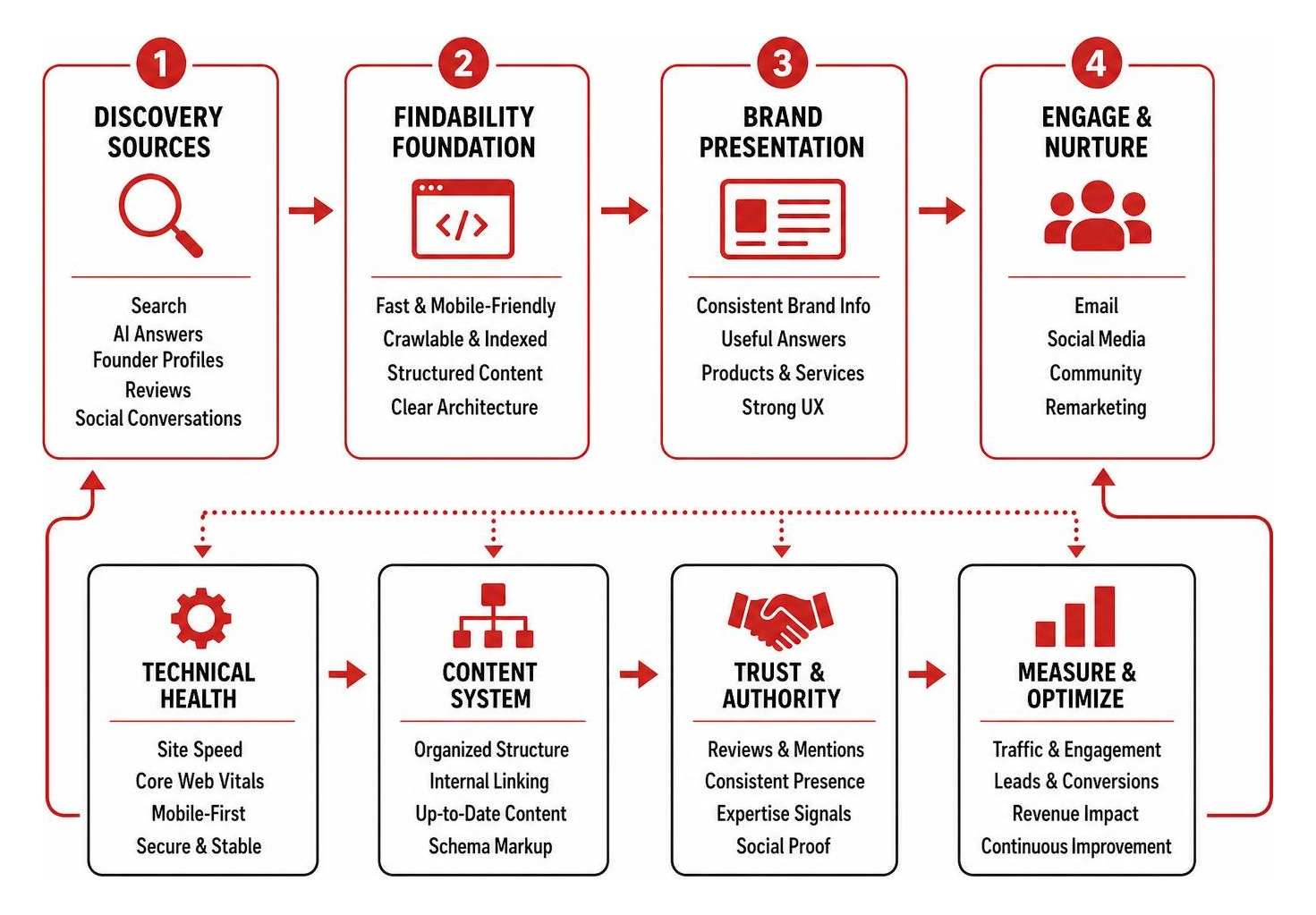
A modern digital footprint is not just a digital business card; it is the central operational hub of your business. If your technical architecture is fragmented, search engines cannot properly crawl your site, and prospective buyers will quickly bounce to a competitor.
At Zen Agency, we have spent over two decades helping businesses transform their digital operations. Our mission is to provide enterprise-grade solutions that empower scaling businesses to boost visibility, profitability, and return on investment. The foundation of any visibility strategy starts by turning technical barriers into smooth customer journeys that turn digital obscurity into organic traffic.

Website Performance, UX, and Mobile-First Infrastructure
User experience (UX) directly dictates whether a visitor converts or abandons your brand. Kissmetrics data shows that 47% of website visitors expect a page to load in under 2 seconds, while 40% will completely abandon a site that takes longer than 3 seconds. Even more striking: every one-second delay in page load time triggers an average 7% loss in conversions.
Users prioritize speed and convenience above all else. If your site’s navigation requires more than three clicks to find essential information, friction spikes. Achieving frictionless UX requires optimizing Core Web Vitals to eliminate visual shifts and input delays.
Furthermore, with mobile devices generating roughly half of all global web traffic, adhering to mobile-first indexing strategies is non-negotiable. Google evaluates the mobile version of your site first; if mobile typography, touch targets, and load speeds falter, your rankings across all devices will decline.
Technical, On-Page, and Local Search Optimization
On-page SEO organizes your content for human readers, while technical SEO ensures search bots can parse and index that content without wasting your allocated crawl budget. A search-ready architecture requires descriptive title tags, structured header hierarchies (H1 through H3), keyword-rich image alt text, and logical, shallow URL structures.
For businesses operating physical offices or service areas—such as our locations across Pennsylvania (including Wilkes-Barre, Scranton, Wyoming PA, Kingston PA, and Hazleton PA) and Billings, Montana—local visibility is driven by comprehensive local SEO tactics. Aligning local citations and business schema ensures search engines connect your physical operations with high-intent geographic searches. Combining these elements creates a solid foundation of structured website design and SEO.
Generative Engine Optimization: Optimizing for AI Overviews and LLMs
The search landscape has shifted dramatically. With 58% of US adults using AI for search weekly and 73% of B2B buyers relying on AI assistants during vendor research, traditional search engine results pages (SERPs) are no longer the sole gatekeepers of traffic. The rollout of AI-driven answer engines has contributed to a 40% drop in top-10 organic click-through rates for informational queries. Projections show that by the end of 2026, up to 30% of traditional web traffic will be absorbed by AI answer engines that resolve questions directly.
To stay visible, brands must adopt Generative Engine Optimization (GEO). Understanding GEO principles and framework helps businesses adapt from simply chasing blue links to earning direct AI citations.

Technical Structure: How to Optimize Online Presence for AI Search Engines
AI language models (such as ChatGPT, Perplexity, Claude, and Google AI Overviews) synthesize answers by evaluating training priors, retrieval quality, and answer structure. Research indicates that pages utilizing clear Q&A headings (H2/H3) are 2.4× more likely to be cited by AI engines than unstructured text blocks.
To structure your digital footprint for AI discovery:
- Deploy an
llms.txtFile: Similar torobots.txt, anllms.txtfile points large language models directly to clean, markdown-formatted source information about your core services and documentation. - Build Direct Answer Pages (DAPs): Create concise, 40- to 60-word definitive answers directly beneath H2 question headers before expanding into deeper technical details.
- Scale Structured Data: Implement
FAQPage,HowTo, andArticleschema markup across high-value pages. - Publish Original Data: AI models prioritize verifiable benchmarks, original research, and proprietary industry metrics when generating citations.
These structural adaptations are essential when optimizing for AI-generated search results.
AI Brand Sentiment, Accuracy Scores, and Citation Mapping
AI engines recommend the brands they understand. If your online messaging is ambiguous, LLMs may hallucinate details or favor competitors. In fact, industry data shows that prominent brands often suffer zero AI visibility on over 40% of queries where competitors actively win recommendations.
Using platforms like OptimizeGEO allows businesses to track share-of-voice across AI models, identify prompt gaps, and correct negative sentiment (often reducing inaccuracies from 5% down to 1%). Incorporating dedicated tools for AI brand indexing and measurement ensures your products, pricing, and positioning remain accurate and authoritative across conversational search tools.
Personal Entity Optimization: Building Machine-Readable Authority for Key Founders
Modern search algorithms and AI models evaluate entities (people, places, and organizations) rather than just keyword strings. If a company’s leadership lacks an established digital footprint, the brand’s overall topical authority suffers.
Steps to Optimize Online Presence Through a Founder Personal Hub
Personal Entity Optimization (PEO) builds a machine-readable, authoritative identity for founders and executives. Implementing Personal Entity Optimization for founders resolves ambiguous identity signals by connecting scattered profiles into a central entity node.
- Audit Canonical Identity: Standardize the founder’s name, professional headshot, and core biographical details across all platforms.
- Build a Dedicated Personal Hub: Create a canonical bio page on your primary domain or personal site that links out to official profiles (LinkedIn, YouTube, GitHub, ORCID).
- Embed Person Schema: Implement structured data containing
sameAsarray properties that point directly to verified social and organizational URLs. - Leverage Creator Tools: Eligible creators and executives can configure their Google Search profiles setup to claim, manage, and enrich their Google Knowledge Panels.
Establishing Third-Party Entity Proof and Credentials
Algorithms treat third-party references as objective proof of authority. To solidify an executive entity graph:
- Maintain a focused topical cluster covering 2 to 4 core areas of expertise.
- Secure external entity citations via podcast appearances, keynote addresses, and industry panel quotes.
- Highlight academic papers, patents, and technical contributions with verified external links.
- Regularly audit brand mentions to ensure third-party publishers use consistent canonical names and titles.
Omnichannel Expansion: Social Media, Email Marketing, and Content Distribution
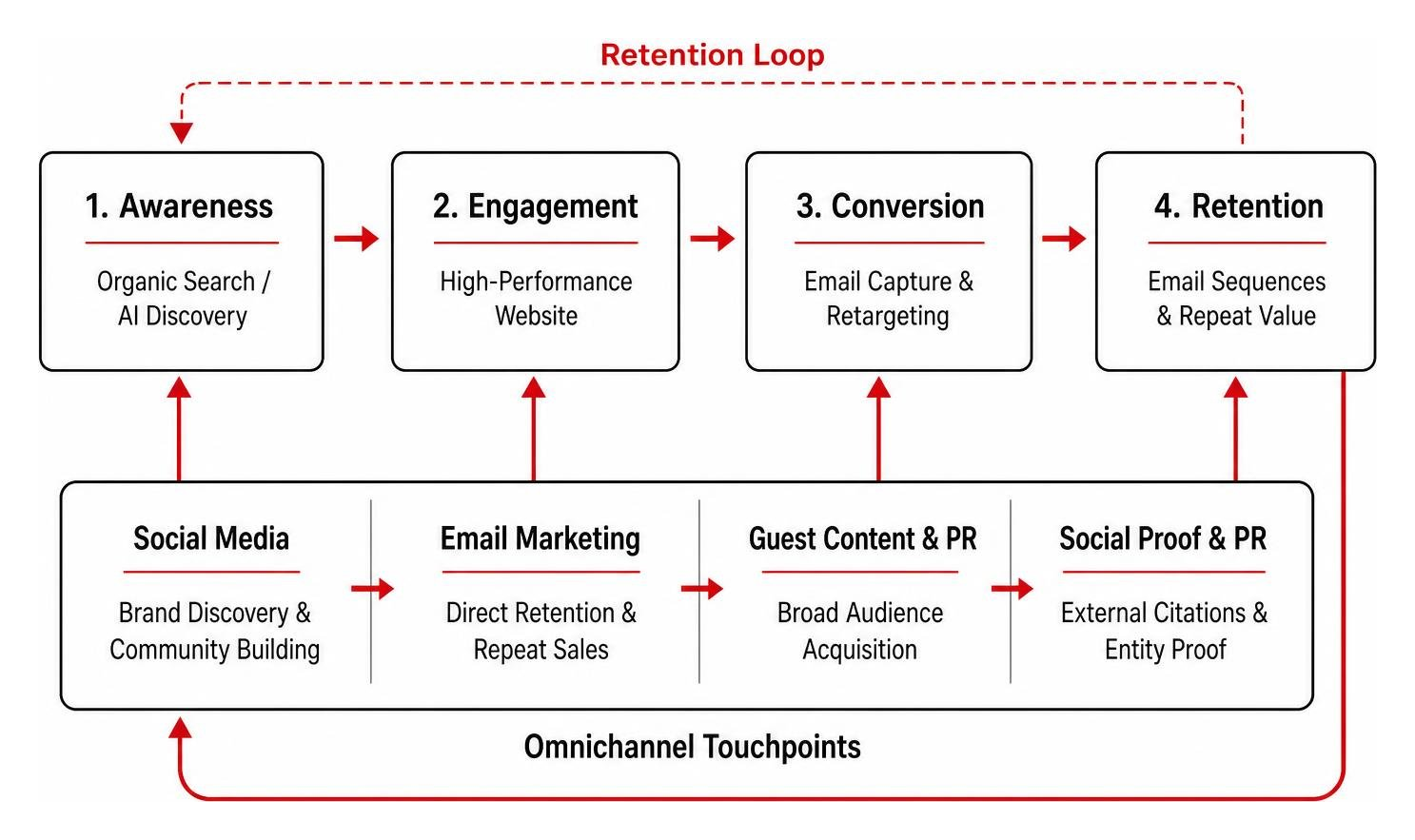
A robust digital strategy does not rely on a single channel. Creating a multi-touch ecosystem ensures that prospective buyers can find, engage with, and return to your brand across multiple touchpoints.
| Channel | Primary Conversion Focus | Typical Engagement Speed | Authority & SEO Impact |
|---|---|---|---|
| Website & Organic Search | High-intent lead capture & sales | Long-term (30–90+ days) | High (Core domain authority & rankings) |
| Email Marketing | Direct retention & repeat sales | Immediate (Hours to days) | Indirect (Traffic referral & engagement) |
| Social Media Channels | Brand discovery & community building | Real-time (Minutes to hours) | Medium (Social signals & referral reach) |
| Guest Content & PR | Broad audience acquisition | Medium (Weeks) | High (Quality backlinks & entity proof) |
High-Converting Email Sequences and Product Prioritization
Around 91% of consumers check their email every day, making email one of the highest-converting digital assets available. While social media algorithms fluctuate, an email list provides direct communication with your audience.
- Welcome Sequences: Introduce your core brand story, highlight primary services, and set clear expectations.
- Cart Abandonment & Re-engagement: Recover missed conversions by addressing purchase hesitations with timely incentives or helpful answers (over 80% of buyers require support during their purchasing journey).
- Product Prioritization: Showcase your primary, high-margin offerings directly on your homepage and in automated email sequences rather than overwhelming visitors with secondary options.
Social Engagement and Guest Content for Brand Growth
Social platforms provide direct brand discovery and customer engagement channels. Adopting proactive strategies for leveraging social media for brand growth builds trust and community advocacy.
Engaging with your audience by responding to comments, sharing educational insights, and incorporating proven tactics from modern social media marketing creates indirect search signals that lift overall branded search interest. Complementing social distribution with high-quality guest blogging establishes authoritative backlinks and introduces your brand to established, relevant audiences.
Auditing and Protecting Your Digital Footprint: Security, Competitors, and KPIs
Building a strong digital presence requires ongoing maintenance and protection. Running regular technical reviews uncovers crawl errors, security vulnerabilities, and competitor content gaps before they impact performance.
Executing a structured audit using our guide to conducting a full SEO audit provides the baseline data needed to prioritize high-impact optimizations.
| Metric Focus | Diagnostic Tool | Primary Purpose | Benchmark Target |
|---|---|---|---|
| Page Speed & UX | Google PageSpeed Insights | Evaluate Core Web Vitals | Load time < 2.0s; LCP < 2.5s |
| Crawlability | Google Search Console | Identify indexation & crawl errors | 0 critical crawl errors |
| AI Visibility & Citations | Specialized GEO Platforms | Track AI engine citations & sentiment | > 70% citation accuracy score |
| Traffic & Conversions | Google Analytics 4 (GA4) | Measure path-to-lead & revenue | Continuous positive conversion trend |
Digital Security Reviews and Trust Signals
Security directly impacts consumer trust and search performance:
- Active HTTPS/SSL Protocols: Secure data transmission protects user inputs and provides a recognized browser trust signal.
- Routine Security Patching: Keep CMS platforms, plugins, and server software updated to eliminate exploitable vulnerabilities.
- Compliance & Backups: Maintain encrypted, off-site daily backups and ensure clear compliance with data privacy regulations.
Key Metrics and Analytics to Measure Growth
Track both traditional search indicators and modern generative metrics:
- Organic Click-Through Rate (CTR): Monitor search impressions against actual clicks in Search Console.
- AI Citation Share: Track how frequently AI tools cite your brand when answering product or service queries.
- Branded Search Volume: Measure name-plus-topic queries over time to gauge brand authority growth.
- Assisted Conversions: Use GA4 multi-touch attribution to assess how content, social channels, and search interactions combine to drive revenue.
Frequently Asked Questions About Optimizing Your Online Presence
What is the difference between traditional SEO and Generative Engine Optimization (GEO)?
Traditional SEO focuses on optimizing web pages to rank in top search engine positions (the classic ten blue links) using keywords, on-page structure, and backlinks. Generative Engine Optimization (GEO) focuses on structuring information so large language models (like ChatGPT, Gemini, and Perplexity) can parse, trust, and synthesize your content into direct citations and conversational answers.
How quickly can a business see measurable results from online presence optimization?
Technical fixes (such as resolving broken links, speeding up page load times, and adding schema markup) can yield indexing improvements within days. Content expansions, backlink acquisition, and AI citation growth typically demonstrate clear, compounding results within 30 to 90 days.
Why is mobile optimization critical for modern conversion rates?
Mobile devices drive roughly half of all internet traffic, and search engines index the mobile version of websites by default. A slow, poorly formatted mobile site increases bounce rates, damages brand credibility, and directly decreases conversion rates.
Conclusion
Optimizing your online presence is not a one-time project; it is an ongoing operational strategy that requires alignment across technical performance, modern search systems, brand authority, and audience retention.
By building a fast, secure website, structuring content for both human readers and AI answer engines, and standardizing your entity authority, you turn passive digital touchpoints into consistent revenue drivers.
If your business is ready to modernize its digital footprint and scale efficiently, explore our custom website design and development services to build an enterprise-grade digital foundation.