Unlock Your E-commerce Potential: Simple Steps to Increase Online Sales
Why Growing Online Revenue Matters More Than Ever
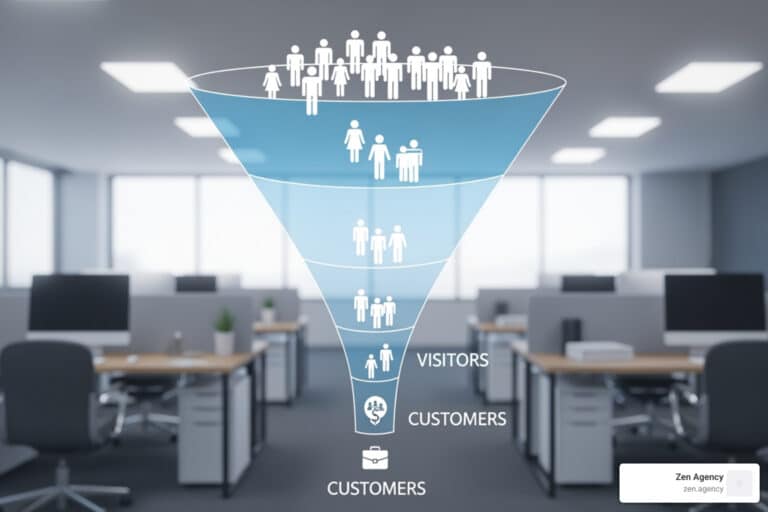
Grow online revenue isn’t just about attracting more visitors to your website—it’s about building a system that converts those visitors into paying customers and maximizes their value over time. Here’s how to do it effectively:
Key Ways to Grow Online Revenue:
- Optimize your conversion rate – Turn more visitors into buyers through better website design and checkout processes
- Increase customer lifetime value – Use upselling, cross-selling, and loyalty programs to maximize revenue per customer
- Expand your reach – Leverage SEO, content marketing, and paid advertising to attract qualified traffic
- Test and refine continuously – Use A/B testing and data analysis to make informed decisions
- Build strategic partnerships – Collaborate with complementary businesses to tap into new audiences
The challenge of increasing online revenue is not just about getting more traffic, but converting that traffic into paying customers and maximizing their value over time. According to recent data, up to 72% of shoppers abandon their shopping cart before completing a purchase, and nearly 50% of online businesses fail within five years due to lack of a documented growth strategy.
Yet businesses with a clear, data-driven approach see dramatically different results. A small 1% price increase can lead to an 11% profit boost. Acquiring a new customer costs five times more than retaining an existing one. These numbers highlight why a systematic approach to revenue growth is essential.
This guide provides a comprehensive roadmap, from foundational strategies to advanced optimization techniques, to help you open up your store’s full potential. Whether you’re struggling with poor conversion rates, high customer acquisition costs, or simply want to scale more effectively, these proven strategies will help you build a sustainable revenue engine.
I’m Joseph Riviello, and over 22 years of leading digital marketing initiatives, I’ve helped countless businesses grow online revenue through holistic, data-driven strategies that address every aspect of the customer journey. At Zen Agency, we’ve seen how the right combination of website optimization, strategic marketing, and continuous testing can transform struggling online stores into thriving revenue generators.
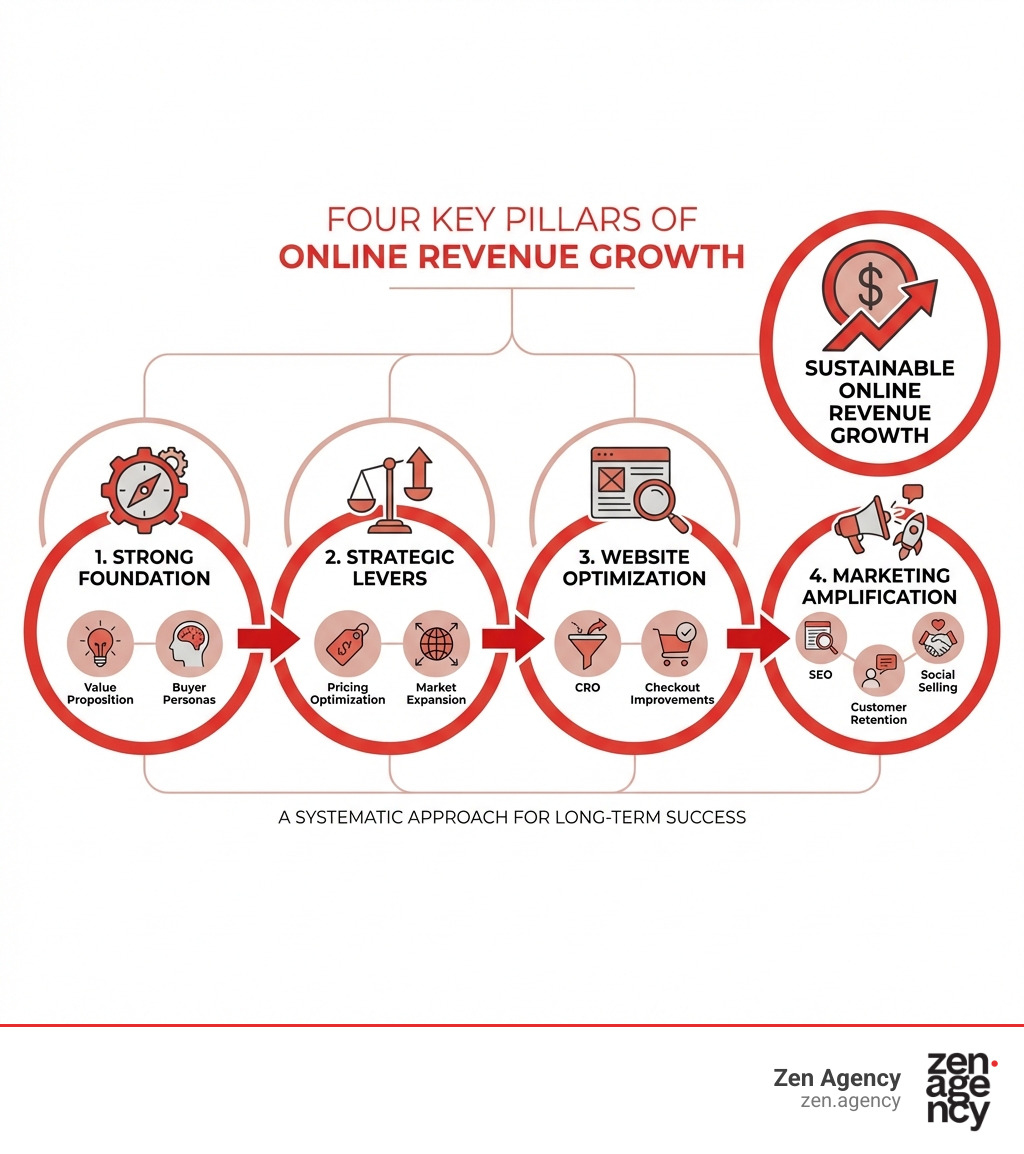
Foundation: Understand and Define Your Revenue Engine
Before we dive into specific tactics, let’s talk about your “revenue engine.” What exactly is it? Think of it as the complete system of marketing and sales processes that consistently brings money into your business. Whether it’s driven by marketing campaigns, direct sales efforts, customer referrals, or a blend of all three, every business has one – even if it’s not clearly mapped out.
Many small business owners we work with in places like Scranton, PA, and Billings, MT, don’t take the time to truly understand where their revenue is coming from. They see the phone ringing, emails coming in, or occasional form submissions on their website, but the underlying mechanics remain a mystery. Understanding this engine is crucial. It’s the first step toward intentional, sustainable growth, allowing you to pinpoint what’s working, what’s not, and how to fix any slowdowns or scale what’s performing well. Without this foundational understanding, any growth efforts might just be temporary boosts rather than long-term gains.
Define Your Unique Value Proposition
At the heart of your revenue engine is your unique value proposition. This isn’t just a catchy slogan; it’s a clear statement that articulates the specific benefit you offer, how you solve your customer’s problems, and what makes you distinctly different from your competitors. For example, if you’re a custom website development agency, your value proposition might be delivering enterprise-grade solutions with a focus on measurable ROI, setting you apart from generalist web designers.
Your value proposition is the core of all your messaging and a critical factor in converting visitors into customers. It’s what makes people choose you over others. If it’s not immediately obvious and compelling, you’re leaving potential revenue on the table. A strong value proposition resonates with your target audience, addressing their needs and desires directly. Developing a strong brand strategy begins with a crystal-clear value proposition.
Create Detailed Buyer Personas
Once you know what you offer, you need to know who you’re offering it to. This is where detailed buyer personas come in. A buyer persona is a semi-fictional representation of your ideal customer, based on market research and real data about your existing customers. We go beyond basic demographics like age and location. We dig into their income, likes, dislikes, motivations, goals, pain points, and even their online behavior.
For instance, a business selling custom WooCommerce solutions in Kingston, PA, might develop a persona for “E-commerce Emily,” a small business owner frustrated with her current platform’s limitations and seeking a scalable, custom solution. By understanding Emily’s challenges and aspirations, we can tailor our marketing messages, product features, and even customer service approach specifically for her. This level of understanding allows for highly targeted marketing campaigns, personalized website experiences, and the development of products or services that genuinely meet their needs. Creating compelling calls-to-action for lead generation becomes infinitely easier when you know exactly who you’re talking to. You can even find example buyer personas to help you get started.
High-Impact Business Strategies for Growth

Moving beyond the day-to-day operations, these high-level strategies act as powerful levers for significant jumps in your online revenue. They demand careful planning, rigorous analysis, and a willingness to innovate. Think of them as strategic moves on a chessboard, each designed to position your business for maximum advantage.
Optimize Your Pricing Strategy
Pricing is often overlooked, but it’s a potent driver of revenue. Did you know that a small 1% price increase can lead to an impressive 11% profit boost? This statistic alone highlights why optimizing your pricing strategy isn’t just about covering costs, but about maximizing profit margins. Many businesses are hesitant to raise prices, fearing customer loss, but often, they’re leaving significant revenue on the table.
We encourage businesses to experiment with different pricing models. Consider bundling products or services, introducing subscription services for recurring revenue, or implementing tiered pricing options (e.g., basic, premium, enterprise). These models can increase perceived value and average order value. For example, offering a slightly less attractive “decoy” option can make your desired product seem like an even better deal. Forecasting and modeling can build your confidence to implement these new pricing strategies. To learn more about how psychological principles can influence buying decisions, check out this post about pricing psychology.
Expand Into New Markets and Product Lines
Growth often comes from reaching beyond your current boundaries. If your products or services have found success locally, perhaps in Wilkes Barre or Hazleton, PA, it might be time to expand your reach. This could mean venturing into new geographic markets or exploring direct-to-consumer (DTC) channels via e-commerce if you’re primarily a wholesale business. Before expanding, conduct a thorough market analysis, looking at competitors, underserved segments, and even tax implications.
Alternatively, consider expanding your product or service offerings. If expanding physical products isn’t feasible, adding complementary services like personalization, subscriptions, maintenance, or installation can be a viable path. Leverage your existing customer knowledge and sales channels; what else do your current customers need or want? Our e-commerce design services can help you build the infrastructure for these expansions.
Forge Strategic Partnerships
Strategic partnerships can create synergistic opportunities that significantly boost your revenue. Identify businesses that offer complementary products or services to yours but aren’t direct competitors. For instance, if you sell high-end outdoor gear in Billings, MT, partnering with a local adventure tour company could expose you to a highly relevant audience.
These partnerships can take many forms: joint marketing campaigns, bundled offers, co-hosted events, or even affiliate arrangements. It’s a cost-effective way to tap into new customer segments and expand your reach without incurring the full cost of new customer acquisition. By collaborating, you improve the customer experience and create a win-win situation for both businesses.
Website Optimization: Turning Visitors into Revenue
Your website isn’t just an online brochure; it’s your digital storefront, your sales engine, and a critical component for how you grow online revenue. Optimizing it is paramount for maximizing sales from the traffic you already have. This isn’t a one-and-done task; it’s a continuous process of testing and refinement that ensures every visitor has the best possible experience, leading to more conversions and increased revenue.
Implement a Conversion Rate Optimization (CRO) Framework
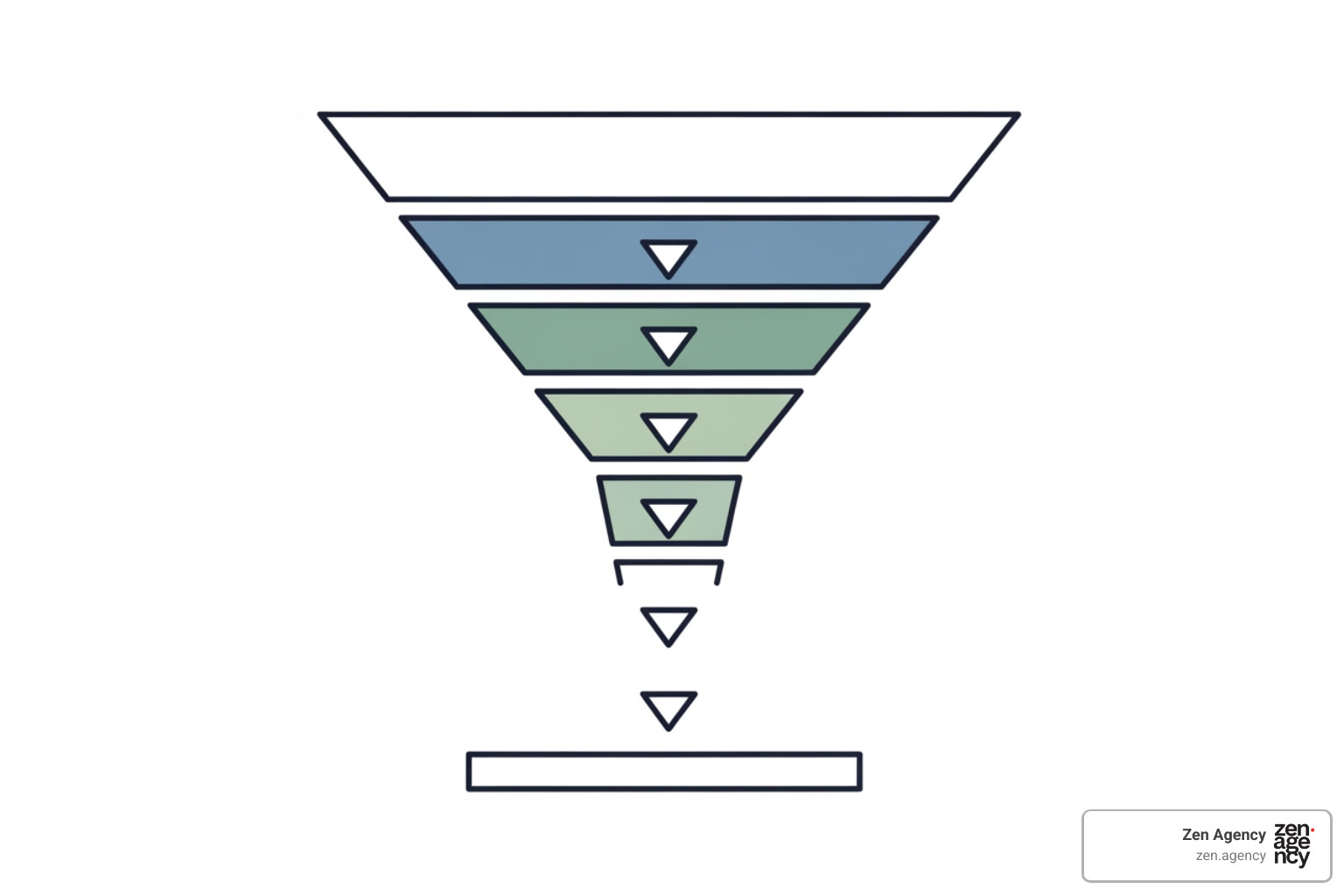
Conversion Rate Optimization (CRO) is all about doing better with what you already have. It’s the systematic process of increasing the percentage of website visitors who take a desired action, such as making a purchase or filling out a form. We’ve seen how even a modest 1% to 2% increase in conversion rate can translate into tens, or even hundreds of thousands of dollars annually for businesses in Pennsylvania and Montana.
A structured CRO approach involves four main stages:
- Identification of problems: Through audits, user tests, and analytics, we pinpoint areas where visitors are dropping off or getting confused.
- Creation of hypotheses: We formulate educated guesses about what changes might solve these problems and improve conversion.
- Testing these hypotheses: We implement changes and run experiments (like A/B tests) to see their impact.
- Analysis and conclusion: We analyze the results to understand what worked, what didn’t, and why, then implement successful changes permanently.
This data-driven method ensures that your website changes positively impact revenue, rather than being based on guesswork. For deeper insights, explore our CRO best practices.
Master the Checkout and Shopping Experience
The checkout process is often the final hurdle, and unfortunately, it’s where many businesses trip up. The average shopping cart abandonment rate hovers around 66.5%, meaning a significant portion of potential sales—approximately $4 trillion worth of online merchandise last year alone—is lost annually. A major culprit? Unexpectedly high costs like shipping, which account for 48% of abandoned carts.
To grow online revenue, you must master this critical stage:
- Reduce Friction: Online shoppers expect transactions to be completed in less than 5 minutes. Streamline your checkout by eliminating unnecessary steps and fields. The average checkout page has nearly 15 form fields, yet a fully optimized flow can have as few as 7. Offer guest checkout to prevent mandatory account creation from deterring purchases.
- Offer Multiple Payment Options: Cater to customer preferences by providing a wide range of payment methods, including digital wallets, credit cards, and local options.
- Mobile Optimization: With mobile search eclipsing desktop and over 40% of online transactions happening on mobile, your checkout process must be flawlessly responsive and easy to use on any device.
- Build Trust: Display clear trust signals. This includes having an SSL certificate to secure customer data and offering a bulletproof money-back guarantee. A guarantee eliminates purchase risk and builds immediate trust, as nearly 70% of consumers check the returns page before buying.
- Free Shipping: 9 out of 10 consumers cite free shipping as a persuasive incentive. Even if you incorporate the cost into your product price, it can significantly reduce abandonment.
Don’t let abandoned carts become lost opportunities. Learn how to recapture lost sales with abandoned cart emails.
How A/B Testing Helps You Grow Online Revenue
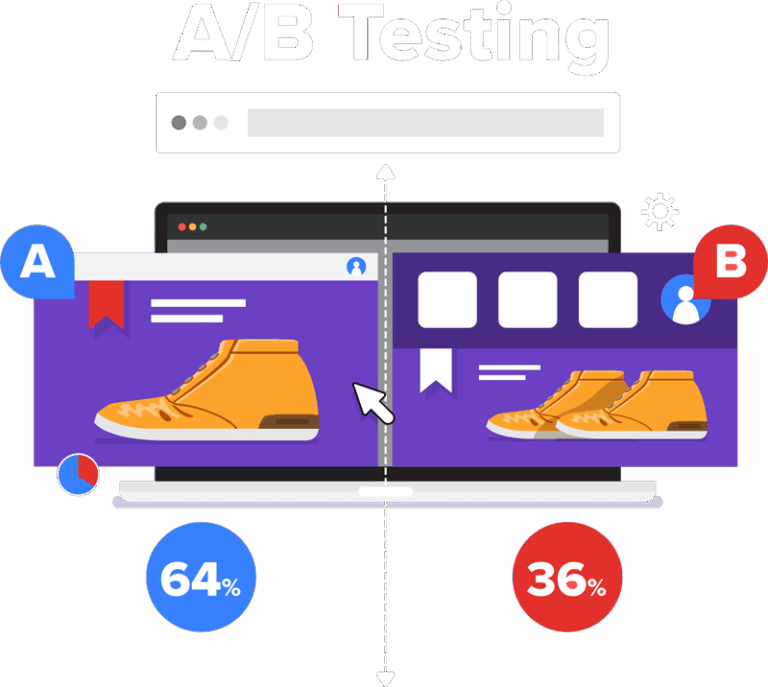
A/B testing is the cornerstone of effective website optimization and a powerful tool to grow online revenue. It’s how we move from assumptions to data-backed decisions. Instead of guessing which changes will improve your website, you can test them systematically.
Here’s how it works: you create two versions of a webpage element (A and B)—it could be a button color, a headline, an image, or an entire page layout. Then, you show version A to a segment of your audience and version B to another segment. By tracking how each version performs (e.g., which one leads to more clicks, sign-ups, or purchases), you can objectively determine which change is more effective.
This continuous process of split testing removes the guesswork from website improvements, allowing you to make incremental, data-driven changes that compound over time for significant revenue gains. For example, testing different call-to-action messages or placements can reveal surprising insights into user behavior. We often use A/B testing in our work with businesses in Allentown, PA, and other regions to ensure every optimization is truly impactful. Understand the importance of A/B testing for your lead generation efforts.
Boost Sales with Optimized Site Search and Personalization
To truly maximize your online store’s potential, you need to think beyond static product displays. Two powerful techniques are optimizing your site search (also known as search merchandising) and personalization.
Search merchandising is the art and science of optimizing your website’s internal search engine. It’s about ensuring that when a customer types a query into your search bar, they don’t just get results, but relevant results that guide them toward a purchase. For example, if a user searches for “running shoes,” a well-optimized internal search might not only show running shoes but also suggest related items like running socks or apparel. This improves the effectiveness of your internal search, particularly for motivated users, and can significantly boost sales, with some businesses seeing a 48% increase in average basket value from these efforts.
Personalization takes this a step further by adapting the entire website experience based on the individual user’s characteristics, behavior, or even traffic source. Think about how Amazon shows different homepages to different users based on their browsing and purchase history. This isn’t magic; it’s data-driven personalization. By using data to customize content, product recommendations, and offers, you make the user journey far more relevant and engaging. We’ve seen personalization lead to impressive results, such as a 37% increase in form launches coupled with a 42% increase in form submissions in one instance. Leveraging customer data to improve marketing strategies and tailor offers is key to increasing conversion rates. For advanced customization and integration of such features, consider custom WooCommerce development.
Amplify Your Reach: Marketing & Sales Strategies to Grow Online Revenue
Driving qualified traffic and maximizing customer value are essential for sustained growth. A well-leveraged, multi-channel marketing strategy not only increases your market share but directly contributes to how you grow online revenue. It’s about reaching the right people, at the right time, with the right message, and then nurturing that relationship.
Improve Online Visibility with SEO and Content Marketing
In today’s digital landscape, being found is the first step to being bought. Improving your online visibility through Search Engine Optimization (SEO) and content marketing is a long-term investment that yields sustainable results. SEO involves optimizing your website’s technical aspects, content, and backlink profile to rank higher in search engine results. This means using relevant keywords in your product descriptions, blog posts, and page titles, ensuring your site loads quickly, and building high-quality backlinks.
Content marketing complements SEO by creating valuable, informative, and engaging content that answers your customers’ questions and positions you as an industry authority. This could be blog articles, how-to guides, videos, or infographics. Google’s algorithms increasingly reward expertise, depth, and user satisfaction, so genuinely helpful content will not only attract visitors but also build trust and credibility. While SEO and content marketing require 6-12 months for significant traction, the organic traffic they generate is highly qualified and cost-effective in the long run. Learn more about why investing in SEO is crucial for your business.
Increase Customer Lifetime Value to Grow Online Revenue
Acquiring new customers is important, but retaining them is often more profitable. The numbers don’t lie: it costs five times more to acquire a new customer than to retain an existing one. This makes increasing Customer Lifetime Value (CLV) a critical strategy for sustainable revenue growth.
We focus on two main tactics to boost CLV:
- Customer Loyalty Programs: Implementing loyalty programs that reward customers with points for purchases, exclusive discounts, or early access to new products encourages repeat business and builds stronger relationships. This makes customers feel valued and incentivizes them to continue shopping with you.
- Upselling and Cross-selling: These strategies involve offering existing customers additional products or services that align with their needs. Upselling is about encouraging a customer to purchase a more expensive, upgraded version of a product they’re already considering (e.g., a premium subscription). Cross-selling involves offering complementary products (e.g., suggesting a phone case when a customer buys a new phone). Both tactics increase the average order value and, consequently, the lifetime value of each customer.
By nurturing your existing customer base, you build a loyal community that not only buys more but also becomes advocates for your brand. Find our 5-step process for increasing customer lifetime value.
Use Social Selling and Remarketing to Close More Deals
In today’s interconnected world, your sales strategy needs to extend beyond your website. Social selling and remarketing are two powerful ways to engage with prospects and close more deals.
Social selling involves building relationships and trust by actively engaging with prospects on social media platforms like LinkedIn, Facebook, and Instagram. This isn’t about hard selling; it’s about sharing valuable content, participating in relevant discussions, and providing quick, honest answers to questions. We’ve seen that LinkedIn posts, for example, receive 300% higher engagement than cold emails, and 81% of shoppers say posts from friends have directly influenced their purchasing decisions. By being present and helpful, you build a rapport that can eventually lead to conversions.
Remarketing, also known as retargeting, is considered a highly effective strategy for closing more deals online. Most website visitors won’t convert on their first visit. Remarketing allows you to show targeted ads to people who have previously visited your website but didn’t make a purchase. This keeps your brand top-of-mind and provides multiple opportunities to bring them back to your site to complete their transaction. Whether it’s reminding them about items left in their cart or showcasing products they viewed, remarketing helps nurture those nearly-there customers across various platforms. To understand its power, check out what remarketing is and why you should care. Analyzing your attribution and conversion paths will further refine these efforts, showing you exactly how these touchpoints contribute to the final sale.
Conclusion
Growing your online revenue is a multifaceted endeavor that combines a solid business foundation, strategic growth initiatives, rigorous website optimization, and smart marketing. It’s not about finding one magic bullet, but about continuously improving across all fronts. By understanding your revenue engine, defining your value proposition, knowing your customers intimately, and then applying high-impact business and website optimization strategies, you can transform your online presence into a powerful, sustainable revenue generator.
For businesses ready to implement enterprise-grade strategies and achieve scalable growth, the team at Zen Agency provides expert guidance in custom website design and development to build a powerful revenue engine. From our offices in Scranton, PA, and Billings, MT, we’re dedicated to helping businesses like yours thrive in the competitive online marketplace.