Designing for GDPR Compliance from Cookie Banners to Checkout
How to Design a GDPR-Compliant Website
Start with the full visitor journey. Block non-essential tracking until users consent. Give people clear accept and reject choices, ask for only the data each form needs, and keep marketing opt-ins separate from purchases or downloads. Make privacy details and ways to withdraw consent easy to find and use, including on mobile.
These choices matter beyond the cookie banner. The EU GDPR can apply to businesses outside the EU when they offer goods or services to people there or monitor their behavior. The UK has its own GDPR rules. Poor privacy design can erode trust, while serious EU GDPR breaches can bring fines of up to €20 million or 4% of worldwide annual turnover, whichever is higher.
I’m Joseph Riviello, founder of Zen Agency. My 22 years leading digital marketing work have taught me to look at the whole website journey; this guide applies that approach to GDPR compliant website design, from the first visit through checkout.
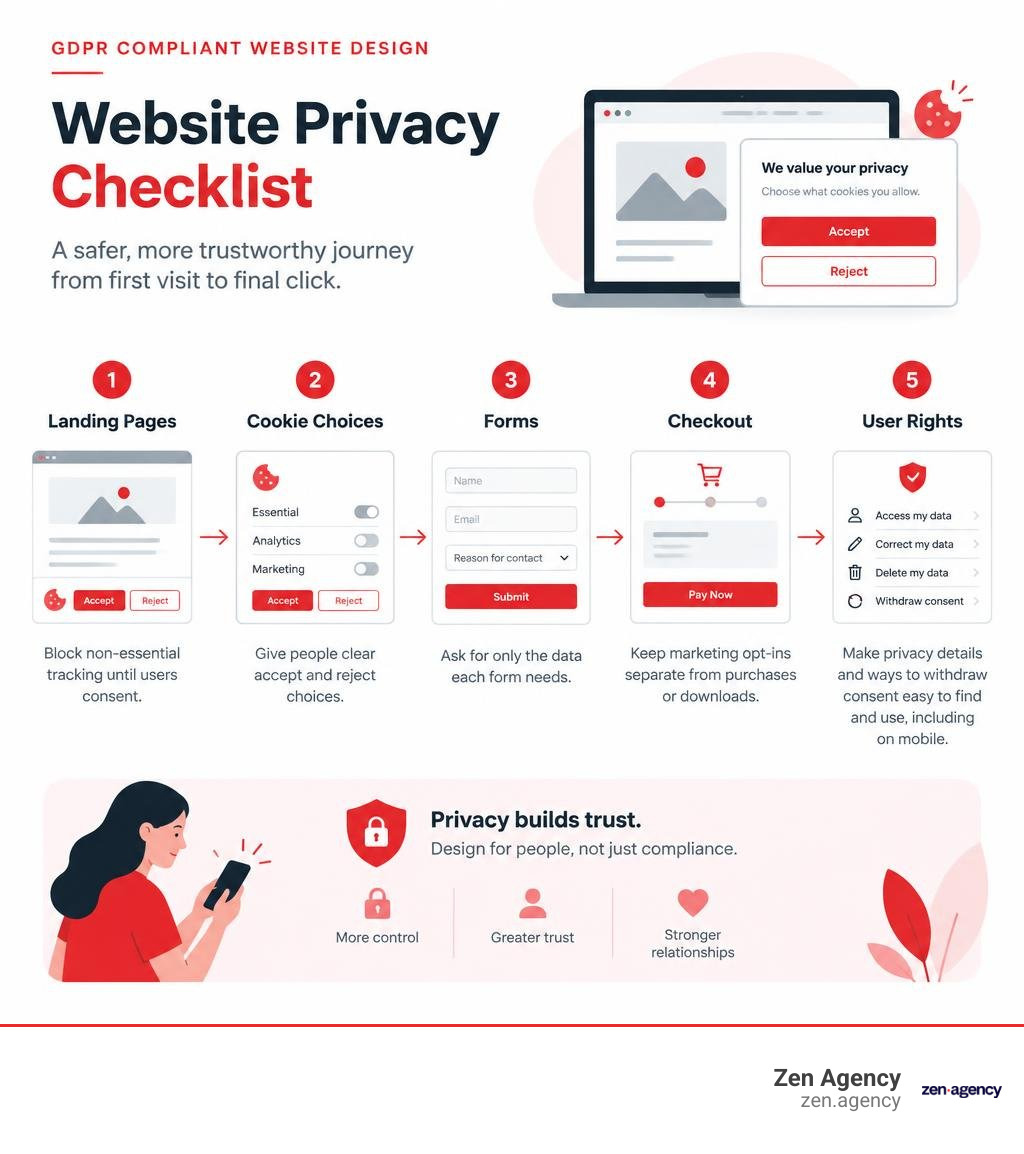
Key terms for GDPR compliant website design:
Core Principles of GDPR Compliant Website Design
Achieving genuine compliance requires integrating data privacy directly into your digital architecture. When building tailored digital experiences through our custom website design services, we align every wireframe and user flow with the fundamental principles outlined in the General Data Protection Regulation (GDPR).
Privacy cannot be an afterthought retrofitted via a generic plugin. According to academic research on design patterns for GDPR compliance, embedding privacy mechanisms directly into user interface patterns dramatically improves user understanding and reduces compliance risks (DOI 10.34726/hss.2019.59380). The core principles that must guide your design decisions include:
- Lawfulness, Fairness, and Transparency: Personal data must be processed lawfully and fairly, with clear visibility into how information is collected, stored, and utilized.
- Purpose Limitation: Data collected for a specific purpose (such as billing an order) must never be secretly repurposed for unrelated marketing campaigns.
- Data Minimization: Interfaces should only solicit the exact fields required to deliver the immediate service.
- Accuracy: Systems must allow users to review, correct, and update their personal records effortlessly.
- Storage Limitation: Retain data only as long as necessary, establishing automated retention and deletion schedules.
- Integrity and Confidentiality: Implement robust encryption, secure session management, and restricted database access to protect personal records from exposure.
Privacy by Design and Data Minimization in UI/UX
Privacy by Design means that privacy settings default to the most restrictive tier. How you structure these initial touchpoints directly influences how user experience affects brand perception. A user-centric, privacy-conscious interface demonstrates respect for your audience’s personal boundaries, establishing foundational brand credibility.
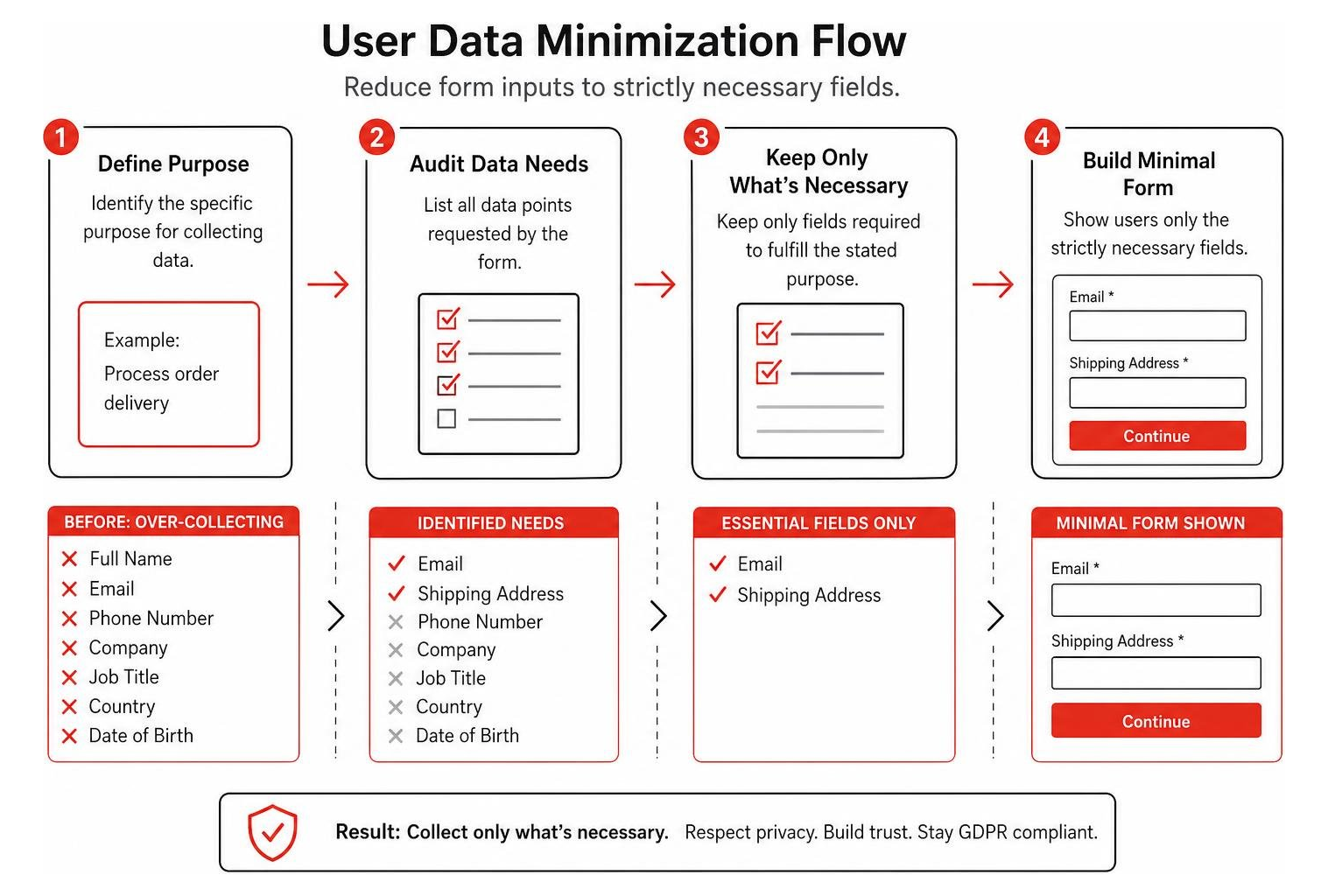
Data minimization in UI/UX involves auditing every interface component:
- Eliminate Superfluous Fields: Remove unnecessary fields (such as phone numbers or birthdates on standard inquiry forms) unless strictly mandatory for fulfillment.
- Zero Pre-Selected Toggles: Ensure all optional tracking, newsletter subscriptions, and cross-site sharing checkboxes remain unchecked by default.
- Context-Driven Input Requests: Solicit secondary data only when the user explicitly triggers an advanced feature that requires it.
Layered Information Architecture and Transparency
Presenting complex legal disclosures without overwhelming your visitors requires a thoughtful approach to user experience information architecture. Walls of dense legal text lead to cognitive overload and uninformed consent.
To solve this, implement the CNIL layered information design pattern, which organizes disclosures into progressive stages:
- Layer 1 (Immediate Context): Concise microcopy displayed at the point of capture (e.g., underneath a form input), detailing who is collecting the data, the exact purpose, and a direct link to full disclosures.
- Layer 2 (Categorized Policy Sections): Structured, scannable privacy centers that group topics (such as analytics, third-party sharing, and user rights) using accordion menus and clear breadcrumb navigation.
- Layer 3 (Complete Legal Documentation): The comprehensive legal policy containing statutory references, Data Protection Officer (DPO) contact records, and formal technical disclosures.
Designing Compliant Cookie Banners and Consent Flows

Cookie compliance is governed by the prior consent rule: no non-essential script (including analytics, heatmaps, remarketing pixels, or third-party embeds) may execute before the user provides an affirmative opt-in.
Step-by-Step GDPR Compliant Website Design for Cookie Notices
Building a compliant consent banner requires balancing regulatory strictness with intuitive visual hierarchy:
- Block Tracking Scripts by Default: Utilize a robust Consent Management Platform (CMP) or custom script gating to hold third-party scripts in a pending state until an affirmative choice is logged.
- Provide Equal Visual Weight: The “Reject All” button must match the “Accept All” button in size, contrast ratio, font weight, and positioning. Concealing the rejection mechanism behind secondary menus violates GDPR standards.
- Offer Granular Category Selection: Allow visitors to customize preferences across distinct categories:
- Strictly Necessary (always active, essential for basic site functionality)
- Functional/Preferences (stores language or regional UI states)
- Analytics/Performance (measures aggregate visitor behavior)
- Marketing/Targeting (tracks users across digital platforms for advertising)
- Integrate Direct Policy Links: Display an accessible link directly to your Cookie Policy within the primary banner text.
- Maintain Responsive Layouts: Ensure consent banners do not obstruct core navigation or cause severe layout shifts on mobile devices, which helps in boosting your website conversions with better design. Designers can explore community-validated frameworks or inspect free GDPR website layouts on Webflow to review standard responsive consent patterns.
Eliminating Deceptive Dark Patterns in Consent Interfaces
The European Data Protection Board (EDPB) maintains strict enforcement against manipulative interfaces, as detailed in regulatory guides on deceptive dark patterns on websites. Deceptive patterns trick users into surrendering personal data under the guise of convenience.
| Interface Element | Compliant GDPR Design Pattern | Non-Compliant Dark Pattern |
|---|---|---|
| Primary Actions | “Accept All” and “Reject All” displayed with identical contrast and styling. | “Accept All” as a prominent colored button; “Decline” hidden as a faint text link. |
| Category Toggles | All non-essential categories unchecked by default. | Pre-ticked analytics and marketing boxes hidden within nested settings. |
| Consent Revocation | Persistent floating badge or footer link accessible across all pages. | Forcing users to clear browser caches or email support to revoke tracking. |
| Language & Copy | Neutral, objective language explaining data processing. | Confirmshaming (e.g., “No thanks, I prefer a worse website experience”). |
| Interface Friction | Single-click reject matched symmetrically with single-click accept. | Asymmetrical friction requiring 4+ clicks to deselect individual ad partners. |
Form Optimization, E-Commerce Checkout, and Rights Management

Lead generation forms and checkout pipelines represent critical touchpoints where transactional data handling intersects with privacy compliance.
Best Practices for GDPR Compliant Website Design on Forms and Checkout
Online stores must balance legal obligations with streamlined user journeys. By incorporating privacy-conscious e-commerce store UX tips, you can maintain legal integrity while optimizing your checkout funnel:
- Unbundle Consent Checkboxes: Never combine terms of service acceptance with marketing subscriptions. Transactional fulfillment (shipping physical goods or sending an order receipt) relies on contractual necessity, whereas promotional emails require a separate, active opt-in.
- Decouple Lead Magnets from Newsletter Lists: Forcing a user to subscribe to a weekly promotional newsletter in order to download a whitepaper or price sheet is prohibited under GDPR’s tying rules. Provide distinct checkboxes for resource delivery versus marketing outreach.
- Support Frictionless Guest Checkout: Avoid forcing users to create persistent user accounts if they prefer a guest transaction. Retain guest details strictly for order fulfillment and statutory tax records.
- Implement Clear Form Microcopy: Place concise notices directly above submit buttons explaining data usage, keeping your forms clean and effective for improving your conversion rate.
Implementing Accessible Data Subject Request Interfaces
Under Chapter III of the GDPR, visitors hold specific enforceable rights regarding their personal records:
- Right of Access (Article 15): The ability to request a complete copy of stored personal data.
- Right to Erasure / “To Be Forgotten” (Article 17): The ability to demand the permanent deletion of personal records where no overriding legal retention obligation exists.
- Right to Data Portability (Article 20): Receiving data in a structured, machine-readable format (such as CSV or JSON).
To facilitate these rights without overburdening internal staff, implement dedicated self-service privacy portals. Ensure these interfaces adhere to strict accessibility standards, aligning with comprehensive WCAG and ADA web accessibility guidelines.
Furthermore, follow established design recommendations for accessible consent and transparency interfaces:
- Maintain a minimum color contrast ratio of 4.5:1 for all text elements and interactive modal buttons.
- Include appropriate ARIA attributes (
role="dialog",aria-modal="true",aria-label) so screen readers can navigate consent modals effectively. - Ensure full keyboard navigability, preventing focus traps within privacy preference dialogs.
Technical Auditing, Security, and Agency Monetization Strategies
A compliant interface must be supported by a secure technical infrastructure. Compliance requires continuous governance of your underlying tech stack.
Technical Security, Encryption, and Third-Party Plugin Audits
Data security is a core pillar of privacy compliance. Align your site’s technical foundation with our foundational website security blueprint to safeguard visitor data:
- End-to-End Encryption: Enforce modern TLS/SSL protocols across all domains, subdomains, and API endpoints to prevent interception during transit.
- Tag Manager Governance: Audit Google Tag Manager and client-side containers regularly. Uncontrolled third-party tags can introduce non-compliant trackers that bypass your consent banner.
- Plugin and Script Audits: Review all content management plugins, form handlers, and analytics scripts. Verify that every vendor executes a legally binding Data Processing Agreement (DPA) and complies with cross-border data transfer safeguards.
- Database Access Controls: Restrict backend administrative access, hash all sensitive user credentials, and automate database sanitization for abandoned, inactive records.
How Web Agencies Can Package and Sell Compliance Audits
For web development and digital marketing agencies, privacy compliance presents an opportunity to deliver high-value, recurring advisory services:
- Offer Baseline Compliance Assessments: Provide introductory audits that scan a prospective client’s public-facing site for script-firing violations, missing DPAs, broken opt-out toggles, and form bundling issues.
- Bundle Compliance with Ongoing Maintenance: Integrate consent banner management, privacy policy updates, and plugin security vetting into regular retainers. Agencies looking to monetize these offerings can review industry guidance on how web agencies sell GDPR compliance to structure client-facing packages effectively.
- Position Compliance as Risk Mitigation and Trust Building: Frame GDPR compliance not merely as an administrative burden, but as an essential investment in brand authority, consumer trust, and defense against crippling regulatory fines.
Frequently Asked Questions About GDPR Website Design
Does the GDPR apply to businesses located outside the EU and UK?
Yes. Under Article 3(2), the GDPR has extraterritorial reach. If your website processes the personal data of individuals residing in the European Union or United Kingdom—regardless of where your company is headquartered—compliance is mandatory if you:
- Offer goods or services (paid or free) to individuals in the EU or UK.
- Monitor user behavior that takes place within the EU or UK (such as using analytics pixels to track browsing activity).
Indicators that target EU consumers include displaying prices in Euros (€) or British Pounds (£), offering international shipping to European nations, or providing localized content in European languages.
What are the financial penalties for non-compliant website design?
Non-compliance carries a tiered penalty structure based on the severity and nature of the infraction:
- Standard Infractions: Fines up to €10 million or 2% of total worldwide annual turnover from the preceding financial year (whichever is higher) for administrative lapses, poor technical safeguards, or failure to maintain records.
- Major Infractions: Fines up to €20 million or 4% of total worldwide annual turnover (whichever is higher) for violations of core data processing principles, invalid consent mechanisms, or breaches of data subject rights.
Beyond statutory fines, non-compliant organizations face formal audits, mandated processing bans from supervisory authorities, and substantial reputational damage.
Can analytics and marketing scripts load before a user clicks accept?
No. Under the ePrivacy Directive and GDPR standards, all non-essential scripts—including standard Google Analytics configurations, Meta tracking pixels, and conversion trackers—must remain completely blocked until the user provides unambiguous, affirmative consent. Only “strictly necessary” cookies required for the fundamental operation of the website (such as session security tokens or e-commerce cart persistence) are exempt from the prior-consent requirement.
Conclusion
Building a GDPR-compliant digital presence is not about restricting your marketing potential—it is about cultivating a modern, privacy-first user experience that respects user autonomy, protects your organization from severe legal exposure, and boosts consumer confidence.
At Zen Agency, we engineer enterprise-grade web solutions that merge technical compliance with conversion performance. Whether you need a comprehensive compliance audit, an accessible redesign, or an end-to-end digital growth strategy, our team is equipped to elevate your online presence. Explore our comprehensive digital marketing and website development services to future-proof your digital operations today.