The Best PPC Advertising Partners for Scaling Your Business Fast
How to Find the Best PPC Advertising Partner for Growth
The best PPC advertising partner is the one that can show how ad spend turns into profitable customers. Look for an agency that checks your margins before setting a budget, tracks sales or qualified leads rather than clicks alone, and can explain why it chose Search, Shopping, Performance Max, or another campaign type. Ask how it separates brand from new-customer traffic and tests whether ads drive additional sales.
This guide will help you compare PPC partners on those measures, so you can choose a team built for growth rather than a good-looking dashboard.
I’m Joseph Riviello, founder and CEO of Zen Agency, with over 22 years of digital marketing leadership. My approach to finding the best ppc advertising partners starts with the full path from traffic to leads, sales, and revenue.
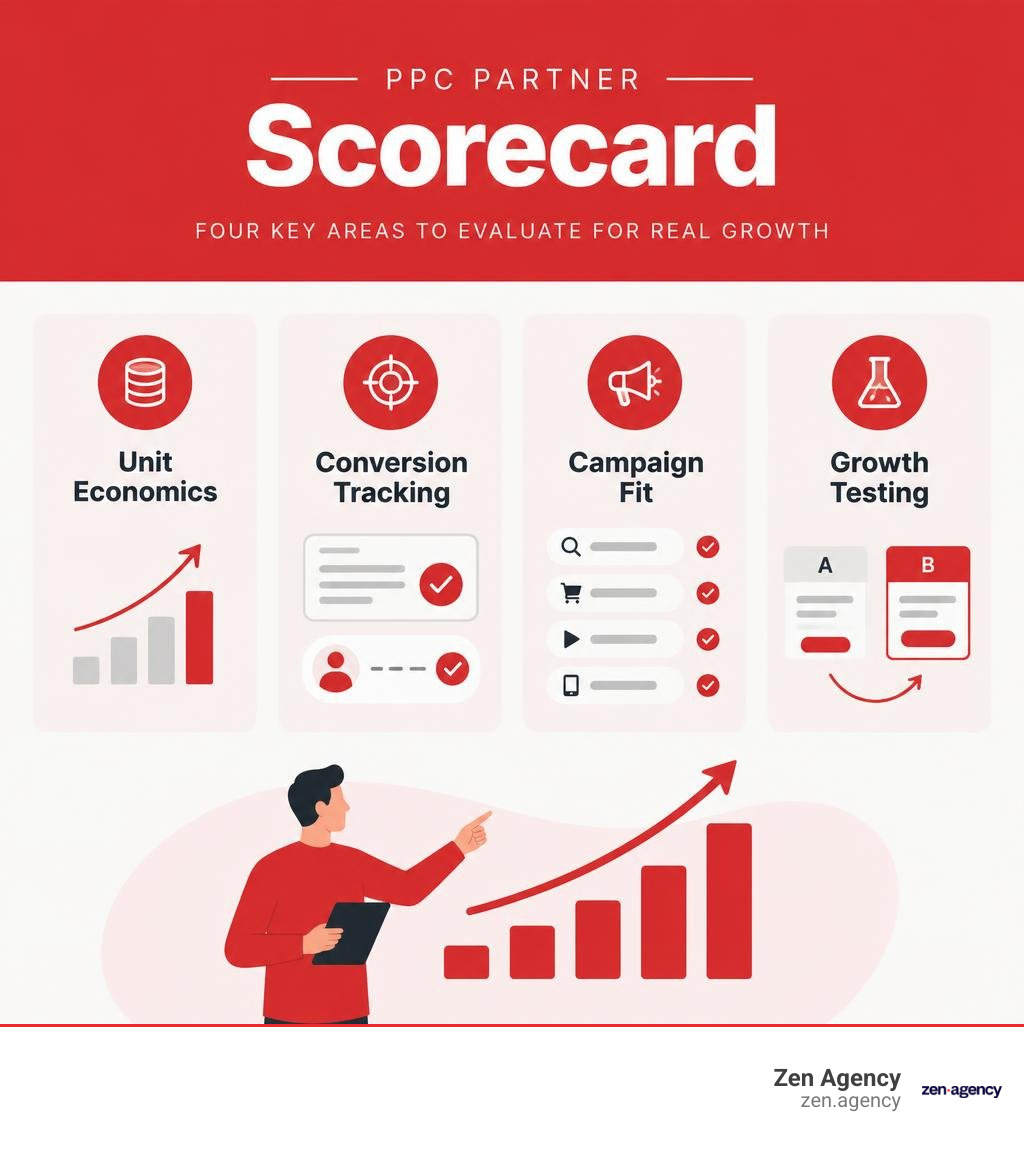
Simple guide to best ppc advertising terms:
- PPC Advertising 101: Learn the Basics
- Best Pay Per Click Agencies Reviewed: The Definitive Partner Evaluation Checklist
- Google Paid Search Advertising: Because Organic Traffic is Taking Too Long
What Defines the Best PPC Advertising Strategy in 2026?
Paid search is no longer about manually tweaking bids at midnight or stuffing ad groups with hundreds of keyword variations. Modern paid media revolves around machine-learning algorithms, rich audience signals, and precise intent capture.
As documented in comprehensive research on digital advertising, paid digital media represents the most direct mechanism for businesses to intercept commercial intent in real time. However, automated bidding systems—such as Google’s Smart Bidding—are only as effective as the data fed into them. If an agency feeds an automated algorithm poor conversion data, the system optimizes for cheap, low-value interactions rather than profitable revenue.
Understanding the profit-generating benefits of paid search requires viewing pay-per-click advertising not as an isolated channel, but as an engine for capturing active market demand. Top practitioners focus heavily on three structural pillars:
- Intent Capture Over Volume: High impression counts mean nothing if search queries lack commercial intent.
- First-Party Signal Quality: Supplying algorithms with verified purchase values and qualified pipeline data rather than superficial page views.
- Algorithmic Governance: Setting strict boundary conditions so machine learning works inside your margin limits instead of spending freely to chase platform inventory.
How the Best PPC Advertising Teams Audit Unit Economics and LTV
Before writing a single ad headline or selecting keywords, an elite partner audits your financial model. Scaling ad spend without knowing your customer lifetime value (LTV) and gross margin is a fast track to burning capital.
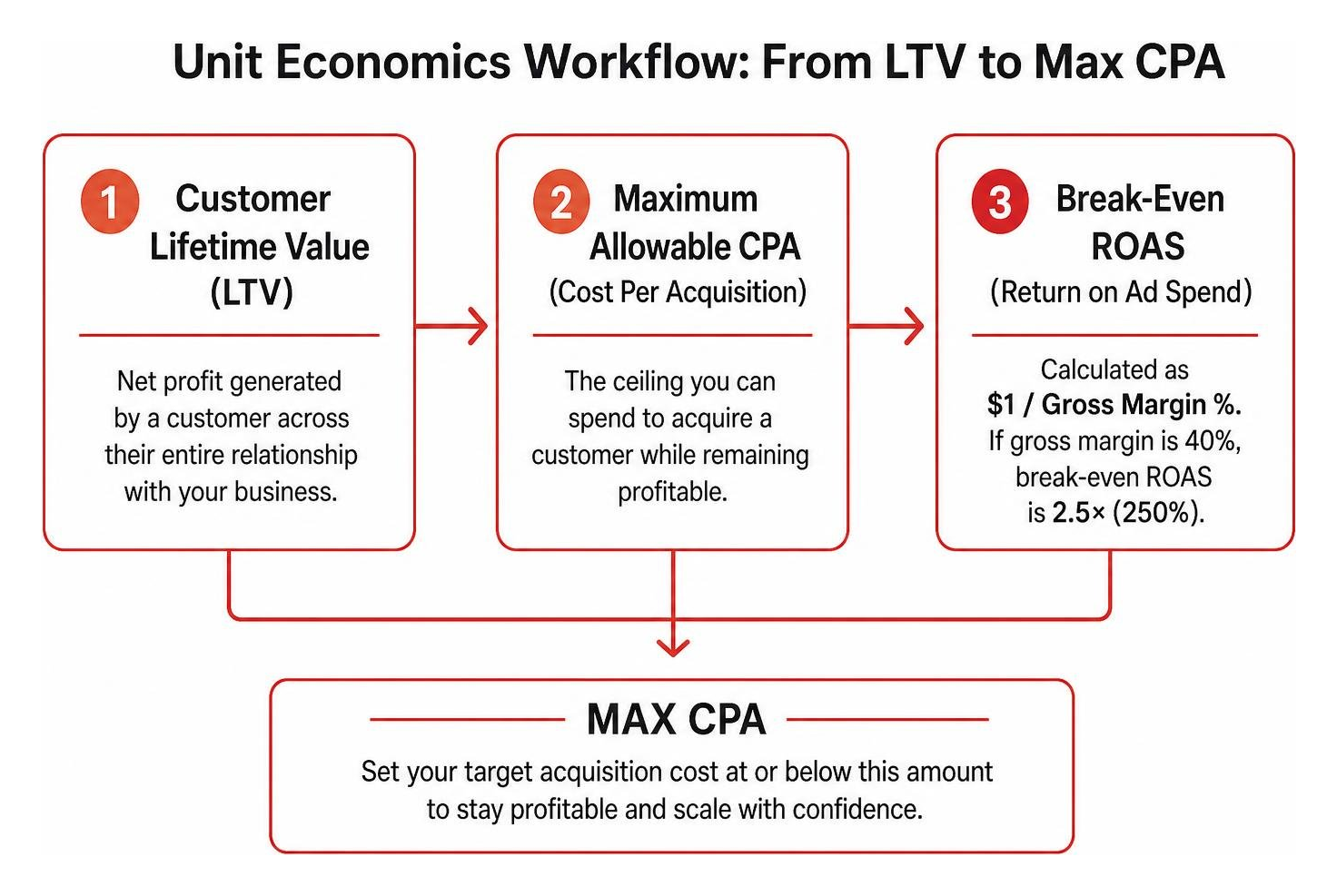
A rigorous PPC audit establishes three core financial benchmarks:
- Customer Lifetime Value (LTV): The net profit generated by a customer across their entire relationship with your business.
- Maximum Allowable CPA (Cost Per Acquisition): The ceiling you can spend to acquire a single customer while remaining profitable on first-purchase margins or predictable retention cycles.
- Break-Even ROAS (Return on Ad Spend): Calculated as $1 / text{Gross Margin Percentage}$. If your gross margin is 40%, your break-even ROAS is $2.5times$ (or 250%).
To determine if paid search is viable for your sector, agencies compare your target CPA against broader market dynamics. Across US Search campaigns, the all-industry average cost per click (CPC) sits at $5.42, with an average conversion rate (CVR) of 8.18% and an average cost per lead (CPL) of $66.69. Specific industries face different dynamics; for example, Physicians & Surgeons average a $4.76 CPC with a 12.43% CVR, while Restaurants & Food see average CPCs around $2.05.
Properly measuring PPC success metrics ensures your targets align with reality before budget allocation begins.
Campaign Types Managed by the Best PPC Advertising Specialists
Top PPC specialists do not apply a generic campaign setup to every client. They select specific campaign architectures based on purchase friction, brand search volume, and product catalog scope.
According to data highlighted in the Pace Ad Spend Index 2026 report, Smart Bidding manages roughly 88% of Google Ads spend, with Performance Max adoption exceeding 80% across enterprise accounts. However, high adoption does not mean automated campaigns fit every scenario equally.
The table below breaks down benchmark performance across major campaign types to illustrate these trade-offs:
| Campaign Type | Primary Use Case | Ecommerce Benchmark CPC | Ecommerce Benchmark CVR / CPA | Benchmark ROAS |
|---|---|---|---|---|
| Search Campaigns | High-intent commercial queries, competitive captures | $1.92 | 2.64% CVR | $2.50times – 3.20times$ |
| Performance Max | Multi-channel automated scaling (Search, Shopping, YouTube, Display) | $1.53 | $46.10 CPA | $4.37times$ |
| Standard Shopping | Granular SKU-level bidding and negative keyword control | $1.15 | $59.09 CPA | $2.81times$ |
| Demand Gen | Visual mid-funnel prospect engagement (YouTube Shorts, Discover) | $0.71 | Variable | $1.80times – 2.40times$ |
| Display Remarketing | Low-cost audience re-engagement | $1.51 | Variable | $1.50times – 2.10times$ |
Search campaigns capture bottom-of-funnel demand with exact query control. Standard Shopping offers transparent product-level negative keyword control, while Performance Max drives volume by automating distribution across Google’s entire ecosystem.
Essential PPC Account Structuring and Budget Allocation Models

A messy account structure fragments your data, limits algorithm learning, and wastes spend. Top agencies organize campaigns around user intent and clean budget controls rather than running dozens of overlapping ad groups.
For e-commerce brands, applying advanced tactics for ecommerce paid search means grouping campaigns by product margin and historical velocity rather than raw category names. In lead generation, it means organizing ad groups by solution urgency and search commerciality.
Reviewing a comprehensive PPC management guide reveals that modern account structures prioritize data consolidation: keeping enough conversion volume in single campaigns to feed automated bidding engines, while maintaining clean keyword boundaries.
Lead Generation and Service-Based Account Structures
Service-based businesses and B2B organizations need account architectures that filter out informational tire-kickers and focus spend on high-intent decision-makers.
Key principles for lead-generation accounts include:
- Intent-Tiered Campaign Separation: High-intent transactional keywords (e.g., “hire commercial plumbing contractor”) remain strictly separated from research-based queries (e.g., “commercial pipe repair costs”).
- Target CPA Budget Alignment: Aligning daily budgets to generate at least 30 to 50 conversion events per month per campaign, ensuring Smart Bidding algorithms have sufficient statistical volume to calibrate.
- Lead Qualification Scoring: Structuring ad groups so that incoming form submissions and calls pass through validation filters before registering as primary conversions.
Deploying proven strategies for paid advertising for lead generation helps service businesses avoid unqualified leads while lowering overall cost per acquisition.
E-Commerce Multi-Campaign Structures and Feed Optimization
E-commerce growth relies heavily on product data feed accuracy and strategic separation between standard search and automated asset campaigns.
A high-performing e-commerce account setup utilizes:
- Clean Feed Hygiene: Optimizing titles, product categories, and custom labels (e.g., Margin Tier, Best Sellers, Seasonal) in Google Merchant Center to guide automated bidding.
- Performance Max with Asset Group Segmentation: Creating distinct asset groups for key audience segments rather than running generic catch-all creative.
- Negative Brand Scrubbing: Applying account-level brand exclusions on Performance Max to stop the campaign from taking credit for organic brand queries.
Understanding the true cost of PPC advertising helps online retailers balance aggressive top-of-funnel scaling with bottom-line profitability.
How to Vet and Select a Top-Tier PPC Agency Partner

Selecting an agency partner requires looking past generic sales decks. You need to evaluate their technical measurement setup, conversion governance, and structural transparency.
When reviewing potential partners, consult a strategic blueprint for building a Google Ads strategy to confirm whether their proposed plan addresses unit economics, search intent tiers, and bid thresholds.
When vetting top-tier PPC management services, look for these operational standards:
- Direct Account Ownership: You must retain full administrative ownership of your Google Ads, Google Analytics, and Merchant Center accounts.
- Transparent Management Fees: Flat-fee or tiered structures tied to workload and performance are preferable over uncapped percentage-of-spend models that incentivize unnecessary budget increases.
- Weekly Search Query and Budget Audits: Documented routines for reviewing search term reports, negative keyword expansions, and auction insights.
Algorithmic Governance and First-Party Data Integration
Ad networks frequently launch automation updates designed to expand available inventory. As detailed in recent industry analysis on auction dynamics and platform revenue optimization, ad platforms continuously optimize for their own network yield. Advertisers must actively govern these systems to protect their return on investment.
A qualified partner manages platform shifts (such as Google’s default matching updates and budget pacing behaviors) through rigorous data integration:
- Enhanced Conversions: Transmitting hashed first-party customer data at the point of conversion to improve attribution accuracy amid tracking constraints.
- Offline Conversion Imports (OCI): Connecting CRM platforms (HubSpot, Salesforce) to upload actual closed-won revenue back into ad accounts.
- Landing Page Conversion Alignment: Constantly optimizing landing pages for PPC conversions to elevate Quality Scores, lower actual CPCs, and improve on-page conversion rates.
Eliminating Brand Traffic Cannibalization and Attribution Illusions
One of the most common ways agencies inflate reported ROAS is by bidding heavily on your own brand name. If a user searches for your exact company name, they already intend to buy or contact you. Claiming credit for these conversions makes ad account dashboards look incredible while masking an unprofitable acquisition strategy for new customers.
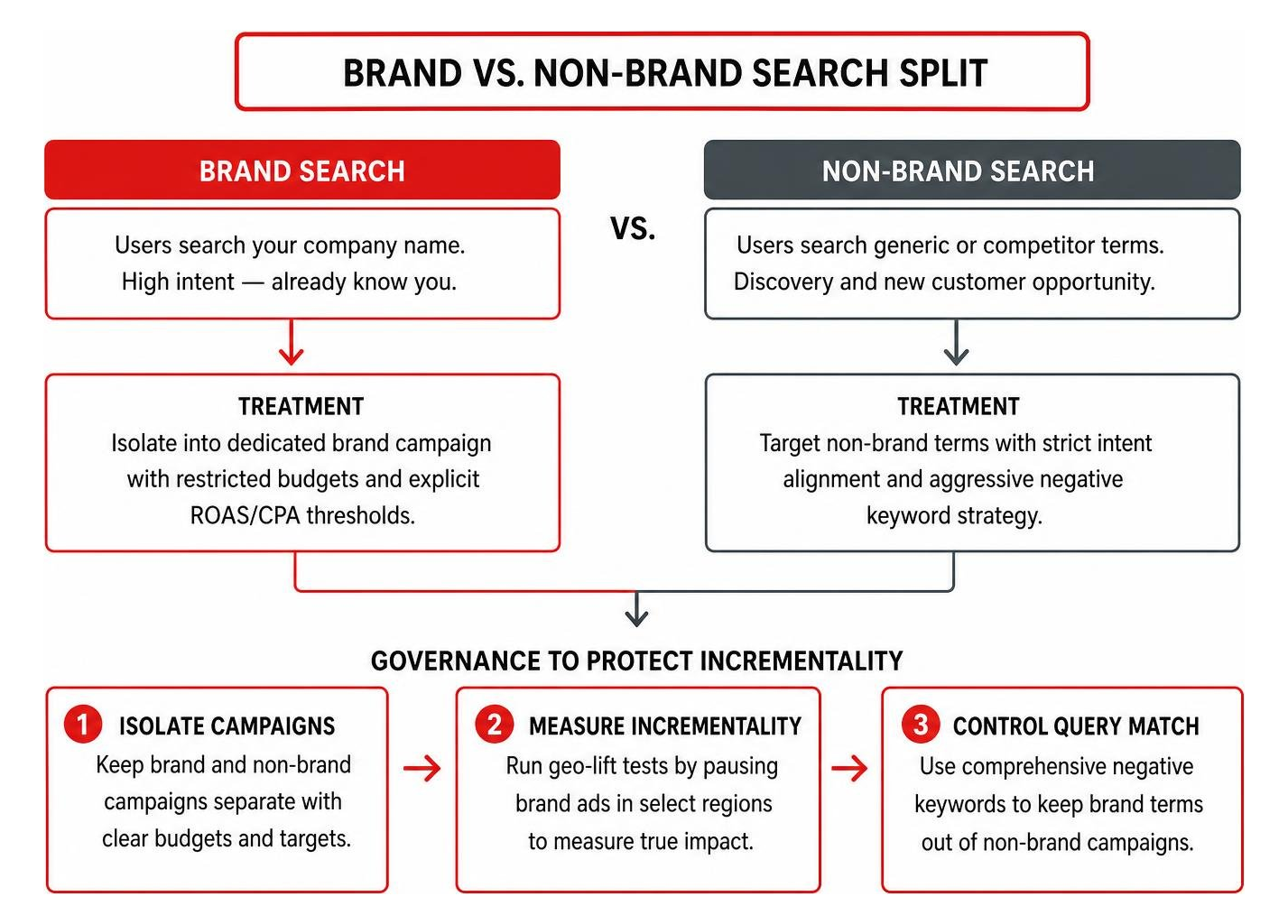
Top partners eliminate this issue using three proven methods:
- Brand vs. Non-Brand Campaign Isolation: Isolating brand terms into their own dedicated campaign with restricted budgets and explicit target ROAS/CPA thresholds.
- Incrementality and Geo-Lift Testing: Running controlled geographic experiments (turning off brand ads in select regions) to measure whether organic search listings capture that traffic without paying for clicks.
- Comprehensive Negative Keyword Lists: Aggressively mastering negative keyword strategy across non-brand and discovery campaigns to prevent generic queries from drifting into brand terms.
Frequently Asked Questions About PPC Advertising
What is a minimum viable monthly PPC budget to start scaling?
To determine a minimum viable monthly budget, multiply your expected Cost Per Click (CPC) by the clicks needed to secure enough conversion volume for Smart Bidding algorithms:
$$text{Monthly Budget} = left( frac{text{Target Monthly Conversions}}{text{Expected Conversion Rate}} right) times text{Average CPC}$$
Because automated bidding algorithms require a minimum of 30 to 50 conversions per campaign per month to operate reliably, a lead-generation campaign with a $5.00 average CPC and an 8% conversion rate needs at least:
$$left(frac{40}{0.08}right) times $5.00 = 500 text{ clicks} times $5.00 = $2,500text{ per month}$$
For visual campaigns like Demand Gen, Google recommends a monthly budget of at least 10 times your target CPA to allow proper exploratory machine learning.
How do I prevent Performance Max from cannibalizing standard search traffic?
Performance Max prioritizes exact-match search keywords present in your Search campaigns, provided those search campaigns are not constrained by budget. To prevent overlap:
- Maintain dedicated Search campaigns containing your highest-value exact-match keywords.
- Apply account-level negative keyword lists and brand exclusion lists directly to Performance Max.
- Monitor your Search Term Insights inside Performance Max asset groups to confirm the campaign is discovering incremental non-brand queries rather than harvesting existing customer searches.
Why are offline conversion imports critical for service and B2B PPC?
Online conversion forms capture volume, but they do not measure lead quality. A lead form submission might turn into a spam entry, an unqualified prospect, or a high-value customer.
Offline conversion imports (OCI) solve this problem by syncing your CRM milestone stages (such as “Qualified Opportunity,” “Contract Sent,” and “Closed Won”) back into your Google Ads account. By passing verified revenue values back into the bidding platform, Smart Bidding shifts budget toward the search queries and audience signals that generate paying clients instead of cheap, low-intent form fills.
Conclusion
Scaling a business through paid media requires a disciplined partner who views ad spend through the lens of unit economics, attribution integrity, and algorithmic control. When campaigns are anchored by accurate conversion tracking, clear brand separations, and dedicated landing page experiences, paid advertising becomes a reliable, repeatable engine for revenue growth.
Since 2008, Zen Agency has developed enterprise-grade digital marketing strategies and custom web solutions for businesses across Pennsylvania, Montana, and nationwide. Whether optimizing complex e-commerce product feeds or engineering high-converting B2B lead generation pipelines, our team focuses on what matters most: growing your bottom line.
Explore our scalable enterprise PPC management services to build a high-performance paid search architecture tailored to your business goals.