Best E-Commerce Platforms: From Shopify to BigCommerce, What Actually Sells?
Choose an E-Commerce Platform That Fits How You Sell
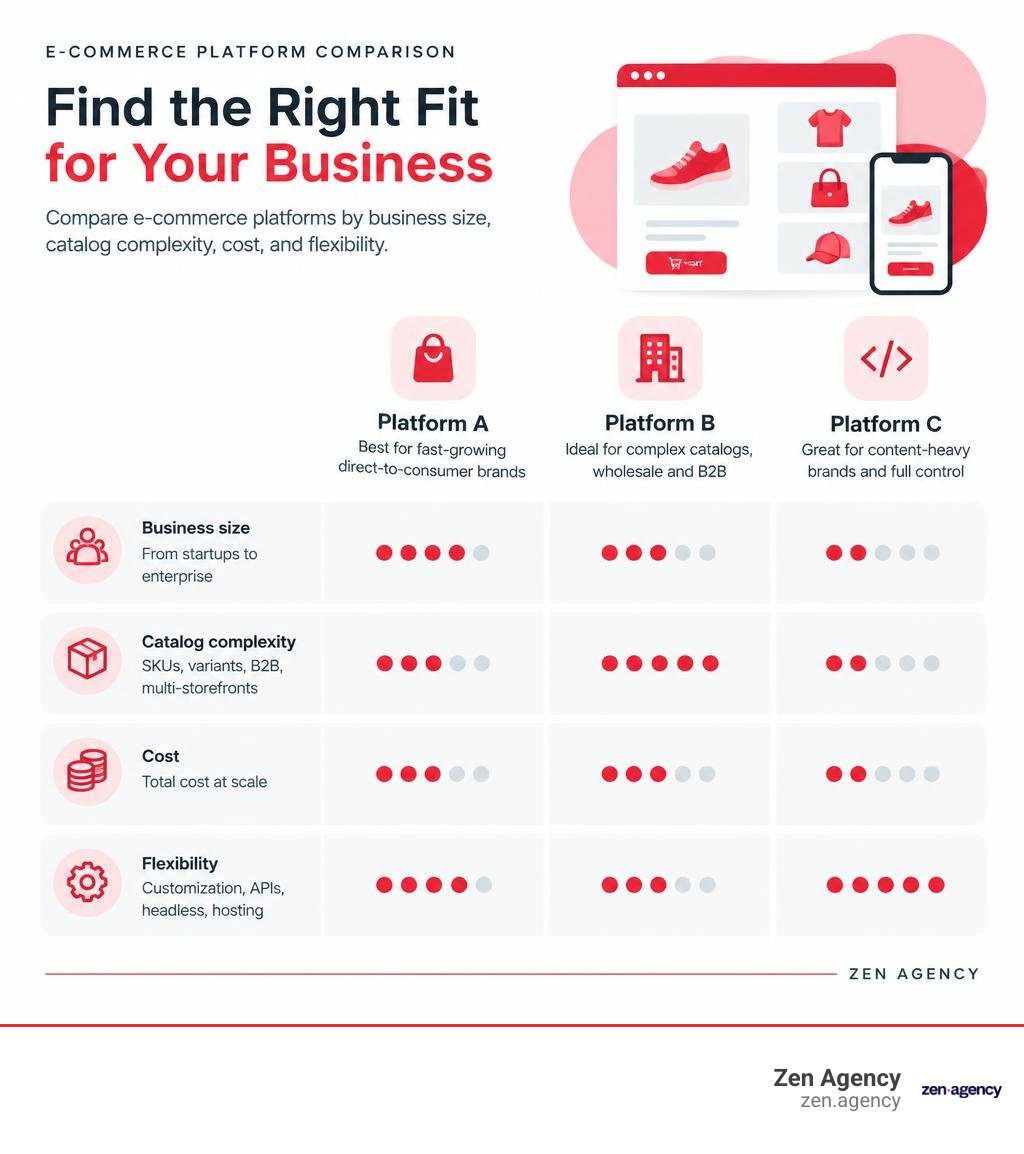
The best e-commerce platforms depend on your business model, not just your current store size. Shopify is often the strongest fit for fast-moving DTC brands that need an easy launch, strong checkout, social selling, and a deep app ecosystem. BigCommerce is often better for merchants with complex catalogs, wholesale pricing, multiple storefronts, or B2B buying workflows. WooCommerce gives content-heavy brands the most ownership and flexibility, but it also requires more hands-on technical management.
Before choosing, compare the factors that affect profit and growth:
- Total cost at scale: Subscription costs, payment processing, transaction fees, apps, development, and support.
- Catalog and B2B needs: SKU volume, product variants, customer-specific pricing, purchase orders, and multi-storefront requirements.
- Growth tools: Checkout performance, AI automation, marketing integrations, international selling, and reporting.
- Technical freedom: Theme controls, API quality, headless options, hosting, and the ability to customize.
- Ecosystem depth: Apps, agencies, ERP connections, payment choices, and ongoing support.
Shopify serves millions of merchants and offers a far larger app ecosystem, making it a practical choice when speed and experimentation matter. BigCommerce has a smaller footprint but bundles more native enterprise and B2B functionality, which can reduce app dependence and total cost for high-volume, catalog-heavy businesses. WooCommerce remains compelling when your website and content strategy need the flexibility of WordPress.
I am Joseph Riviello, CEO and Founder of Zen Agency, with more than 22 years of experience helping companies grow through integrated digital strategy, conversion work, and scalable online experiences. In this guide to the Best E-Commerce Platforms, I will help you weigh the tradeoffs that matter for revenue, operations, and long-term ROI.
Best e-commerce platforms terms to learn:
Key Selection Criteria Across the Best E-Commerce Platforms
Selecting a modern commerce foundation is never as simple as picking the software with the flashiest marketing campaign. In 2026, the digital retail environment is ruthless. If your checkout stutters during a seasonal traffic surge, or if your tech stack requires five disconnected third-party plugins just to calculate wholesale tier discounts, your margins evaporate.

To make a confident investment, merchants must review the 5 most important questions to ask when choosing an e-commerce platform. Beyond fundamental feature checklists, we evaluate solutions using four core operational pillars:
- Total Cost of Ownership (TCO): Platform base rates are only the tip of the iceberg. True TCO includes mandatory platform transaction penalties, payment gateway fees, third-party recurring app subscriptions, ongoing developer retainers, and infrastructure hosting expenses.
- Catalog and Architectural Flexibility: Your platform must accommodate your specific SKU architecture without forcing painful code workarounds. This includes managing complex product options, parent-child relationships, custom bundles, and high variant counts.
- Omnichannel & Conversion Engine: A high-performing platform must turn casual browsers into repeat buyers across mobile apps, social marketplaces, and web storefronts. Conversion benchmarks such as accelerated one-click checkouts directly dictate your bottom-line return on advertising spend (ROAS).
- Native Extensibility vs. App Bloat: Relying on dozens of third-party plugins creates security vulnerabilities, slows page load speeds, and increases monthly software overhead. Native functionality consistently wins over fragile plugin chains.
Best E-Commerce Platforms for Enterprise Catalog Complexity and B2B
Enterprise merchants managing thousands of SKUs, complex product configurations, or wholesale distribution channels hit technical bottlenecks much faster than standard consumer brands. If your product catalog requires custom dimension matrices, multi-tiered volume pricing, customer-specific price lists, or automated corporate purchase orders (POs), platform selection becomes an architectural priority.
When comparing enterprise architectures, Magento vs WooCommerce and BigCommerce frequently surface as the heavy hitters for raw data complexity:
- Variant Thresholds: Standard hosted setups often cap product options or require complex app configurations once a product exceeds basic color and sizing attributes. BigCommerce shines natively here, supporting up to 600 variants on a single SKU without requiring external apps.
- B2B Buying Workflows: Enterprise clients rarely pay exclusively via credit card. They require net-30 terms, corporate credit limits, quote-to-order negotiation, multiple user roles with purchasing approvals, and split shipments.
- ERP and CRM Synchronization: Enterprise catalogs demand reliable REST and GraphQL endpoints capable of processing bidirectional inventory updates from ERPs like SAP, NetSuite, or Microsoft Dynamics without hitting restrictive API rate limits.
For merchants deciding between hosted architectures or open systems, evaluating WooCommerce vs BigCommerce helps determine whether a structured SaaS environment or a fully custom, database-level open-source configuration better suits your operational scale.
Best E-Commerce Platforms for Small Businesses and Fast Deployment
For direct-to-consumer (DTC) startups, agile boutiques, and growing mid-market brands, time-to-market and operational simplicity take precedence over complex multi-tier ERP mappings. Small business operators need intuitive visual site builders, automated marketing integrations, native AI copywriting tools, and an ecosystem that handles PCI compliance out of the box.
According to research from major industry publications like Forbes and payment leaders like Stripe, emerging brands benefit most from integrated ecosystems that minimize administrative friction. Modern platforms offer AI-assisted catalog creation, automated background removal on product photography, predictive inventory alerts, and instant multi-channel syncing across TikTok Shop, Instagram, and Amazon.
Small businesses must decide between turn-key hosted platforms like Shopify and content-first architectures. Many growing entrepreneurs discover why WooCommerce is the best ecommerce platform for small businesses, specifically because it eliminates recurring platform percentage cuts, provides absolute data sovereignty, and merges robust digital commerce directly into the world’s most widely adopted content management framework.
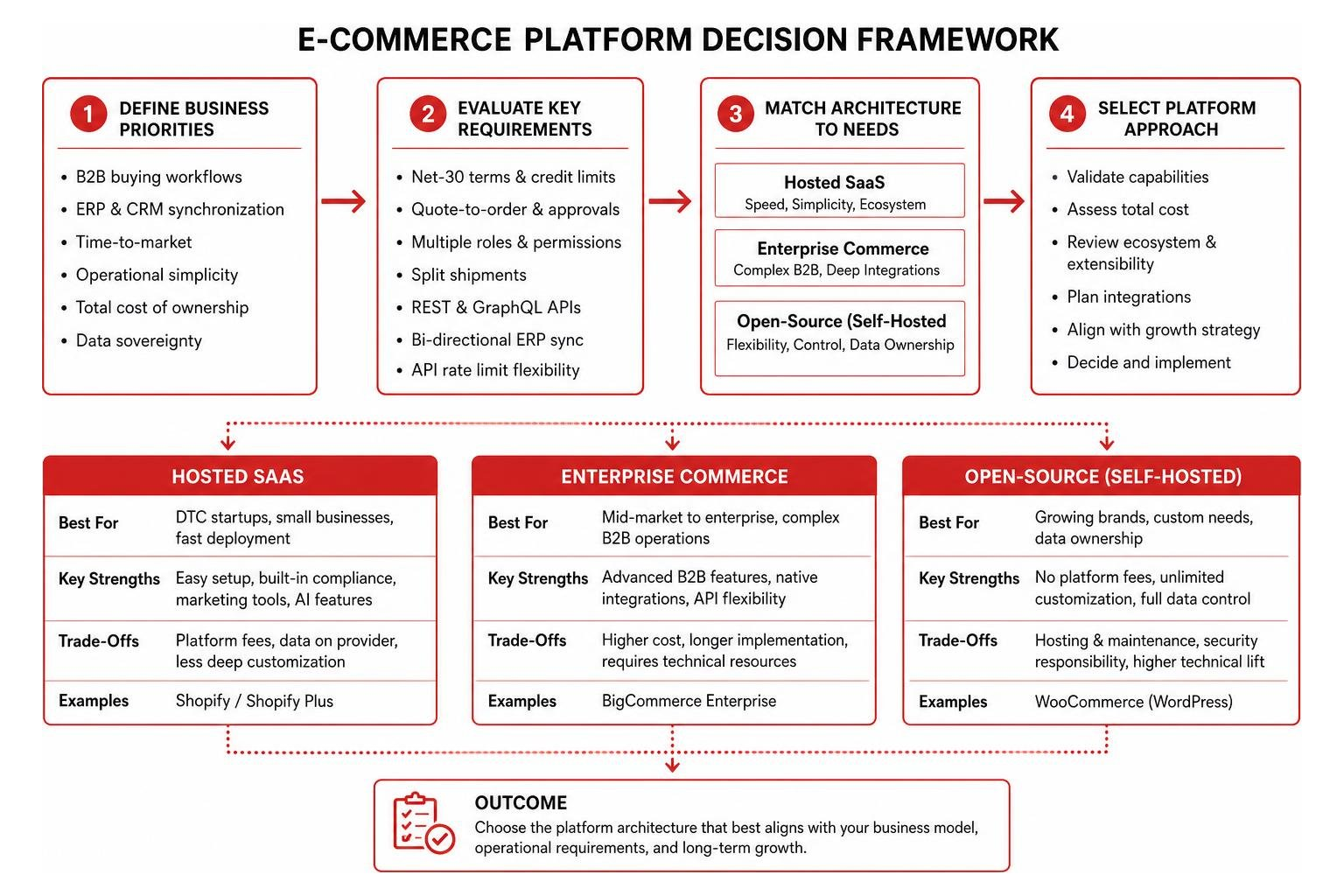
Comprehensive Platform Breakdown: Hosted SaaS vs. Enterprise Commerce vs. Open-Source Platforms
To choose the right engine for your business, you need an objective breakdown of how the leading platforms operate at an architectural and commercial level:
| Feature / Metric | Shopify / Shopify Plus | BigCommerce Enterprise | WooCommerce (Self-Hosted / Managed) |
|---|---|---|---|
| Market Footprint | ~4.8M Active Stores; $310B+ GMV | ~45,000 Stores; $360M ARR | 3.5M+ Active Stores (30% of web shops) |
| Core Architecture | Proprietary Cloud SaaS | Open SaaS Cloud | Open-Source PHP / WordPress Core |
| Transaction Fees | 0.5%–2.0% unless using Shopify Payments | 0% Native Platform Surcharge | 0% (Standard Payment Gateway Fees Only) |
| Product Variants | Standard limits (requires apps for large matrices) | Up to 600 variants per SKU natively | Unlimited custom attributes & variations |
| B2B & Wholesale | Native on Plus; app-reliant on standard plans | Advanced B2B Edition natively integrated | Advanced via custom code / B2B plugins |
| Ecosystem Size | 10,000+ App Store extensions | ~1,200 App Marketplace integrations | 60,000+ WordPress plugins & extensions |
| Partner Network | ~12,000 Certified Agency Partners | ~3,000 Certified Agency Partners | Global developer community (Millions) |
| Headless Tech | Hydrogen 3.0 & Oxygen hosting | Catalyst framework & Next.js GraphQL | Headless WP REST API & WPGraphQL |
Hosted SaaS Ecosystem and Market Dominance
Shopify has established itself as an undeniable powerhouse within the retail landscape. Powering roughly 4.8 million active merchants globally and processing an annualized GMV run rate topping $310 billion, its platform scale is massive. A significant component of its business model stems from its Merchant Solutions division—encompassing Shopify Payments, point-of-sale hardware, shipping fulfillment, and merchant capital advances—which accounts for roughly 74% of its total corporate revenue.
For high-velocity DTC merchants, Shopify delivers several distinct advantages:
- Conversion-Engine Checkout: The proprietary Shopify Checkout combined with Shop Pay converts up to 50% higher than standard guest checkouts, dramatically minimizing cart abandonment.
- App Marketplace: With over 10,000 certified apps in its ecosystem, merchants can test new loyalty programs, recurring subscription tools, affiliate portals, and upsell funnels with single-click installations.
- Financial Solutions: Through Shopify Capital, the platform has deployed over $5 billion in growth funding to merchants, enabling rapid inventory procurement without equity dilution.
- Integrated Site Building: Utilizing tools like the Shopify Ecommerce Website Builder, non-technical founders can launch functional storefronts in hours using intuitive drag-and-drop theme sections.
However, scaling on hosted SaaS requires careful attention to detail. As your brand expands, stacking multiple paid third-party applications can cause “app bloat,” dragging down Core Web Vitals and inflating your monthly software overhead. Ensuring your storefront maintains clean markup requires a solid grasp of the ins and outs of ecommerce website design.
Enterprise Commerce and Multi-Storefront Architecture
BigCommerce takes a distinctly different path, positioning itself as an “Open SaaS” platform engineered for enterprise scalability, complex data management, and zero vendor lock-in on payment processing. Backed by $360 million in annualized recurring revenue and an enterprise customer base that grew 18% year-over-year entering 2026, BigCommerce focuses heavily on mid-market and enterprise merchants.
Key architectural strengths include:
- Zero Transaction Penalties: Unlike competitors that levy a 0.5% to 2.0% fee when using third-party payment gateways like Adyen, Stripe, or Authorize.net, BigCommerce never charges platform transaction fees, regardless of your chosen gateway.
- Native Multi-Storefront (MSF): Enterprise merchants can deploy and manage multiple localized, international, or B2B digital storefronts from a single administrative console, drastically lowering multi-brand operating overhead.
- Deep Catalog Capabilities: Handling complex products with multiple colorways, sizing metrics, custom materials, and technical specifications is native to the platform, comfortably accommodating up to 600 variants per SKU.
- Enterprise B2B Functionality: Features like company hierarchy trees, buyer purchasing roles, custom credit limits, quote management, and price list mapping operate natively without forcing you into expensive third-party software contracts.
In practical terms, for a scaling $15 million apparel and equipment enterprise, avoiding external app dependencies and third-party transaction fees can translate to thousands of dollars in monthly bottom-line savings.
Open-Source Commerce and Flexibility
Open-source commerce represents the ultimate expression of code control, data sovereignty, and structural freedom. At the center of this movement is WooCommerce, built upon the WordPress framework that powers over 40% of the entire internet. Today, more than 3.5 million online stores run on WooCommerce—representing roughly 30% of all digital storefronts globally and 8.8% of all websites across the web.
There are 6 reasons why WooCommerce is one of the best shopping carts for retailers, primarily anchored in ownership and extensibility. For a direct head-to-head comparison of costs and features, reviewing WooCommerce vs Shopify provides clarity on where each software model delivers maximum value.
For businesses evaluating open-source deployment, consider these operational realities:
- True Cost Predictability: Understanding is WooCommerce free requires looking past the initial zero-dollar software license. While the core engine is free, scaling merchants invest in enterprise-grade managed cloud hosting, premium security layers, transactional email servers, and custom development.
- Content and Commerce Synergy: For brands where organic search, editorial blogs, high-converting buyer guides, and educational content drive sales, pairing commerce directly with the world’s most powerful content management system delivers unrivaled SEO advantages. Merchants can even utilize cloud-managed options like the WordPress Ecommerce Website Builder to streamline maintenance.
- Custom Business Logic: When your business model requires custom manufacturing calculations, non-standard shipping rules, or proprietary membership tiers, open-source code eliminates the arbitrary technical walls imposed by hosted SaaS platforms.
Merchants evaluating open-source platforms often discover three reasons WooCommerce is better than Shopify: no arbitrary platform fees, unconstrained custom checkout design, and perpetual ownership of customer data. To execute this properly at scale, businesses frequently find why you should hire a WooCommerce specialist for your store’s customization to ensure optimal database architecture, page speed, and bulletproof security.
Headless Architecture and Modern Composable Commerce
As omnichannel customer journeys grow more sophisticated, enterprise brands are shifting toward decoupled, headless commerce architectures. In a headless setup, the frontend user interface (the “head”) is decoupled from the backend commerce database, inventory management, and checkout engine. Communication between the layers is handled via high-speed APIs.

Understanding why headless e-commerce has become such a prominent topic requires analyzing how modern engineering teams balance page speed and brand presentation:
- Unmatched Frontend Speed: Decoupled frontends built on modern frameworks like Next.js, React, or Shopify Hydrogen 3.0 compile static assets and leverage global edge networks. This cuts latency to milliseconds and optimizes Core Web Vitals for search rankings.
- Unified Omnichannel Experiences: A single backend commerce engine can broadcast products, process carts, and track inventory across progressive web apps (PWAs), native mobile iOS/Android apps, IoT smart devices, point-of-sale terminals, and digital kiosks.
- Flexible Composable Tech Stacks: Composable commerce lets enterprise architects choose specialized tools for each operational layer—such as pairing a dedicated content management system with a high-speed search engine like Algolia, an ERP inventory core, and a secure checkout backend.
Both hosted and enterprise platforms now offer streamlined headless development paths. Shopify provides its React-based Hydrogen framework hosted on edge infrastructure (Oxygen), while BigCommerce delivers its open-source Catalyst framework optimized for Next.js and GraphQL operations. Choosing headless requires higher engineering investment, making it best suited for scaling merchants whose transaction volume justifies custom digital storefront builds.
Frequently Asked Questions About E-Commerce Platforms
What are the main differences between hosted SaaS and enterprise commerce platforms for scaling stores in 2026?
Hosted SaaS platforms like Shopify prioritize speed-to-market, unified platform updates, automated hosting security, and an expansive app ecosystem. They are ideal for high-velocity DTC merchants who prefer turnkey solutions over custom backend development.
Enterprise-oriented platforms like BigCommerce Enterprise and open-source frameworks focus on multi-storefront deployments, native complex B2B buying rules, multi-tier pricing, and deeper ERP integration. Furthermore, enterprise platforms generally eliminate secondary platform transaction fees and support higher native product variant limits out of the box.
How do transaction fees impact total cost of ownership at scale?
Platform-imposed transaction fees can significantly reduce your profit margins as your annual gross merchandise value (GMV) climbs. For instance, if a merchant generates $10 million in annual online sales and uses an external payment gateway, a 1% platform transaction surcharge adds $100,000 in direct platform fees on top of standard credit card processing rates.
Platforms like BigCommerce and open-source solutions like WooCommerce never impose third-party transaction penalties, allowing scaling businesses to retain more gross margin or negotiate private interchange rates with custom payment processors.
When should a merchant transition to headless commerce?
A merchant should consider transitioning to headless commerce when standard monolithic themes restrict user experience, frontend performance drops due to third-party scripts, or custom international omnichannel delivery is required.
If your brand needs sub-second page loads across international markets, custom mobile app integration, or complex interactive product configurators that standard theme engines cannot support, decoupled headless architecture provides the technical flexibility required to scale.
Conclusion
Choosing the right digital storefront architecture is one of the most critical operational decisions your company will make. There is no one-size-fits-all answer. The ideal platform depends entirely on your product catalog structure, wholesale needs, operational workflows, and long-term business goals:
- Choose Shopify if your primary focus is rapid DTC growth, seamless social selling, access to a massive app marketplace, and an ultra-optimized checkout experience.
- Choose BigCommerce if your catalog demands complex variant matrices, native B2B buying workflows, unified multi-storefront management, and an architecture free of third-party transaction fees.
- Choose WooCommerce if you require complete ownership of your code, unrestricted database customization, unconstrained checkout flows, and deep synergy with a content-led organic search strategy.
Navigating platform selection, enterprise migrations, custom integrations, and data modeling requires a seasoned technical partner. At Zen Agency, we bring over two decades of technical web development, UI/UX design, and digital marketing experience to help growing businesses build profitable, enterprise-grade shopping experiences.
If your current online storefront is struggling to scale or you need clarity on selecting the best development path for your business, learn how to choose the right WooCommerce development agency for your business and partner with our team. Explore our custom e-commerce website design services to turn your digital storefront into a sustainable engine for revenue and growth.