BigCommerce Development Agency Vetting Playbook for High-Growth Brands
How to Choose a BigCommerce Development Agency for Growth
To hire the right BigCommerce development agency, look for a partner that can do more than build a polished storefront. They should prove they can connect your essential systems, protect SEO during migration, improve site speed and conversion paths, and support growth after launch.
Start your vetting with four questions:
- Can they show relevant BigCommerce work? Ask for examples involving stores with similar products, complexity, B2B needs, or traffic levels.
- Do they understand integrations and migration risk? Your ERP, CRM, PIM, shipping tools, and payment setup must work reliably with the new store.
- How will they measure results? Look for a plan tied to performance, conversion rate, usability, and revenue – not just a launch date.
- What happens after launch? Confirm support terms, response times, optimization services, and ownership of code and assets.
BigCommerce gives growing merchants a strong foundation, including a broad app marketplace and support for multi-storefront and B2B commerce. But platform capability alone does not solve weak brand experiences, disconnected data, or a checkout that loses buyers. The agency you choose determines how well those pieces work together.
I am Joseph Riviello, CEO and Founder of Zen Agency, with more than 22 years of experience helping companies improve digital visibility, conversion, and revenue. In this BigCommerce development agency vetting playbook, I will help you assess partners based on the work that matters most to sustainable e-commerce growth.

Related content about BigCommerce development agency:
Core Capabilities of a Dedicated BigCommerce Development Agency
Modern online retail demands far more than off-the-shelf templates. BigCommerce currently powers over 60,000 online stores globally across 120 countries, processing billions of dollars in gross merchandise value (GMV) annually. Catering to mid-market and enterprise operations at this scale requires deep platform mastery.
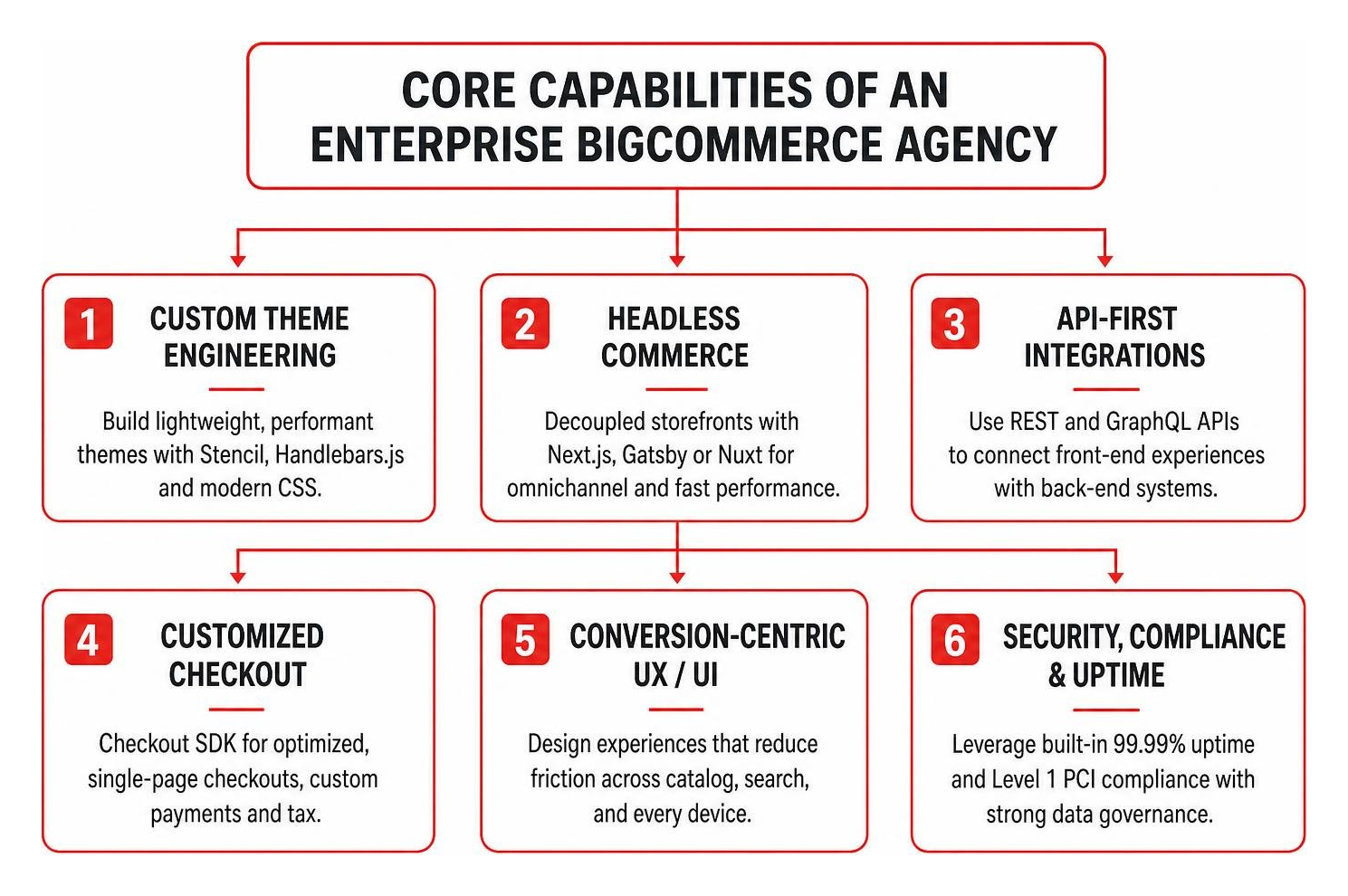
A specialized agency should bring technical capabilities across several disciplines:
- Custom Theme Engineering with Stencil: Agencies should build lightweight, performant themes using BigCommerce’s Stencil framework, Handlebars.js, and modern CSS frameworks rather than bloated pre-made themes.
- Headless Commerce Implementations: For brands seeking decoupled presentation layers powered by Next.js, Gatsby, or Nuxt, an agency must understand Why Headless E-commerce? makes sense for omnichannel distribution and sub-second load times.
- API-First Ecosystem Engineering: BigCommerce features robust REST and GraphQL Storefront APIs. Your partner must demonstrate experience building synchronous connections between front-end views and core back-end microservices.
- Customized Checkout Workflows: Utilizing the BigCommerce Checkout SDK to build optimized, frictionless single-page checkouts, custom payment gateways, and localized tax engines.
- Conversion-Centric UX/UI: Deploying specialized E-commerce Design Services that remove user friction across complex catalog navigations, faceted search, and mobile viewport variations.
- Security, Compliance, and Uptime Management: Leveraging BigCommerce’s native 99.99% average uptime and Level 1 PCI compliance, while ensuring third-party scripts and custom webhooks adhere to modern data governance standards.
Critical Evaluation Pillars for Vetting Development Partners
Hiring the wrong technical partner results in blown budgets, delayed launches, and lost revenue. When evaluating an agency, look beyond presentation decks and evaluate demonstrable engineering acumen.
Technical Vetting: Evaluating a BigCommerce Development Agency
BigCommerce merchants have access to over 600 apps and integrations in the native marketplace. An experienced engineering team knows when an off-the-shelf app fits your architecture and when custom middleware is necessary.
During technical interviews, probe their architectural depth:
- Middleware Development: How do they handle rate limits and event queuing when synchronizing inventory across multiple distribution centers?
- Platform Strategy: When evaluating platforms, do they provide transparent guidance on trade-offs? It helps to evaluate The 5 Most Important Questions to Ask When Choosing an E-commerce Platform to ensure their platform recommendations match your catalog complexity.
- App Synchronization: How do they prevent app bloat from degrading your Core Web Vitals and Document Object Model (DOM) rendering speeds?
- Serverless Infrastructure: Do they leverage serverless functions (AWS Lambda, Cloudflare Workers) to process custom logic outside the standard storefront runtime?
Multi-Storefront and B2B Commerce Architecture
Growing brands frequently expand into international markets, localized microsites, or hybrid B2B/B2C operations. BigCommerce Multi-Storefront (MSF) enables management of multiple distinct front-ends from a single back-end control panel.
For B2B merchants, BigCommerce B2B Edition provides complex wholesale functionality. An agency must understand:
- Buyer Portal Customization: Configuring tailored corporate account hierarchies, approval routing workflows, and invoice payment options.
- Wholesale Price Lists & Customer Segmentation: Structuring custom pricing matrices, bulk discount tiers, and gated category access.
- Platform Comparisons: Understanding how native B2B tools compare to other options, such as WooCommerce vs BigCommerce: One Wins, particularly regarding database scalability for high-SKU operations.
- ERP Connectivity: Integrating systems like NetSuite, SAP, Epicor, or Microsoft Dynamics 365 to synchronize customer ledger balances and custom contract catalogs.
Legacy Platform Migration Protocols
Replatforming carries operational and organic search risks. A technical partner needs a documented, battle-tested migration protocol.
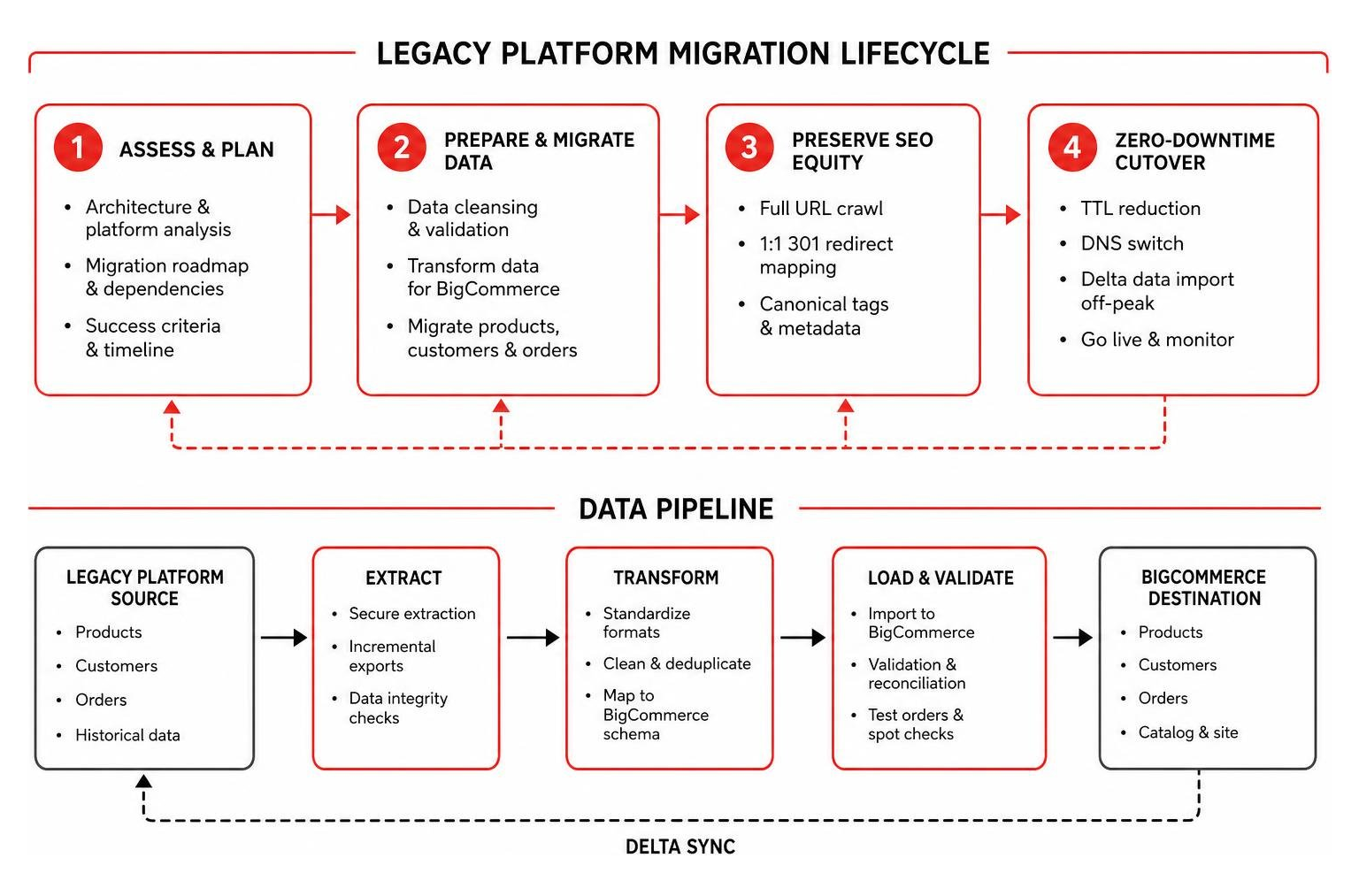
When migrating from legacy software, agencies must navigate architecture differences, as discussed in Magento vs WooCommerce: Which Ecommerce Platform is Best for Your Business?. A migration strategy must include:
- Data Migration: Cleansing, transforming, and validating product catalogs, customer password hashes, and historical order records without data corruption.
- SEO Equity Preservation: Performing complete URL crawls, mapping 1:1 301 redirect trees, and structuring canonical tags to retain established rankings.
- Zero-Downtime Cutover: Orchestrating TTL reductions, DNS switches, and delta data imports during off-peak hours to prevent order disruption.
Full-Lifecycle Development Process and Project Milestones
A predictable e-commerce build requires structured milestone delivery, clear testing parameters, and thorough QA procedures.

- Technical Discovery & Architecture: Auditing current systems, defining API mapping schemas, catalog taxonomy, and infrastructure dependencies.
- UX/UI Wireframing & Prototyping: Designing conversion-focused interfaces informed by The Ins and Outs of Ecommerce Website Design to validate user journeys before writing code.
- Agile Sprint Development: Building in bi-weekly sprints covering frontend components, custom widget development, and middleware logic.
- User Acceptance Testing (UAT) & Automated Code Reviews: Rigorous testing across browsers, checkout gateways, mobile devices, and automated pipeline regression suites.
- Load Testing & Launch Hypercare: Stress-testing checkout throughput, monitoring API error rates, and providing round-the-clock developer support during launch week.
Pricing Models and Investment Frameworks
Building an enterprise e-commerce platform represents a substantial capital investment. Understanding agency pricing models helps align project scope with budget realities, especially when investing in tailored Websites E-commerce infrastructure.
How a BigCommerce Development Agency Structures Pricing and Retainers
Agencies typically operate across three distinct pricing models:
- Fixed-Price Contracts: Best for clearly scoped, turnkey implementations with minimal third-party unknowns.
- Time & Materials (T&M): Preferred for complex integrations, enterprise migrations, or agile iterations where requirements evolve based on operational discovery.
- Dedicated Growth Retainers: Monthly SLA retainers that combine conversion optimization, continuous feature development, speed tuning, and proactive maintenance.
| Engagement Model | Typical Investment Range | Ideal Use Case | Pros / Cons |
|---|---|---|---|
| Fixed-Price Project | $25,000 – $85,000+ | Well-defined rebuilds, straightforward migrations | Predictable cost; less flexibility for scope changes |
| Time & Materials | $125 – $250 / hour | Complex ERP builds, custom headless front-ends | Maximum agility; requires active scope oversight |
| Dedicated Retainer | $3,000 – $15,000+ / mo | Ongoing CRO, feature builds, tier-1 technical support | Continuous improvement; recurring operational expense |
Frequently Asked Questions About BigCommerce Development
What is the typical timeline for an enterprise BigCommerce store build?
A standard custom theme and migration project generally takes between 10 to 16 weeks. Highly complex enterprise builds—involving custom middleware, multi-ERP synchronizations, headless frameworks, or multi-storefront setups—typically take 16 to 28 weeks depending on integration discovery and QA cycles.
How do BigCommerce development agencies handle complex ERP and CRM integrations?
Agencies utilize BigCommerce’s REST and GraphQL APIs alongside custom middleware hosted on scalable cloud environments. Middleware acts as a traffic controller, managing data transformations, batch queuing, webhook subscriptions, and retry logic to keep inventory, customer, and order data aligned without hitting API rate limits.
What ongoing optimization services do BigCommerce agencies provide after launch?
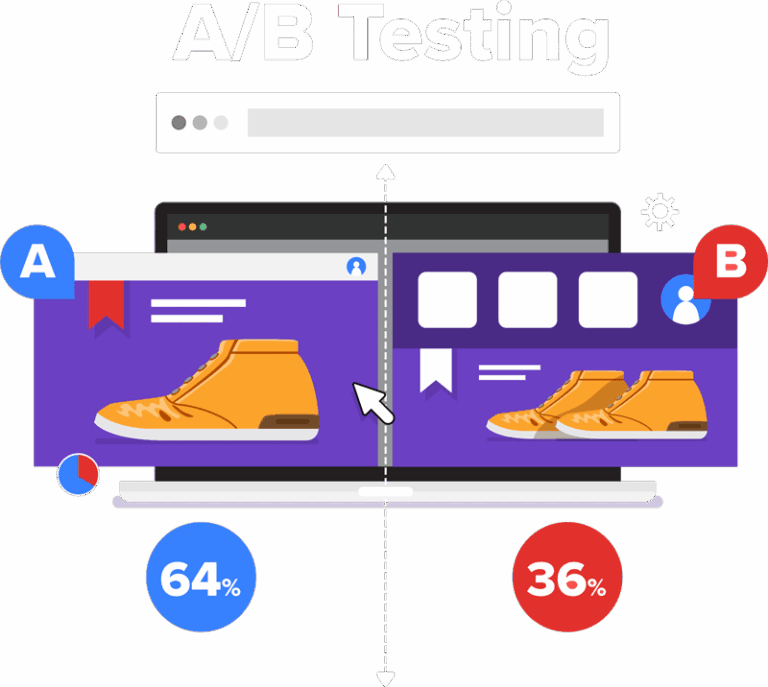
Post-launch services focus on conversion rate optimization (A/B testing, checkout funnel analysis), Core Web Vitals maintenance, search engine optimization audits, recurring security reviews, new feature engineering, and platform update testing.
Conclusion
Selecting the right development partner directly shapes your e-commerce growth trajectory. The ideal agency serves as an extension of your technical team, navigating complex data migrations, B2B logic, and architectural integrations while keeping the store performant and resilient.
Since 2008, Zen Agency has developed custom, enterprise-grade e-commerce solutions for brands across the United States. Whether you need end-to-end website design services or complex backend engineering, our team helps solve platform bottlenecks and build scalable digital storefronts.
Ready to plan your e-commerce project? Request a Quote to connect with our technical strategists.