Stop Settling for Mediocre Brochure Design Agency Results
Why a Brochure Design Agency Can Turn Print Into a Sales Tool
A brochure design agency helps businesses turn product details, brand messages, and sales goals into print and digital collateral people can understand and act on. The right partner does more than make pages look polished: it shapes the message, builds a clear visual path, prepares files for commercial printing, and can create digital PDFs for email, websites, and sales follow-up.
That matters when your current marketing is not earning attention or trust. Research cited in industry reporting suggests 78% of recipients at least skim a brochure, while 38% keep printed collateral for several days. Print can give prospects something real to revisit after a meeting, trade show, or store visit.
A strong brochure should make three things clear within seconds:
- What you offer
- Why it matters to the reader
- What they should do next
Whether you need a simple tri-fold, a product catalog, an investor prospectus, or an interactive digital publication, mediocre design can bury your value. Professional design brings together strategy, copy, layout, imagery, brand consistency, and production details so the finished piece supports real business goals.
I’m Joseph Riviello, CEO and Founder of Zen Agency, with more than 22 years in digital marketing and growth strategy. I help companies connect brand, traffic, leads, conversions, and revenue – and choose a brochure design agency approach that supports the full customer journey.
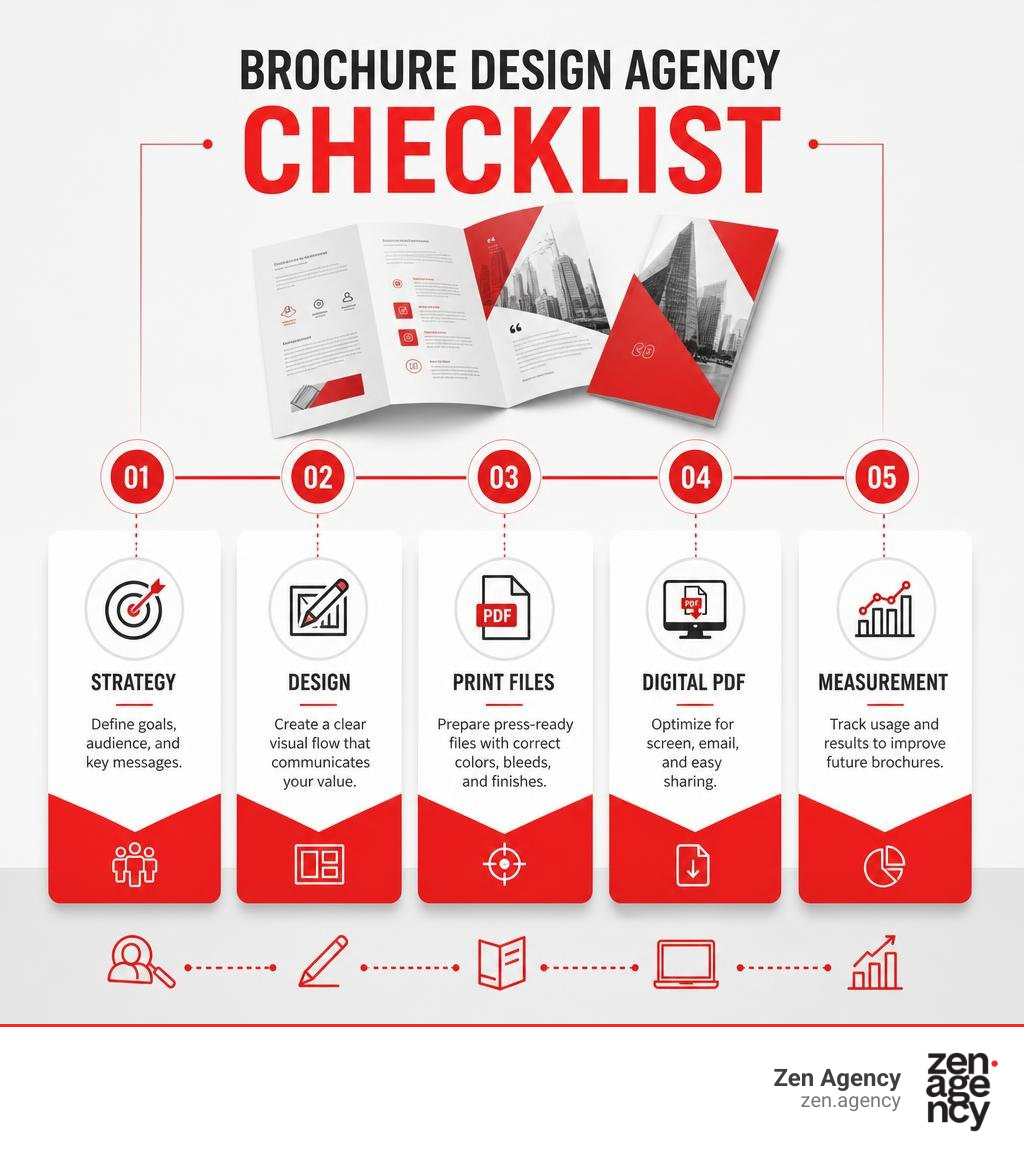
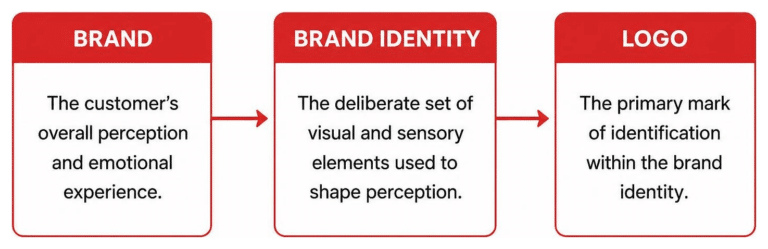
Common brochure design agency vocab:
Why Partnering with a Professional Brochure Design Agency Outperforms Freelancers and DIY
In an era saturated with digital noise, tactile marketing provides an unmatched competitive edge. Handing a prospective client a flimsy, poorly formatted sheet of paper printed from an office desktop can destroy credibility in seconds. Conversely, a masterfully engineered brochure commands attention, functioning as an tangible “offline website” that prospects keep on their desks for weeks.
When evaluating production models, businesses typically weigh three paths: DIY templates, freelance hires, or a specialized agency. While DIY tools promise speed and low initial costs, they routinely produce generic layouts that lack narrative pacing and fail commercial print preflight checks. Freelancers provide flexibility, but often lack cross-functional expertise, requiring you to source copywriters, production specialists, and brand strategists separately.
Partnering with an established creative firm eliminates these bottlenecks. If you are exploring how to evaluate potential partners, our guide to finding your perfect match a custom graphic design company for every need details how comprehensive infrastructure protects your brand equity.
| Evaluation Metric | Professional Design Agency | Freelance Graphic Designer | DIY Software / AI Generators |
|---|---|---|---|
| Strategic Copywriting | Integrated in-house messaging & conversion structure | Rarely included; client must provide finalized copy | Generic placeholder text requiring complete manual drafting |
| Pre-Press Technical Accuracy | Guaranteed 300 DPI CMYK, precise bleeds, ink limit verification | Variable; often dependent on designer’s print experience | High failure rate for commercial press specs |
| Brand Consistency | Strict adherence to global style guides and design systems | Dependent on individual interpretation | Fragmented; relies on mismatched stock templates |
| Scalability & Turnaround | Multi-designer teams with strict delivery windows | Subject to individual freelancer bandwidth | Instant, but requires substantial manual user labor |
| Deliverable Scope | Vector source files, press-ready PDFs, lightweight interactive PDFs | Typically limited to final exported PDF | Web-grade exports with limited high-res customization |
Essential Capabilities to Expect from a Brochure Design Agency
A high-performing agency delivers turnkey creative assets rather than just decorative artwork. When you engage a specialized firm, you should expect:
- End-to-End Content Architecture: Transforming raw technical specifications and unrefined company notes into concise, persuasive sales copy structured for immediate readability.
- Unified Visual Identity: Seamlessly integrating your foundational brand identity design across typography, color palettes, and imagery so every panel feels native to your organization.
- Complex Data Visualization: Translating dense data sets, operational workflows, and statistical proofs into custom branded infographics, tables, and iconography.
- Multi-Channel Adaptation: Delivering high-resolution CMYK press files alongside compressed, interactive RGB digital PDFs optimized for direct email outreach and web downloads.
- Print Production Oversight: Advising on precise paper stock weights, binding methods, and premium tactile coatings (such as soft-touch lamination or spot UV) to match your distribution environment.
Tangible ROI and Trust Metrics in Modern Print Marketing
Print collateral delivers sustained business impact precisely because it breaks through digital fatigue. Industry data demonstrates that 82% of internet users trust print advertisements when making purchasing decisions, while 56% of consumers consider print marketing the most trustworthy advertising medium available. Furthermore, 62% of surveyed consumers confirm that tangible print collateral directly influences their final buying decisions.
These trust metrics translate into substantial commercial returns. Studies have recorded that response rates from printed materials increased by as much as 170% over extended tracking periods. When prospective buyers engage with a physical brochure, 79% pick up collateral related to their specific business interests, and 85% become aware of a new company or capability strictly through that physical engagement. A professional brochure equips sales teams with a high-credibility tool that maintains buyer mindshare throughout complex enterprise purchasing cycles.
Popular Brochure Formats and Folding Architectures That Drive Sales
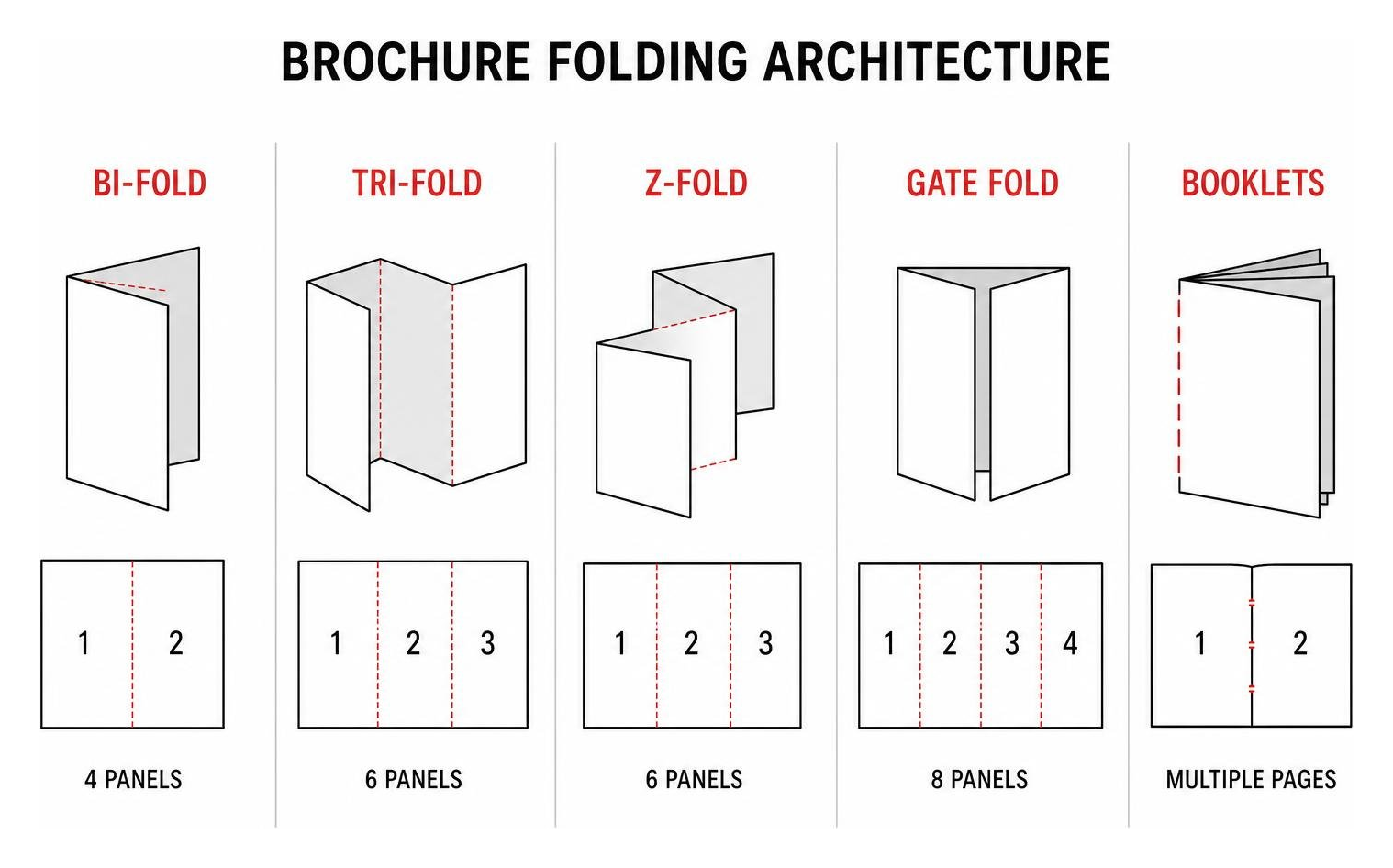
The physical architecture of a brochure dictates how a prospective buyer ingests your value proposition. Choosing the correct folding structure ensures your narrative unfolds logically rather than overwhelming the reader with a wall of unstructured text.
Standard Bi-Fold and Tri-Fold Collateral for Quick Conversions
For trade shows, point-of-sale displays, and direct mail campaigns, standard folding formats provide compact portability and high visual focus:
- Standard Bi-Fold (4 Panels): Typically constructed by folding an 11″ x 17″ sheet to form four 8.5″ x 11″ pages. This layout provides generous white space and clean structural divisions, making it ideal for high-level corporate profiles, service overviews, and executive summaries.
- Standard Tri-Fold (6 Panels): Folds an 8.5″ x 11″ sheet down to 3.6″ x 8.5″ through a classic roll-fold mechanism. It creates six discrete panels, allowing you to compartmentalize distinct product tiers, step-by-step onboarding sequences, or event agendas into focused sections.
- Z-Fold / Accordion Fold: Alternates folding directions to create an accordion-style flow. This format is ideal for chronological timelines, engineering processes, and narrative journeys where the reader naturally absorbs information panel by panel.
Multi-Page Booklets, Gate Folds, and Interactive Digital Formats
When communicating complex B2B capabilities, technical catalogs, or high-stakes investment opportunities, expanded formats provide the necessary visual depth:
- Gate Fold and Double Gate Fold: Features side panels that open outward like double doors to reveal an expansive interior spread. This dramatic reveal is ideal for high-end product launches, architectural developments, and prestige brand presentations.
- Multi-Page Saddle-Stitched Booklets (8 to 64+ Pages): Bound along the spine with commercial wire staples, these booklets accommodate comprehensive product catalogs, healthcare guides, and organizational overviews containing complex tables and data charts.
- Perfect Bound Publications: Utilizes a clean, squared glued spine for high-page-count investor prospectuses and annual reports, delivering the premium feel of a coffee-table magazine.
- Interactive Digital Publications: Modern agencies format print assets into responsive digital publications featuring clickable navigation, embedded media, and WCAG accessibility standards. Just as in modern web engineering where you must look beyond templates the smart way to get a custom website built, your digital brochures require custom structural architecture rather than automated page-turn plugins.
The Strategic Design and Print Production Process from Concept to Press
Executing an enterprise-grade brochure requires an iterative, highly controlled workflow that bridges strategic creative development with rigorous mechanical pre-press engineering.
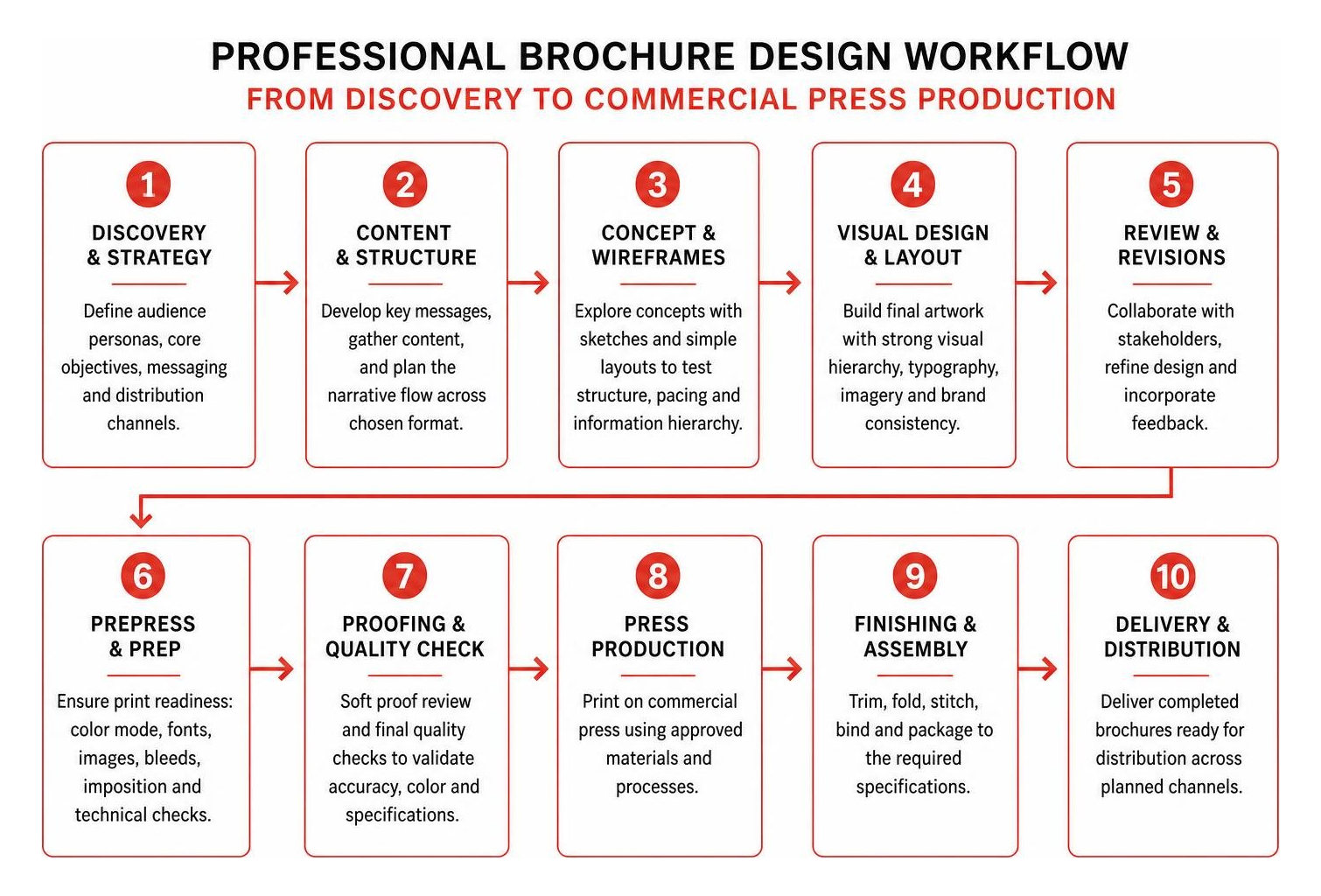
Strategy, Visual Hierarchy, and Commercial Preflight Standards
Professional brochure development begins with an in-depth discovery phase to establish audience personas, core conversion objectives, and distribution channels. Designers often begin concept exploration with hand-drawn structural sketches to test narrative pacing across folds before transitioning to digital layout environments.
If you are structuring your creative team or evaluating design talent, reviewing the ultimate guide to hiring a branding graphic designer provides valuable frameworks for identifying true production expertise.
During layout execution, strict commercial preflight standards must be enforced:
- Resolution Verification: All raster artwork and photography must sit at a native 300 DPI at 100% scale to prevent pixelation on physical press runs.
- Color Space Formatting: Converting all RGB screen values to CMYK color profiles, managing total ink coverage limits, and establishing exact Pantone spot colors where brand consistency is paramount.
- Bleed and Safety Margins: Building precise 0.125-inch (or metric equivalent) bleed lines and inner margin boundaries to prevent critical copy or borders from being clipped during automated guillotine trimming.
- Substrate Specification: Selecting paper stocks (ranging from 80 lb text weights to 130 lb heavy cover stocks) and applying functional coatings (matte, silk, gloss, soft-touch, or spot UV) to guarantee readability under various lighting environments.
How to Choose the Right Brochure Design Agency for Your Industry
Selecting an agency partner requires validating both creative vision and technical reliability. When reviewing prospective agencies, evaluate these essential criteria:
- Demonstrated Industry Fluency: Look for portfolio work within your specific sector (e.g., manufacturing, SaaS, healthcare, real estate) that proves the agency can translate technical subject matter into intuitive visual layouts.
- Transparent Revision Frameworks: Ensure the project scope clearly outlines concept counts and refinement rounds to avoid hidden revision surcharges.
- Comprehensive Deliverable Ownership: Confirm that the agency delivers unflattened, layered source files (such as Adobe InDesign or Illustrator packages) alongside press-ready and digital PDFs, guaranteeing you maintain full ownership of your visual assets.
- Integrated Production Capabilities: Choose an agency that either manages end-to-end commercial printing or provides direct technical consultation with your chosen press vendor to ensure flawless execution.
Frequently Asked Questions About Brochure Design
How much does professional brochure design cost?
Professional brochure design pricing scales based on page count, content complexity, and whether strategic copywriting or printing is bundled:
- Standard Flat-Rate Formats: Professional design for double-sided flyers and standard bi-fold or tri-fold brochures typically ranges from $350 to $1,200 for custom design-only packages.
- Multi-Page Booklets and Catalogs: Formats spanning 8 to 16+ pages generally range from $1,200 to $2,800+ depending on the volume of custom data visualization and technical charts required.
- Design-and-Print Bundles: Bundled solutions that incorporate high-volume offset or digital printing scale according to quantity, paper stock grade, and specialized finishes.
How long does the brochure design process typically take?
Turnaround schedules depend directly on project scope and client revision timelines:
- Standard Bi-Fold and Tri-Fold Collateral: Typically requires 3 to 5 business days for initial concepts, with final sign-off completed within 1 to 2 weeks following revision cycles.
- Multi-Page Booklets and Catalogs: Comprehensive publications spanning 12 to 64+ pages generally require 3 to 6 weeks to allow for thorough content structuring, custom illustration, and pre-press proofing.
- Commercial Print Fulfillment: Physical production, finishing, and delivery typically add an additional 3 to 7 business days following final artwork approval.
Can agencies handle both print production and interactive digital PDFs?
Yes. A professional design firm builds a unified collateral ecosystem. Upon project completion, you should receive:
- High-Resolution Print-Ready PDFs: Complete with CMYK color separation, embedded vector fonts, crop marks, and proper bleed allowances for commercial offset or digital printing.
- Interactive Digital PDFs: Compressed, web-optimized RGB files featuring clickable links, bookmarked table-of-contents navigation, and interactive form fields for email distribution.
- Layered Source Files: Master packaging containing linked high-resolution images, vector graphics, and editable document layers for future internal updates.
Conclusion
A well-crafted brochure is a high-impact sales asset that anchors your brand with credibility, clarity, and authority. By moving away from generic templates and partnering with an experienced agency, your business gains tactile marketing collateral that cuts through digital fatigue, nurtures long enterprise sales cycles, and drives measurable commercial growth.
Elevate your brand’s offline and digital marketing presence by partnering with our expert creative team—explore Zen Agency’s comprehensive graphic design services to begin designing collateral that drives results.