WooCommerce Marketing Strategies: From Ghost Town to Sold Out
WooCommerce Marketing Strategies: From Ghost Town to Sold Out
Why Most WooCommerce Stores Struggle to Get Sales (And How to Fix It)
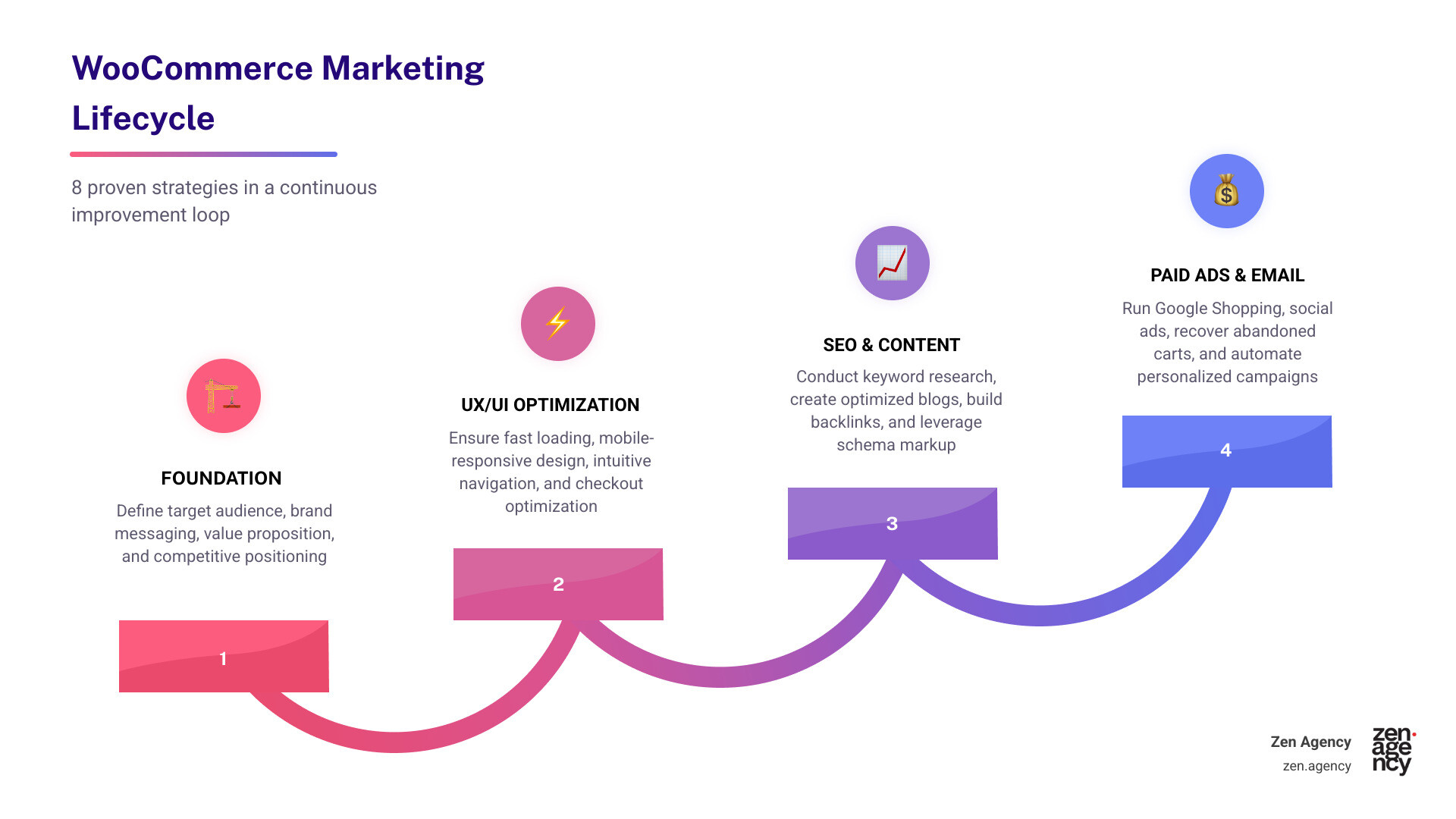
WooCommerce marketing strategies are the difference between a store that quietly collects digital dust and one that drives consistent, scalable revenue. Here’s a quick look at the core strategies covered in this guide:
Top WooCommerce Marketing Strategies:
- Lay the foundation – Define your audience, brand messaging, and competitive positioning
- Optimize UX/UI – Make your store fast, mobile-friendly, and easy to navigate
- Invest in SEO and content – Drive long-term organic traffic through keyword-optimized pages and blogs
- Run PPC and social ads – Use Google Shopping, Facebook, and Instagram for immediate visibility
- Automate email marketing – Recover abandoned carts and nurture customers with targeted sequences
- Build loyalty programs – Reward repeat buyers with points, coupons, and personalized offers
- Sell across multiple channels – Sync your products to Google, Amazon, eBay, and affiliate networks
- Track and optimize – Use analytics and A/B testing to improve what’s working
You’ve built your WooCommerce store. You’ve listed your products. But the sales aren’t coming in the way you expected.
That’s not a product problem. It’s a marketing problem — and it’s more common than you think.
The good news? WooCommerce gives you one of the most flexible and powerful eCommerce platforms available. The challenge is knowing which marketing levers to pull, in what order, and how to make them work together.
Whether you’re getting zero traffic or plenty of visitors but no conversions, this guide walks you through every proven strategy — from quick wins to long-term growth engines.
I’m Joseph Riviello, CEO and Founder of Zen Agency, and with over 22 years of digital marketing experience, I’ve helped countless businesses implement WooCommerce marketing strategies that turn underperforming stores into revenue-generating machines. Let’s break down exactly what works.
Glossary for WooCommerce marketing strategies:
Laying the Foundation for WooCommerce Marketing Strategies
Before you spend a single dollar on ads, you need a solid foundation. Jumping straight into tactics without a strategy is like trying to build a house on quicksand. At Zen Agency, we see many stores in Pennsylvania and Montana struggle because they haven’t defined who they are selling to or why they are better than the competition.
Define Your Target Audience
Broad language doesn’t work in eCommerce. If you try to sell to everyone, you end up selling to no one. You must find the specific language that attracts your ideal customer. For example, if you sell bath towels, are you targeting bargain hunters, eco-friendly shoppers, or parents looking for fun designs? Each group requires a different message.
Craft Compelling Brand Messaging
Your value proposition should answer one question: “Why should I buy from you instead of a big corporate giant?” Use your messaging to highlight your unique story. Whether it’s your commitment to sustainability or your specialized expertise, make it the centerpiece of your store.
Perform a SWOT Analysis
A Business strategy: A 9-step guide for growth – WooCommerce often begins with a SWOT analysis (Strengths, Weaknesses, Opportunities, and Threats).
- Strengths: What do you do better than anyone else?
- Weaknesses: Is your site slow? Is your checkout process clunky?
- Opportunities: Are there untapped niches in your market?
- Threats: Are competitors using new tech like Tap to Pay?
Why Choose WooCommerce?
We often explain Why WooCommerce is the Best eCommerce Platform for Small Businesses because of its unmatched flexibility. Unlike closed platforms, WooCommerce allows you to own your data and customize every aspect of the buyer journey.
Optimizing UX and UI for Maximum Conversions
User Experience (UX) covers the entire visitor journey, while User Interface (UI) focuses on the visible elements like buttons and menus. If your site is hard to use, you’ll lose customers before they even see your products.
Speed is a Ranking Factor
A slow-loading site isn’t just annoying; it’s a revenue killer. Research shows that slow sites cause billions in lost sales annually. We recommend using tools like Jetpack Boost to fine-tune your content and ensure your site loads instantly. For more technical improvements, check out our guide on How to Optimize Your WooCommerce Store for Speed and Performance.
Mobile Optimization and Core Web Vitals
With billions of people using mobile devices for social media and shopping, your store must be responsive. Google also prioritizes sites that meet “Core Web Vitals” standards. Following a guide on how to speed up your WooCommerce store can help you stay ahead of these technical requirements.
Streamline the Checkout
The checkout page is where most sales are lost. Using The 6 Best WooCommerce Checkout Plugins That Will Increase Sales can help you simplify the layout and reduce friction. Features like “Buy Now, Pay Later” via Klarna can also increase your average order value.
Strategic SEO and Content Marketing for Organic Growth
SEO is the long-term engine of your WooCommerce marketing strategies. While ads provide a quick burst of traffic, SEO builds a sustainable stream of visitors without ongoing per-click costs.
Keyword Research and On-Page SEO
Don’t just use manufacturer part numbers as your product titles. If you sell a red metal wagon, call it a “Fischer Price Red Metal Toy Handcart” so people can actually find it. Integrate keywords into your H1 tags, meta descriptions, and image alt text. Our WooCommerce SEO Secrets to Rank High in Google can help you identify the high-intent terms your audience is searching for.
Schema and Rich Snippets
Adding schema markup allows search engines to display “rich snippets,” such as star ratings and price ranges, directly in the search results. This significantly increases your click-through rate. You can learn more about this in our article on how to Boost Online Stores Search Rankings with WooCommerce and SEO.
Leveraging Content as a WooCommerce Marketing Strategy
Blogging is one of the most effective ways to build trust. If you sell coffee machines, write about “How to make the perfect espresso” or “Top 10 drip coffee makers.”
- Educational Blogging: Solve customer problems to establish authority.
- Video Tutorials: Show your products in use.
- User-Generated Content: Repost customer photos to build social proof.
Knowing how to optimize each of those posts ensures that your helpful advice actually reaches the people who need it.
Driving Immediate Sales with PPC and Social Media
When you need traffic now, Pay-Per-Click (PPC) and social media advertising are like guided missiles for your store.
Google Shopping and Remarketing
Google Shopping ads appear at the very top of search results with a product image and price. They are incredibly effective because they target people who are already in “buying mode.” If a visitor leaves without purchasing, use remarketing ads to follow them across the web and remind them of what they missed. Don’t forget about secondary search engines; Bing Ads for WooCommerce Unveiling Features Successes shows that there is often less competition and lower costs on other platforms.
Social Media Marketing
Social media is where your customers hang out. We suggest focusing on one primary channel where your audience is most active rather than spreading yourself too thin.
- Facebook & Instagram: Use the Facebook Pixel to track conversions and run catalog ads.
- Scheduling: Use social media scheduling tools to batch-create content so you can focus on running your business.
- Authenticity: Keep your tone informal and fun. People are “nosey” by nature; show them behind-the-scenes content of your team or how products are made.
Retention Tactics: Email Automation and Loyalty Programs
It is much cheaper to keep an existing customer than to acquire a new one. This is where automation becomes your best friend.
| Strategy | Purpose | Timing |
|---|---|---|
| Abandoned Cart | Recover lost revenue | 1-24 hours after abandonment |
| Post-Purchase | Build loyalty/Get reviews | 3-7 days after delivery |
| Win-Back | Re-engage inactive buyers | 30-90 days of inactivity |
Abandoned Cart Recovery
Abandoned cart emails are essential. Sometimes a customer just got distracted. A simple reminder—perhaps with a small discount or free shipping offer—can bring them back to complete the sale.
Loyalty and Rewards
Reward your best customers. Implementing a points system where “coins” can be redeemed for discounts creates a “gamified” experience that keeps people coming back. You can find many Practical WooCommerce Extensions Wallet Friendly that handle points, rewards, and advanced coupons without breaking the bank.
Automating Your WooCommerce Marketing Strategies
Using a customer relationship management (CRM) tool allows you to segment your audience. You can send personalized offers based on purchase history or even wishlists. For B2B stores, this level of personalization is even more critical; see our Guide to WooCommerce B2B and Beyond for specialized tactics.
Expanding Reach via Multi-Channel Selling and Affiliates
Don’t limit your sales to just your website. Multi-channel selling allows you to meet customers where they already shop.
Product Feeds and Marketplaces
Use product feeds to sync your inventory in real-time with Amazon, eBay, and Google Shopping. This prevents the frustration of a customer buying an item that is actually out of stock.
Affiliate and Influencer Marketing
Affiliate marketing allows others to promote your products in exchange for a commission on actual sales. It’s a low-risk way to grow because you only pay when you make money.
- Influencers: Partner with people who have the trust of your target audience.
- Regulations: Always ensure your partners follow FTC regulations by disclosing their relationship with your brand.
- Social Media Synergy: You can Maximize Affiliate Marketing with WooCommerce Social Media by providing your affiliates with high-quality graphics and unique discount codes to share.
For those looking to scale even further, Building a Multivendor Marketplace on WooCommerce allows you to host other sellers on your site, turning your store into a niche version of Amazon.
Tracking Performance and Continuous Optimization
You can’t improve what you don’t measure. Tracking your WooCommerce marketing strategies ensures you are getting a positive ROI.
Key Metrics to Watch
- Conversion Rate: The percentage of visitors who buy.
- Average Order Value (AOV): How much the average customer spends.
- Customer Lifetime Value (CLV): The total revenue you expect from a single customer.
- Cost Per Acquisition (CPA): How much you spend in marketing to get one new customer.
A/B Testing and AI
Don’t guess which headline or button color works better—test it. Leveraging AI in WooCommerce can help you analyze data faster and even personalize product recommendations automatically. Always start by using a free tool that will measure your site speed and performance to ensure your technical foundation remains strong as you scale.
Frequently Asked Questions about WooCommerce Marketing
How can I drive free traffic to my WooCommerce store?
The best way to get free traffic is through organic SEO and content marketing. By researching the keywords your audience uses and creating helpful blog posts, you can attract visitors from Google. Additionally, engaging authentically on social media and encouraging word-of-mouth through excellent customer service can drive traffic without an ad budget.
Is WooCommerce SEO-friendly compared to other platforms?
Absolutely. WooCommerce is built on WordPress, which powers over 40% of the web and is designed with SEO in mind. Unlike some competitors, WooCommerce gives you full control over your technical SEO, custom metadata, and site structure. For a deeper dive, read our comparison: WooCommerce vs Shopify Which Platform is Best for Your Online Store?
What are the best tools for WooCommerce marketing automation?
For email, we recommend tools like AutomateWoo, MailPoet, or Klaviyo. For CRM and customer management, Jetpack CRM is a fantastic integrated solution. You can find more budget-friendly options in our list of Practical WooCommerce Extensions Wallet Friendly.
Conclusion
At Zen Agency, we believe that no WooCommerce store should be a “ghost town.” Whether you are located in Wilkes Barre, Scranton, or Billings, MT, the right WooCommerce marketing strategies can transform your business.
Marketing isn’t a “one and done” task; it’s a continuous cycle of laying a foundation, driving traffic, and optimizing for conversions. By combining long-term organic growth with targeted paid ads and smart automation, you can build a sustainable, profitable eCommerce brand.
If you’re ready to take your store to the next level with enterprise-grade solutions, we are here to help. Explore our e-commerce-power-woocommerce-development-agency services to see how we can increase your visibility and ROI. Let Zen Agency Your Path to Robust WooCommerce Websites be the partner that helps you scale from your first sale to your millionth.