
The New Rules of Content Marketing and PR: Stop Competing and Start Collaborating
Why Most Brands Are Leaving Money on the Table With Content Marketing and PR
Content marketing and PR are two of the most powerful tools in your brand’s arsenal — but most companies run them as completely separate operations. That’s a costly mistake.
Here’s the quick answer if you want it:
| Content Marketing | PR | |
|---|---|---|
| Primary goal | Build owned audience; drive traffic and leads | Earn third-party coverage; build credibility |
| Main audience | Existing and potential customers | Journalists, media, and public |
| Key assets | Blog posts, guides, reports, videos | Press releases, pitches, media relationships |
| Measures success by | Traffic, leads, backlinks, conversions | Media placements, coverage quality, reach |
| When integrated | Content becomes the pitch; PR amplifies reach | Earned media drives traffic back to owned assets |
The bottom line: When PR and content work from the same strategy, they amplify each other. You get more reach, stronger SEO, higher conversion rates, and brand authority that compounds over time.
Right now, in June 2026, the divide between these two disciplines is quietly draining budgets and killing ROI for businesses that haven’t figured this out yet. Research reports and blog posts sit unread after two weeks. PR teams pitch stories that journalists ignore because the content behind them isn’t compelling. Meanwhile, companies that have aligned their PR and content functions are seeing 72% higher ROI than those that keep them separate.
This isn’t a new observation — it’s been building for years. But the gap between teams that have integrated and teams that haven’t is getting wider. Shrinking newsrooms, AI-driven search, and increasingly skeptical buyers have made the old siloed approach even less effective than it used to be.
I’m Joseph Riviello, CEO and Founder of Zen Agency, and over my 22+ years leading digital marketing strategy I’ve seen how the failure to connect content marketing and PR into one coherent function consistently undercuts otherwise strong campaigns. In this guide, I’ll show you exactly how to bridge that gap and build a strategy that drives real, measurable business growth.
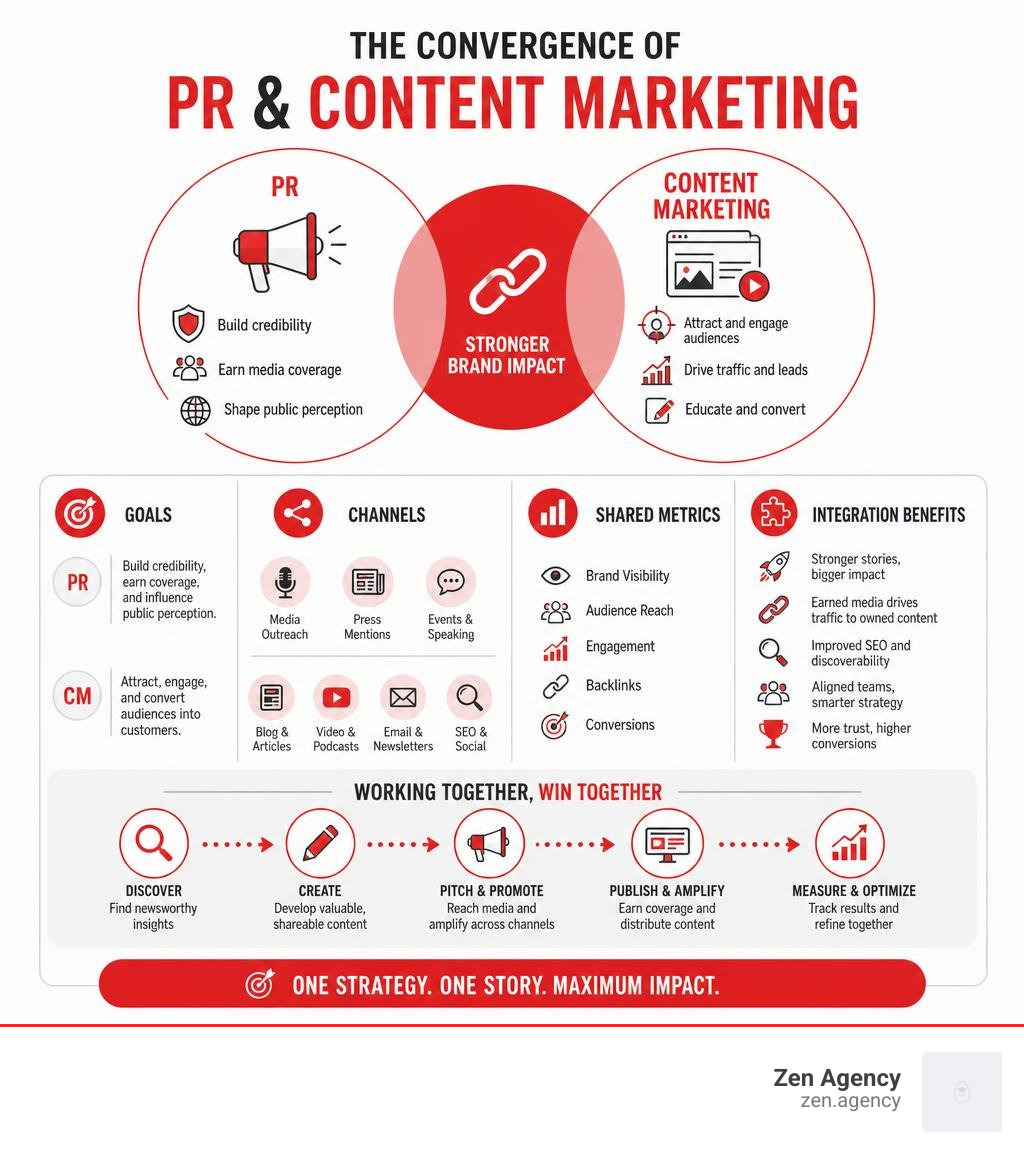
The Strategic Convergence of Content Marketing and PR
For decades, public relations and content marketing lived in different corners of the office. PR professionals were the gatekeepers of brand reputation, managing media relations and securing earned coverage. Content marketers were the digital storytellers, building blogs, writing SEO guides, and nurturing leads through owned channels.
But in June 2026, those lines have completely blurred. Independent media consumption, the rise of AI search engines, and tighter corporate budgets have forced a dramatic shift. Today, successful brands realize that PR and content marketing are two sides of the same coin. When you bring them together, you create a powerful, unified strategy that accelerates brand authority and earns deep audience trust.
As outlined in the guide on How PR and Content Marketing Work Together to Drive Long-Term Growth, the goal of this convergence is to build a reinforcing growth loop. PR secures the third-party validation that makes your brand believable, while content marketing constructs the authoritative home base that captures and converts that attention.
The structural separation of these teams is one of the most quietly expensive problems in modern marketing. When you run parallel tracks that rarely intersect, your PR team learns about valuable content assets weeks too late, and your content team produces deep resources with zero media appeal. Breaking down these walls is no longer optional; it is a structural necessity. Bridging this gap prevents wasted resources and ensures that every piece of content you produce works harder for your bottom line.
To thrive in this environment, teams must adopt Four strategies to thrive in the merger of public relations and content marketing, which include cross-departmental partnering, delivering multi-format “story packages” to journalists, aligning SEO goals with media outreach, and tracking shared performance metrics.
Key Differences Between Content Marketing and PR
While collaboration is essential, we must still respect the unique strengths of each discipline. They are not identical; they are complementary. PR focuses on earning coverage and credibility through external channels, whereas content marketing builds owned assets that attract and retain an audience over time.
Understanding these differences helps us integrate them without diluting their individual power. According to the Public Relations and Content Marketing: 5 Key Differences | CO, the primary differences lie in their audience focus, risk tolerance, and key objectives.
| Feature | Content Marketing | Public Relations (PR) |
|---|---|---|
| Primary Objective | Drive profitable customer action via valuable owned assets | Build mutually beneficial relationships and positive brand image |
| Audience Focus | New prospects, existing leads, and loyal customers | Journalists, industry influencers, editors, and the public |
| Risk & Experimentation | Higher tolerance; room to test creative angles and formats | Lower tolerance; statements are viewed as fully endorsed brand positions |
| Primary Channels | Owned blogs, resource hubs, email, social media | Earned media, publications, broadcast, analyst relations |
| Core Metrics | Page views, organic search traffic, leads, conversions | Media placements, domain authority of coverage, brand search volume |
How to Build a Unified Content Marketing and PR Workflow
To stop the divide from costing you, you must move past simply putting both teams in the same Slack channel. True integration requires structured operational workflows.
- A Shared Editorial Calendar: Both teams must work from a single source of truth. The calendar should lay out upcoming content campaigns, product launches, industry events, and planned media pitches. This ensures the PR team knows what owned assets are in development months before they launch, allowing them to build pitches around high-value content.
- A Single Editorial Brief: When a major content asset (like a research report or industry survey) is commissioned, the brief should be co-authored by both content and PR leads. This guarantees that the asset is built with a clear news hook for journalists, while still satisfying SEO and lead generation goals.
- A Shared Asset Library: PR teams need quick access to publish-ready collateral. Build a centralized, easily searchable library containing high-resolution executive headshots, product photos, data visualizations, audio clips, and expert commentary sheets.
- Cross-Team Collaboration Meetings: Establish regular syncs where content creators share performance data (which topics are trending or driving organic traffic) and PR professionals share media insights (what journalists are currently writing about). This exchange of mutual insights ensures your content remains timely and your PR pitches remain highly relevant.
The Business Case: Why Integrating PR and Content Drives Higher ROI
If you want your marketing budget to work harder, alignment is the key. The data is clear: organizations with aligned PR and content goals achieve 23% higher marketing ROI than those without alignment. Furthermore, companies with fully integrated PR and content strategies see a 72% higher ROI overall compared to those keeping these functions siloed.
When you coordinate these efforts, you maximize brand visibility and establish undeniable thought leadership. Instead of paying for temporary visibility through ads, you build an organic powerhouse. To explore how to optimize your overall spend, check out our guide on How to Improve Marketing ROI and Make Your Budget Work Harder.
For regional businesses looking to scale, aligning your local PR outreach with high-quality content marketing is the fastest way to dominate your regional market. Marrying earned media with strong owned assets builds localized authority and ensures your brand stands out in competitive regional landscapes.
The Trust Signal Effect on Sales Cycles
Why does this integration work so well? It comes down to psychology. Earned media coverage acts as a powerful “trust signal.” When a respected industry publication or local journalist features your brand, that third-party validation functions as social proof.
When a prospect encounters your brand through a trusted media outlet and is directed back to an authoritative, deeply helpful blog post on your website, their skepticism drops. This combination of external validation (PR) and internal expertise (content marketing) directly improves conversion rates on your landing pages. Prospects enter the sales funnel already convinced of your credibility, which significantly shortens sales cycles—especially in complex B2B markets.
The Compounding Effect of Long-Term Brand Authority
Paid advertising stops delivering results the second you turn off the budget. An integrated PR and content strategy, however, acts as an appreciating asset.
As we look at the landscape in How PR and Content Marketing Work Together to Drive Long-Term Growth in 2026, the compounding effect of sustained integration over two to three years builds a competitive advantage that is incredibly difficult for competitors to replicate. High-authority media placements earn permanent, editorially-given backlinks that continuously boost your domain authority. This authority makes it easier for your new content to rank on search engines, driving a steady stream of organic search traffic and increasing brand search volume over time.
How to Execute: Content Formats and Assets That Support PR Campaigns
To get journalists to pay attention to your brand, you have to give them something of real value. Understaffed newsrooms do not have the time to read through self-serving press releases. They want stories, data, and unique perspectives that their readers will care about.

When you design content assets, keep media relations in mind from the beginning. According to the strategic guide on How To Combine PR and Content Marketing Superpowers To Achieve Business Goals, certain formats perform exceptionally well for both content marketing and PR amplification:
- Original Research and Proprietary Data Reports: This is the gold standard of PR assets. When you survey your industry or analyze proprietary data to reveal new trends, you create an exclusive resource. Journalists will naturally link back to your site as the original source of the data.
- Distinctive Expert Commentary: Safe, generic opinions get ignored. Bold, well-reasoned perspectives that challenge industry dogmas make for compelling reading. Use your blog to house thought leadership pieces that your PR team can pitch as contributed articles.
- Deep-Dive Case Studies: Instead of dry summaries, write narrative-driven case studies highlighting unusual or highly successful real-world results.
- Visual Data Assets: Infographics, charts, and interactive maps simplify complex concepts and are highly shareable, making them excellent link magnets.
Leveraging Owned Content for Media Outreach
Did you know that 73% of reporters say one-fourth or less of the stories pitched to them are actually relevant to their audiences? This is a massive waste of outreach effort.
You can solve this discovery problem by treating journalists as an audience. Instead of pitching your products, pitch your owned content assets. If a journalist is writing an article about supply chain issues, do not pitch your software; pitch your newly published research report on supply chain bottlenecks. By delivering a complete content package—complete with a summary, data visualizations, and pre-written expert quotes—you make the journalist’s job incredibly easy, vastly increasing your chances of securing high-quality coverage.
Maximizing SEO and Backlink Authority
The relationship between content and link building is entirely symbiotic. Content marketing provides the valuable assets, and PR secures the high-authority, editorially-given backlinks that search engines heavily favor.
Companies that blog receive 97% more links to their websites than those that don’t. When your PR team secures a feature in a major publication, ensuring that link points directly to a relevant, high-value blog post or resource page (rather than just your homepage) dramatically improves your SEO. For a complete look at how to structure your digital channels for maximum visibility, see The Only Digital Channel Marketing Guide You Will Ever Need.
Navigating Integration in Regulated Sectors
Integrating PR and content marketing is highly effective, but it comes with unique hurdles in highly regulated sectors like life sciences, healthcare, or business-to-government (B2G) procurement. In these spaces, a single unverified claim can lead to legal penalties, compliance violations, or lost government contracts.
Because of these risks, many regulated companies default to keeping their PR and content marketing teams completely siloed. However, as noted in the analysis of Why Siloing PR and Content Marketing is a Mistake, this separation actually increases risk and reduces messaging consistency. When teams operate in isolation, they are more likely to publish conflicting information or miss critical compliance standards.
Overcoming Compliance Bottlenecks in Life Sciences and Healthcare
In healthcare and life sciences, content must pass through rigorous medical, legal, and regulatory reviews before it can be published or pitched. This process often becomes a bottleneck, causing PR campaigns to miss crucial news cycles.
To solve this, you must build compliance review into your upstream planning. Do not treat legal review as a final hurdle at the very end of production. Instead, involve compliance officers during the initial brainstorming and editorial brief stages. When legal teams understand the strategic context of a research report or media pitch early on, they can help guide the language from day one. This proactive approach ensures your integrated campaigns launch on time and remain fully compliant.
Measuring the Combined Impact of PR and Content Marketing
If you are still measuring your PR success through vanity metrics like clip counts or Advertising Value Equivalency (AVE), you are missing the bigger picture. These metrics tell you nothing about actual business outcomes or commercial impact.

To prove real ROI, organizations must track integrated metrics across channels. Organizations that track integrated metrics see a 31% improvement in campaign effectiveness. By connecting top-of-funnel PR reach to bottom-of-funnel content conversions, you gain a clear picture of how your marketing spend drives revenue. To learn how to structure your tracking for full-funnel visibility, refer to our guide: Full Funnel Digital Marketing Is the Only Way to Fly.
Key Performance Indicators for Unified Campaigns
When evaluating your integrated campaigns, focus on key performance indicators (KPIs) that bridge the gap between both disciplines:
- Referral Traffic Quality: Measure the volume, bounce rate, and average session duration of visitors coming directly from your earned media placements. High-quality referral traffic is a strong indicator that your PR pitches targeted the right audiences.
- Backlink Profile and Domain Authority: Track the number of high-authority, editorially-given links secured through PR outreach and how they improve your site’s overall search engine visibility.
- Brand Search Volume: Monitor increases in search queries for your company name following major media coverage.
- Pipeline Contribution: Use multi-touch attribution models to see how many leads or closed-won deals touched both a PR-secured placement and an owned content asset.
- Team Satisfaction: A unified workflow should reduce friction and duplication of effort. If your content and PR teams feel more aligned and less stressed, your collaborative systems are working.
Common Pitfalls to Avoid When Integrating PR and Content
Even with the best intentions, integration can hit roadblocks. Knowing what to watch out for will keep your collaborative efforts on track:
- Retrofitting Stories After the Fact: The most common mistake is creating a piece of content and then handing it to the PR team, asking them to “make it go viral.” If a news hook isn’t built into the content brief from day one, your PR team will struggle to pitch it.
- Focusing on Vanity Metrics: Don’t let your teams retreat to their safe, siloed metrics. Content teams shouldn’t just celebrate page views, and PR teams shouldn’t just celebrate impressions. Both must stay focused on pipeline impact.
- Outreach Fatigue: Pitching journalists generic, low-value educational content will quickly ruin your media relationships. Only pitch assets that meet a high bar of timeliness, relevance, and unique insight.
How to Align Teams and Avoid Friction
Friction usually stems from structural silos and misaligned incentives. If your PR team is evaluated solely on media mentions and your content team is evaluated solely on blog output, they will continue to work in isolation.
To align your teams, establish joint KPIs that require collaboration to achieve—such as organic search improvements for key terms or qualified leads generated from referral traffic. Implement shared dashboards using tools like GA4 so everyone can see how earned media placements drive traffic to owned resources. Finally, allocate your budget and resources to support collaborative assets, like original research, that serve both departments equally.
Frequently Asked Questions about Content Marketing and PR
What is the main difference between PR and content marketing?
The main difference lies in ownership and intent. PR focuses on earning credibility and coverage through third-party channels (like journalists and publications) to build a positive brand image. Content marketing focuses on creating and distributing valuable owned assets (like blogs, guides, and reports) on your own channels to attract, educate, and drive profitable action from a targeted audience.
How does PR coverage improve SEO performance?
PR coverage improves SEO by securing high-authority, editorially-given backlinks from reputable media outlets. Search engines view these earned links as strong trust signals, which boosts your domain authority and helps your owned content rank higher in search results. Additionally, media coverage increases brand search volume, another key signal to search engines.
What content formats are most attractive to journalists?
Journalists are most attracted to content that provides immediate, exclusive value to their readers. This includes original research reports, proprietary industry data, highly visual assets like infographics, narrative-driven case studies with impressive results, and distinct, timely expert commentary on breaking industry news.
Conclusion
In the modern digital landscape, running PR and content marketing as isolated departments is a luxury your business cannot afford. When these two disciplines stop competing for budget and start collaborating on strategy, they create an unstoppable growth engine.
At Zen Agency, we specialize in breaking down these silos. Since 2008, we have provided enterprise-grade digital marketing strategies, custom website development, and branding solutions to help struggling-to-scale businesses maximize their visibility, efficiency, and ROI. Whether you are operating in Pennsylvania, Montana, or anywhere across the country, we can help you build a unified digital presence that turns attention into measurable revenue.
Ready to stop leaving money on the table and build a unified, high-performing strategy for your brand? More info about Zen Agency digital marketing services is just a click away. Let’s start collaborating.