
A Practical Guide to Content Marketing Basics
What Is Content Marketing and Why Is It Essential in 2026?
At its core, content marketing is a strategic marketing approach focused on creating and distributing valuable, relevant, and consistent content to attract and retain a clearly defined audience. Rather than pitching your products directly, you provide authentic value by solving your prospects’ real-world problems. This help-first mindset builds deep credibility long before a buyer ever reaches out to a sales representative.
In 2026, buyer behavior has fundamentally transformed. Research shows that B2B buyers spend only 17% of their total purchase journey meeting directly with potential vendors. The remaining 83% is spent reading, comparing, and educating themselves independently. Furthermore, content influences a staggering 96% of B2B buying decisions. If your brand isn’t providing the educational materials buyers consume during this self-directed research phase, you are completely invisible to them.
Modern organic search habits have also shifted toward zero-click and zero-visit search environments. With search engines delivering instant answers via direct SERP summaries and AI overviews, audiences often get the answers they need without clicking through to a website. To survive, businesses must build interconnected “trust ecosystems”—networks of high-value video, written, visual, and social assets across multiple platforms—ensuring their brand voice remains dominant wherever potential clients search.
| Inbound Content Tactics | Outbound Advertising |
|---|---|
| Pull Strategy: Attracts qualified buyers who actively search for answers. | Push Strategy: Interrupts audiences with direct product promotions. |
| Help-First Approach: Solves buyer pain points to establish long-term trust. | Sell-First Approach: Demands immediate attention and quick action. |
| Compounding Value: Content assets continue generating leads indefinitely. | Ephemeral Value: Lead generation stops immediately when budget ends. |
| High Credibility: 64% of buyers trust brands creating educational content. | Low Credibility: 96% of consumers report feeling inherent distrust toward ads. |
Core Benefits of Value-First Content
Adopting a strategic, value-first content engine directly impacts your bottom line across every stage of the funnel:
- Accelerated Brand Awareness: 87% of marketers report that consistent content directly increases brand visibility and reach.
- Higher-Quality Lead Generation: 76% of marketers say content generates more leads overall, while 70% confirm it delivers significantly higher-quality prospects.
- Superior Cost Efficiency: Companies publishing consistent, high-quality material generate 3x more leads than those relying strictly on outbound tactics, achieving far better acquisition costs.
- Compounding Business Returns: Unlike pay-per-click advertising, where lead flow disappears the moment ad spend halts, optimized content acts like a compounding financial asset, driving continuous organic traffic for years.
To maximize these compounding returns, your written assets must be built upon strong technical and structural search foundations. For a deeper look at optimizing your site’s foundation, check out our guide on SEO 101: From Zero to Search Hero.
Educational Value vs. Interrupted Advertising
Traditional advertising operates by stepping in front of an audience’s attention—interrupting a video, disrupting a social feed, or placing a commercial break in a broadcast. However, consumer sentiment toward direct promotion is at an all-time low: 96% of people state they do not trust traditional ads.
In contrast, 64% of buyers report trusting brands that create educational content, a figure that jumps to 73% within a week of consuming that material. Educational content respects the buyer’s time and intelligence. By offering non-disruptive, actionable insights, you foster natural brand affinity, guiding prospects through their buying journey without friction or hard-sell tactics.
Core Formats for Modern Digital Strategies

A resilient digital strategy doesn’t rely on a single channel. Instead, it weaves together diverse formats to engage users across different touchpoints and learning preferences.
Written Assets and Search Engine Optimization
Written copy remains the bedrock of search engine visibility. High-performing written strategies rely on pillar pages and topic clusters. A pillar page provides a comprehensive overview of a broad topic, while clustered subtopic articles answer specific long-tail queries, linking back to the central hub. This semantic structure establishes site authority and signals Experience, Expertise, Authoritativeness, and Trustworthiness (E-E-A-T) to modern search engines.
To explore how comprehensive search strategies turn obscure sites into market leaders, read our article on From Obscurity to Opportunity: Mastering Online Presence and Organic Traffic.
Visual and Interactive Content Marketing Formats
As online media consumption habits accelerate, visual and interactive elements are essential for capturing attention:
- Short-Form Video: Engaging video clips distill complex topics into consumable social updates.
- Visual Infographics: Graphical data summaries make dense statistical research easily shareable and digestible.
- Interactive Calculators & Assessments: Tools like ROI estimators and interactive product selectors drive engagement while delivering real-time user data for lead qualification.
Mobile readability is vital here—over half of all global internet traffic originates from mobile devices. If your interactive components or graphics fail on small screens, bounce rates soar. Discover detailed techniques for keeping mobile audiences engaged in our guide on Visual Content Creation for People with Short Attention Spans.
Email Nurturing and Omnichannel Distribution
Creating remarkable content is only half the battle; distributing it effectively is what unlocks pipeline growth. Email newsletters and automated drip campaigns allow you to nurture prospective leads over long sales cycles directly in their inboxes. Simultaneously, syndicating snippets, LinkedIn carousels, and short video clips across social platforms ensures multi-channel synergy. To align your social distribution with modern platform trends, review our comprehensive Social Media Marketing Guide 2026.
How to Build an Effective Framework and Editorial Workflow
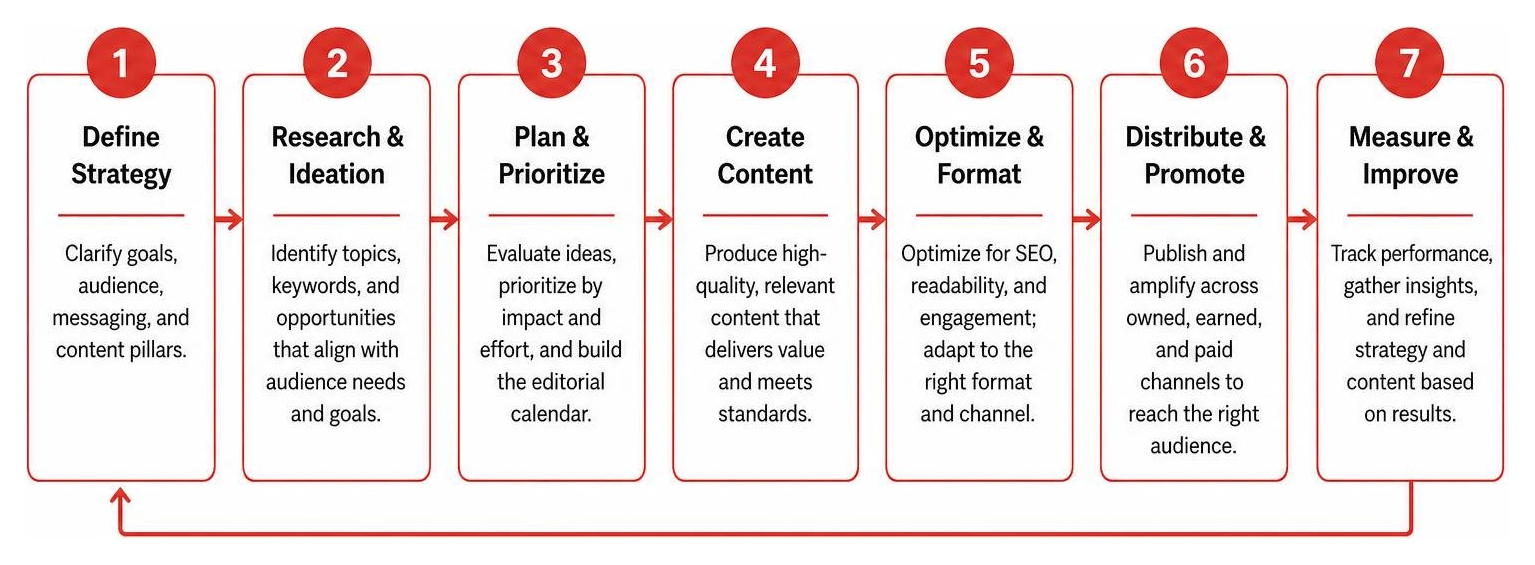
To succeed without wasting valuable internal resources, marketing teams must move away from ad-hoc creation and deploy a structured publishing workflow.

Building an enterprise-grade framework involves seven essential steps:
- Define Audience & Goals: Interview actual customers to clarify buyer pain points and tie KPIs to revenue.
- Conduct Intent-Driven Research: Group audience questions into targeted keyword sets and semantic topic clusters.
- Draft Strategy Blueprint: Document core brand positioning, publishing cadences, and tone guidelines.
- Establish Editorial Calendar: Map out topics 4 to 6 weeks in advance with clear assignees and deadlines.
- Develop Production Workflows: Use standardized content briefs and quality rubrics to streamline drafting and editing.
- Execute Multi-Channel Distribution: Follow a 72-hour launch playbook across email, social, and industry communities.
- Audit and Repurpose: Perform quarterly audits to refresh declining assets and repurpose top performers into new formats.
Adopting this structured approach ensures every piece of content supports your broader growth pipeline. Learn more about aligning top-of-funnel content with bottom-of-funnel conversions in our guide to Full-Funnel Digital Marketing Is the Only Way to Fly.
Audience Research and Funnel Mapping
Effective execution requires mapping your materials to specific stages of the customer buying journey:
- Awareness Stage (Top of Funnel): Educational blog posts, quick videos, and infographics that address broad industry challenges and pain points.
- Consideration Stage (Middle of Funnel): Detailed how-to guides, technical briefs, buyer checklists, and comparison frameworks designed for buyers evaluating solutions.
- Decision Stage (Bottom of Funnel): In-depth case studies, live ROI calculators, custom product walkthroughs, and client success stories that validate vendor capabilities.
Topic Discovery and Editorial Calendars
Uncovering powerful topic ideas requires looking beyond standard keyword software. Explore community forums, Reddit subreddits, customer support tickets, and sales call recordings to discover the precise language your customers use.
Organize those discoveries into distinct content pillars—core themes central to your business offerings. An organized editorial calendar acts as your team’s tactical mission control, establishing production timelines, review handoffs, and distribution schedules weeks in advance.
Scaling Production Without Sacrificing Quality
As your output grows, maintaining brand authority requires robust governance:
- Comprehensive Content Briefs: Provide writers with intent guidelines, target audience profiles, structural outlines, and competitive research before drafting begins.
- Strict Quality Rubrics: Grade drafts against readability metrics, factual accuracy, E-E-A-T signals, and brand voice alignment before approval.
- Strategic Asset Repurposing: Maximize ROI by transforming a single long-form research paper into five LinkedIn posts, an email sequence, an infographic, and a short video script.
Overcoming Challenges and Measuring Business ROI
Marketing teams today face significant operational headwinds. Survey data shows that over 20% of marketers wear ten or more hats within their organizations, with 54% performing tasks outside their primary job descriptions. Tool fragmentation compounds this strain—marketers lose an average of 60 hours per year navigating inefficient, disconnected software tools. Establishing clear production processes and streamlined tech stacks is crucial to avoiding burnout and maintaining output quality.
Measuring true business impact requires moving past simple traffic metrics and implementing a three-tiered performance measurement framework:
- Tier 1: Business Outcomes: Pipeline growth, customer acquisition cost (CAC), sales conversion speed, and total revenue closed.
- Tier 2: Conversion Metrics: Lead form completions, gated asset downloads, email signups, and demo requests.
- Tier 3: Engagement Indicators: Page views, organic keyword rankings, dwell time, social shares, and scroll depth.
To dive deeper into maximizing your marketing performance and eliminating wasteful spending, explore our insights on How to Improve Marketing ROI and Make Your Budget Work Harder.
Navigating AI in Content Marketing Teams
Generative AI has transformed modern marketing operations, but using it effectively requires balance. Approximately 60% of US businesses leverage AI for content scheduling, research synthesis, and outline drafting. However, relying on unedited AI output poses serious risks—research indicates unedited AI text carries a 35% higher error rate than human-crafted writing.
Smart teams treat AI as a research partner and efficiency assistant rather than an automated author. Human strategists and editors must provide subject-matter expertise, conduct factual verification, inject authentic brand voice, and weave real customer stories into the text.
For an in-depth look at implementing AI technology into your workflows without sacrificing quality, read From Hacking to Hypergrowth: Generative AI in Marketing.
Measuring Performance, Conversion Rates, and Revenue ROI
To tie content spend directly to revenue, organizations must implement multi-touch attribution models within their CRM platforms. Multi-touch attribution tracks every asset a prospect interacts with throughout their purchase journey—from the initial blog post that introduced them to your brand, to the technical guide they downloaded before requesting a quote. By analyzing these multi-touch conversion pathways, you can confidently double down on high-performing topics and formats while refining or retiring underperforming assets.
Frequently Asked Questions About Content Strategy
How long does it take to see results from content marketing?
While paid advertising offers instant impressions, strategic content marketing builds compounding long-term equity. Most organizations see measurable organic traffic growth within 6 months of launching a consistent, search-optimized publishing cadence. By months 12 to 18, as domain authority builds and topic clusters index fully, lead generation and pipeline acceleration compound significantly.
What is the difference between content marketing and SEO?
Search Engine Optimization (SEO) is the technical discipline of structuring websites and assets so search engines can easily crawl, index, and rank them. Content marketing is the broader business strategy of planning, producing, and distributing value-driven media to attract, educate, and convert a specific target audience. SEO ensures your content is discoverable, while content marketing ensures that once visitors arrive, they engage, build trust, and convert.
How can small teams publish consistent content on a budget?
Small teams achieve enterprise-level impact by focusing on quality over sheer quantity. Publishing 1 to 2 deeply researched, highly actionable pieces per month will consistently outperform publishing dozens of thin, uninspired articles. Smaller teams should also leverage AI for outline generation and initial research synthesis, while establishing a strict repurposing framework to turn every main asset into multiple bite-sized social updates and email newsletters.
Conclusion
In 2026, educational, buyer-centric content is no longer an optional tactic—it is the foundational infrastructure of modern customer acquisition and brand trust. By delivering genuine value, optimizing assets for modern search environments, and building a structured operational pipeline, your business can turn published insights into a predictable growth engine.
At Zen Agency, we specialize in delivering enterprise-grade web development, custom branding, and custom-tailored strategy designed to scale growing businesses. If you’re ready to enhance your brand visibility, generate high-quality leads, and maximize your digital ROI, explore our Zen Agency Digital Marketing Services or reach out to our team today to build a high-impact content strategy engineered for your long-term success.