Stop Overthinking Your Brand Naming Strategy and Pick a Winner
A Brand Naming Strategy Helps You Choose With Confidence
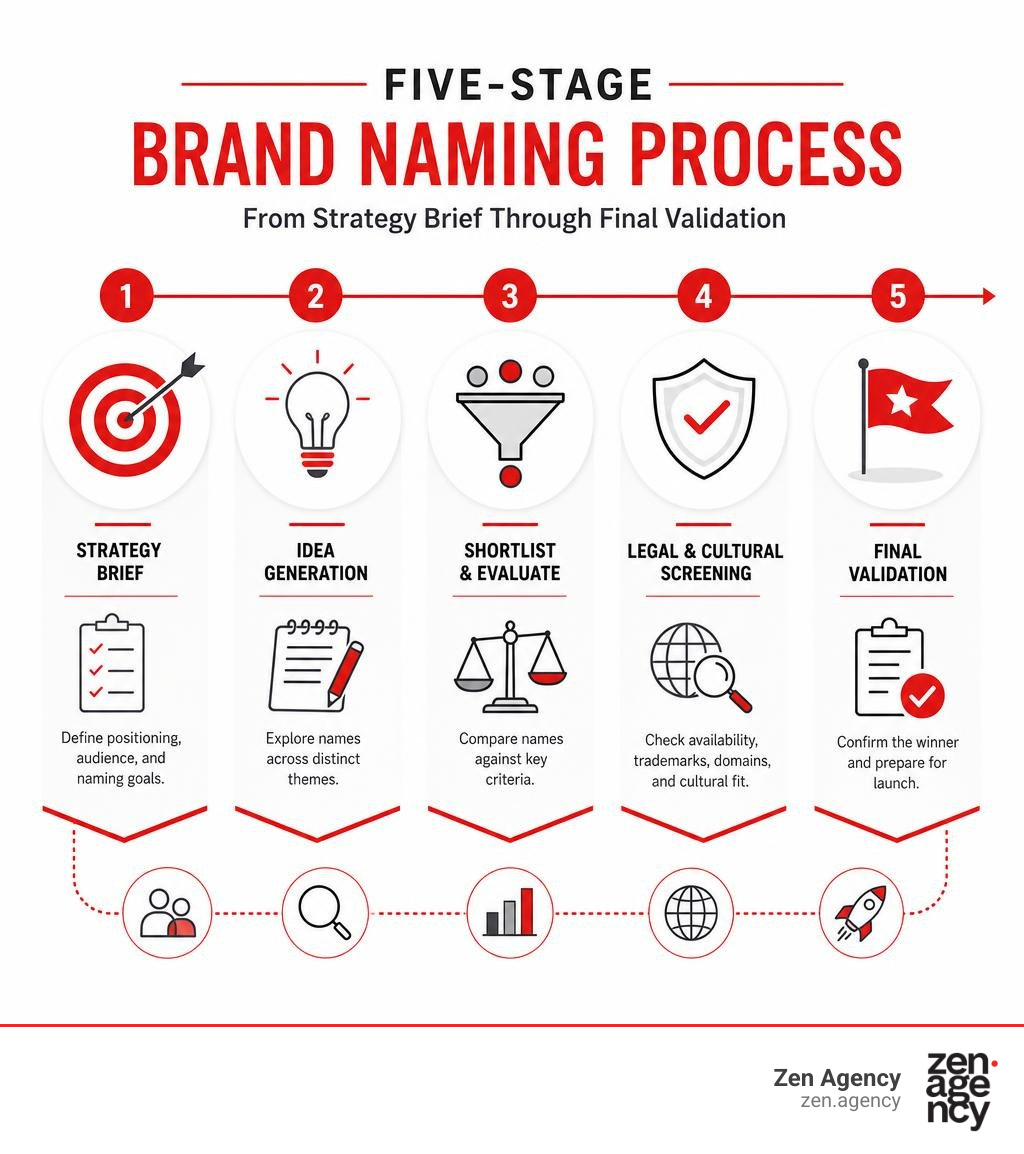
A strong brand naming strategy turns a vague creative debate into a clear business decision. Start with your positioning and audience, generate ideas across a few distinct themes, then select the name that best balances:
- Distinctiveness – It stands apart from competitors.
- Memorability – People can recall, say, spell, and search for it.
- Fit – It signals the right feeling and supports your future plans.
- Protectability – It can pass trademark, domain, and cultural checks.
- Usability – It works in a logo, sales conversation, ad, URL, and product line.
Do not wait for a name that every stakeholder loves on first hearing. The right name is rarely magic in isolation. It earns meaning through the product, customer experience, visual identity, and marketing behind it.
Your name is both important and limited: it cannot rescue weak positioning, but it can make a strong business easier to recognize, recommend, and defend. Since roughly half of buying decisions are influenced by emotion, a name that creates the right first impression can give every future marketing effort a better starting point.
I’m Joseph Riviello, CEO and Founder of Zen Agency, with more than 22 years of experience helping businesses grow through integrated digital marketing and brand decisions. In this guide, I’ll show how a practical brand naming strategy can reduce costly guesswork and help you pick a name built to scale.
Brand naming strategy glossary:
The Foundations of an Enduring Brand Naming Strategy

A business name is often described paradoxically: it is the most important least important brand asset you will ever create. A clever name cannot compensate for a broken product or flawed operations, but a strong, defensible verbal anchor unlocks compounding market leverage.
Far too many leadership teams approach naming backward. They gather around a whiteboard, throw out random ideas based on personal aesthetic preferences, and immediately reject great concepts because someone’s cousin disliked the sound of it. Moving beyond brainstorming: mastering the art of brand naming requires grounding your verbal identity in objective strategic criteria rather than momentary emotional whims.
The Strategic Value of the Brand Name
At its core, a brand name serves as a cognitive retrieval mechanism. In a crowded marketplace, consumers process thousands of commercial messages every single day. Your name is the psychological filing cabinet label under which customers store their memories, perceptions, emotional reactions, and purchase experiences.
Legally, your name acts as a primary trademark device alongside logos, packaging, and digital assets to distinguish your commercial offerings from competitors. When aligned tightly with positioning, a great name lowers customer acquisition costs by increasing processing fluency—the ease with which the human brain perceives, decodes, and remembers information.
Measuring and Preventing Compounding Naming Debt
When businesses pick a name impulsively, they accumulate what strategists call naming debt. Much like technical debt in software development, naming debt is the accumulated operational and marketing friction resulting from an ill-fitting, confusing, or overly narrow moniker.
Naming debt compounds quietly across several areas:
- Sales friction: Sales reps spend the first thirty seconds of every discovery call spelling out, explaining, or apologizing for an ambiguous company moniker.
- Search obfuscation: Generic or hyper-descriptive names compete against millions of dictionary terms in organic search results.
- Strategic pigeonholing: A company named after its original offering (like “Fast Cloud Accounting”) faces massive cognitive resistance when expanding into broader enterprise financial operations.
- Rebranding expenses: Fixing a failed brand name down the road typically costs 8 to 12 times more than executing a disciplined naming process at the start.
Learning how to build a brand that lasts: a step-by-step strategy guide ensures your company establishes verbal and structural assets capable of supporting long-term commercial growth without necessitating an expensive mid-journey overhaul.
The 7 Brand Name Typologies and Strategic Trade-Offs
Before generating ideas, you must understand the primary structural typologies available in commercial naming. As detailed in the comprehensive brand naming toolkit | techniques and insights – Martin Roll, different structural styles demand distinct balances between immediate functional clarity, trademark protection, and long-term marketing spend.
| Typology | Primary Characteristic | Trademark Defensibility | Education Cost | Strategic Flexibility |
|---|---|---|---|---|
| Descriptive | Explains what the product/service does | Very Low | Low | Very Low |
| Suggestive | Hints at a benefit, attribute, or experience | High | Moderate | High |
| Abstract / Coined | Completely invented neologisms | Very High | High | Maximum |
| Metaphorical / Evocative | Uses vivid real-world imagery laterally | High | Moderate | High |
| Founder-Led | Built around an individual’s surname | Moderate | High | Moderate |
| Acronymic | Initialisms of longer descriptive names | Low to Moderate | Very High | Low |
| Compound | Blends two real words or morphemes together | Moderate to High | Low to Moderate | Moderate |
Descriptive and Geographical Names
Descriptive and geographical names state exactly what a business offers or where it is based (e.g., General Motors, The Container Store, Pennsylvania Logistics).
While they require almost zero initial marketing spend to explain what you do, they carry immense strategic liabilities:
- They are virtually impossible to register as exclusive trademarks because government intellectual property offices prohibit companies from monopolizing common language terms without proven secondary meaning.
- They severely restrict future business model evolution and geographic expansion.
- They blend into category noise, providing negligible differentiation against competitors using similar generic keywords.
Suggestive and Evocative Names
Suggestive names hint at an underlying benefit, functional attribute, or brand value through metaphor and creative association (e.g., Zen, Agile, Amazon).
These represent an ideal sweet spot for growing enterprises. They provide intuitive psychological cues that stimulate consumer imagination while remaining sufficiently broad to accommodate new product lines and service expansions. Suggestive naming gives your marketing team an enduring storytelling platform that can yield creative campaigns for decades.
Abstract, Coined, and Neologism Names
Abstract names are entirely fabricated linguistic constructions engineered from morphemes, prefixes, and classical Latin or Greek roots (e.g., Pentium, Vercel, Swiffer).
As explored in the wizard behind the names of billion-dollar companies, coined names offer unmatched trademark protection and give an enterprise a completely blank canvas upon which to build brand equity. Because invented words trigger novelty in the human brain, they naturally capture consumer curiosity and command attention when supported by sound marketing.
Founder Names, Acronyms, and Compound Words
- Founder-led names (e.g., Ford, Dell) foster immediate personal accountability and authentic craft heritage, though they can make eventual company transitions or acquisitions more complicated.
- Acronyms (e.g., IBM, SAP) are almost always a poor starting strategy for new organizations. They lack inherent emotional resonance, create substantial cognitive friction, and demand massive capital to establish meaning in customer memory.
- Compound words (e.g., Snapchat, Facebook) combine two familiar words to deliver clear imagery, manageable syllable counts, and immediate processing ease.
The 5-Stage Framework for Developing a Defensible Name
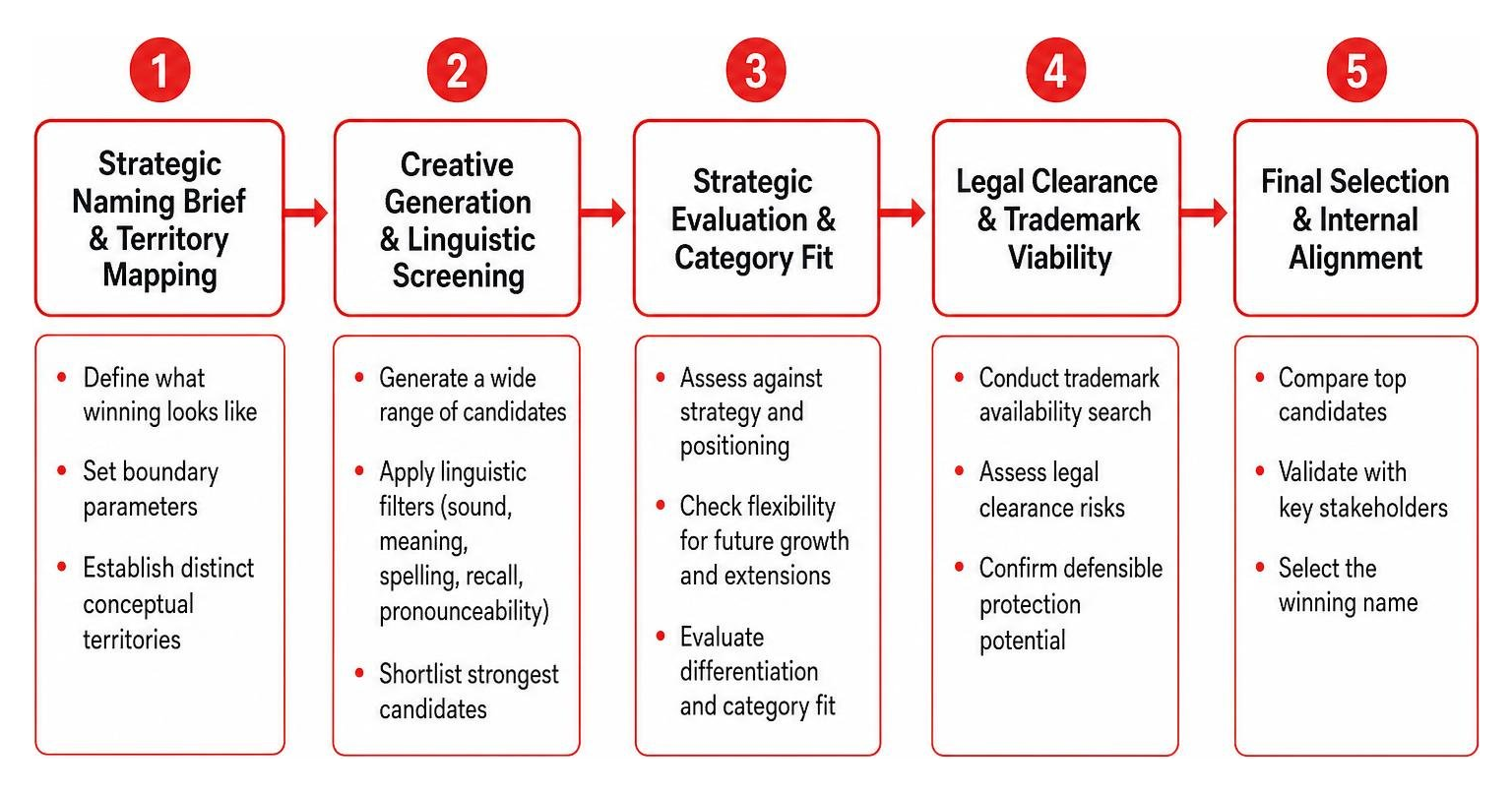
Developing a powerful brand name requires a repeatable, stage-gated process that systematically eliminates personal bias and filters candidates through strategic, linguistic, and legal parameters.
Stage 1: The Strategic Naming Brief and Territory Mapping
Never start generating names in an unstructured vacuum. The naming brief defines what winning looks like, sets rigid boundary parameters, and establishes distinct conceptual territories before a single word is brainstormed.
A robust naming brief outlines:
- Brand Purpose & Positioning: The specific customer problem you solve and your unfair competitive advantage.
- Target Audience Profile: The cultural values, aesthetic sensibilities, and communication style of your ideal buyer.
- Competitive Landscape: Monikers used by category peers that must be explicitly avoided.
- Conceptual Territories: 4 to 6 broad storytelling angles (e.g., speed, precision, structural harmony, effortless navigation, organic craft).
Stage 2: Mass Candidate Generation and Lateral Brainstorming
To find five exceptional names, professional naming teams generate between 500 and 1,500 raw candidates. Founders who brainstorm fewer than twenty options inevitably settle for obvious, clichéd, or legally contested terms.
Effective lateral brainstorming techniques include:
- Semantic Overlap & Metaphor Mapping: Mining cross-disciplinary vocabularies across architecture, marine biology, mathematics, and philosophy.
- Morpheme Stacking: Combining Latin and Greek affixes, prefixes, and root stems to assemble novel linguistic structures.
- Divergent Prompts: Splitting ideation into separate tracks—one focusing on literal solution paths, one exploring lateral metaphors, and another studying competitor vulnerabilities.
For deeper insights into linguistic generation frameworks, review how to find the perfect name – by David Placek to see how professional agencies generate expansive naming matrices.
Stage 3: Phonetic Profiling and the SMILE Evaluation Filter
Once you have established a large longlist, filter candidates using sound symbolism (phonosemantics) and objective structural criteria. Phonetics shape subconscious perception before conscious analysis begins:
- Plosive Consonants (B, D, K, P, T) create a sharp acoustic pop that drives higher immediate recall and cognitive memorability.
- Soft Fricatives (F, S, V, Z) communicate fluid movement, speed, and approachability.
- Uncommon Initials (X, Z, Q, K) deliver striking visual distinction on crowded digital interfaces.
Filter shortlisted candidates against Alexandra Watkins’ battle-tested SMILE criteria:
- Suggestive: Does it evoke positive brand attributes?
- Memorable: Is it easily retained in consumer memory?
- Imagery: Does it spark immediate mental pictures?
- Legs: Does it serve as a theme that extends into marketing campaigns and sub-products?
- Emotional: Does it trigger a visceral, emotional reaction?
Stage 4: Trademark Clearance and Digital Asset Verification
Never fall in love with a name before running comprehensive legal and digital clearance checks. In the United States alone, over 5.5 million active trademarks exist across 45 international trademark classes.
The clearance stage must include:
- USPTO TESS Database Searches: Screening your selected name against direct matches and phonetically confusing marks within your specific commercial classes (such as Class 42 for SaaS or Class 35 for business services).
- State Business Registries: Conducting business entity availability checks through regional resources like naming your business – PA business one-stop shop for domestic compliance.
- Common Law Searches: Searching industry directories, domain registrations, and general search engines to identify active unregistered commercial use.
- Digital Presence Screening: Checking top-level domains (.com, .io, .co) and social handles.
Stage 5: Contextual Stress-Testing and Decision Governance
Do not judge names as isolated, naked black words on a white sheet of paper. Real consumers encounter names in rich visual and conversational contexts.
Stress-test finalist names using the following protocols:
- The Barista Test: Can you state the name aloud in a noisy coffee shop or on a phone call without having to spell it out letter by letter?
- Contextual Mockups: Place shortlisted candidates onto billboard mockups, website hero headers, mobile app icons, and business cards to evaluate visual balance.
- Small Committee Governance: Make final naming decisions within a tight leadership team (2 to 4 key decision-makers). Abandon internal company-wide voting; democratic consensus consistently produces bland, compromised compromises that offend no one but inspire nobody.
Translating Name Concepts into Full Brand Systems
A name is only the initial verbal anchor of your broader commercial strategy. To build true market equity, your verbal positioning must integrate seamlessly with visual systems, digital experiences, and portfolio architecture.
Understanding beyond logos: why your business needs a digital branding agency ensures your name works in total harmony with dynamic digital applications, omnichannel campaigns, and conversion-focused touchpoints.
Aligning Portfolio Architecture with Brand Naming Strategy
Multi-offering businesses must establish a standardized brand naming architecture to govern how sub-brands, service tiers, and product features interact:
- Branded House (e.g., FedEx Express, FedEx Freight): One master brand name anchors every single service line, maximizing enterprise marketing efficiency.
- House of Brands (e.g., Procter & Gamble owning Tide, Pampers): Individual standalone names created for distinct target markets, isolating risk between business units.
- Endorsed Brand Architecture: Independent names supported by a prominent master brand endorsement.
When tiering products, use logical semantic taxonomies. A company with thousands of SKUs benefits tremendously from structured catalog categorization. For instance, global furniture leader IKEA organizes its vast inventory of roughly 9,500 products (introducing 2,500 new items annually) by assigning specific Scandinavian geographic locations to distinct functional departments, transforming complex inventory into intuitive customer navigation.
Structuring portfolio clarity is explored further in the ultimate guide to brand alignment consulting and channel control, illustrating how proper brand architecture prevents cross-channel customer confusion.
Integrating Verbal Anchors with Visual Design Systems
Once the verbal anchor is secured, pair it immediately with a customized visual identity. Hard, energetic plosive consonant names pair naturally with bold, geometric typography, while soft, organic names demand fluid lines and warmer palettes.
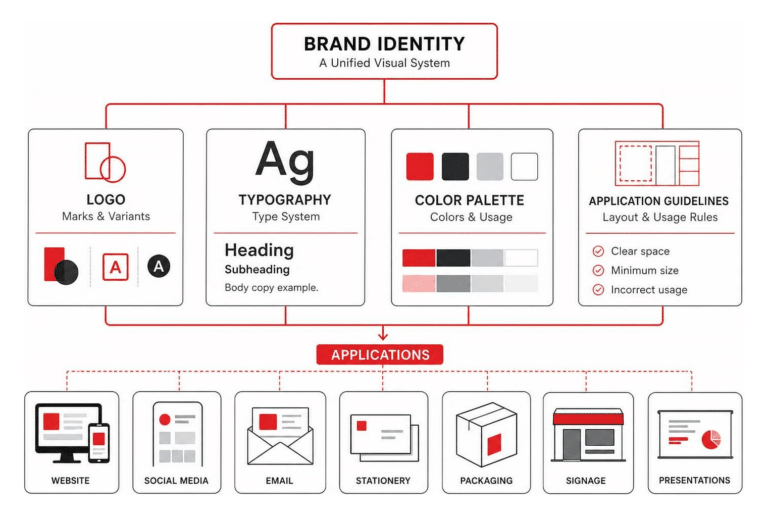
Investing in bespoke brand identity design bridges the gap between your strategic positioning, logo craft, color psychology, and multi-channel digital touchpoints, delivering a unified customer experience that commands market authority.
Avoiding Pitfalls That Derail Your Brand Naming Strategy
As you finalize your brand name, avoid these classic execution traps:
- Demanding Universal First-Sight Love: Exceptional, distinctive names frequently feel unfamiliar or uncomfortable upon first exposure. If a name provokes zero debate, it is likely too safe to be memorable.
- Domain Name Paralysis: Do not abandon a world-class name simply because the exact-match .com is owned by a domain squatter. Modern consumer discovery occurs via search engines, app stores, and direct links; adding simple modifiers (e.g., get[brand].com, use[brand].io) is widely accepted.
- Treating Legal Clearance as an Afterthought: Discovering a fatal trademark conflict after designing logos, producing signage, and building web properties results in massive wasted capital and avoidable delays.
Frequently Asked Questions About Brand Naming Strategy
How long does a rigorous brand naming process take?
A thorough, professional naming process typically takes 4 to 6 weeks from initial strategic briefing through final trademark filing. Complex global projects requiring localized linguistic screening across dozens of international markets can take 8 to 12 weeks to complete thoroughly.
Should domain availability dictate our initial brand name choices?
No. Trademark clearance and strategic brand alignment should always precede domain searches. Securing an exact-match .com domain is useless if the underlying word infringes on an existing registered trademark in your commercial class. Furthermore, search engine algorithms and modern digital consumer behavior have significantly decreased dependency on pristine .com URLs.
How do we test a brand name across international languages and cultures?
International brands should conduct transcreation audits and native linguistic screenings. This involves engaging native speakers across your target expansion markets to verify that the proposed name does not carry offensive, vulgar, or unintended slang connotations when spoken or transliterated into local dialects.
Conclusion
A powerful brand naming strategy is an objective, systematic engineering process that aligns your business purpose, psychological differentiation, and legal defensibility into a single verbal asset. By establishing a clear strategic brief, generating expansive candidate volume, filtering through phonetic and trademark criteria, and eliminating subjective committee voting, you can select an enduring name built to scale.
At Zen Agency, we deliver enterprise-grade digital marketing, web development, and branding strategies designed to increase market visibility, profitability, and ROI. Discover how our professional branding and graphic design services can transform your strategic vision into an unmistakable market presence.