A Modern Field Guide to Sourcing Better Data-Driven Leads
How Data-Driven Leads Help You Find Buyers Ready to Act
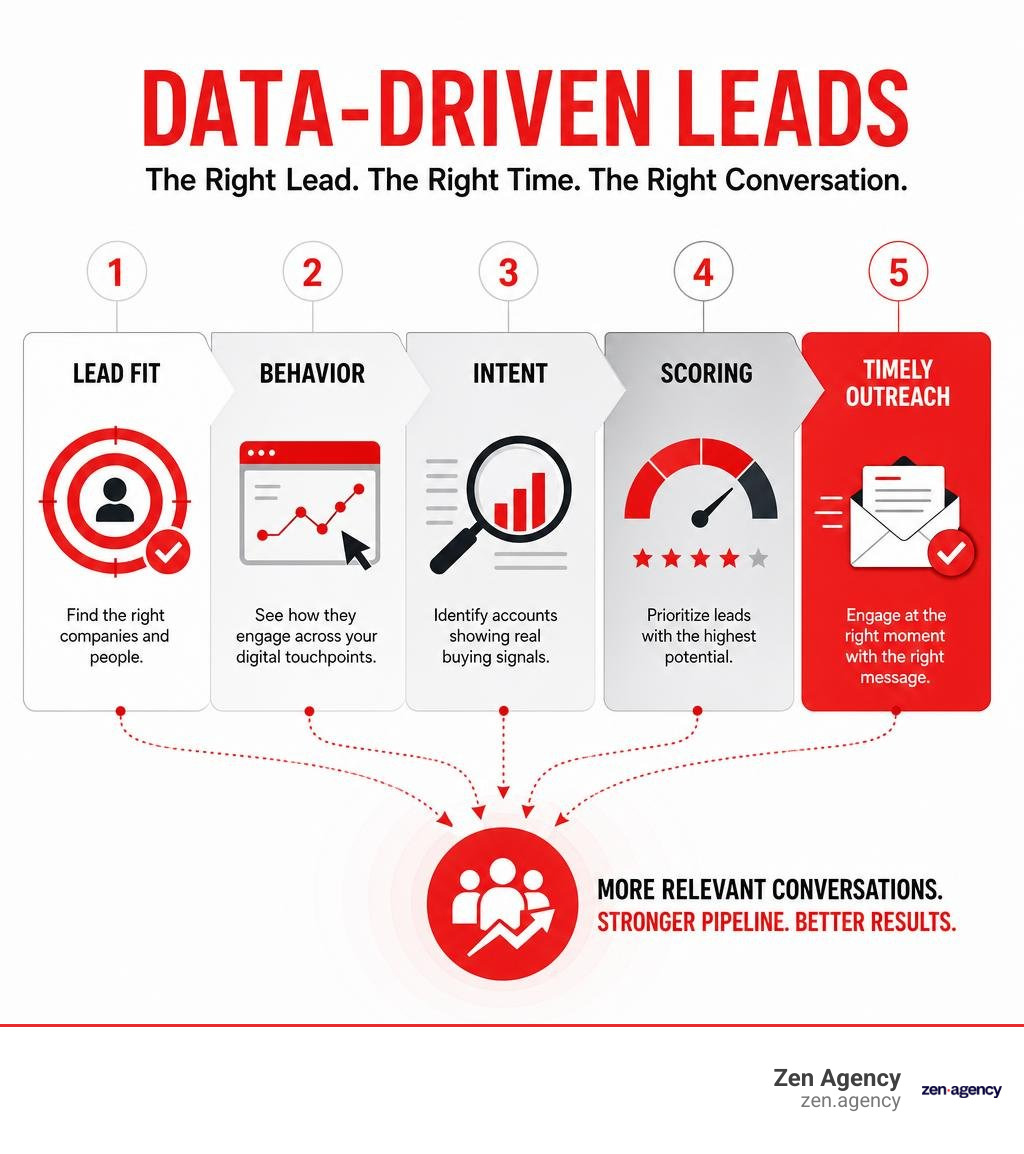
Data-driven leads are prospects selected and prioritized using real customer, account, and buying-intent signals instead of a broad list or a form fill alone. To source better leads, define your ideal customer, unify your CRM and website data, score fit and engagement, and trigger outreach when signals show real interest.
That shift matters because most teams do not need more names. They need clearer proof of who is likely to buy, what they care about, and when a sales conversation makes sense.
A useful lead profile can combine:
- Fit data – industry, company size, role, location, and technology used.
- Behavior data – repeat site visits, content downloads, demo requests, and pricing-page activity.
- Intent data – signs that an account is researching a problem, comparing options, or showing a surge in interest.
Used well, this approach replaces guesswork with a practical system for focusing budget and sales time on accounts with the strongest potential. It can also make outreach more relevant, which is far more valuable than sending the same message to thousands of weak matches.
I am Joseph Riviello, CEO and Founder of Zen Agency, with more than 22 years of experience helping companies connect traffic, leads, conversions, and revenue. In this guide, I will show how Data-driven leads can give your team a more focused, measurable path to profitable growth.
Data-driven leads helpful reading:
What Are Data-Driven Leads and Why Has Lead Sourcing Shifted?
Lead generation used to be a simple volume game: buy a directory list, run cold calls across broad regions, blast cold emails, and hope a small percentage convert. But in a digital economy where humanity generates over 402.74 million terabytes of data daily, relying on broad lists is a fast track to burned budgets and burned-out sales reps.
Today, high-growth organizations rely on evidence-based prospecting. Instead of treating every contact equally, a data-driven approach evaluates multi-touch signals across the web to identify prospects demonstrating active market interest.
The business impact of this shift is measurable:
- Companies that adopt data-driven marketing are six times more likely to be profitable year-over-year.
- Deploying data-driven personalization delivers five to eight times the ROI on marketing spend and boosts sales by 10% or more.
- Optimizing campaigns with real performance data reduces overall marketing costs by up to 30%.
- Evidence-based targeting drives a 20% increase in customer acquisition and a 10% enhancement in customer retention.
Modern business analytics methodologies allow revenue teams to analyze behavior, spot conversion velocity trends, and prioritize high-value prospects.
| Feature / Dimension | Traditional Leads | Data-Driven Leads |
|---|---|---|
| Sourcing Method | Static purchased lists, generic web directories, broad form gates | Dynamic behavioral triggers, intent tracking, multi-touch analytics |
| Qualification Focus | Basic contact info (name, email, phone) | Deep multi-layered fit (technographics, firmographics, intent scoring) |
| Outreach Timing | Arbitrary or immediate automated blasts regardless of buyer readiness | Triggered by active buying signals, intent surges, and engagement depth |
| Personalization Level | Generic mail-merge fields (Hi {{First_Name}}) |
Contextual messaging based on pain points, tech stack, and content consumed |
| Pipeline Efficiency | High volume, low conversion, high sales fatigue | High fit, lower volume, accelerated deal velocity and higher win rates |
The Fundamental Difference: Intuition vs. Multi-Touch Intelligence
Operating on gut instinct causes severe pipeline leakage. Sales reps end up chasing unverified contacts who have no budget, no authority, and no active need.
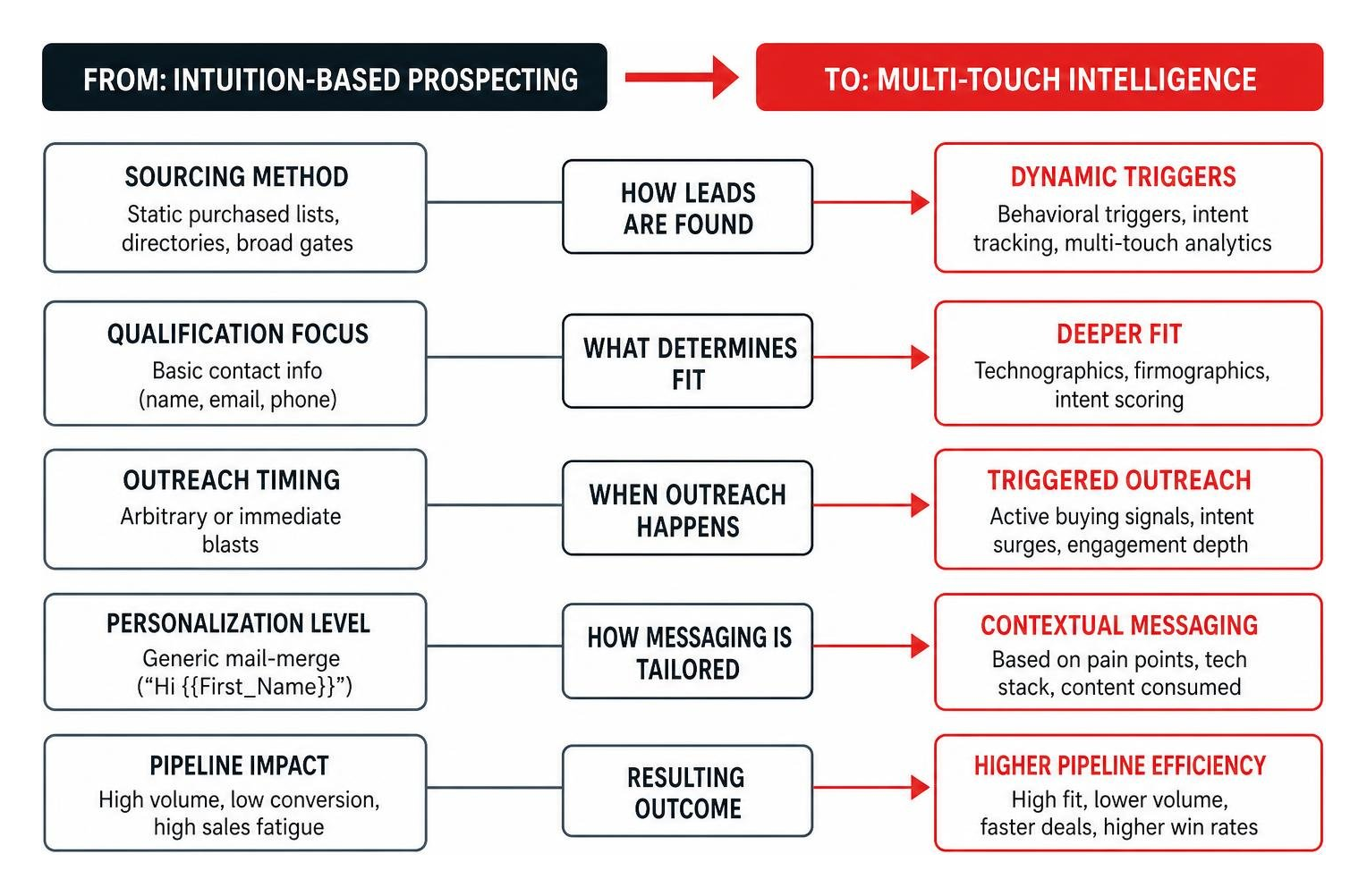
Multi-touch intelligence tracks account interactions across multiple touchpoints before sales reps ever reach out. By implementing comprehensive customer journey mapping, marketing and sales teams can see exactly when an account moves from passive exploration to active product evaluation.
Behavioral vs. Intent Signals in Data-Driven Leads
To capture buyers before your competitors do, you must distinguish between behavioral data and intent signals:
- Behavioral Signals (First-Party): Actions taken directly on your digital properties—reading technical blog posts, visiting pricing pages, downloading implementation guides, or testing interactive ROI calculators.
- Intent Signals (First- and Third-Party): Aggregated external search trends, industry forum queries, review platform comparisons, and content consumption across third-party media networks indicating an active project.
Evaluating both lets you qualify leads for better conversion rates by identifying both who fits your product and who is actively searching for a solution right now.
Core Data Layers That Reveal High-Intent Prospects
Uncovering actionable leads requires layering multiple data dimensions to build a complete profile of account readiness.

- Firmographic Data: Company size, revenue bands, geographic territory, industry vertical, and organizational structure.
- Technographic Data: Hardware, software platforms, CMS systems, security tools, and tech stack integrations currently used by the prospect.
- Behavioral Data: Specific digital actions taken on your domain, such as video completions, form interactions, and navigation paths.
- Intent Signals: In-market spikes, competitive alternative research, and topic consumption across B2B networks.
First-Party Engagement and Account-Level Tracking
First-party data is the most reliable intelligence asset in your organization. Tracking IP-level account visits, form drop-offs, and micro-conversions uncovers high-intent buyers before they fill out a form.
When analyzing on-site activity, look closely at user behavior to identify site friction. Monitoring dead clicks and rage clicks helps identify poor user experiences that cause form abandonment, which you can resolve through targeted conversion rate optimization.
Predictive Scoring and Timing Outreach with Intent Signals
Timing outreach correctly is often the difference between booking a meeting and getting marked as spam.
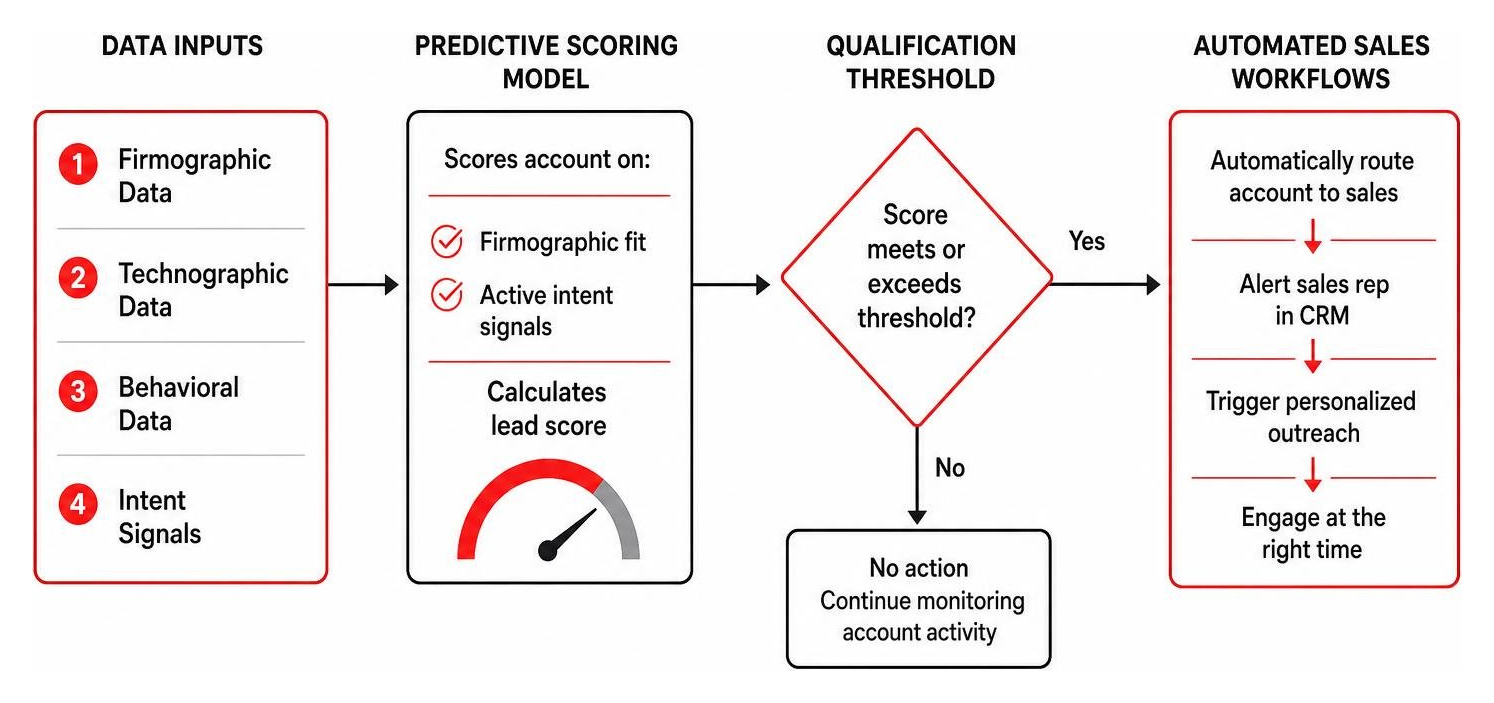
Scoring models assign quantitative values to firmographic fit and active intent signals. Understanding why lead scoring is essential allows revenue teams to establish real-time triggers. When an account exceeds your qualification threshold—for example, visiting your pricing tier twice in 48 hours after reading a comparison guide—your CRM immediately routes the account to sales for personalized outreach.
Sourcing High-Value Data-Driven Leads: The Modern Framework
Transitioning to a modern demand-generation pipeline requires a structured execution framework.

- Step 1: Define Dynamic Ideal Customer Profiles (ICPs): Analyze historical closed-won data to uncover common traits among your highest lifetime-value clients.
- Step 2: Consolidate First-Party Touchpoints: Connect website event tracking, marketing automation, and transactional systems into a unified analytics hub.
- Step 3: Enrich with Technographic & Firmographic Data: Append verified contact details, mobile verification, and installed software tools using trusted enrichment engines.
- Step 4: Layer Real-Time Intent Signals: Monitor topical intent surges across industry publications and search networks.
- Step 5: Apply Predictive Lead Scoring: Score accounts automatically based on fit, recency, and signal frequency.
- Step 6: Trigger Contextual Multi-Channel Sequences: Route scored leads directly into personalized email, phone, and paid retargeting streams.
Building the Data Infrastructure and Clean Data Foundation
A high-performing strategy depends on clean data infrastructure. Enterprise teams maintain an average of 15+ data analytics platforms across their tech stack, with 94% of enterprise and mid-market organizations deploying dedicated business intelligence and analytics tools to run their go-to-market operations.
Establishing proper ETL (Extract, Transform, Load) pipelines and integrating your CRM with lead generation automation ensures leads are deduplicated, enriched, and validated before reps initiate contact.
Personalizing Outreach for Data-Driven Leads Using AI
Outreach delivers maximum impact when the prospect feels you understand their exact situation. Modern natural-language platforms allow sales teams to parse prospect research—such as recent leadership hires, funding rounds, or software migrations—and generate highly tailored messaging at scale. This improves email deliverability and response rates by focusing on relevant business problems rather than generic sales pitches.
Overcoming Common Obstacles: Data Quality, Silos, and Compliance
Even the most advanced data platforms can struggle if data hygiene and compliance practices are neglected.
Resolving Identity Discrepancies and Siloed Systems
One major challenge in lead identification is data accuracy. Industry benchmarks show that 1 in 4 typical matches from identification vendors resolve to a household member rather than the actual professional who visited your website.
Relying on probabilistic household guesses wastes sales bandwidth. Academic data science research highlights the importance of deterministic matching—anchoring identities using direct first-party signals such as authenticated email addresses and verified phone numbers before adding contacts to sales cadences.
Sales and Marketing Alignment on Lead Qualification
Data-driven lead generation breaks down when marketing and sales define success differently. If marketing celebrates delivering 500 top-of-funnel downloads while sales complains that none of them have purchasing authority, pipeline growth stalls.
To solve this:
- Create a joint Service Level Agreement (SLA) defining exact quantitative criteria for Marketing Qualified Leads (MQLs) and Sales Qualified Leads (SQLs).
- Base lead qualification on objective data points: company size, verified software stack, specific page actions, and intent score thresholds.
- Implement a continuous closed-loop feedback mechanism where sales reps log disqualification reasons directly in the CRM, automatically refining marketing’s targeting parameters.
Essential Metrics and Attribution to Track Lead Effectiveness
Tracking lead performance requires looking beyond vanity metrics like total impressions or top-of-funnel form downloads. Focus on bottom-line pipeline indicators that reflect lead quality and revenue contribution.
- MQL-to-SQL Conversion Rate: The percentage of marketing leads that meet sales criteria and turn into active opportunities.
- Sales Pipeline Velocity: How quickly an identified data-driven lead moves from first touch to closed-won.
- Customer Acquisition Cost (CAC) by Channel: The true cost to acquire a paying customer across specific data sources and campaigns.
- Customer Lifetime Value (LTV): The long-term revenue generated by accounts sourced through data-driven campaigns versus traditional outbound channels.
Tracking these metrics gives you the clarity needed for improving your marketing ROI and reallocating budget toward your most profitable acquisition channels.
Frequently Asked Questions About Data-Driven Leads
How do data-driven leads directly improve sales team productivity?
By filtering out non-buyers and delivering verified contact information alongside actionable context (such as recently visited pages or verified tech stack details), sales reps spend less time researching and cold dialing, and more time having qualified conversations with active buyers.
What is the biggest difference between first-party and third-party intent data?
First-party intent data tracks direct interactions on your own digital assets (such as pricing page visits and documentation downloads), offering high accuracy and immediate activation value. Third-party intent data tracks broader content consumption and search behavior across external websites, providing early notice that an account has entered an active buying cycle.
How often should an organization update and refine its Ideal Customer Profile data?
Organizations should conduct a comprehensive review of their Ideal Customer Profile at least quarterly. Reviewing recent closed-won deals and lost opportunities helps identify shifting market trends, expanding verticals, and changing buyer personas.
Conclusion
Sourcing high-quality leads is no longer about collecting massive lists of unverified contacts. By unifying behavioral tracking, technographic intelligence, verified identity data, and real-time intent signals, modern organizations build predictable, scalable sales pipelines that consistently drive revenue.
At Zen Agency, we help growing businesses build custom marketing infrastructures, optimize conversion funnels, and capture high-intent buyers. Explore our scalable lead generation services to turn your prospect data into a dependable growth engine.