Automated Lead Generation for Real Estate: Work Smarter, Not Harder
Why Automated Lead Generation Real Estate Matters Now
Automated lead generation real estate uses software, data, and AI to attract prospects, capture their details, qualify their needs, and trigger follow-up without requiring an agent to do every task by hand.
At its best, it creates a reliable system:
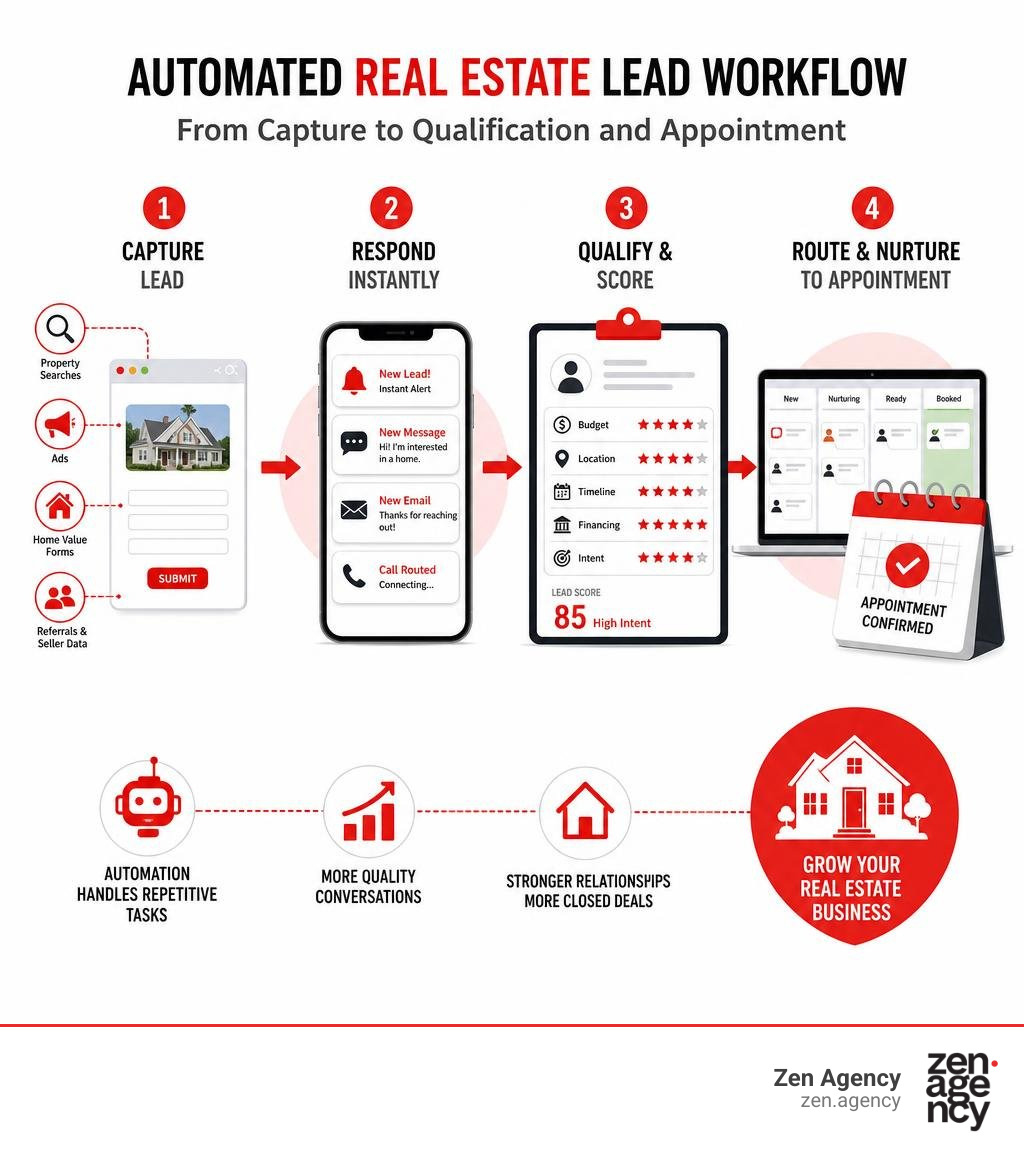
- Capture demand from property searches, ads, home-value forms, referrals, and seller data.
- Respond instantly with email, text, chat, or a call-routing alert.
- Qualify and score leads by budget, location, timeline, financing, and intent.
- Route and nurture prospects in one CRM until they are ready to talk or book a showing.
This matters because timing is everything. Only 3-6% of contacts may be thinking about selling at a given time. The other 94% still need useful, consistent contact until their plans change. Manual prospecting can build relationships, but it is hard to maintain at scale while also handling showings, negotiations, and closings.
Automation does not replace the agent-client relationship. It removes repetitive work so your team can spend more time on the conversations that move a deal forward.
I am Joseph Riviello, CEO and Founder of Zen Agency, with more than 22 years of experience helping businesses grow through integrated digital marketing, conversion strategy, and revenue-focused systems. In automated lead generation real estate, that means connecting visibility, lead capture, follow-up, and measurement into a process built to scale.
Quick look at automated lead generation real estate:
What Is Automated Lead Generation in Real Estate?
In traditional real estate marketing, acquiring new clients required manual labor. Agents spent hours every week door-knocking, cold calling tax records, stuffing envelopes for direct mail, and relying on word-of-mouth referrals. While these traditional tactics can still work, they are notoriously volatile. When you are busy showing homes or closing contracts, prospecting stops. Two months later, your active pipeline dries up.
Automated lead generation solves this roller-coaster cycle. By deploying digital entry points—such as search engine campaigns, automated valuation models (AVMs), social media ads, and interactive property portals—you establish lead acquisition channels that run 24 hours a day, 7 days a week.
The single biggest operational advantage of automated systems is speed-to-lead. When a prospective homebuyer or seller fills out an inquiry form online, their intent is at its peak. Waiting even thirty minutes to call back drastically reduces your chance of connecting. Automated systems step in immediately, sending instant SMS responses, delivering property reports, or initiating interactive AI messaging within seconds of a submission.
Automating these touchpoints is crucial because not all real estate leads carry equal strategic value:
- Seller leads are 4.5x more valuable than buyer leads. Securing a listing generates marketing assets, sign-board visibility in local neighborhoods, open house traffic, and organic buyer inquiries.
- The 3-6% seller reality: In any given geographic market or database, only 3% to 6% of homeowners are contemplating selling their home right now. That means 94% to 97% of your target market is passive.
To convert that passive majority over time, you need automated nurture sequences that keep your brand top-of-mind without taking up your entire afternoon. Understanding how consumer behavior differs across real estate segments is key to structuring these systems; for a deeper breakdown, explore our guide on Navigating the Lead Landscape: B2B vs B2C Strategies. To see how top teams map out these technical setups, check out this video on Real Estate Lead Automation Overview.
The Four Pillars of Automated Lead Generation Real Estate
Building a modern lead engine requires connecting four distinct operational pillars. Rather than relying on a single lead channel, high-performing agents combine inbound demand, targeted outbound prospecting, predictive data analytics, and conversational AI into a unified workflow.
Inbound and Outbound Prospecting Systems
Lead acquisition divides into two approaches: inbound systems that pull interested buyers and sellers to your brand, and outbound systems that systematically identify and contact off-market sellers.
Inbound systems rely heavily on digital assets: IDX property search portals, local landing pages, paid Google search campaigns, and automated home valuation pages. When a home shopper searches for local homes or a property owner requests a home valuation, inbound workflows capture their contact details and instantly deliver the requested report.
Outbound prospecting automation focuses on high-intent seller segments:
- Expired Listings: Statistics show that 43% of expired listings will relist and sell with a real estate agent for full commission. Automation tools track MLS cancellations daily, perform compliant skip tracing to find accurate phone numbers and email addresses, and push records straight into multi-line dialers or automated mailing workflows.
- For Sale By Owner (FSBO): Approximately 88% of FSBO sellers eventually hire an agent after experiencing marketing fatigue or contract complexities. Outbound automated systems aggregate FSBO web listings, scrub numbers against Do Not Call (DNC) registries, and trigger drip campaigns that offer helpful listing tools until the owner is ready for professional help.
- Pre-Foreclosures & Distressed Property: Homeowners facing default have a historic listing rate near 15%. Automated data feeds flag pre-foreclosure filings, evaluate property equity ratios, and launch soft, empathy-driven direct response campaigns.
- Circle Prospecting (GeoLeads): When an agent lists or sells a property, automated geographic tools draw a radius around the home, identify neighbor contact details, and send localized market update texts or postcards.
If you want to audit how these options fit your business model, read our In-Depth Guide to Finding Lead Generation Services.
AI Agents and Conversational Automated Lead Generation Real Estate Tools
Once a prospect reaches out, conversational AI agents take over initial engagement. Modern real estate AI chatbots go far beyond old decision-tree scripts; they use natural language processing to answer complex listing queries, gather financing details, assess timeline urgency, and schedule in-person tours directly on your calendar.
Tools like CodeNameZee | The AI Sales Agent for Real Estate operate 24/7 across agent websites and property landing pages. When prospective buyers browse listings late at night, these AI tools qualify budgets, capture verified phone numbers, and send instant alerts via text or WhatsApp.
The metrics behind conversational engagement highlight why top real estate teams adopt AI assistants:
- 54% higher open rates and 1.8X higher conversion rates over traditional, static email campaigns.
- 98% response rates on automated text messaging threads.
- Reduced cost-per-listing acquisition by up to 50% using Click-to-WhatsApp messaging ads.
Automating early-stage screening frees up your staff, saving up to 30% of their working week while keeping hot leads from sliding over to local competitors.
Data-Driven Predictive Analytics
Instead of waiting for a homeowner to post a listing sign or search for an agent, predictive analytics platforms allow you to identify potential listings months before they hit the market.
These platforms utilize Automated Valuation Models (AVMs)—supported by national property databases encompassing over 120 million residential records—to combine financial indicators, debt levels, tax records, life events, and ownership duration. Algorithms analyze these data points to generate sell propensity scores ranging from 0 to 100.
Using data tools like AI Real Estate Lead Generation | Tracerfy, real estate teams can run customized plain-English queries (for example, targeting absentee property owners with over 50% equity who have held titles for more than seven years). These tools deliver skip-traced property owner phone numbers and email addresses complete with TCPA/DNC flags, allowing agents to focus their geographic farming budgets exclusively on high-yield properties.
Costs, ROI, and Evaluating Lead Quality
Investing in automated lead generation real estate software requires a clear understanding of acquisition costs, referral models, and lead exclusivity.
Shared vs. Exclusive Paid Leads
Not all paid leads carry the same probability of conversion. Real estate lead providers typically operate under two primary models:
- Shared (Non-Exclusive) Leads: Generated by high-traffic listing search portals or general ad networks, these leads are distributed to multiple competing agents simultaneously. Major platforms, such as Zillow (which drives over 230 million page views per month), deliver high volume, but success requires instant automated response times because the first agent to connect usually wins the business.
- Exclusive Leads: Exclusive platforms route individual prospect inquiries directly to a single agent or team. For example, niche marketplaces like DomiLead — Motivated sellers, matched with real-estate investors score distress signals and route verified seller leads exclusively to one buyer per territory.
Evaluating lead models requires weighing upfront software expenses against long-term conversion splits. For an honest look at evaluating budget options without sacrificing performance, see our review of Cheap Lead Gen Services Analysis and our actionable framework to Improve Lead Quality Strategies.
Cost Breakdown and ROI Optimization
Pricing structures across real estate software and lead providers generally fall into three tiers:
- Pay-At-Closing / Referral Models: Zero upfront monthly platform fees, but the provider collects a 30% to 35% commission split upon successful deal completion.
- Subscription Software Platforms: Ranging from basic IDX lead websites at $29 to $299 per month to robust AI and predictive analytics suites costing $500 to $1,500+ monthly.
- Per-Lead / Data Credit Pricing: Direct pay-as-you-go property data platforms charging fractions of a dollar per verified, skip-traced lead record.
To maintain strong return on investment, your revenue must significantly outpace software expenses and ad spend. If you want to optimize your site conversion rates and prevent costly drop-offs, apply our recommended strategies to Stop Losing Leads With CRO Secrets.
| Lead Generation Method | Average Monthly Cost | Lead Exclusivity | Typical Conversion Rate | Best For |
|---|---|---|---|---|
| Portal Search Ads | $300 – $1,500+ | Shared / Non-Exclusive | 1% – 3% | Fast volume, immediate buyer contacts |
| Predictive Analytics Data | $500 – $1,000 | Exclusive Data | 3% – 7% (Long-term) | Targeted seller farming & listing acquisition |
| Pay-At-Closing Portals | $0 upfront (30-35% split) | Exclusive per lead | 5% – 10% | Risk-averse agents with limited marketing capital |
| AI IDX Capture Sites | $29 – $399 | Exclusive to your site | 2% – 5% | Consistent inbound website traffic capture |
Building a Unified Pipeline and CRM Workflow
To prevent lead decay, every lead channel must flow into a single, unified Customer Relationship Management (CRM) pipeline. If your software does not sync with your main database, your system will not scale.
A seamless CRM setup relies on clear, automated rules:
- Centralized Data Ingestion: Connect portal inquiries, website valuation forms, and property search tools into one database using webhooks or direct integrations, such as mcp.
- Instant Autoresponder Trigger: The moment a lead record arrives, an automated SMS and email sequence sends a personalized message acknowledging their inquiry within 60 seconds.
- Automated Screening & Routing: Specialized systems like LeadNest AI — AI-Powered Real Estate Platform for Agents evaluate home tour requests and budget details, tag lead records by urgency, and instantly assign hot leads to active sales agents.
- Multi-Channel Drip Sequences: Leads that are 6 to 12 months away from buying or selling are tagged for long-term nurture, receiving regular market updates, neighborhood home sales reports, and property value alerts.
If you are just beginning to design your automated funnel, check out our baseline guide: Beginners Guide to Lead Generation Leads.
Customizing Strategies for New vs. Experienced Agents
Lead generation priorities naturally evolve as your business grows:
- New Agents (Years 1–3): Focus on building momentum quickly. Start by organizing your core database—your sphere of influence (SOI). Combine entry-level buyer engines, social media ad setups, and automated open-house landing pages to establish a steady stream of active buyer inquiries.
- Experienced Agents & Teams (Years 4+): Shift your investment toward listing acquisitions and market share dominance. Deploy predictive analytics platforms to identify likely home sellers in your key geographic farm, utilize AI chatbots to manage initial client inquiries, and scale paid seller-acquisition funnels.
Regardless of your experience level, building hyper-local organic visibility keeps your pipeline filled with low-cost, high-intent leads. To drive sustained local search traffic to your site, implement our proven strategies on How Local SEO Drives More Leads.
Frequently Asked Questions About Real Estate Lead Automation
What is the difference between shared and exclusive automated real estate leads?
Shared real estate leads are sold to multiple competing agents within the same ZIP code or territory. They are generally less expensive per lead, but they require rapid response times because the first agent to call usually secures the relationship. Exclusive real estate leads are delivered solely to one agent or brokerage, yielding higher contact and conversion rates, though they generally carry higher upfront acquisition or platform costs.
How quickly do AI chatbots and automated systems follow up with new leads?
Automated lead systems respond within seconds. Modern AI chatbots and instant messaging triggers engage prospects immediately after a web form is submitted or a listing inquiry is made. Instant responses capture user intent while it is highest, maintaining engagement 24 hours a day, even when agents are out on property tours or offline.
Are paid automated leads worth the investment for solo real estate agents?
Yes, paid automated leads offer strong value for solo agents, provided there is a structured follow-up pipeline in place. Since single agents have limited hours for manual cold outreach, automated tools handle initial lead screening, database nurturing, and appointment booking. This ensures agents invest their working time exclusively in high-value conversations with serious buyers and sellers.
Conclusion: Scaling Your Business with Real Estate Automation
Scaling a real estate practice in modern markets requires building predictable lead assets rather than relying on inconsistent manual prospecting. By combining inbound property capture pages, automated outbound prospecting datasets, predictive seller analytics, and 24/7 AI conversational engagement, you establish an engine that generates opportunities around the clock.
Technology works best as an multiplier for human interaction. Automation secures the initial contact, handles preliminary screening, and maintains consistent database communication—leaving your team free to focus on building personal relationships, negotiating contracts, and closing transactions.
At Zen Agency, we specialize in helping growth-focused businesses design enterprise-grade digital marketing systems, custom web conversion platforms, and scalable lead engines built for high ROI. If you are ready to stop chasing cold prospects and start building a predictable pipeline, explore our full suite of customized Lead Generation Services by Zen Agency today.