
A Quick Start Guide to Branding Strategy Basics
What Is a Branding Strategy and Why Does It Matter?
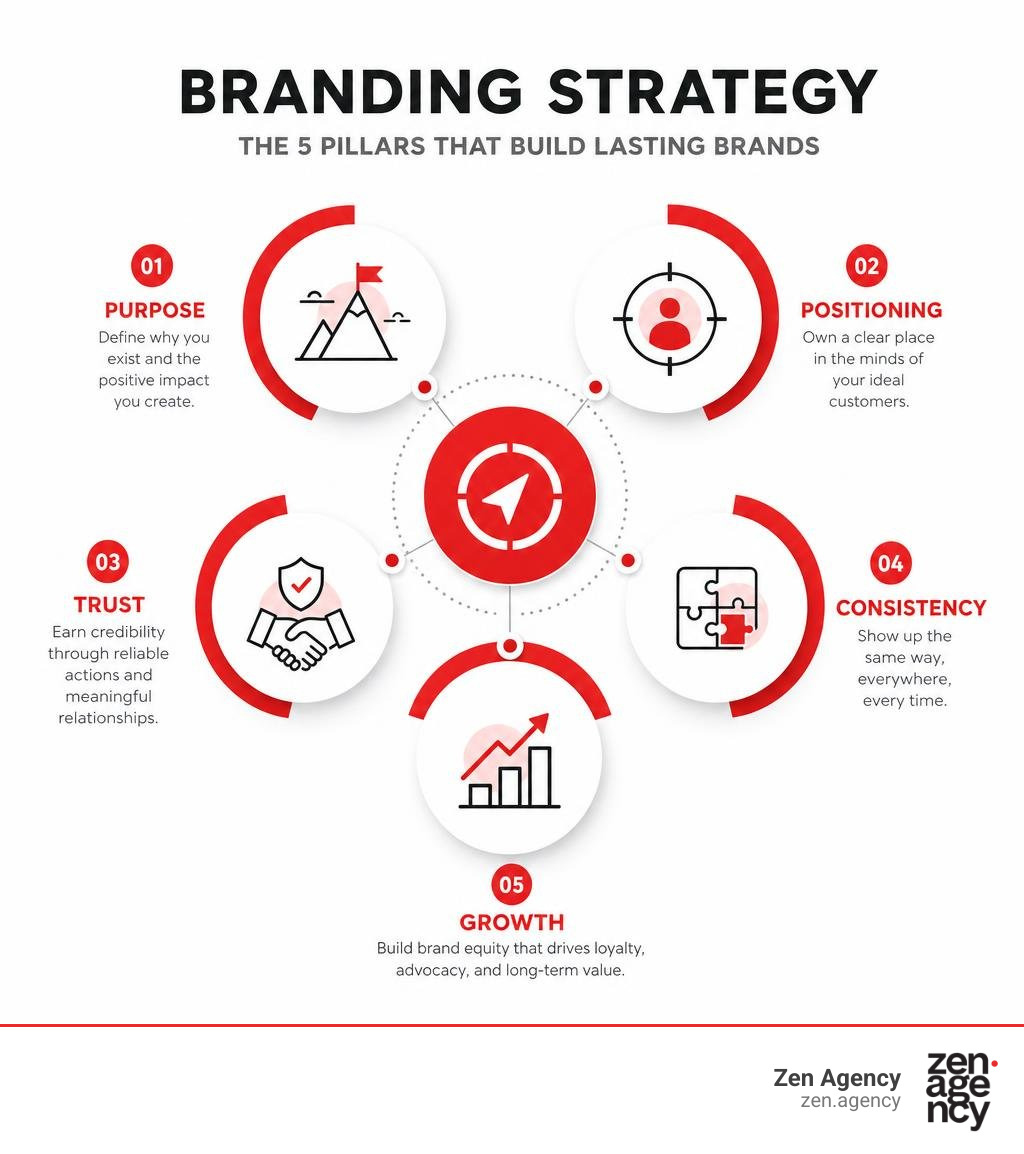
Branding strategy is the long-term plan for shaping how customers understand, and choose your business over other options. It defines what you stand for, who you serve, why you are different, and how every customer touchpoint should reinforce that message.
It is not just a logo, color palette, or ad campaign. Those are expressions of the strategy. A strong strategy creates a clear market position, builds trust, and gives marketing, sales, product, and service teams one shared direction.
That clarity has real business value. Research cited in recent industry reports shows that customers spend more with brands they trust, while consistent brand presentation across channels is associated with higher revenue. When buyers know what you represent and believe you can deliver, growth becomes less dependent on chasing every short-term lead.
I am Joseph Riviello, CEO and Founder of Zen Agency, with more than 22 years of experience helping companies scale through integrated digital marketing and branding strategy. In the sections ahead, we will break down the foundations that turn brand visibility into stronger demand, loyalty, and revenue.
Understanding the Foundations of a Branding Strategy
At its core, a branding strategy acts as the commercial compass for your entire organization. It is not an abstract artistic project—it is a concrete business decision framework designed to shape market perception and drive long-term equity. In saturated modern markets where buyers are inundated with thousands of commercial messages daily, having a defined strategy ensures your enterprise is not reduced to a price-discounted commodity.
When we look at sustainable market leaders, their advantage rarely stems solely from feature specifications. Instead, it comes from the strategic clarity with which they communicate their value. A well-executed strategy defines how a company establishes mindshare, defends its pricing power, and scales customer acquisition efficiently over multi-year horizons. If you want to dive deeper into why digital positioning matters, check out our insights on Beyond Logos Why Your Business Needs A Digital Branding Agency.
Defining Concepts: Strategy vs. Identity vs. Marketing
One of the most frequent points of confusion among executive teams is conflating brand strategy, brand identity, and marketing strategy. While they work in tandem, they fulfill vastly different functions across your operational blueprint:
- Brand Strategy (The Business Logic & Blueprint): This is the foundational why and who. It outlines your long-term market positioning, target audience profile, competitive differentiation, brand promises, and internal values over a 5-to-10-year horizon.
- Brand Identity (The Visual & Verbal Expressions): This represents what the brand looks and sounds like. It encompasses your logo, color palette, typography, imagery style, sound design, and tone of voice. As explored in comprehensive resources like Vivaldi Group’s brand strategy guide, identity is the tactile translation of your overarching strategic logic.
- Marketing Strategy (The Tactical Campaigns & Channels): This represents how and where you achieve immediate business goals over 12-to-24-month cycles. It involves acquisition channels, promotional campaigns, ad budgets, sales funnels, and content distribution.
When organizations launch marketing campaigns without a clear strategic foundation, they end up spending heavily on lead generation while leaking conversion revenue due to weak trust and muddy positioning.
The Business ROI of Long-Term Brand Building
Building brand equity is not merely a feel-good exercise; it delivers compound interest directly to your bottom line. Industry research highlights concrete financial and operational advantages for businesses that invest continuously in strategic brand alignment:
- Drastic Customer Acquisition Cost (CAC) Reductions: Strong, recognized brands achieve a 20% to 40% lower CAC over time. When buyers already recognize and trust your name, paid acquisition efficiency skyrockets.
- Unrivaled Pricing Power: Companies in the top quartile of brand awareness can command up to 13% price premiums over lesser-known alternatives. Loyal buyers are inherently less price-sensitive because they buy based on perceived value rather than baseline transaction cost.
- Accelerated Sales Cycles: Known, trusted brands close deals up to 24% faster in competitive sales environments. Furthermore, category leaders win 31% of competitive deals compared to just 18% for challenger brands.
- Resilience Against Economic Downturns: Organizations maintaining above-average brand awareness navigate economic shifts with twice the revenue stability of competitors. Businesses that maintain their strategic investment through recessions emerge with up to 4.5x the market share gain of those that cut back.
- Customer Trust & Lifetime Value: Global consumer studies reveal that 87% of buyers spend more on brands they trust, while 88% rate brand trust as equally critical as price and quality.
Core Components of a Sustainable Brand Blueprint
A comprehensive branding strategy requires a structured blueprint that aligns your operational purpose with external market expectations. To build a brand that endures, leadership teams must establish clear, non-negotiable core pillars. For a deeper step-by-step dive on crafting enduring assets, explore our guide on How To Build A Brand That Lasts A Step By Step Strategy Guide.
The 5 Ps Framework for Brand Alignment
At Zen Agency, we evaluate strategic cohesion using the 5 Ps Framework. This model transforms abstract brand concepts into actionable commercial guidelines across every organizational touchpoint.
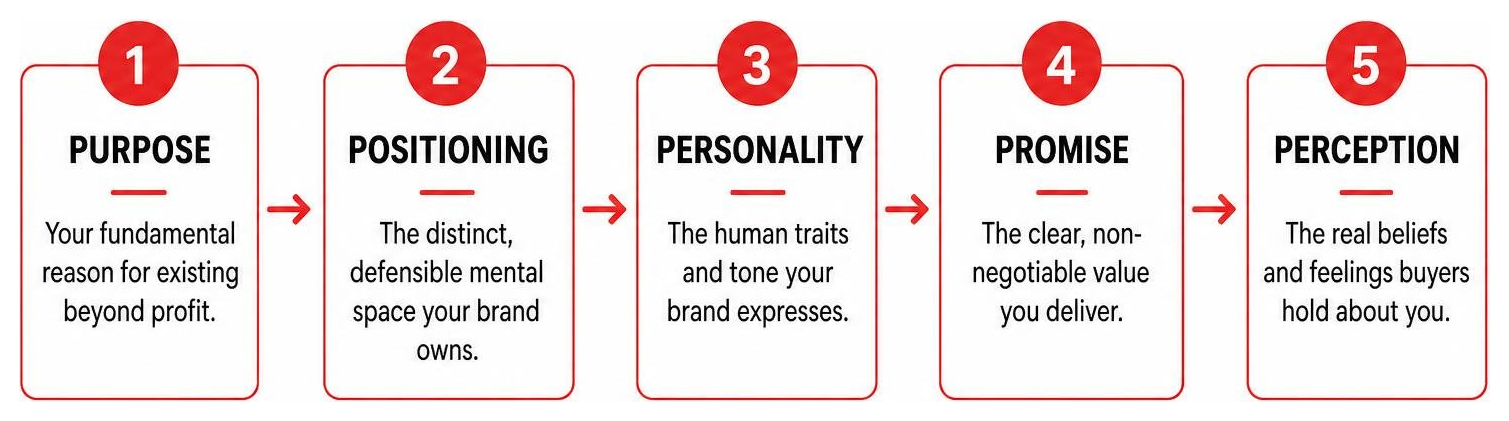
- Purpose: Your fundamental reason for existing beyond generating bottom-line profit. It answers why your business exists and how it improves the lives of your target buyers or community.
- Positioning: The distinct, defensible mental space your brand occupies relative to alternatives in the marketplace.
- Personality: The human traits, behavioral characteristics, and tone of voice your brand embodies across all customer interactions.
- Promise: The explicit, non-negotiable value commitment you deliver to every client, backed by real operational proof points.
- Perception: The actual mental picture and emotional sentiment buyers hold regarding your company—and how effectively you bridge the gap between internal goals and external reality.
| Core P Component | Strategic Focus | Primary Objective | Example Metric |
|---|---|---|---|
| Purpose | The foundational “Why” | Inspire internal team & align customer values | Value-alignment survey scores |
| Positioning | Market slot vs. competitors | Own a distinct, defensible mental niche | Unprompted brand recall |
| Personality | Tone, behavior, & voice | Create authentic emotional connection | Social sentiment & engagement |
| Promise | Explicit value commitments | Build trust and operational reliability | Net Promoter Score (NPS) |
| Perception | Buyer reality vs. claims | Bridge expectations and actual experience | Retention & repeat purchase rate |
To maintain governance across these pillars, organizations formalize their rules into systematic document hubs. Learn more about standardizing these rules in our article on The Ultimate Guide To Brand Guideline Creation.
Key Types of Brand Strategies for Modern Markets
Not all organizations leverage the exact same strategic model. Depending on your business model, growth objectives, and industry dynamics, you may deploy one or a combination of distinct branding models:
- Corporate Branding: Shaping the master identity of the overarching corporate entity (e.g., Apple, GE, or IBM). This strategy creates an umbrella halo effect that builds enterprise valuation, stakeholder confidence, and corporate trust.
- Product Branding: Focusing strategic resources on individual products or service lines (e.g., Procter & Gamble managing Tide or Pampers as distinct brands). This isolates product risks and caters to hyper-targeted buyer segments.
- Employer Branding: Positioning your enterprise as an employer of choice to attract and retain top-tier talent. Companies with strong employer brands see a 28% reduction in employee turnover and significantly lower recruiting costs.
- Co-Branding & Strategic Partnerships: Joining forces with complementary brands to cross-pollinate audiences and create unique joint value propositions.
- Personal Branding: Leveraging executive or founder authority to humanize the business, drive thought leadership, and foster direct community engagement.
Choosing the Right Branding Strategy Model for Your Sector
Selecting the right branding architecture depends heavily on your corporate structure and target demographics. Modern consumers increasingly demand value alignment; in fact, 7 out of 10 consumers prefer buying from brands that mirror their personal values.
Whether you deploy ethical branding emphasizing sustainability, high-touch luxury positioning, or minimalist digital branding, your chosen model must resonate with your ideal buyers’ psychographic needs. To understand how strategic positioning marries with active promotional execution, read our breakdown on Branding And Promotion The Ultimate Marketing Marriage. You can also review insights from Branding Strategy Insider regarding modern brand architecture models.
B2B vs. B2C Strategic Execution
While the fundamental principles of trust remain constant, executing a branding strategy differs significantly between Business-to-Business (B2B) and Business-to-Consumer (B2C) environments:
As detailed in revenue-focused frameworks like Konabayev’s Brand Strategy Guide, B2B buyers interact with a business across an average of 27+ touchpoints before making a commitment. Thus, B2B brand strategy must prioritize trust, operational proof, and authority, whereas B2C strategy often leans on emotional connection, immediate utility, and seamless digital interaction.
How to Build, Execute, and Refresh Your Strategy

Developing an enterprise-grade strategy requires a structured, research-backed methodology. Moving forward without empirical market feedback leads to empty claims that buyers instinctively ignore.
5 Steps to Build an Effective Branding Strategy
To establish a defensible, revenue-generating strategy, follow this 5-step roadmap:
- Competitive Discovery & Market Research: Map out key competitors across your space. Identify what they claim to be versus what buyers actually know them for. Locate unserved market gaps where your unique capabilities shine.
- Ideal Customer Profile (ICP) & Persona Definition: Go deep into customer psychographics. Conduct depth interviews with your best-fit clients to understand their unstated frustrations, evaluation criteria, and trigger events. Define explicitly who your brand is not designed to serve.
- Positioning Logic & Value Proposition: Craft a concise positioning statement detailing your target audience, frame of reference, distinct benefit, and explicit reason to believe. For additional perspective on structuring this, consult Canva’s definitive brand guide.
- Messaging Architecture & Voice Guidelines: Build a multi-tiered messaging hierarchy starting with a core value proposition down to persona-specific messaging pillars. Establish operational rules for your brand voice—defining mandatory traits, power words, and prohibited jargon.
- Multi-Touchpoint Rollout & System Design: Translate strategy into tangible assets. Build accessible guidelines, visual design systems, and digital touchpoints across your website, sales decks, and marketing campaigns to ensure total consistency.
How to Adapt and Refresh Your Brand Over Time
A branding strategy is not a static PDF meant to gather dust on a server; it is an evolving business framework. While foundational elements like core purpose and values should remain stable for a decade or more, positioning nuances, visual identities, and campaign tactics require periodic re-evaluation.
Market dynamics change, customer expectations evolve, and new technologies emerge. Conducting quarterly strategy reviews every 90 days allows executive leadership to evaluate channel performance and maintain alignment. When market positioning begins to feel outdated or fails to reflect your true operational capabilities, it may be time for a strategic refresh. Explore how to navigate this transformation safely in our analysis of From Bland To Brand Finding The Perfect Development And Refresh Partners.
Measuring Performance and Common Strategic Pitfalls
One of the oldest misconceptions in marketing is that brand building cannot be measured quantitative. In reality, tracking brand performance combines leading brand health indicators with lagging business results.
Key Metrics to Evaluate Brand Equity
To build a robust brand health tracking dashboard, track metrics across two primary categories:
- Leading Indicators (Brand Health & Sentiment):
- Unprompted & Prompted Brand Recall: How easily prospective buyers recall your brand name within your market category.
- Share of Voice (SOV) & Organic Search Volume: The proportion of industry conversation and brand-name search traffic your business commands relative to competitors.
- Net Promoter Score (NPS) & Social Sentiment: Quantitative measurement of customer satisfaction, word-of-mouth likelihood, and brand sentiment.
- Lagging Indicators (Commercial Business Impact):
- Customer Acquisition Cost (CAC): Lower overall blended acquisition spend driven by higher brand familiarity.
- Sales Cycle Length & Win Rates: The speed at which prospective buyers move through the funnel and your close rate in competitive deals.
- Customer Lifetime Value (LTV) & Retention Rate: Research published in the International Journal of Managerial Studies and Research demonstrates that customer service experience accounts for 71.7% of the variation in customer retention. Strong retention directly reflects brand trust.
Common Brand Strategy Mistakes to Avoid
Even well-funded organizations make critical mistakes when shaping their strategic market presence. Executive guidance resources like MarkCMO’s Brand Strategy Guide and tactical breakdowns on Predis.ai’s resource hub highlight several frequent traps:
- Treating Strategy as a Mere Visual Design Project: Designing a flashy new logo without defining positioning logic, ICP targets, and value pillars produces visual polish without business substance.
- Positioning to Appeal to Everyone: Trying to serve every buyer market segment dilutes your core value proposition until you mean nothing to anyone.
- Making Feature Claims Without Empirical Proof: Buyers ignore generic claims like “best-in-class service” unless accompanied by concrete data points, client case studies, or third-party verification.
- Brand Schizophrenia (Inconsistency Across Touchpoints): When sales pitches, web messaging, customer support experiences, and social content express conflicting tones or pricing expectations, buyer trust breaks down immediately. Consistent brand presentation across channels increases revenue by 23%.
- Static Documentation & Lack of Governance: Storing strategic guidelines in buried PDF documents instead of empowering teams with accessible digital hubs, centralized asset libraries, and clear escalation protocols. For details on controlling multi-channel consistency, refer to The Ultimate Guide To Brand Alignment Consulting And Channel Control.
Frequently Asked Questions About Branding Strategy
How long does it take to develop a brand strategy?
For small-to-mid-market enterprises, building a thorough, research-backed strategy typically takes between 4 and 8 weeks. This timeline allows for deep competitive analysis, internal leadership workshops, 8 to 12 depth customer interviews, positioning articulation, and messaging architecture creation without rushing critical logic decisions.
Who should own brand strategy within an organization?
Brand strategy is ultimately a core business strategy decision that requires active endorsement and sign-off from executive leadership (CEO, Founder, and C-suite). While day-to-day execution and channel deployment are managed by marketing leadership, the overall strategy influences human resources, product development, customer support, and sales culture across the entire enterprise.
How often should a business update its brand strategy?
Core foundational components—such as your overarching corporate purpose, core values, and fundamental mission—should remain consistent for 5 to 10 years. However, competitive positioning messaging, channel distribution tactics, and visual style nuances should be reviewed every 2 to 3 years to ensure your business stays ahead of changing market conditions and evolving customer expectations.
Conclusion
A well-crafted branding strategy is much more than a marketing asset—it is a long-term economic engine that builds trust, protects profit margins, and drives enterprise valuation. By taking a structured approach to defining your purpose, positioning, messaging architecture, and brand experience, your company moves away from competing on price and begins building true market equity.
At Zen Agency, we have spent over two decades helping struggling-to-scale enterprises and modern growth brands turn market visibility into measurable profitability across web development, brand strategy, and omnichannel marketing execution. Whether you operate out of our regional hubs in Pennsylvania and Montana or serve national markets across the USA, our team provides the enterprise-grade expertise needed to command your market space.
Ready to clarify your market positioning, lower acquisition costs, and build a brand strategy that drives real revenue? Transform your market position with expert branding and digital services with Zen Agency today.